
Generative search ranking is how AI systems select and combine sources to generate answers instead of listing links. Unlike traditional SEO, which focuses on clicks, this approach prioritizes citations within responses. Content is evaluated at a granular level, meaning smaller chunks are ranked rather than full pages.
Key factors include authority, clarity, and relevance. Semantic retrieval signals help systems understand meaning and intent, while AI answer ranking signals decide what gets quoted. Structured, fact-based content performs better because it is easier to extract and interpret. LLM search optimization improves visibility by aligning content with AI behavior, and fresh, well-organized content increases the chances of being included in AI-generated summaries like Google AI Overviews.
What is Generative Search Ranking?
Generative search ranking is the process by which AI powered search systems evaluate, retrieve, score, and synthesize content into generated answers.

Platforms like Google, ChatGPT, and Perplexity no longer just list links. They generate direct answers by pulling information from multiple sources.
Traditional search ranks pages.
Generative search ranks information units inside pages and decides which ones deserve to be cited.
This shift changes everything. Instead of competing for clicks, you are now competing to be quoted inside the answer itself.
Traditional SEO vs Generative Search Ranking
| Factor | Traditional SEO | Generative Search Ranking |
| Ranking unit | Web page | Source chunk |
| Goal | Click | Citation |
| Algorithm type | Link based | Retrieval plus LLM scoring |
| Signals | Backlinks | Semantic plus authority |
This table highlights the core shift. Links still matter, but meaning, clarity, and usability now play a bigger role.
Win in Generative Search
Not showing up in AI-generated answers? Let experts optimize your content for LLM visibility.
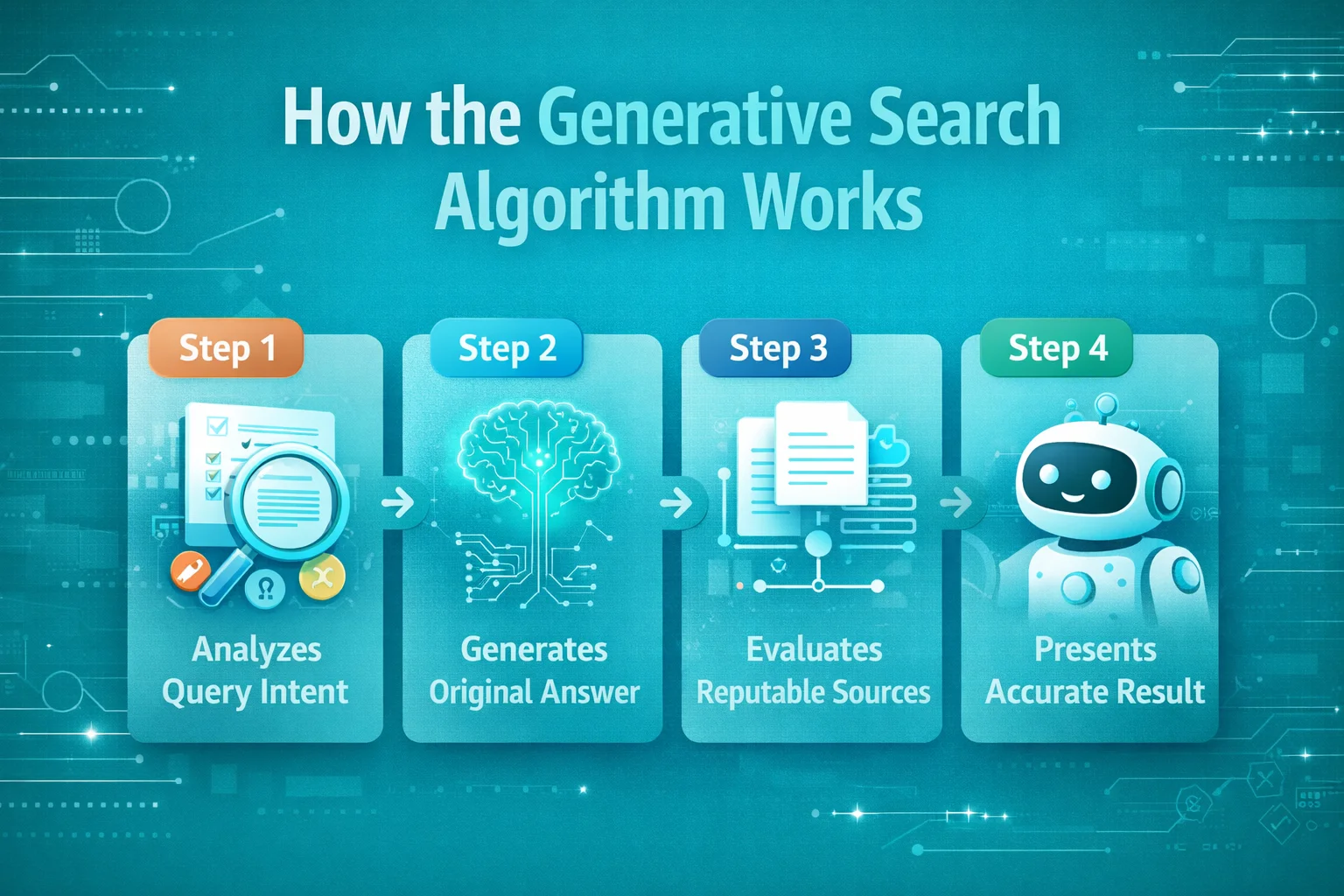
How the Generative Search Algorithm Works
Modern AI-powered search algorithms go far beyond traditional keyword matching. They interpret user queries using intent detection, entity recognition, and contextual expansion to deliver highly relevant results.
For instance, a search query about SEO doesn’t just focus on keywords—it expands to include related concepts such as:
- Content structure and formatting
- Topical authority and expertise
- Ranking signals and search intent
This allows the system to understand the true meaning behind the query, not just the words used.
Semantic Retrieval
At this stage, the algorithm relies on semantic retrieval mechanisms to identify the most relevant content.
Key processes involved include:
- Vector embeddings: Converting text into numerical representations
- Embedding matching: Comparing vectors to find semantically similar content
- Vector similarity search: Retrieving content based on meaning, not exact wording
- Topical clustering: Grouping related content into meaningful clusters
- Context overlap analysis: Ensuring the retrieved content aligns with the query intent
This approach enables the system to match user intent and contextual meaning, rather than relying solely on keyword presence.
Source Scoring
Once relevant content is retrieved, the system evaluates it using generative engine ranking factors to determine quality and trustworthiness.
Important evaluation criteria include:
- Domain authority and credibility
- Author expertise and subject knowledge
- Content freshness and recency
- Accuracy and factual reliability
- Consistency across the content
- Structured clarity and readability
Content that is well-structured, factually accurate, and clearly written is more likely to rank higher and be selected for AI-generated responses.
AI Answer Synthesis
In the final stage, the AI constructs a response by synthesizing the highest-quality information available.
The system prioritizes content that includes:
- Clear, quotable sentences
- Verified statistics and data points
- High information density
- Well-structured and easily extractable insights
This step determines whether your content is:
- Or completely ignored
- Included in the AI-generated answer
- Partially referenced
Core Generative Engine Ranking Factors
To perform well in AI-driven search, content must align with evolving ranking factors, including:
- Topical authority and in-depth subject coverage
- Clear and consistent terminology
- Demonstrated author expertise (E-E-A-T signals)
- Structured content for better extractability
- Credible references and data-backed insights
- Unlinked brand mentions across the web
- User-generated content signals from platforms like Reddit and Wikipedia
These factors collectively influence content visibility and inclusion in AI-generated results.
Understanding AI Answer Ranking Signals
AI systems prioritize content that is easy to extract, interpret, and integrate into responses.
Key AI answer ranking signals include:
- Clear definitions and direct answers
- Relevant statistics and supporting data
- Concise, quotable sentences
- Logical structure with optimized headings
- Up-to-date and regularly refreshed information
Content that is:
- Easy to scan
- Well-organized
- Directly answers user queries
has a significantly higher chance of being featured in AI-generated answers.
LLM Search Optimization – How to Optimize for Generative Engines
To optimize for LLM search and generative AI engines, your content must align with semantic search principles and intent-driven writing. This means using entity-rich language, avoiding vague or generic phrasing, and ensuring your content clearly communicates its purpose so AI systems can accurately interpret and match it with user queries.
Equally important is content extractability—how easily AI models can pull, summarize, and reuse your information in generated answers. To improve this:
- Keep paragraphs concise and focused
- Use clear headings and logical structure
- Add FAQs and structured sections for quick extraction
- Write in a way that answers specific user intents directly
Building topical authority clusters is another critical factor in generative search visibility. Instead of isolated articles, create a connected ecosystem of content:
- Develop pillar pages around core topics
- Publish supporting articles that cover subtopics in depth
- Use strategic internal linking to connect related content
- Maintain content consistency across your domain
This approach strengthens your knowledge graph footprint and improves how AI systems understand your expertise within a subject area.
Semantic Retrieval Signals
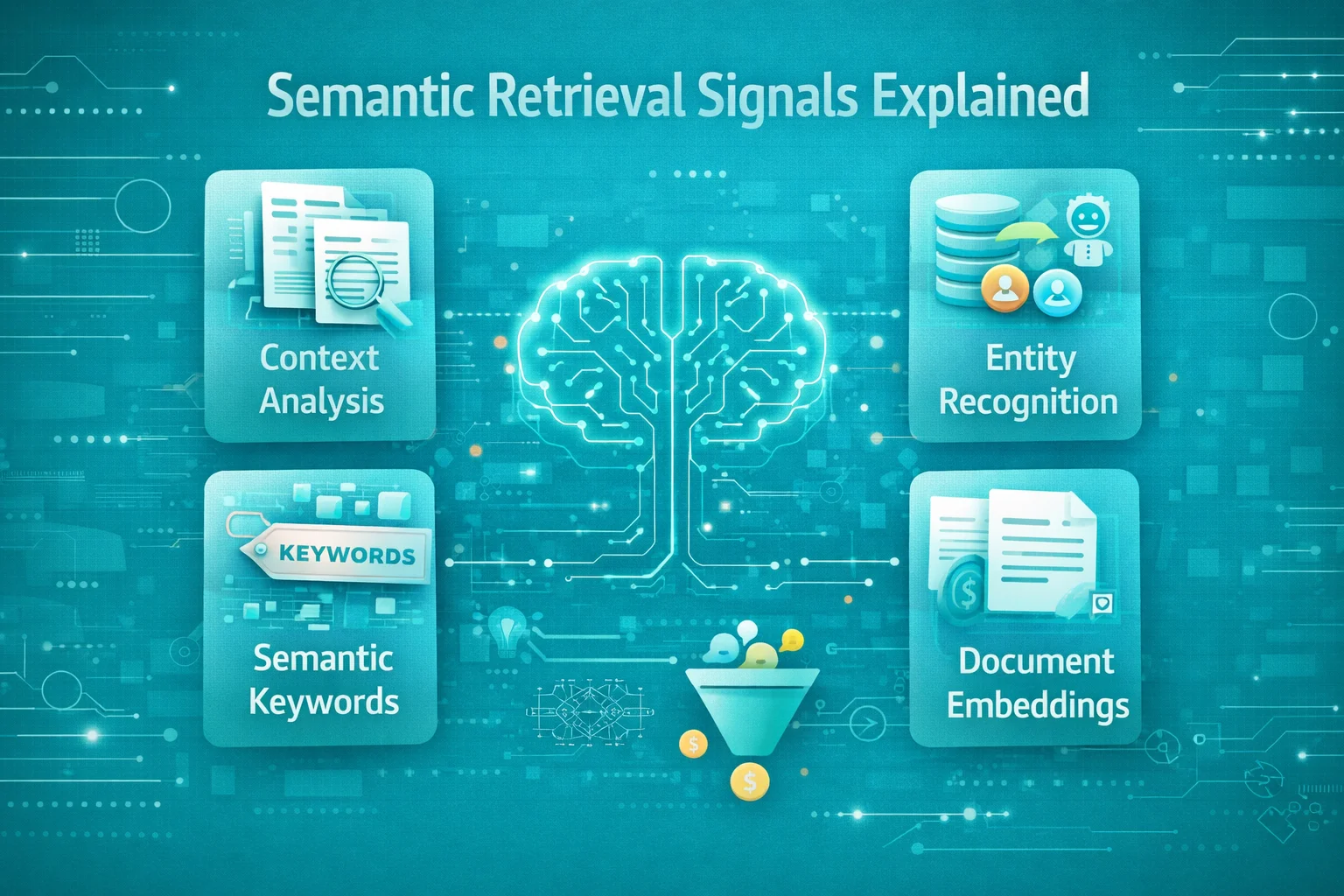
Generative search engines rely on advanced semantic retrieval models to evaluate and rank content. These systems use:
- Dense embeddings to convert text into numerical vectors
- Query-document similarity to measure relevance
- Cosine similarity scoring to determine how closely content matches a query
Additionally, modern AI systems use:
- Chunk-level retrieval to extract specific sections of content
- Context windows to maintain coherence across responses
- Passage ranking techniques to prioritize the most relevant segments
Because of this, long-form, well-structured content performs better—it provides more meaningful “chunks” that AI can retrieve and reuse in responses.
Measuring Generative Search Ranking Performance
Tracking performance in AI-driven search environments is fundamentally different from traditional SEO. Instead of focusing only on rankings and traffic, you need to measure how your content appears in AI-generated answers.
Key performance indicators include:
- Prompt testing – Analyze how your content responds to different AI queries
- Citation tracking – Identify where your content is referenced in AI outputs
- Share of voice – Measure your visibility across generative search results
- Brand mentions – Monitor how often your brand appears in AI-generated content
These insights help you understand your true visibility in LLM-powered search systems. Tools like Semrush are beginning to support these metrics, making it easier to evaluate and optimize performance.
Common Mistakes That Hurt Generative Search Rankings
Certain issues can significantly reduce your chances of being featured in AI-generated results. Avoid the following:
- Keyword over-optimization that reduces content quality
- Thin or low-value content lacking depth and relevance
- Weak credibility signals (no sources, expertise, or trust factors)
- Poor content structure that limits extractability
- Technical rendering issues affecting crawlability
- Outdated data and statistics that reduce trustworthiness
Fixing these issues improves both AI visibility and content usability.
Future of Generative Search Ranking
Search is rapidly evolving beyond traditional ranking systems. Key trends shaping the future include:
- Real-time indexing for faster content discovery
- Multimodal search results (text, images, video, audio)
- AI trust scoring to evaluate credibility and authority
- Brand knowledge graphs that define expertise and relationships
Overall, generative search is shifting toward contextual understanding, authority, and trust, rather than simple keyword-based rankings.
Final Thoughts
Generative search is not just an extension of SEO—it’s a complete transformation in how content is discovered, evaluated, and delivered.
To stay competitive today and beyond, focus on:
- Creating clear, structured, and intent-driven content
- Building strong topical authority and content clusters
- Using data-backed insights and performance tracking
- Optimizing for semantic retrieval and AI ranking signals
Adopting LLM search optimization strategies early will position your brand to stand out in increasingly competitive, AI-driven search ecosystems.
Ready to dominate generative search and future-proof your SEO strategy?
Let’s build a data-driven LLM optimization plan that helps you rank, get cited, and stay visible in AI-powered results.
Schedule your call now and start optimizing for the future of search.
FAQs
What is generative search ranking?
Generative search ranking is how AI-powered search engines evaluate and combine content from multiple sources to generate direct answers, focusing on relevant content snippets rather than full web pages.
How is generative search different from traditional SEO?
Traditional SEO ranks web pages to drive clicks, while generative search prioritizes citations within AI-generated answers. It assesses content at a chunk level, emphasizing semantic meaning, structure, and clarity over backlinks and keywords.
What are generative engine ranking factors?
Key factors include content authority, author expertise, clarity, structure, freshness, and relevance — helping AI systems identify trustworthy, useful content worth including in generated answers.
What are semantic retrieval signals?
Semantic retrieval signals help AI understand content meaning beyond keyword matching. They use embeddings, vector similarity, and contextual relevance to find content that aligns with user intent.
What are AI answer ranking signals?
These signals determine which content gets selected and cited in AI responses. Content with clear definitions, specific data, structured formatting, and easily extractable sentences performs best in generative search.