
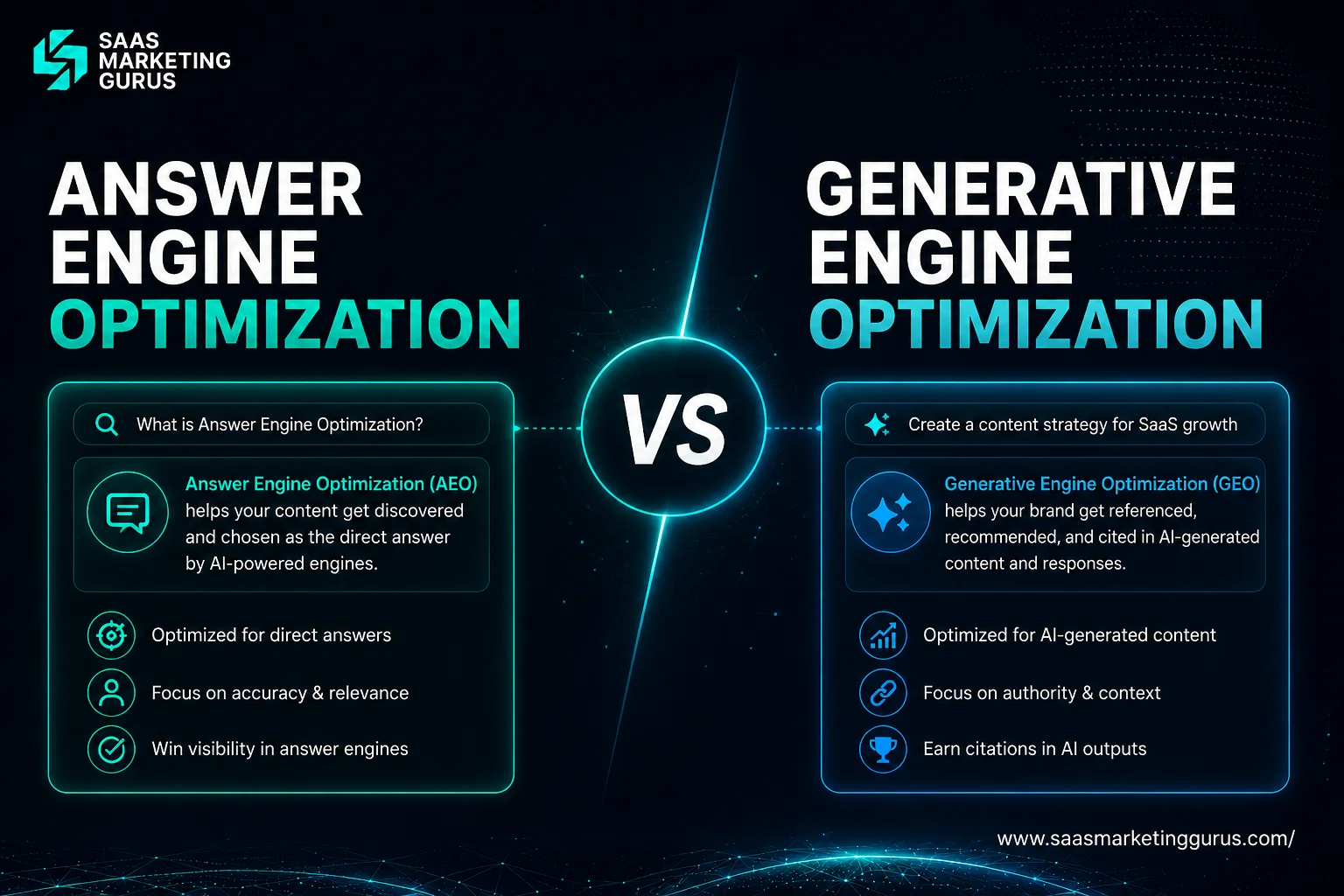
Learn the difference between Answer Engine Optimization (AEO) and Generative Engine Optimization (GEO) in 2026. Understand how SaaS content gets retrieved, cited, and included in AI answers across ChatGPT, Perplexity, and Google AI Overviews.
Answer Engine Optimization (AEO) helps search engines extract direct answers.
Generative Engine Optimization (GEO) helps AI systems retrieve and cite content in generated responses.
The key difference is that AEO improves answer extraction, while GEO improves AI retrieval and citation.
This guide explains how AEO and GEO differ, how AI retrieval works, and how SaaS companies can improve long-term AI search visibility.
What Is Answer Engine Optimization and Generative Engine Optimization?
Answer Engine Optimization (AEO) focuses on structuring content so search engines and AI assistants can extract direct, concise answers to user queries.
Generative Engine Optimization (GEO) focuses on structuring content so AI systems can retrieve, understand, and reuse meaningful passages within generated responses.
As AI search continues to evolve, clear passage boundaries and structured content appear to improve the likelihood of retrieval and citation across AI-powered search platforms.
AEO vs GEO vs SEO
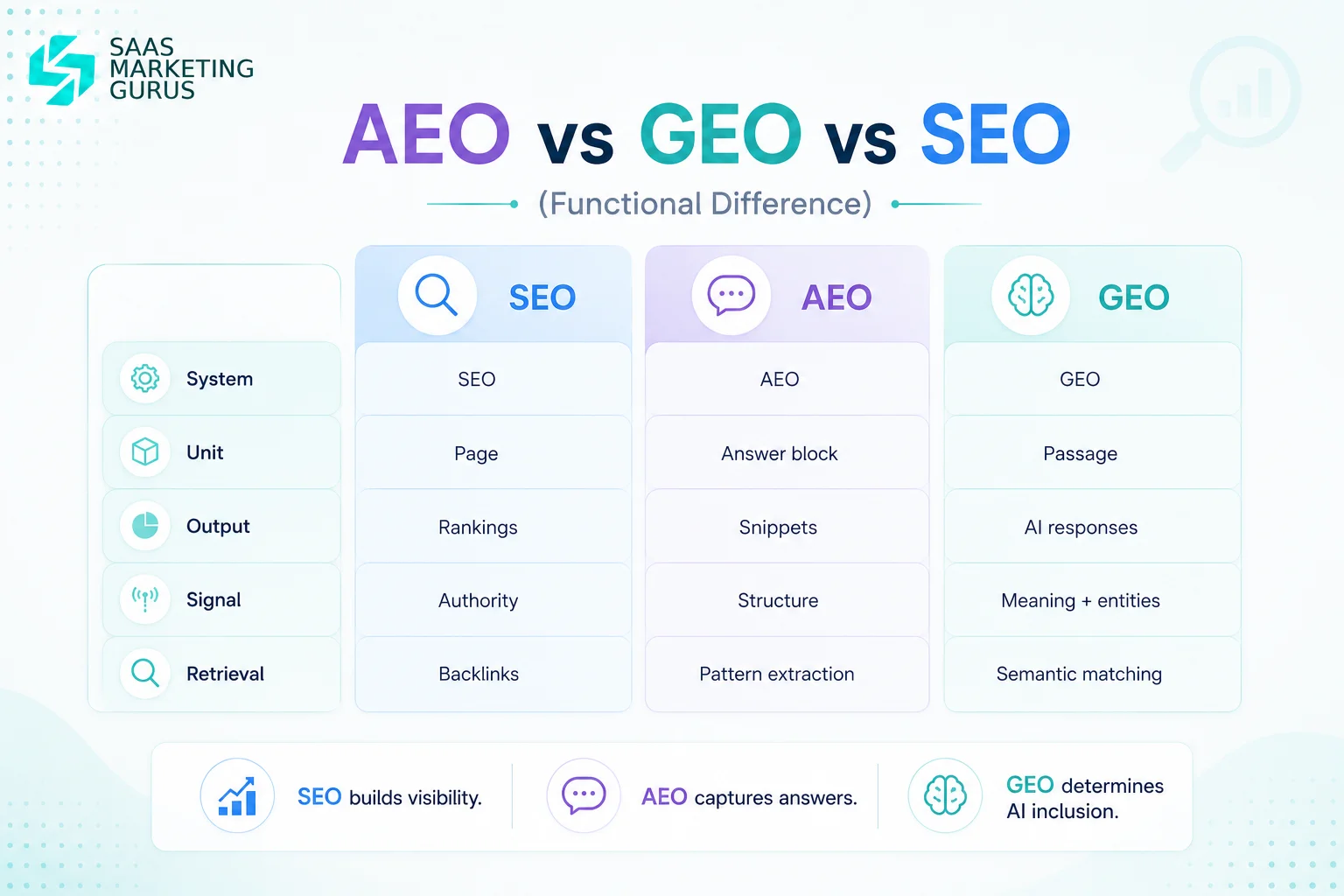
The table below compares how SEO, AEO, and GEO differ across their primary objectives, outputs, and retrieval signals.
| System | SEO | AEO | GEO |
|---|---|---|---|
| Unit | Page | Answer block | Passage |
| Output | Rankings | Snippets | AI responses |
| Signal | Authority | Structure | Meaning + entities |
| Retrieval | Backlinks | Pattern extraction | Semantic matching |
Comparing AEO vs SEO highlights how search optimization has evolved. Traditional SEO focuses on improving page rankings, while AEO focuses on structuring content so search engines and AI assistants can extract direct answers for users. Together, they create the foundation for stronger AI search visibility.
Generative search optimization expands on GEO by helping AI systems retrieve, interpret, and reference content within AI-generated responses.
Rather than focusing only on rankings, it emphasizes structured information, strong entity relationships, and clear context so AI platforms like ChatGPT, Perplexity, and Google AI Overviews can confidently use your content in their answers.
When Should You Use SEO, AEO, or GEO?
| Goal | Best Strategy |
|---|---|
| Increase organic rankings | SEO |
| Win featured snippets | AEO |
| Appear in ChatGPT | GEO |
| Improve AI citations | GEO |
| Increase topical authority | SEO + GEO |
| Answer common questions | AEO |
Should SaaS Companies Focus on AEO or GEO?
For most SaaS companies, the answer is both. AEO and GEO solve different problems and work together to improve AI search visibility.
Use AEO when your goal is to:
- Answer specific user questions.
- Improve visibility in featured snippets and AI summaries.
- Create clear FAQ pages and definitions.
Use GEO when your goal is to:
- Increase visibility in AI-generated responses.
- Optimize comparison pages, workflows, and use cases.
- Help AI systems retrieve and reference your content across platforms like ChatGPT, Perplexity, and Google AI Overviews.
The strongest SaaS content strategies combine AEO, GEO, and traditional SEO to improve visibility across both search engines and AI-powered discovery platforms.
Does GEO Replace Traditional SEO?
No.
Generative Engine Optimization is not a replacement for SEO. Instead, it builds on traditional SEO by helping AI systems retrieve and understand content after it has been discovered.
A successful SaaS content strategy combines:
- SEO to build authority and organic rankings
- AEO to improve answer extraction
- GEO to increase AI citations and retrieval
Together, these approaches improve visibility across Google Search, AI Overviews, ChatGPT, Perplexity, and other AI-powered search experiences.
How AI Retrieval Actually Works?
AI systems do not rank pages. They operate through passage-level retrieval.
They select only content chunks that match intent, structure, and entity clarity.
1. Query understanding
Query:
“best SaaS tools for email outreach”
System extracts intent:
- outbound automation
- sequencing workflows
- CRM integration
2. Content chunking
Pages are split into retrieval units:
- workflow explanations
- tool comparisons
- use case statements
Example chunk:
“HubSpot enables email sequencing, CRM tracking, and automated follow-ups for outbound teams.”
Only structured chunks survive retrieval filtering.
3. Retrieval scoring
Each chunk is evaluated on:
- semantic match
- entity presence (HubSpot, Apollo, Mailchimp)
- clarity of outcome
- completeness of workflow
Weak:
“Email marketing is important for growth.”
Strong:
“HubSpot, Apollo, and Mailchimp support outbound email sequencing with automation, tracking, and personalization.”
4. Response assembly
AI constructs answers using only top passages:
HubSpot for CRM based sequencing
Apollo for outbound prospecting workflows
Mailchimp for campaign automation
Key insight:
AI systems reconstruct responses from passages, not full pages.
LLM Optimization for SaaS Content
Optimizing content for large language models goes beyond traditional SEO. Effective LLM optimization helps AI systems understand context, identify important entities, and retrieve information that directly answers user questions.
To improve LLM optimization for SaaS content:
- Answer one question or intent per section.
- Use descriptive headings that match real user queries.
- Keep paragraphs concise and focused on a single topic.
- Include product names, categories, and related entities naturally.
- Support explanations with comparisons, workflows, tables, and FAQs.
- Maintain consistent terminology throughout the content.
Content that is easy for AI models to understand is more likely to be retrieved, cited, and included in AI-generated responses across platforms such as ChatGPT, Perplexity, and Google AI Overviews.
Additional Best Practices
To improve retrieval across AI systems:
- Write one complete answer per section.
- Keep related ideas together instead of mixing multiple topics.
- Introduce entities before discussing features or workflows.
- Use comparison tables where users are evaluating software.
- Include concise summaries after major sections to reinforce key concepts.
These practices make content easier for both readers and AI systems to interpret, retrieve, and reuse.
Why Most SaaS Content Fails in AI Retrieval
Most SaaS content is invisible in AI systems not because it lacks quality, but because it lacks a retrieval structure.
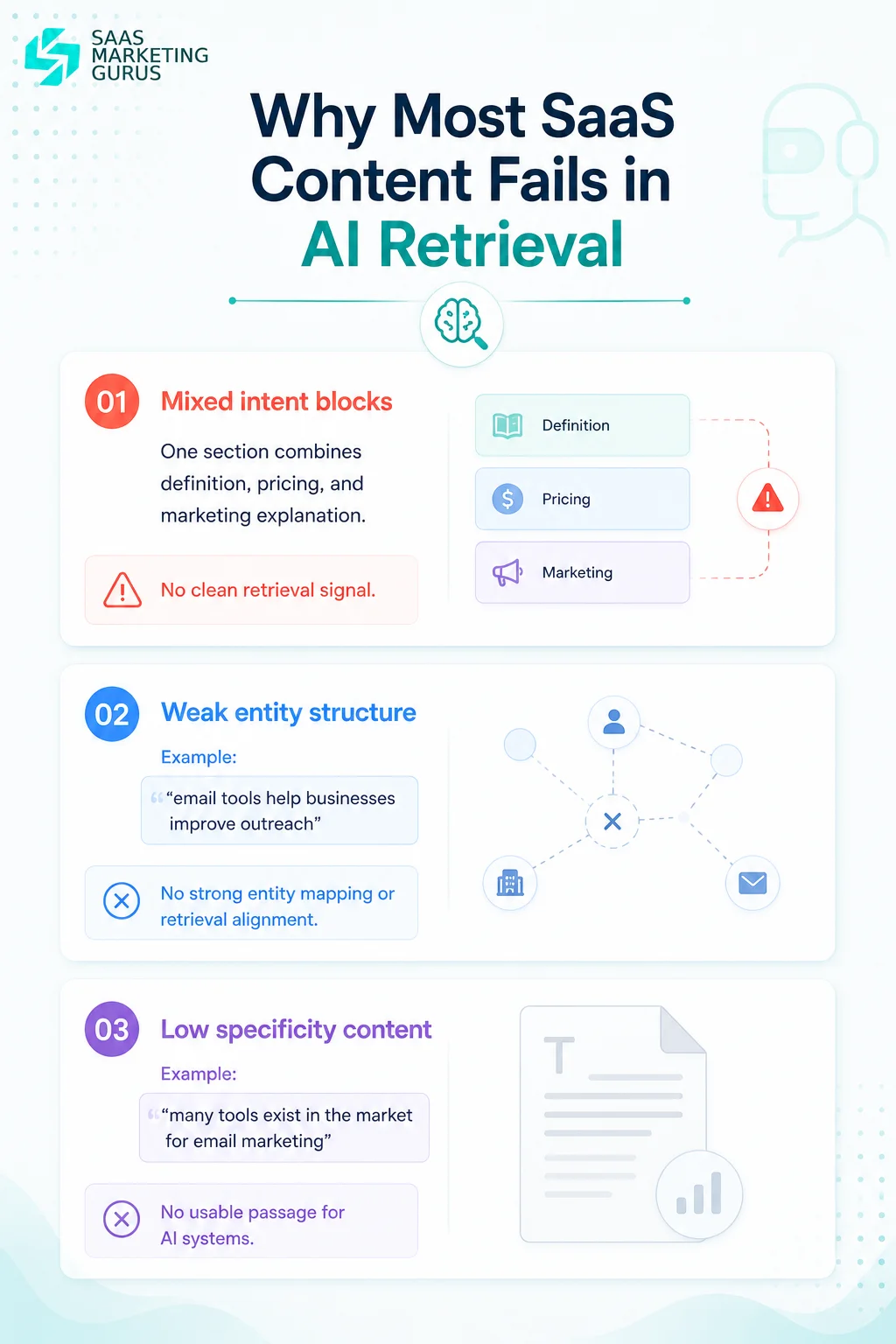
1. Mixed intent blocks
Many SaaS pages combine definitions, pricing, feature descriptions, and promotional messaging within the same section. This makes it difficult for AI systems to determine the primary purpose of the content.
Result: AI models struggle to retrieve a clear, standalone passage that directly answers a user’s query.
Recommendation: Keep each section focused on a single topic or question to improve retrieval accuracy.
2. Weak entity structure
Generic references such as “email tools” provide little context for AI systems. Without clear product names, categories, or related entities, content becomes harder to understand and compare.
Result: Weak entity relationships reduce the likelihood of AI systems selecting your content.
Recommendation: Mention relevant products, industries, and use cases naturally throughout the page.
3. Low specificity content
Broad statements without examples or supporting details rarely provide enough value for AI retrieval. AI systems prefer content that explains a concept with clear examples, comparisons, or measurable outcomes.
Result: Generic content is less likely to appear in AI-generated responses.
Recommendation: Use practical examples, workflows, and comparisons to improve semantic clarity.
Key takeaway: AI systems retrieve content that is focused, specific, and easy to understand. Structuring each section around a single topic with clear entities and practical examples improves the likelihood of AI citation.
According to Google’s documentation on AI Overviews, AI-generated search experiences prioritize content that is helpful, well-structured, and demonstrates clear expertise. Structuring content for both users and AI systems is becoming increasingly important as AI-powered search expands.
AI Visibility Risk (Urgency Layer)
Most SaaS companies assume ranking equals visibility.
In reality, based on observed AI Overviews extraction behavior and Perplexity citation patterns, visibility is now determined by retrievability, not ranking.
If your content is not structured for passage retrieval:
it will not be cited in ChatGPT responses
it will not appear in Perplexity summaries
it will not surface in AI Overviews
Even if it ranks in Google.
AI Visibility Diagnostic CTA
If your SaaS is not appearing in AI-generated answers, the issue is not traffic.
It is a retrieval exclusion.
You can identify this using a structured GEO audit:
- Check whether your brand appears in ChatGPT responses
- Check whether Perplexity cites your pages
- Check whether the AI Overviews extract your definitions
AI Answer Visibility Audit for SaaS
If your SaaS content isn’t appearing in ChatGPT, Perplexity, or Google AI Overviews, improving traditional SEO alone is no longer enough. Your content also needs to be optimized for answer extraction, AI retrieval, and generative search.
At SaaS Marketing Gurus, we help SaaS companies improve AI search visibility through AEO, GEO, content restructuring, entity optimization, and LLM optimization.
Book an AI answer visibility Audit to identify the gaps preventing your content from being retrieved and cited by AI platforms.
How Should You Structure SaaS Content for GEO?
Most content fails because it does not follow retrieval design.
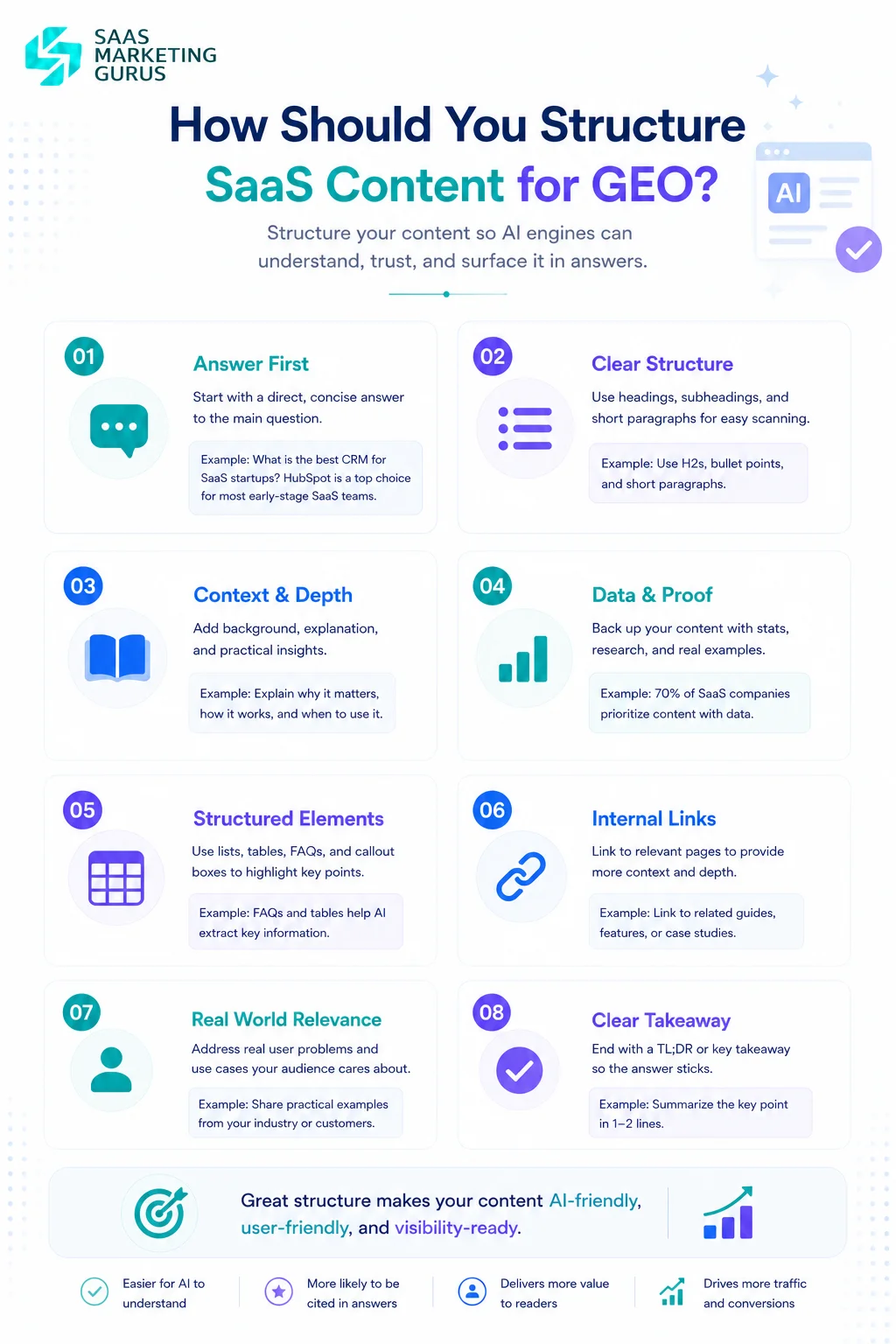
Here is the correct structure:
Step 1: Query aligned definition
Example:
“What is GEO”
GEO is the process of structuring content so AI systems can retrieve and cite passages inside generated responses.
Step 2: Entity anchored sections
Each section must include:
- 1 concept
- 1 use case
- 2–3 entities
Example:
HubSpot, Apollo, Mailchimp → email outreach workflows
Step 3: Comparison blocks
AI systems prefer structured comparisons:
- Tool A → use case
- Tool B → use case
- Tool C → use case
Step 4: Retrieval-based examples
Query → system behavior → selected chunk
Example:
Query: “best CRM for startups”
AI selects HubSpot due to onboarding speed and structured workflow clarity
Step 5: FAQ in query format
Must mirror real AI queries:
- what is AEO
- how does GEO work
- why does AI cite SaaS tools
GEO Content Checklist
Before publishing a SaaS page, check that it includes:
- A clear definition near the beginning
- Question-based headings
- One search intent per section
- Relevant product and industry entities
- Workflow or use-case examples
- Comparison tables where appropriate
- FAQs based on real user questions
- Internal links to supporting resources
- Updated information and credible references
Content that meets these criteria is generally easier for AI systems to retrieve and cite.
Real-World Examples of AEO and GEO
Different SaaS companies benefit from AEO and GEO in different ways depending on the type of content they publish.
HubSpot
HubSpot structures many of its glossary pages and FAQs with clear definitions and question-based headings. This approach supports Answer Engine Optimization by making content easier for search engines and AI assistants to extract as direct answers.
Zapier
Zapier publishes workflow guides and software comparisons that explain how different tools connect and solve specific business problems. These structured use cases help AI systems retrieve relevant passages when users ask process-oriented questions.
Notion
Notion combines documentation, templates, and educational resources with consistent product terminology. This improves entity recognition and provides AI systems with clear, reusable content about productivity and knowledge management.
Salesforce
Salesforce publishes detailed implementation guides, industry solutions, and product documentation that consistently reference CRM workflows and enterprise use cases. This structured content provides strong entity relationships and contextual depth that support AI retrieval.
Key takeaway: SaaS companies that organize content around clear topics, practical use cases, and consistent entities are more likely to improve AI search visibility across traditional search engines and generative AI platforms.
SaaS Visibility Model
SaaS visibility operates across three layers:
SEO layer → authority signals
AEO layer → direct answer extraction
GEO layer → AI citation inclusion
Based on observed AI system behavior in Perplexity and AI Overviews, missing any layer reduces inclusion probability even if SEO rankings are strong.
AI Retrieval Behavior (simplified system model)
Query:
“best SaaS tools for cold email outreach”
System process:
Step 1: intent detection – Outbound sales automation
Step 2: retrieval filtering – Only structured workflow chunks are eligible
Step 3: exclusion logic – Generic marketing content is removed
Step 4: response construction – Only entity-rich, workflow-aligned passages are used
Final output is fully reconstructed from chunks.
BEFORE vs AFTER GEO CONTENT
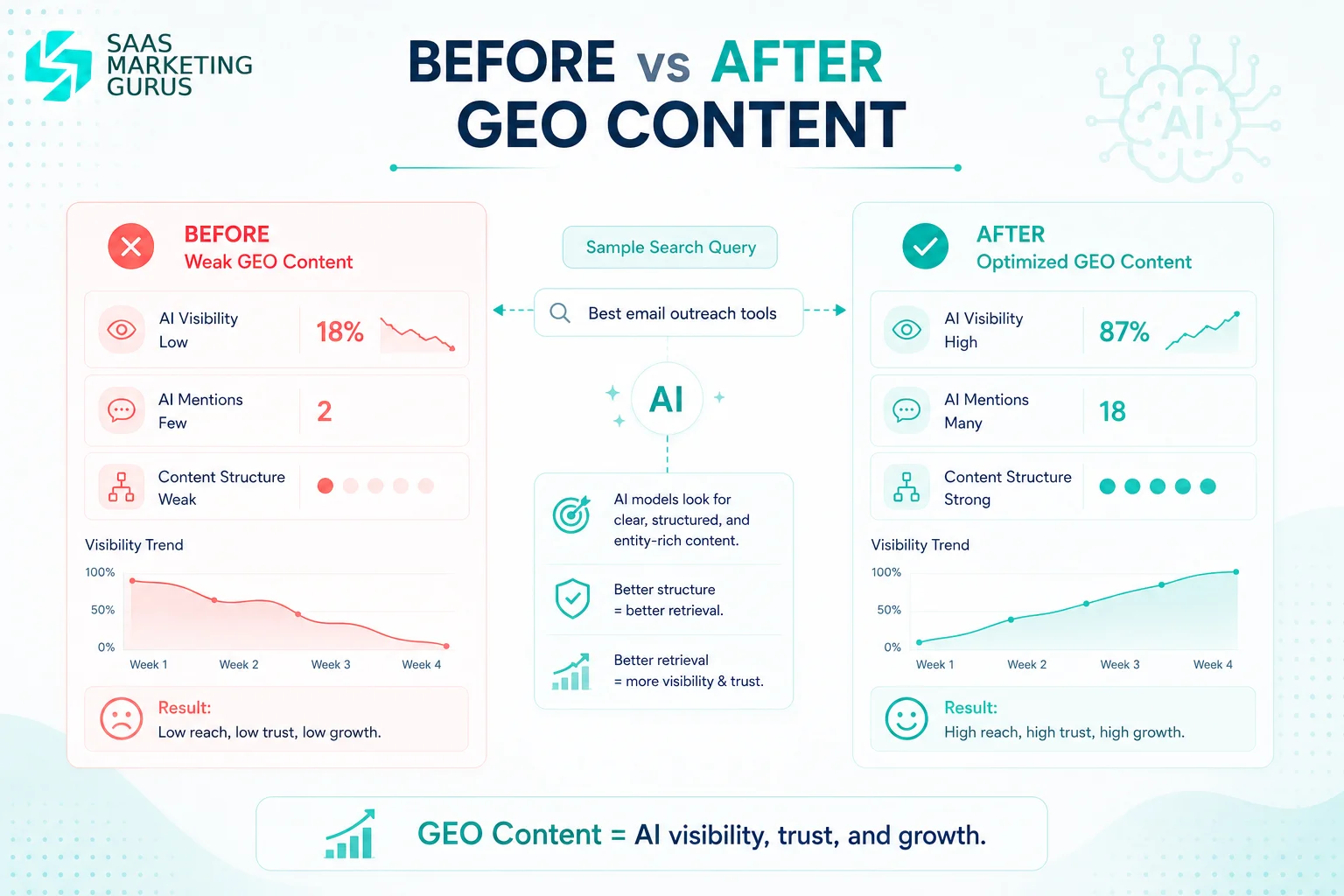
BEFORE (bad GEO structure)
“Email marketing tools are useful for businesses. Many companies use different platforms to improve outreach. There are several features available in the market.”
Problem:
- no entity clarity
- no workflow
- no retrieval structure
AFTER (GEO optimized structure)
“HubSpot, Apollo, and Mailchimp support email outreach through sequencing, automation, and CRM tracking for outbound SaaS teams.”
Why it works:
- clear entities
- clear use case
- retrieval ready structure
- high semantic density
KPI Tracking for AI Visibility
- AI Overview tracking
- snippet appearance
- query coverage
- extraction frequency
- ChatGPT tracking
- brand inclusion frequency
- competitor comparison ratio
- Perplexity tracking
- citation consistency
- source repetition across queries
Based on emerging AI SEO patterns, these are early indicators of GEO performance.
Clean System Explanation
AI systems evaluate content based on retrievability, not publication quality.
Content becomes eligible when:
- structured into passages
- aligned with query intent
- entity rich
If not:
It is excluded from AI responses even if it ranks in traditional SEO.
How to Measure GEO Success
Unlike traditional SEO, GEO performance is measured by visibility inside AI-generated responses rather than rankings alone.
Useful indicators include:
| Metric | Why It Matters |
|---|---|
| ChatGPT mentions | Brand visibility |
| Perplexity citations | Retrieval frequency |
| AI Overview appearances | Search visibility |
| Comparison inclusion | Competitive positioning |
| Branded prompt success | AI awareness |
| Entity consistency | Retrieval confidence |
Tracking these metrics alongside traditional SEO provides a clearer picture of AI search performance.
Conclusion
SEO remains an important foundation for organic visibility, but AI-powered search introduces a new layer of optimization. While AEO helps search engines and AI assistants extract direct answers, GEO improves how AI systems retrieve, interpret, and cite content in generated responses.
For SaaS companies, the strongest long-term strategy combines SEO, AEO, and GEO. Creating structured, entity-rich, and retrieval-friendly content increases the likelihood of appearing across Google Search, AI Overviews, ChatGPT, Perplexity, and future AI search experiences.
Is Your SaaS Content Ready for AI Search?
Many SaaS companies rank well in Google but remain invisible in AI-generated answers because their content isn’t structured for retrieval.
An AI visibility audit can identify issues such as weak entity relationships, mixed search intent, and poor passage structure that limit AI citations.
Want to improve AI search visibility? Explore our AI Search Optimization services to see how retrieval-focused content can increase visibility across ChatGPT, Perplexity, and Google AI Overviews.
FAQs
What is the difference between Answer Engine Optimization (AEO) and Generative Engine Optimization (GEO)?
Answer Engine Optimization (AEO) helps search engines and AI assistants extract direct answers from your content. Generative Engine Optimization (GEO) helps AI systems retrieve, understand, and cite your content within AI-generated responses.
Does Generative Engine Optimization (GEO) replace traditional SEO?
No. GEO complements traditional SEO rather than replacing it. SEO improves rankings and authority, while GEO improves how AI systems retrieve and reference your content in platforms like ChatGPT, Perplexity, and Google AI Overviews.
How does Generative Engine Optimization (GEO) work?
GEO works by organizing content into clear, retrievable sections with strong entity relationships, relevant context, and focused answers. AI systems use these passages to generate responses to user queries.
Why is GEO important for SaaS companies?
More buyers are discovering software through AI-powered search. GEO helps SaaS companies improve visibility in AI-generated recommendations, increasing the chances of being cited when users ask for tools, comparisons, or solutions.
What type of content performs best for Answer Engine Optimization (AEO)?
Definition pages, FAQs, glossary content, and concise answers perform best for AEO because they make it easier for search engines and AI assistants to extract direct responses.
What type of content performs best for GEO?
Comparison pages, workflow guides, use cases, implementation tutorials, and “best software” lists perform well because they provide structured, entity-rich information that AI systems can retrieve and reuse.
7. How do AI tools like ChatGPT, Perplexity, and Google AI Overviews choose sources?
They prioritize content that clearly answers the query, includes relevant entities, provides helpful context, and is easy to retrieve. High-quality, well-structured content is more likely to be referenced.
Can my website rank on Google but still be invisible in AI search?
Yes. A page can rank well in traditional search but still not appear in AI-generated answers if it lacks clear structure, strong entities, or retrieval-friendly content.
9. How can I check if my website appears in AI search?
Search for your target keywords, products, or brand in ChatGPT, Perplexity, and Google AI Overviews. If your content is rarely mentioned or cited, it may need improvements in AI retrieval optimization.
10. Should SaaS companies use SEO, AEO, and GEO together?
Yes. SEO builds authority and rankings, AEO improves answer extraction, and GEO increases AI retrieval and citations. Combining all three creates a stronger strategy for both traditional and AI-powered search.