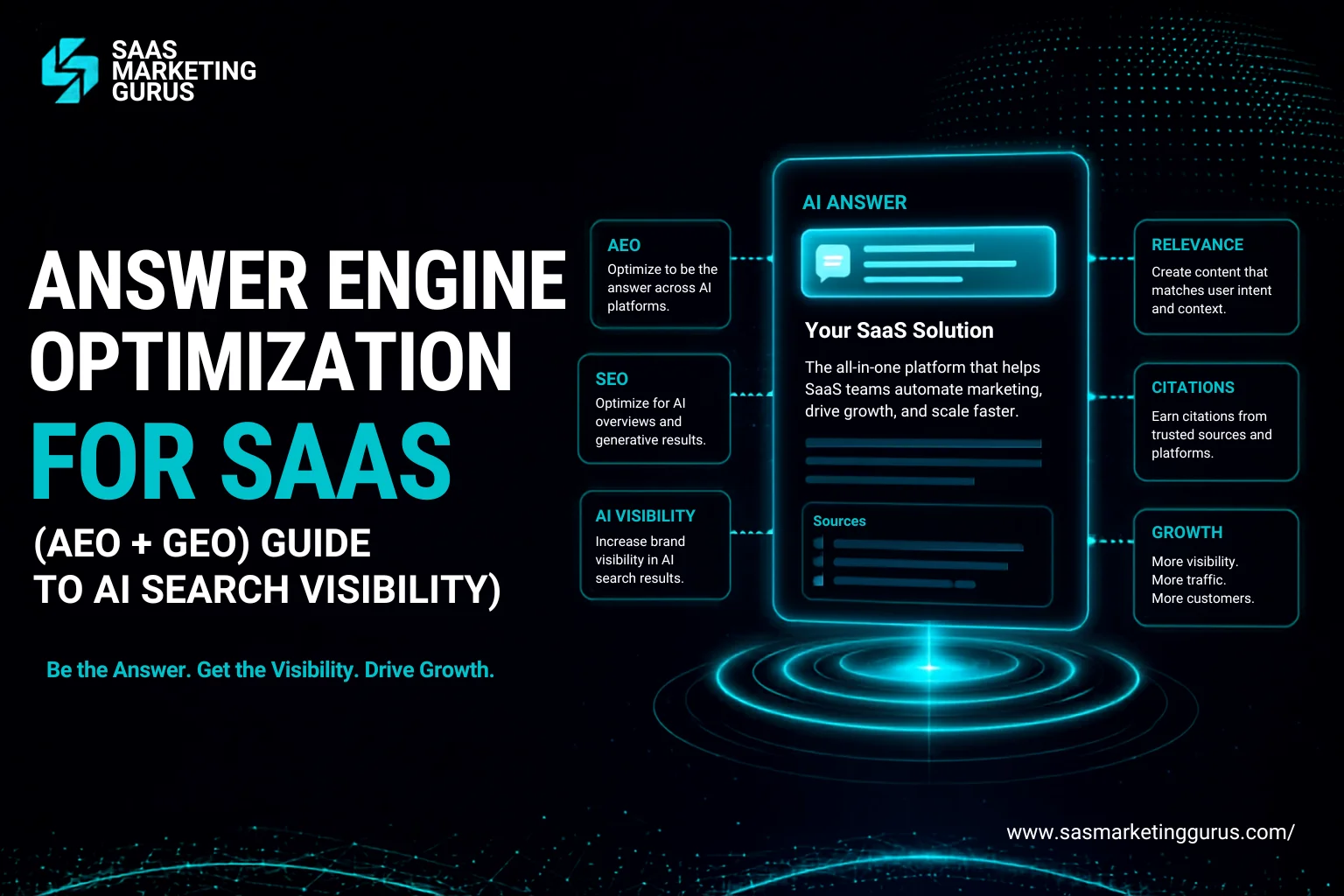
Answer engine optimization for SaaS is the work of making your product information and expertise easier to find, understand, and reference in generated answers. Start with important buyer questions and the pages that answer them. If those pages contain inaccurate information or cannot be accessed, fix those problems before expanding content.
For a SaaS team, the practical priorities are clear pricing explanations, useful comparisons, accurate integration details, and evidence that supports product claims. Measure whether answers describe your product correctly, whether they cite useful pages, and whether resulting visits lead to qualified actions.
SaaS Marketing Gurus (SMG), a B2B SaaS marketing agency based in Magdeburg, Germany, offers Generative Engine Optimization services covering buyer questions, content, and visibility measurement.
What Is Answer Engine Optimization for SaaS?
Answer engine optimization, or AEO, applies search and content improvements to questions answered through AI search experiences. For SaaS companies, that includes explaining what a product does, who it suits, what it costs, and where its limitations matter.
AEO and Generative Engine Optimization, or GEO, overlap in common usage. They do not require separate versions of the same page. Google describes optimization for its generative search features as part of SEO because those features rely on its core Search systems.
Use one content plan that serves buyers across search experiences. For the terminology and scope differences, see SMG’s AEO versus GEO comparison.
Does AEO Matter for B2B SaaS?
AEO deserves attention when prospective customers use generated answers to investigate problems, compare products, or check buying requirements. Your first task is to establish whether those questions matter in your own sales process.
Ask sales and customer success teams which questions repeatedly delay evaluation. Review search queries, support conversations, and prospect feedback. Then inspect a small sample of relevant AI answers for missing information or incorrect product descriptions.
Prioritize AEO work when you find a clear problem, such as an outdated integration claim or an unanswered migration question. If your basic product pages remain incomplete, improve those pages first. A separate stream of generic AI visibility articles is unlikely to resolve the underlying information gap.
How Do Answer Engines Find and Cite Sources?
Answer engines can generate responses using retrieved information, model knowledge, or a combination of both. A response with cited web sources should be evaluated differently from an answer with no visible source trail.
Google explains that its generative search features can retrieve relevant pages and issue related searches to gather supporting information. The resulting answers can include clickable links. This does not establish an identical process or ranking formula for every AI product.
For a practical audit, record:
- Which product and search mode produced the answer.
- Whether the answer includes source links.
- Which pages support the product statements.
- Whether those statements match current documentation.
Private assistants that search internal company documents represent a different use case. Improving an internal knowledge base does not, by itself, establish public search visibility.
How Do You Build a B2B AEO Strategy?
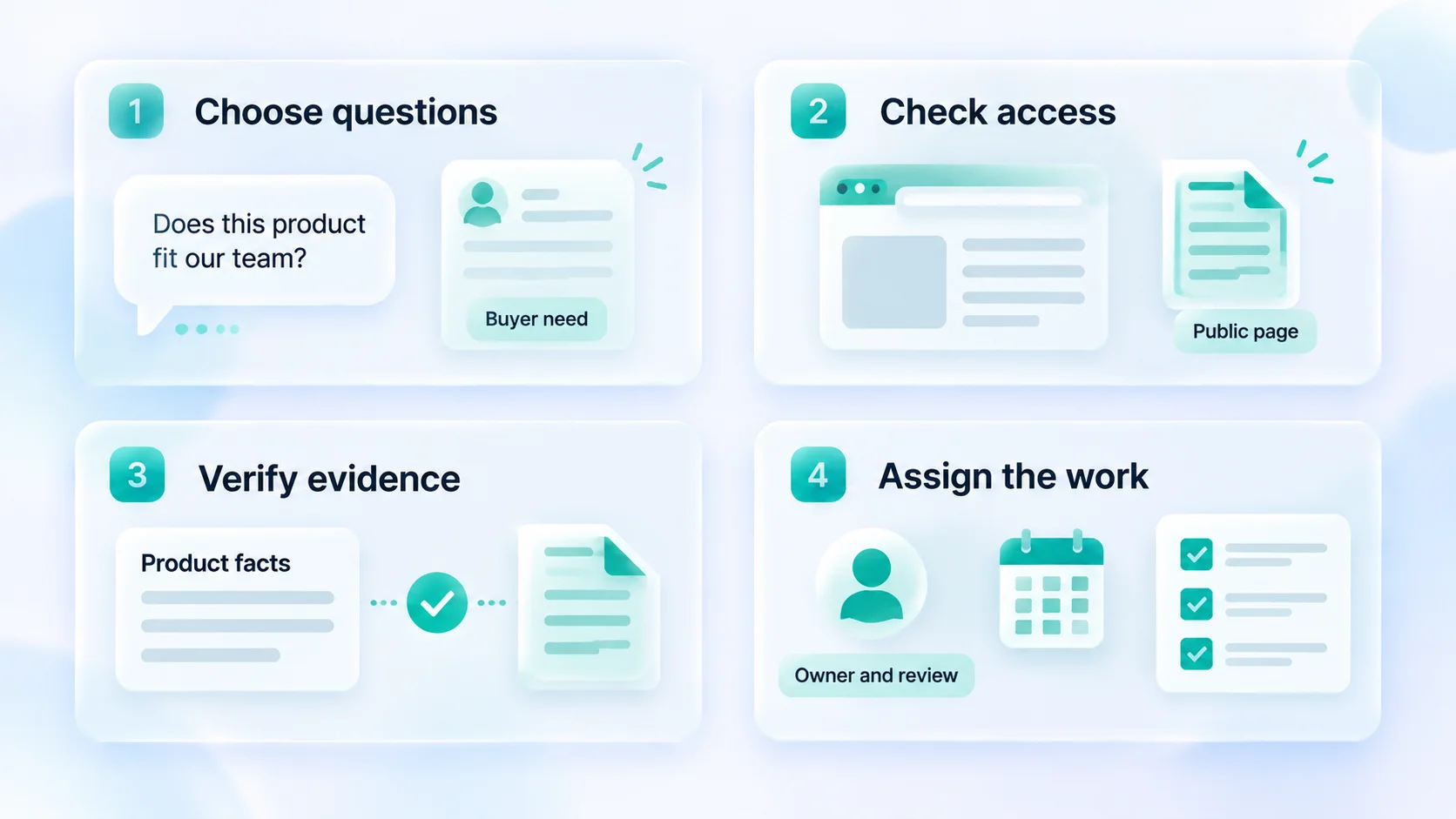
Build a B2B AEO strategy around a small set of buyer questions, verified product evidence, and measurable page improvements. Assign an owner to each change so the plan can move from research to publication.
Choose questions that affect buying decisions
Start with questions your team can connect to a real customer need. Collect them from sales calls, support tickets, search reports, and product feedback.
For each question, record the audience, the decision being made, the best existing page, and the evidence needed to answer it. Prioritize questions with clear commercial relevance and a fix your team can deliver.
SMG’s CLARITY framework for keyword clustering can help assess intent, page value, topic relationships, and measurement. Keep wording variants together when one page can answer them fully.
Check whether important pages are accessible
Confirm that the intended public pages load correctly and expose their main content. Review indexing, canonical URLs, crawler access, and any restrictions that could prevent the relevant platform from using the page.
Google’s May 2025 guidance identifies accessible pages, successful server responses, and indexable content as technical foundations for its AI search experiences. These checks establish eligibility, not guaranteed inclusion.
Use SMG’s B2B SEO audit checklist to organize the wider technical review.
Match each answer to verified product evidence
Ask the relevant product owner to confirm feature availability, plan restrictions, integration behavior, and setup requirements before publication.
Keep a simple evidence record containing the claim, its source, its owner, and the date checked. When a claim cannot be confirmed, qualify it or remove it.
Apply the same review to product descriptions on external profiles your team controls. Correct inaccurate information without inventing reviews or endorsements.
Budget for implementation and review
Estimate the work by page, including research, writing, product review, development, and measurement. Content changes may need a marketer and product specialist; access problems may also require engineering time.
Start manually if your question set is small. Consider outside support when the main constraint is specialist capacity or coordination across teams.
For an agency proposal, ask which pages will change, who verifies claims, what reporting is included, and how success will be assessed. Evaluate the scope and review process before comparing prices.
Which SaaS Pages Should You Improve First?
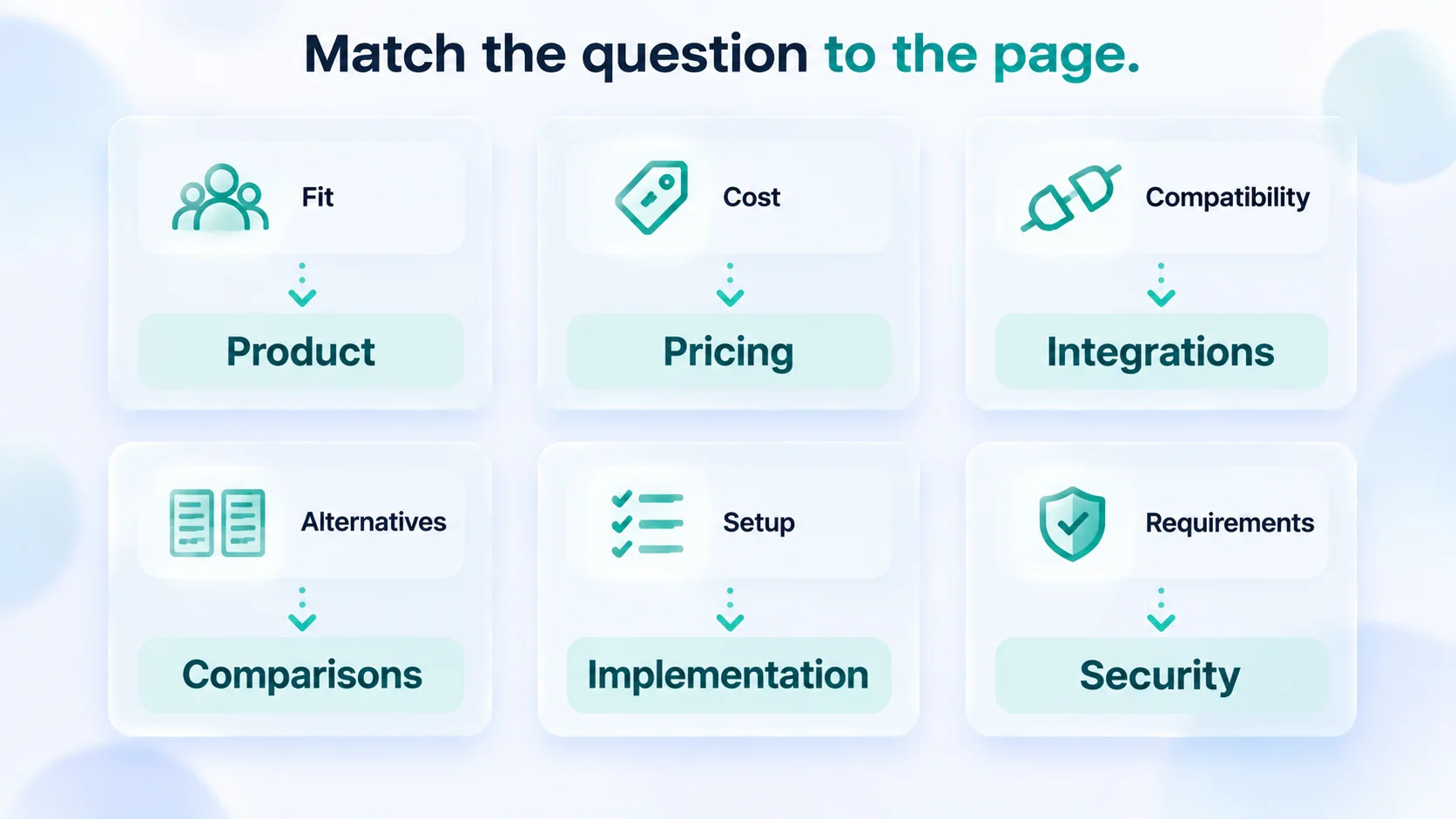
Improve the pages that resolve important buyer questions and contain information you can verify. The best starting page depends on the information gap, not a universal preference for blog posts or comparisons.
| Buyer question | Page to review | Details the answer needs |
|---|---|---|
| Is this product suitable for our team? | Product or use case page | Intended users, workflow, requirements, and limitations |
| What will we pay? | Pricing page | Billing basis, plan differences, usage limits, and additional charges |
| Does it work with our existing system? | Integration page | Supported actions, setup requirements, permissions, and known limits |
| How does it compare with another option? | Comparison page | The same relevant criteria for both products, with current evidence |
| What does implementation involve? | Setup or migration guide | Inputs, responsibilities, steps, validation, and rollback considerations |
| Can we meet our procurement requirements? | Security or trust page | Accurate documentation and a route for detailed review |
Choose one unresolved question and improve its existing destination before creating another page.
For comparisons, explain when each option is suitable. Separate native features from integrations, optional services, and paid add ons. If a detail cannot be verified, say so.
How Do You Write a Useful SaaS Answer?
Open with a direct answer, explain the conditions that change it, and show the reader what to do next. Add enough evidence and detail to resolve the question without turning every section into a fixed template.
A useful product answer usually includes the capability, prerequisites, limitations, and a way to check the result.
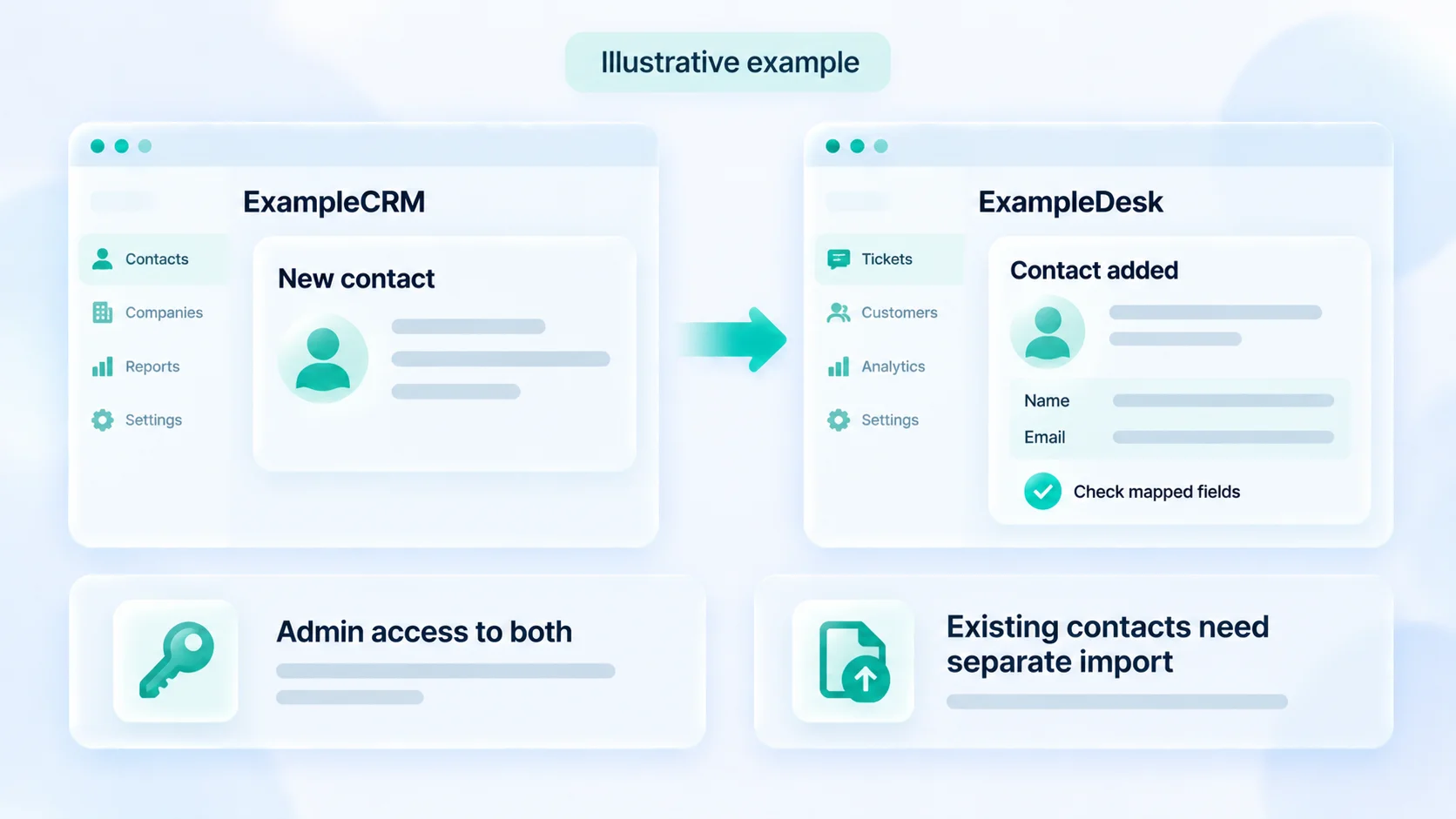
Example: Explain a CRM integration clearly
An integration answer should name what moves between systems and how the customer verifies that it worked. “Connect your CRM easily” leaves those questions unanswered.
The following is an illustrative example, not an SMG client result or a claim about a real product:
ExampleCRM can send newly created contacts to ExampleDesk through its native integration. Setup requires administrator access to both accounts. Existing contacts need a separate import.
Connect the accounts, map the required contact fields, and create one test contact. Confirm that the expected fields appear in ExampleDesk before enabling the workflow for the wider team.
This example covers contact creation only. It does not imply support for deal records, automatic updates, or synchronization in both directions.
For a real integration page, replace every detail with confirmed product behavior. Link to the relevant setup instructions and explain where customers can check errors.
What Mistakes Weaken a SaaS AEO Program?
A SaaS AEO program becomes less useful when it prioritizes formatting tricks over accurate answers and verifiable product information. Avoid changes that create more content without resolving a buyer’s question.
Common mistakes include:
- Claiming a universal ranking formula. Separate documented platform behavior from working hypotheses.
- Treating short sections as a technical requirement. Google explicitly says content does not need to be divided into tiny pieces for its AI features.
- Publishing comparisons without equal criteria. Explain strengths, limitations, implementation, and cost factors for both options.
- Leaving product facts inconsistent. Review pricing, integrations, documentation, and external profiles together.
- Calling a mention a business result. Track mentions, citations, visits, and qualified outcomes separately.
- Publishing unverified success stories. Use documented client evidence or label an example as hypothetical.
- Creating duplicate pages for wording variants. Expand a useful existing page when it already serves the same intent.
Before publishing, ask whether the revision helps a buyer make a better decision. If the answer is unclear, reconsider the change.
How Do You Measure SaaS AI Visibility?
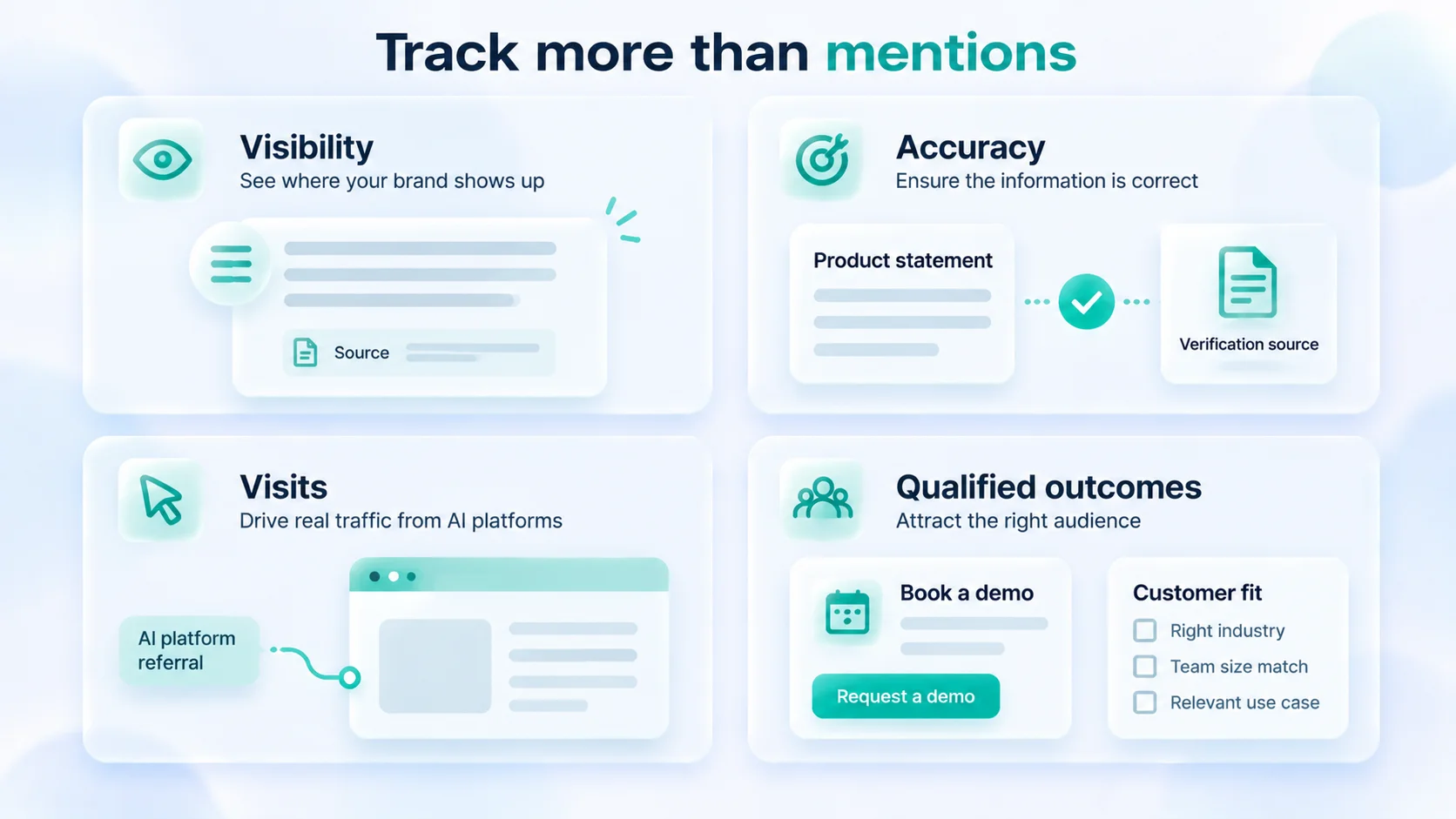
Measure SaaS AI visibility through separate records of appearances, accuracy, visits, and qualified outcomes. A citation is an observed reference, not evidence that someone visited your website or became a customer.
| Measurement | What to record | Main limitation |
|---|---|---|
| Visibility | Brand mentions and citations within a defined question sample | The sample does not represent every buyer or answer |
| Accuracy | Whether product statements match current documentation | Requires human verification |
| Visits | Identifiable referral sessions and landing pages | Some discovery journeys lack a clear referral trail |
| Qualified outcomes | Relevant demos, activated trials, or other agreed actions | Attribution can involve several interactions |
Use a repeatable observation method
Keep the same core questions, target market, language, and platform settings across review periods. Record the date, exact prompt, product or model where visible, search mode, answer, and cited URLs.
Calculate a sampled citation rate as answers citing your domain divided by valid answers reviewed. Record failed requests separately. Do not silently count a technical failure as an answer without a citation.
Repeat observations over time because one answer is not a stable ranking report. If you change the question set, report the new set separately before comparing results.
Bing’s AI Performance reporting shows citations and cited pages across supported Microsoft experiences. Microsoft explicitly distinguishes these measurements from ranking, placement, and authority. Its grounding queries are a sample of retrieval activity.
Choose reporting software around the work
Start with a spreadsheet if the sample is small enough to review consistently. Add software when collection, evidence storage, or reporting becomes a recurring burden.
Before buying, check platform and regional coverage, saved answer evidence, export options, scheduling, prompt limits, and integration requirements. Confirm whether the product observes a consumer interface or uses an API workflow. Treat them as separate measurement methods unless equivalence is demonstrated.
Review the evidence before scaling: did accuracy improve, did useful citations recur, and did identifiable visits produce relevant actions?
How Can Answer Visibility Support Conversions?
Answer visibility can support evaluation when the cited page resolves the buyer’s question and offers a relevant next step. It does not create a predictable sequence from mention to revenue.
Match the action to what the visitor needs:
| Page purpose | Useful next action |
|---|---|
| Explain a problem | Explore a relevant use case or implementation guide |
| Explain product fit | Review requirements, limitations, or a demonstration |
| Compare options | Check current pricing and the criteria that matter |
| Explain setup | Follow the documentation or contact implementation support |
Keep helpful answers accessible rather than hiding basic information behind a form.
Define a qualified action before measuring results. For example, a demo request from the intended customer segment may matter more than an unrelated download. Connect those events to your customer records where possible, while acknowledging attribution gaps.
SMG’s SEO conversion funnel guide explains how content and next actions can work together.
Start With One Buyer Question and One Page
For most SaaS teams, answer engine optimization should begin with an important buyer question and an existing page that answers it poorly. Confirm the product facts, improve the explanation, and establish a baseline before making further changes.
Choose a small review set your team can maintain. A practical pilot might cover five buyer questions and three relevant pages. These are suggested starting limits, not platform requirements or a promised timeline.
Define success before publication: verified product information, fewer observed inaccuracies, and relevant next actions from identifiable visits. Review citations alongside these measures rather than treating citation growth as the only objective.
If access problems prevent discovery, prioritize technical fixes. If answers are accurate but visitors do not progress, review product fit, page usefulness, and the next action before publishing more content.
For support choosing the first pages and measurement plan, get a free consultation with SMG.
FAQs
Can SaaS companies optimize existing content for AI search?
Yes. Start with pages that already answer relevant buyer questions. Correct outdated claims, fill important gaps, improve navigation, and make the next action clear. Create a new page only when the existing page cannot serve the distinct intent well.
What is the role of entities in SaaS AI visibility?
An entity is an identifiable thing, such as a company, product, or integration. Name the product clearly and explain its relationship to features, plans, and supported systems. Consistent wording reduces ambiguity, but it does not guarantee inclusion in an answer.
Why are topic clusters important for AEO and GEO?
Topic clusters organize related questions across pages with distinct purposes. A product overview can link to pricing, integrations, comparisons, and implementation guidance. Use those links to help readers find missing detail rather than creating several pages that repeat the same answer.
How does LLM content optimization help SaaS brands?
LLM content optimization is a label for improving information that language model based systems may use. Useful work includes accurate product descriptions, clear explanations, accessible documentation, and supporting evidence. Editing a page does not directly update a model’s training data or guarantee its next response.
How long does AEO take to produce results?
There is no dependable universal timeline for citations or business outcomes. Set a review period based on your publishing pace and sales cycle, record the baseline, and review several observations. Check discovery, accuracy, and buyer relevance before assuming that more content is needed.
What should SaaS companies look for in an AEO service?
Look for a defined scope covering buyer research, page improvements, product verification, technical coordination, and reporting. Ask for documented evidence behind outcome claims. A useful proposal explains responsibilities and measurement limits without promising rankings or AI recommendations.