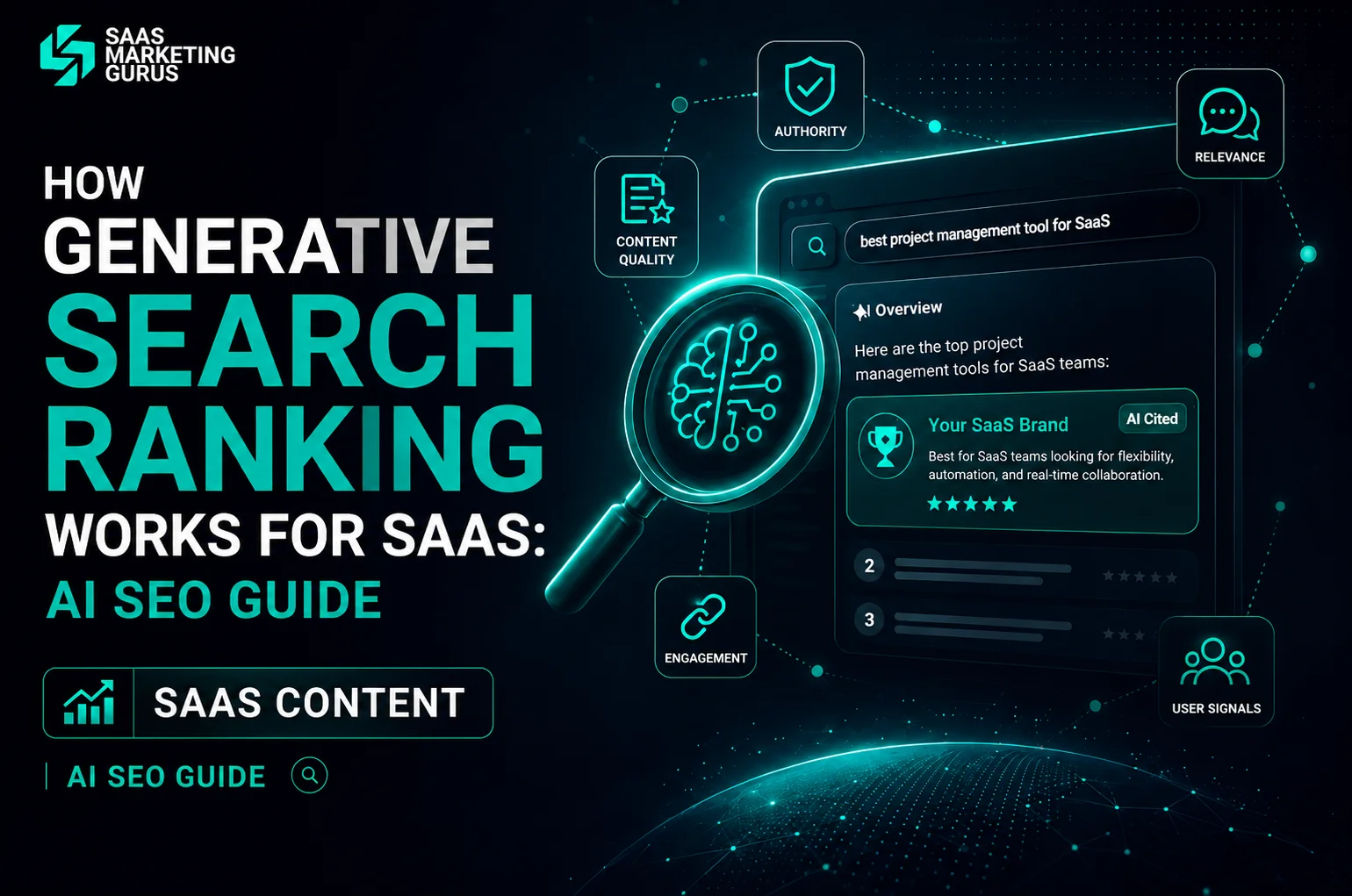
Learn how generative search ranking works and optimize your SaaS content for ChatGPT, Google AI, and Perplexity visibility.
Generative search engines are changing how people find information online. Instead of a list of links, platforms like ChatGPT, Google AI Overviews, Perplexity, Claude, and Microsoft Copilot generate direct answers by retrieving and synthesizing information from multiple trusted sources.
The stakes are real: Ahrefs’ analysis of 300,000 keywords found AI Overviews now correlate with a 58% lower average click-through rate for the top-ranking page (Ahrefs, 2025). Ranking #1 in classic search no longer guarantees a visitor. Generative search ranking decides whether your content gets cited at all.
SaaS Marketing Gurus (SMG), a B2B SaaS marketing agency based in Magdeburg, Germany, specializing in Reddit marketing, Quora marketing, Generative Engine Optimization (GEO), SaaS SEO, and Product Hunt launches, works with SaaS companies on exactly this problem. Unlike traditional SEO, where rankings depend on keywords and backlinks, AI search evaluates content quality, semantic relevance, entity recognition, authority, and how easily information can be extracted.
To improve your chances of being cited in AI-generated answers, focus on:
- Creating self-contained, answer-first content that AI can easily understand.
- Maintaining consistent brand and product mentions across every channel.
- Building authority through blogs, documentation, videos, community discussions, and industry publications.
- Supporting claims with trustworthy data, examples, and expert insights.
By optimizing for these signals, SaaS companies can improve AI visibility, strengthen brand authority, and increase the likelihood of being referenced across modern AI search experiences.
What is Generative Search Ranking?
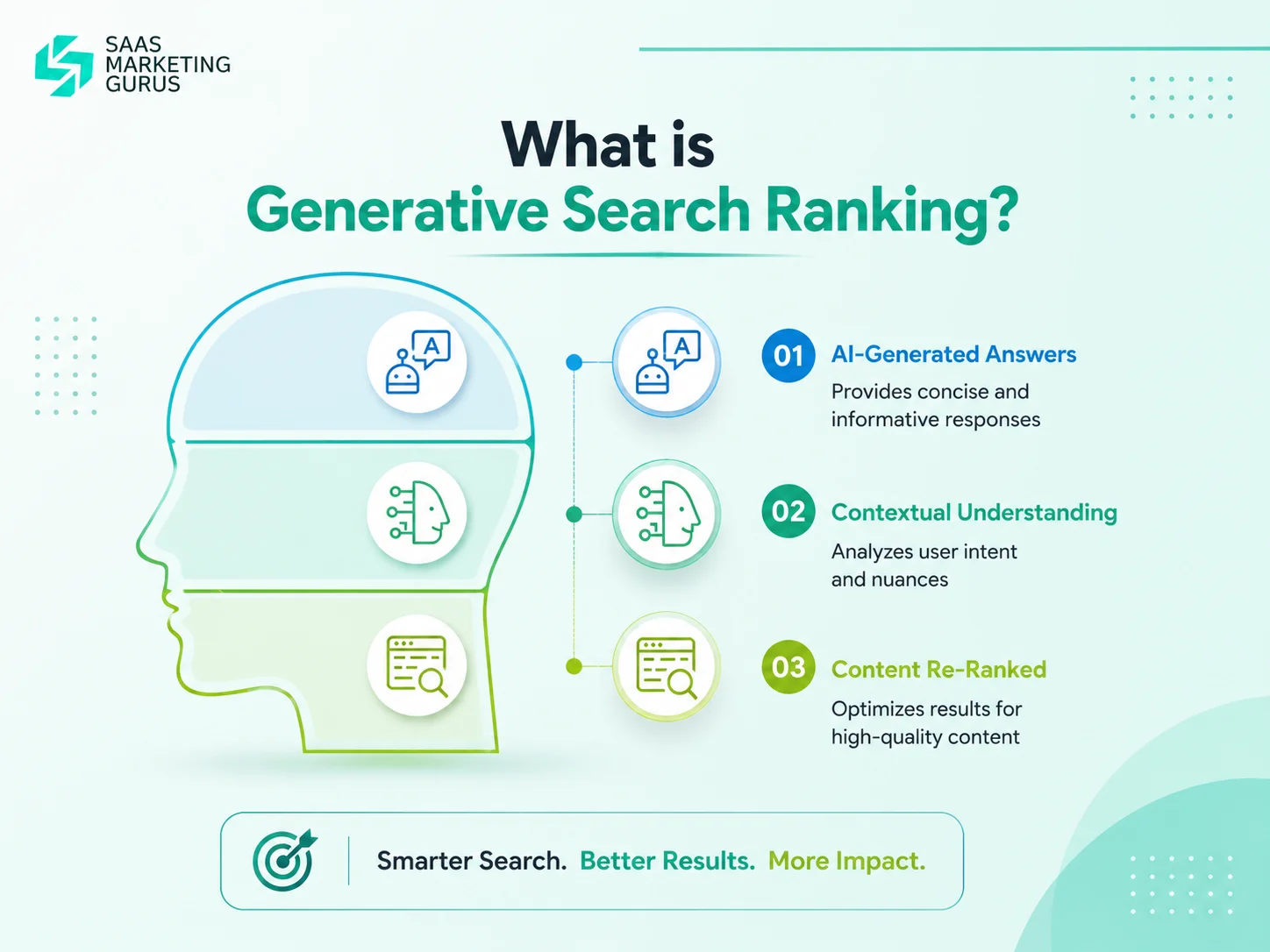
Generative search ranking determines which content AI engines select, synthesize, and cite when answering a user’s question. Unlike SaaS SEO rankings, position on a results page doesn’t decide the outcome. Selection does.
Key Differences from Traditional SEO:
- Standalone paragraphs: AI prefers content that can be interpreted independently.
- Consistent entity naming: Using clear brand and product references ensures relevance.
- AI citations independent of clicks: Your content can appear in AI answers even without visits.
Traditional SEO vs Generative Search Ranking
| Traditional SEO | Generative Search Ranking |
|---|---|
| Ranks web pages | Generates direct answers |
| Focuses on keywords and backlinks | Focuses on entities, context, and semantic relevance |
| Success measured by clicks | Success measured by AI citations and visibility |
| Users browse multiple pages | Users often receive an immediate answer |
| Search rankings determine visibility | AI models determine which sources to reference |
How Do Generative Search Engines Generate Answers?
Generative search engines retrieve, evaluate, and combine information from multiple trusted sources to produce one direct answer instead of a list of web pages. Every platform uses a different model, but most follow the same five-step process.
1. Understand User Intent
AI first determines what the user is trying to accomplish rather than simply matching keywords. It analyzes context, intent, and related concepts to understand the underlying question.
2. Retrieve Relevant Information
The model gathers information from indexed web pages, documentation, knowledge bases, community discussions, research publications, and other authoritative sources that best match the user’s intent.
3. Evaluate Content Quality
Retrieved content is assessed using signals such as authority, freshness, semantic relevance, factual accuracy, structured formatting, and consistent entity references.
4. Generate a Response
Instead of copying a single source, the AI synthesizes information from multiple trusted sources into a comprehensive answer.
5. Attribute Sources
Many AI search platforms—including Google AI Overviews and Perplexity—cite or link to the sources they use, allowing users to verify information and explore topics further.
Understanding this workflow helps SaaS companies create content that is easier for AI systems to retrieve, interpret, and reference in generated responses.
What Are the Generative Engine Ranking Factors?
Every AI search algorithm evaluates content differently, but most generative search engines rely on similar ranking principles. These are the factors that decide how AI engines select and rank brands in responses, not just whether your page is indexed.
| Factor | Definition | SaaS Example |
|---|---|---|
| Brand Recognition | How clearly AI identifies your company and product | monday.com labeled as “project management software” |
| Extractable Content | Each paragraph can stand alone and be actionable | CRM FAQs with a single question per paragraph |
| Multi-Platform Visibility | Brand content exists consistently across channels | Blog posts, LinkedIn, YouTube tutorials, Reddit Q&A |
| Technical Accessibility | Fast, crawlable, structured pages | JSON-LD schema for product features and pricing |
| Semantic Alignment | Keywords and entities match user intent | Use “SaaS onboarding platform” instead of “software” |
These factors, covered in more depth in SMG’s AEO for SaaS guide, decide whether your content is relevant, trustworthy, and worth citing in an AI-generated answer.
Why Does Generative Search Ranking Matter More for SaaS Companies?
B2B SaaS buying cycles run through more research stops than most categories, and AI is now one of them. 6sense’s 2025 Buyer Experience Report found buyers settle on a preliminary vendor earlier than in past years, often shaped by evaluating a company’s AI capabilities before the vendor even knows it’s being considered (6sense, 2025).
That shift changes what it means to rank in AI search. A SaaS company can rank #1 on Google for its category and still lose the buyer’s shortlist if ChatGPT or Perplexity never surfaces its name. Global SaaS companies now compete on a different scoreboard: not “do we rank,” but “does the AI recommend us.”
This is also why working with an agency that ranks content in generative search engines looks different from a standard SEO retainer. It means:
- Auditing brand and product mentions across every platform an AI model might retrieve from, not just the company blog.
- Structuring comparison and pricing content so a model can extract and cite it directly.
- Tracking citations in ChatGPT, Perplexity, and Google AI Overviews as a KPI, alongside keyword rankings.
SMG’s Generative Engine Optimization (GEO) team runs this exact audit-and-build process for SaaS clients, treating AEO and GEO as complementary disciplines rather than competing ones (see AEO vs. GEO for how the two differ).
Key AI Answer Ranking Signals
While every generative search engine uses its own models, most evaluate similar AI answer ranking signals when selecting content for generated responses. These signals help determine whether information is trustworthy, relevant, and easy to extract.
Common AI answer ranking signals include:
- Clear answers that directly address the user’s question.
- Consistent brand and product entity references.
- Strong semantic relevance between topics and user intent.
- Structured headings, lists, and tables that improve content extraction.
- Accurate, up-to-date information supported by credible sources.
- Consistent publishing across multiple authoritative platforms.
Focusing on these signals helps improve the likelihood that your SaaS content will be selected and referenced in AI-generated answers.
How Do You Rank Content in AI Search Engines?
Ranking content in AI search engines comes down to one test: can a large language model lift a paragraph out of your page and use it as-is? LLMs retrieve and prioritize content that is factually accurate, easy to parse, and structured for extraction.
Best Practices
- Begin each section with a direct answer.
- Keep paragraphs concise and focused on one idea.
- Use descriptive headings that match user questions.
- Include statistics, examples, or mini case studies to support claims.
- Maintain consistent brand and product names across every platform.
- Use tables, bullet lists, and FAQs to improve extractability.
- Refresh content regularly to keep information accurate and relevant.
Example
Less effective: “Our CRM software helps businesses manage customers.”
Optimized: “monday.com helps sales teams manage customer relationships by automating follow-ups, centralizing customer data, and improving team collaboration.”
SMG’s AI search optimization guide walks through how to audit an existing content library against this checklist, section by section.
What Are Semantic Retrieval Signals?
Semantic retrieval allows AI systems to understand meaning instead of relying only on exact keyword matches. Large language models evaluate relationships between topics, entities, and user intent to determine whether content answers a question.
For example, an article discussing “customer onboarding,” “user activation,” and “trial conversion” may still be relevant for a search about “SaaS onboarding software,” even if those exact words are not repeated throughout the page.
To strengthen semantic retrieval signals:
- Use descriptive language instead of repeating keywords.
- Explain related concepts and industry terminology.
- Keep product and brand names consistent.
- Group related ideas under clear headings.
Strong semantic relationships help AI systems better understand your content and improve its likelihood of appearing in AI-generated responses.
Common SaaS Content Mistakes
Many SaaS teams fail to fully optimize content for AI visibility. Common errors:
- Keyword stuffing instead of semantic alignment
- Example: Repeating “SaaS software, software tools” across paragraphs. Corrected by using descriptive phrases like “SaaS onboarding platform.”
- Vague or non-extractable paragraphs
- Example: “Our tool improves team efficiency.” Corrected by:
“Our project management tool, monday.com, reduced task completion time by 25% within three months.”
- Example: “Our tool improves team efficiency.” Corrected by:
- Inconsistent entity references
- Example: Switching between “Tally forms” and “Tally tool.” Corrected by consistently using “Tally form builder.”
- Ignoring multi-platform presence
- Example: Only blogging about features. Corrected by posting YouTube tutorials, LinkedIn Q&A, and Reddit discussions.
- Relying solely on traditional SEO
- Example: Optimizing search traffic without structuring FAQs for AI extraction. Corrected by using extractable, actionable paragraphs.
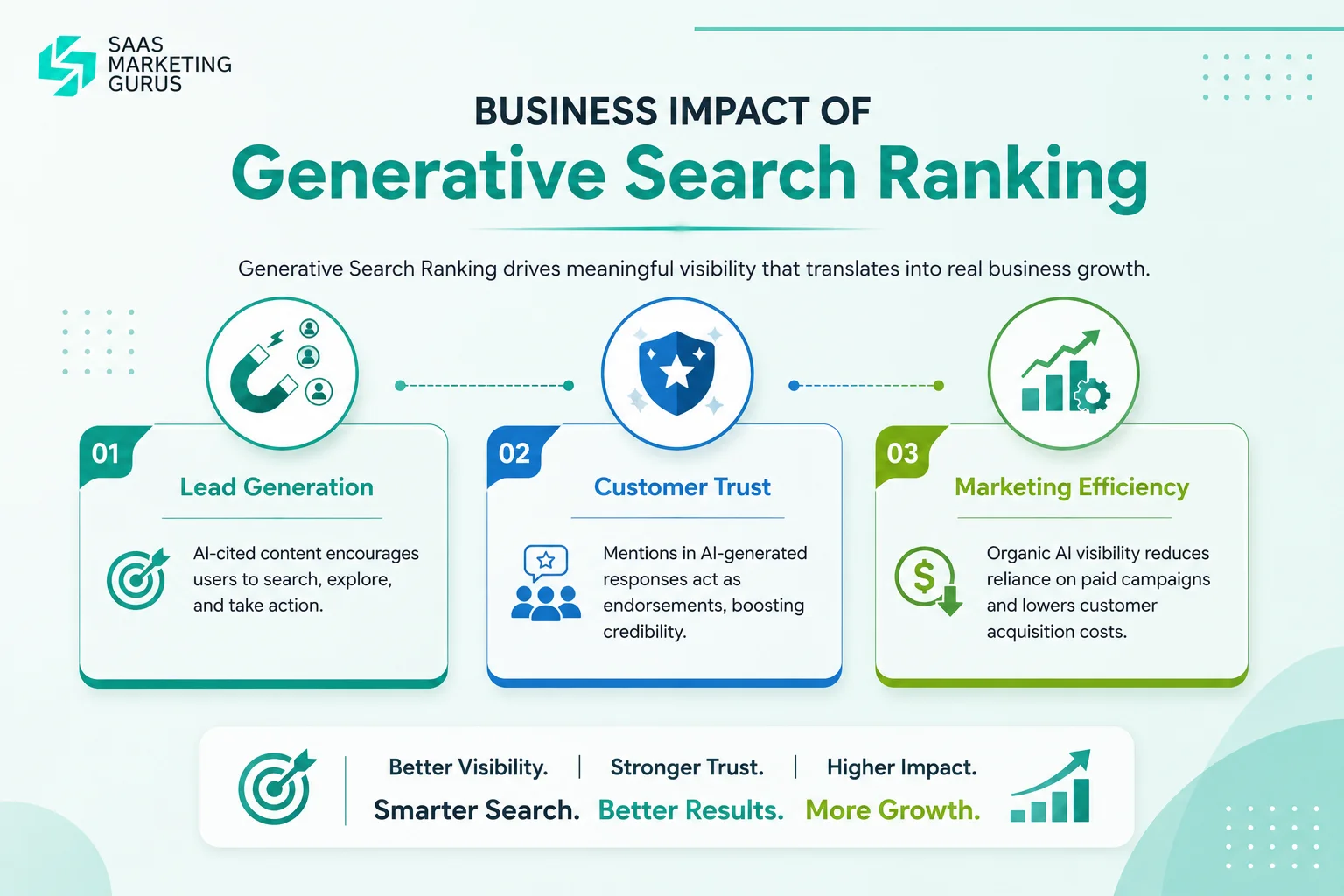
Business Impact of Generative Search Ranking
Improving generative search visibility creates a business benefit no organic ranking chart shows: it protects you from a shrinking click pool. Ahrefs’ December 2025 analysis of 300,000 keywords found AI Overviews now correlate with a 58% lower average click-through rate for the top-ranking page (Ahrefs, 2025). Ranking #1 matters less when fewer people click through at all.
- Increase qualified leads: being cited in AI-generated answers introduces your brand to users actively researching solutions.
- Build trust and credibility: AI references reinforce your brand’s authority during the decision-making process.
- Reduce customer acquisition costs: stronger organic AI visibility can lessen dependence on paid advertising.
- Strengthen brand awareness: consistent citations across AI platforms help more buyers recognize your company and products.
- Support long-term growth: AI-friendly content keeps delivering value as generative search takes a larger share of how people discover information.
Optimizing Content for AI Retrieval
AI-Ready Content Checklist:
- Answer one question per paragraph.
- Include definitions, stats, or mini-case studies.
- Maintain consistent brand/entity references.
- Use structured headings and bullet points.
- Publish across blogs, LinkedIn, YouTube, and forums.
Ready to Improve Your Generative Search Rankings?
Generative search ranking isn’t a traditional SEO checklist with new labels. It rewards content built to be extracted, cited, and trusted by a model, not just crawled and indexed. Start by auditing your highest-traffic pages against the ranking factors above, then rebuild the ones that fail the extraction test.
If you’re ready to put generative search ranking into practice, book a free strategy call with SMG and see how a dedicated SaaS marketing team can build the audit, content, and tracking for you.
FAQs
What is generative search ranking?
Generative search ranking is the process AI search engines use to determine which content should be retrieved, evaluated, and referenced when generating answers. Unlike traditional SEO, it prioritizes semantic relevance, authority, entity recognition, and content quality over keyword rankings alone.
How is generative search different from traditional SEO?
Traditional SEO focuses on ranking web pages in search results, while generative search focuses on selecting trustworthy information to create AI-generated answers. Success is measured by visibility and citations rather than clicks alone.
Which AI search engines use generative search ranking?
Platforms such as ChatGPT, Google AI Overviews, Perplexity, Claude, and Microsoft Copilot use generative AI to retrieve, evaluate, and present information in conversational responses.
How can SaaS companies improve AI visibility?
SaaS companies can improve AI visibility by creating answer-first content, maintaining consistent brand entities, publishing across multiple trusted platforms, adding structured data, and supporting claims with credible sources. Many work with a GEO agency that ranks content in generative search engines full-time rather than building this in-house from scratch.
What are AI ranking signals?
AI ranking signals include semantic relevance, factual accuracy, structured formatting, content freshness, entity consistency, topical authority, and overall trustworthiness.
Does keyword optimization still matter for AI search?
Yes. Keywords remain important, but AI search relies more heavily on semantic relationships, user intent, topical depth, and entity recognition than exact keyword matching.
Why are AI citations important?
AI citations increase brand credibility, improve visibility during research, and expose your business to users even when they do not click through to your website.