
A keyword can bring thousands of visitors and still create little business value if those visitors are only looking for general information. Meanwhile, a smaller search term with strong buying intent can attract users who are actively comparing solutions.
SaaS keyword research helps companies identify the searches behind customer problems, software evaluations, and purchase decisions. Instead of focusing only on traffic, it helps SaaS teams discover opportunities that connect search behavior with business growth.
Based on SaaS Marketing Gurus’ experience helping SaaS brands improve search visibility and content strategies, this guide explains how to find high intent keywords, create content that matches buyer needs, and turn organic search opportunities into measurable outcomes.
What Is SaaS Keyword Research?
SaaS keyword research is the process of finding and evaluating the search terms potential software buyers use to understand problems, research solutions, compare products, and make purchasing decisions. Effective SaaS keyword research goes beyond search volume by evaluating search intent, product fit, business value, and the likelihood that a keyword can support trials, demos, or revenue.
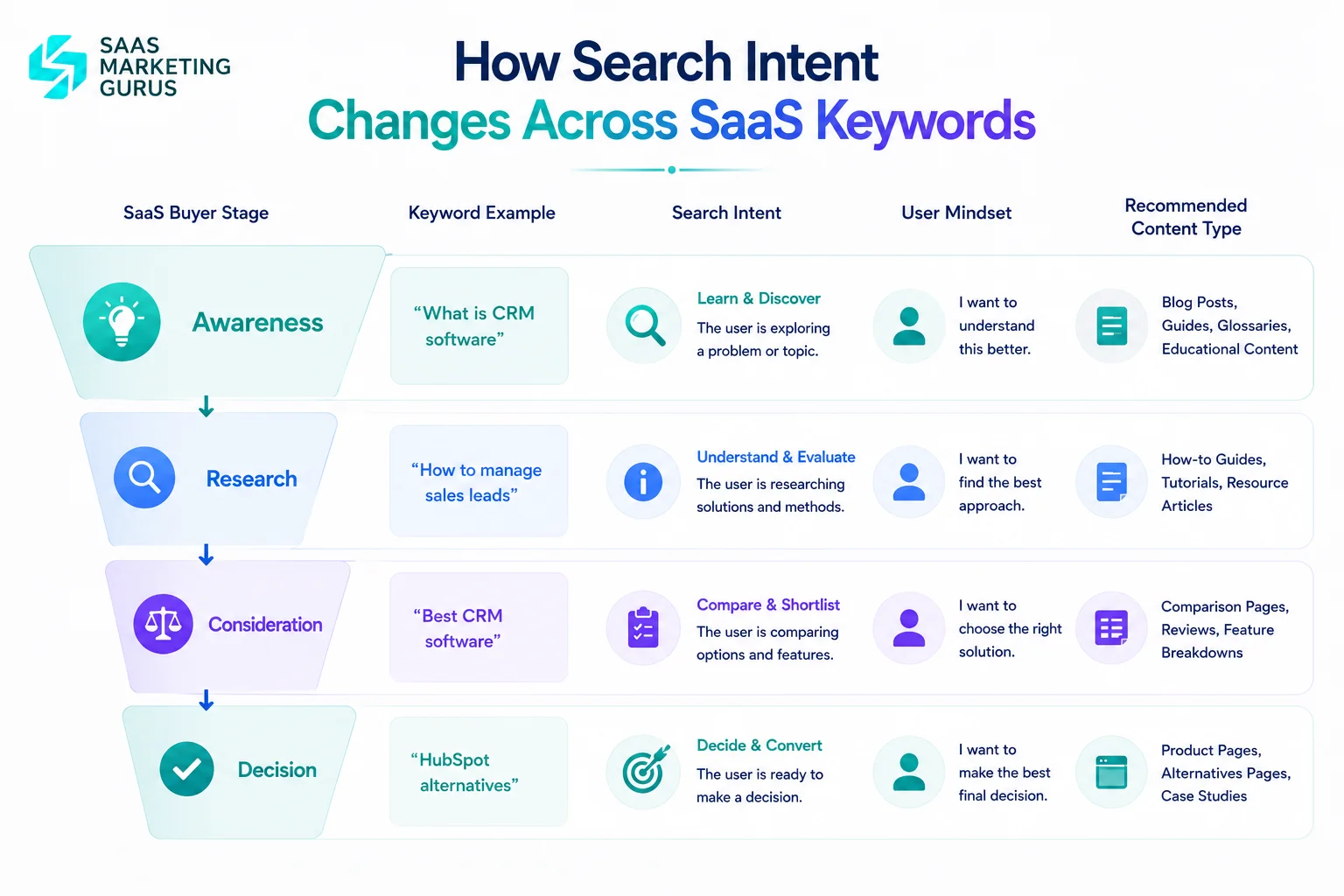
How Search Intent Changes Across SaaS Keywords
SaaS buyers rarely search for software and purchase immediately.
Before choosing a solution, they usually move through four stages:
Problem discovery → Solution research → Product comparison → Purchase decision
Each stage creates different keyword opportunities.
The table below shows how the same SaaS buyer may use different search terms as they move from problem discovery to purchase evaluation.
| Keyword Example | Search Intent | Buyer Stage | Recommended Content |
|---|---|---|---|
| What is project management | Educational | Awareness | Beginner guide |
| How to manage remote teams | Problem research | Early research | Problem solving article |
| Best project management software | Solution comparison | Consideration | Comparison guide |
| Asana alternatives | Product evaluation | Decision | Alternative landing page |
A user searching for information has different needs from a user comparing products. SaaS companies that understand this difference can create content that supports buyers from their first question to their final decision.
Why SaaS Keyword Research Is Different From Traditional SEO
Traditional SEO often focuses on increasing organic traffic.
SaaS companies need to focus on the intent behind every search. A strong SEO for SaaS strategy connects keyword research, content planning, and technical optimization to attract users at different stages of the buying journey.
Software buyers usually research:
- Features
- Pricing
- Integrations
- Reviews
- Competitors
- Use cases
A SaaS buyer may first search:
“How to manage remote teams”
Then move to:
“Best project management software for remote teams”
Finally:
“Asana alternatives for small teams”
Each search shows a different level of buying intent.
The goal is not only ranking for more keywords. The goal is understanding what customers search before they choose a solution.
How to Find High-Intent Keywords for SaaS Companies
Finding valuable keywords requires more than entering a topic into a keyword tool.
A strong process combines:
- Customer research
- Competitor analysis
- Search data
- Product understanding
- Business goals
Step 1: Start With Customer Problems, Not Keyword Tools
The strongest keyword ideas often come from customer conversations.
Before using tools like Ahrefs or Semrush, collect insights from:
- Customer interviews
- Sales conversations
- Support tickets
- G2 and Capterra reviews
- Reddit discussions
- Online communities
These sources reveal the exact language customers use when describing problems.
For example, a marketing automation SaaS company may discover customers saying:
“We spend too much time manually following up with leads.”
This can create keyword opportunities such as:
- Automated lead follow-up software
- Sales automation tools
- CRM workflow automation
Customer language helps SaaS companies create content that matches real search behavior.
Keyword research tools can help validate these ideas by analyzing search demand, related terms, and ranking opportunities:
Step 2: Identify SaaS Keywords Based On Buyer Intent
Different keyword types represent different stages of the buying journey.
The following keyword types represent different levels of buyer intent and can support different content and conversion goals.
| Keyword Type | Example | Intent | Typical Content |
|---|---|---|---|
| Problem-based | How to reduce employee turnover | Informational | Educational guide |
| Category | Employee engagement software | Commercial | Category or product page |
| Feature | CRM with email automation | Commercial | Feature page |
| Use-case | Employee recognition software for remote teams | Commercial | Use-case page |
| Comparison | Salesforce vs. Zoho | Commercial | Comparison page |
| Alternative | HubSpot alternatives | High commercial | Alternative page |
| Pricing | Employee engagement software pricing | Transactional | Pricing page |
| Integration | Salesforce Slack integration | Commercial | Integration page |
High intent keywords often have lower search volume but stronger potential to drive trials, demos, and revenue.
Step 3: Analyze Competitor Keywords And Find Content Gaps
Competitor research helps SaaS companies discover proven search opportunities and identify areas where they can create better content.
Analyze:
- Product pages
- Comparison pages
- Alternative pages
- Feature pages
- Integration pages
Look for:
- Keywords competitors rank for
- Unanswered customer questions
- Missing use cases
- Weak comparison content
Example:
Instead of targeting a broad keyword like:
“Salesforce alternatives”
A CRM company could create:
“Salesforce alternatives for small SaaS teams”
This targets a specific audience with stronger buying intent and clearer search relevance.
The goal is not copying competitors. It is finding gaps where your SaaS brand can provide a more useful answer.
Step 4: Expand and Validate Keyword Opportunities
Once you have keyword ideas from customer research and competitor analysis, expand them into related searches and validate the intent behind each one.
Use:
- Google Search suggestions and related searches
- Google Search Console data
- Ahrefs or Semrush
- Competitor ranking pages
- Reddit, G2, Capterra, and other customer discussions
For each keyword, review the search results before deciding what to create. The SERP can reveal whether users expect:
- An educational guide
- A software category page
- A comparison
- An alternative page
- A feature page
- A pricing page
A keyword is only valuable when the content you create matches what searchers are trying to find.
Step 5: Score Keywords by Business Value
Search volume should be one input in keyword prioritization, not the final decision.
Evaluate each opportunity based on:
- Buyer intent
- Product fit
- Revenue opportunity
- Content advantage
- Search demand
- Ranking difficulty
For example, a broad keyword such as employee recognition software may attract more searches, while employee recognition software for distributed teams may have lower volume but stronger audience relevance and product fit.
The best opportunity depends on the SaaS company’s product, target audience, competitive position, and conversion path.
Step 6: Map Keywords to Content and Conversion Goals
After prioritizing keywords, assign each opportunity to an existing page or a new content asset.
A simple mapping process is:
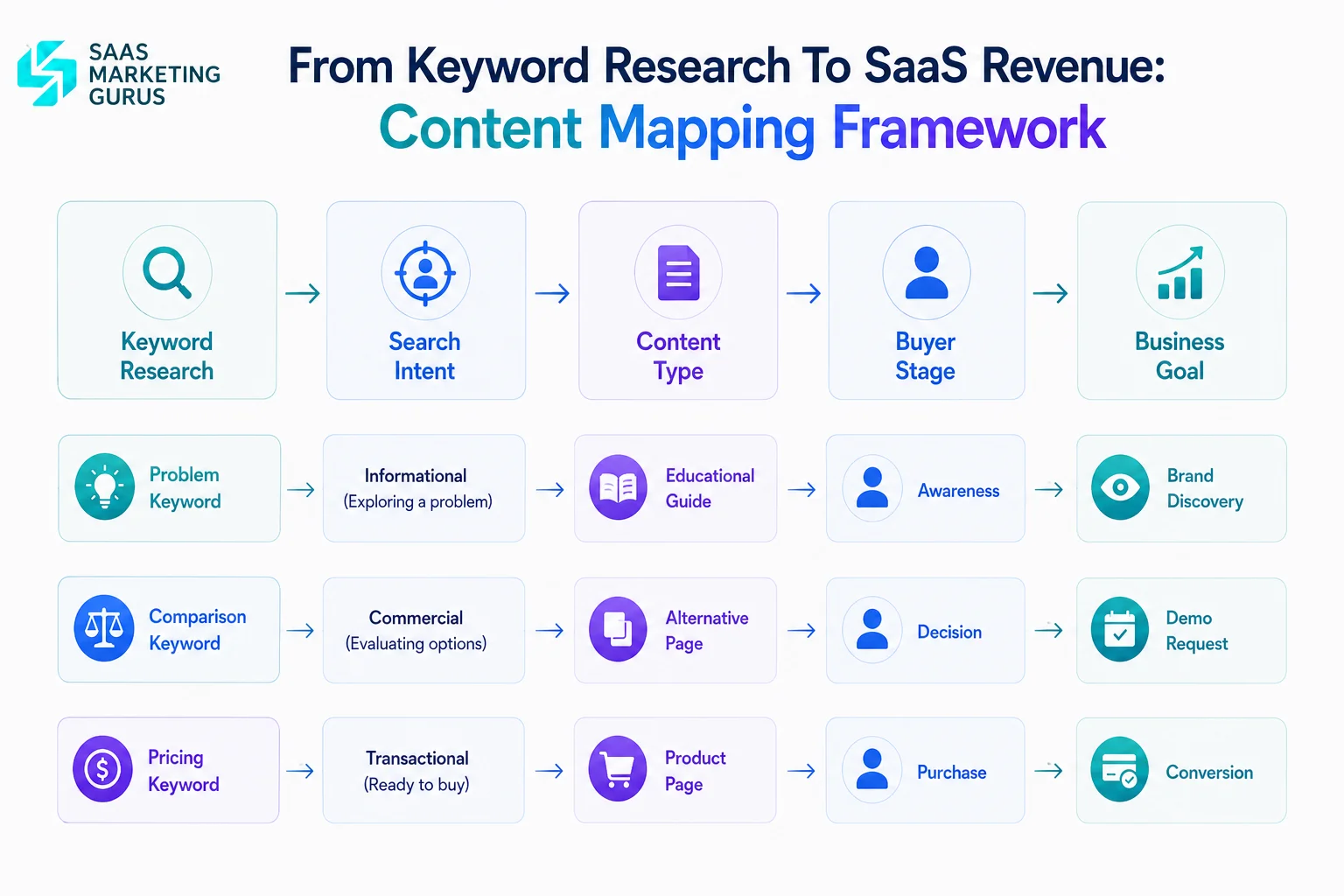
Keyword → Search intent → Page type → Conversion goal
For example:
| Keyword | Intent | Page type | Conversion goal |
|---|---|---|---|
| How to reduce employee turnover | Informational | Educational guide | Newsletter or related resource |
| Employee recognition software | Commercial | Category or service page | Demo |
| Employee recognition software for remote teams | Commercial | Use-case page | Demo or trial |
| Employee recognition software pricing | Transactional | Pricing page | Trial or sales conversation |
This prevents SaaS teams from creating content that ranks for a keyword but has no clear path to a business outcome.
Which Tools Should SaaS Companies Use for Keyword Research?
No single keyword tool provides the complete picture. SaaS teams can combine keyword data with customer research and SERP analysis to understand both search demand and buyer intent.
Different tools reveal different parts of the keyword research process, so SaaS teams should combine search data with customer and SERP research.
| Tool or source | Best use |
|---|---|
| Google Search Console | Find queries your website already receives impressions or clicks for |
| Google Search | Understand SERP intent, related searches, and question patterns |
| Ahrefs | Analyze competitor rankings, keyword gaps, and backlink context |
| Semrush | Discover keyword opportunities, analyze competitors, and organize keyword clusters |
| Find real customer language, problems, and use cases | |
| G2 and Capterra | Identify recurring complaints, feature needs, and comparison language |
The best SaaS keyword research process combines quantitative search data with the language customers use when describing their problems.
The SaaS Marketing Gurus Keyword Opportunity Framework
Finding keywords is simple. Finding the right keywords that attract buyers, influence decisions, and create revenue opportunities is where SaaS teams need a stronger process.
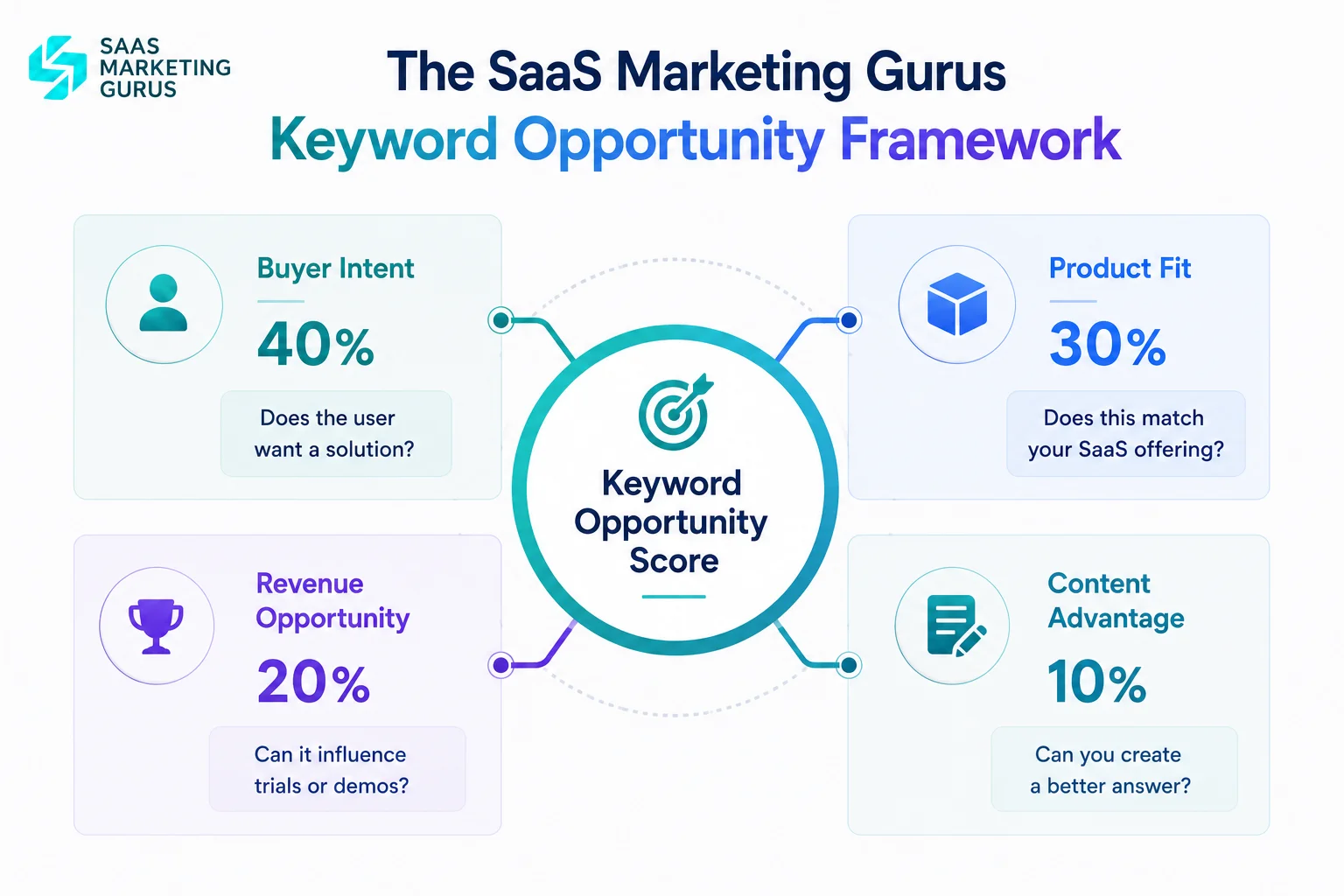
Based on SaaS Marketing Gurus’ experience helping SaaS companies improve search visibility and content performance, we evaluate keyword opportunities using four key signals:
| Signal | What We Evaluate | Example |
|---|---|---|
| Buyer Intent | Does the search show that someone is actively looking for a solution? | Lower intent: “What is CRM”Higher intent: “Best CRM software for startups” |
| Product Fit | Does the keyword match your SaaS product and the problems it solves? | Customer support SaaS → “Customer support automation software” instead of only “What is customer service” |
| Revenue Opportunity | Can this keyword influence trials, demos, or purchase decisions? | Alternatives, comparisons, pricing, reviews, and feature searches often show stronger buying signals |
| Content Advantage | Can your brand provide a more useful answer than existing results? | Better examples, original insights, clear explanations, and real customer experiences |
How to Apply the Keyword Opportunity Framework
For example, imagine a SaaS company that provides employee recognition software.
| Keyword | Buyer Intent | Product Fit | Revenue Opportunity | Content Advantage | Priority |
|---|---|---|---|---|---|
| What is employee recognition? | Low | Medium | Low | Medium | Low |
| Employee recognition software | High | High | High | Medium | High |
| Employee recognition software for remote teams | High | High | High | High | Very High |
The highest-priority keyword is not necessarily the one with the greatest search volume. It is the opportunity where audience intent, product relevance, commercial value, and the ability to create a better result overlap.
The highest-value SaaS keywords are not always the ones with the most searches. They are the ones that connect customer needs with your solution and create a clear path from search to conversion.
Need Help Finding High Intent SaaS Keywords?
SaaS Marketing Gurus helps SaaS companies identify buyer focused searches, create content strategies, and improve organic visibility.
How to Turn SaaS Keywords Into a Content Strategy
Keyword research creates value when it connects with content execution. A SaaS content marketing strategy helps turn these keyword opportunities into educational resources, comparison pages, and conversion-focused content.
A strong SaaS content strategy maps:
Keyword → Search Intent → Content Format → Business Goal
| Buyer Stage | Keyword Type | Example | Content Format |
|---|---|---|---|
| Awareness | Problem keywords | How to improve employee engagement | Educational guide |
| Research | Category keywords | Best employee engagement software | Comparison article |
| Evaluation | Comparison keywords | BambooHR alternatives | Comparison page |
| Decision | Pricing keywords | Employee engagement software pricing | Product page |
How to Build Topic Clusters Around Your SaaS Category
Search engines can better understand a SaaS website when related content covers a topic from multiple useful angles. A topic cluster connects a central category with supporting content about problems, features, use cases, integrations, comparisons, and purchasing decisions.
This structure can also make content easier to discover and interpret across modern search experiences, including AI-powered search. Google states that the same foundational SEO practices remain important for AI features such as AI Overviews and AI Mode, including helpful content, internal linking, accessible text, and structured data that accurately reflects visible content.
Example:
Main topic:
CRM Software
Supporting topics:
- CRM automation
- Sales pipeline management
- CRM integrations
- CRM reporting
- CRM alternatives
- CRM pricing comparison
The goal is not to publish multiple pages simply to cover keywords. Each page should serve a distinct user need and contribute to a broader topic and conversion path.
How SaaS Companies Can Improve Visibility in AI Search
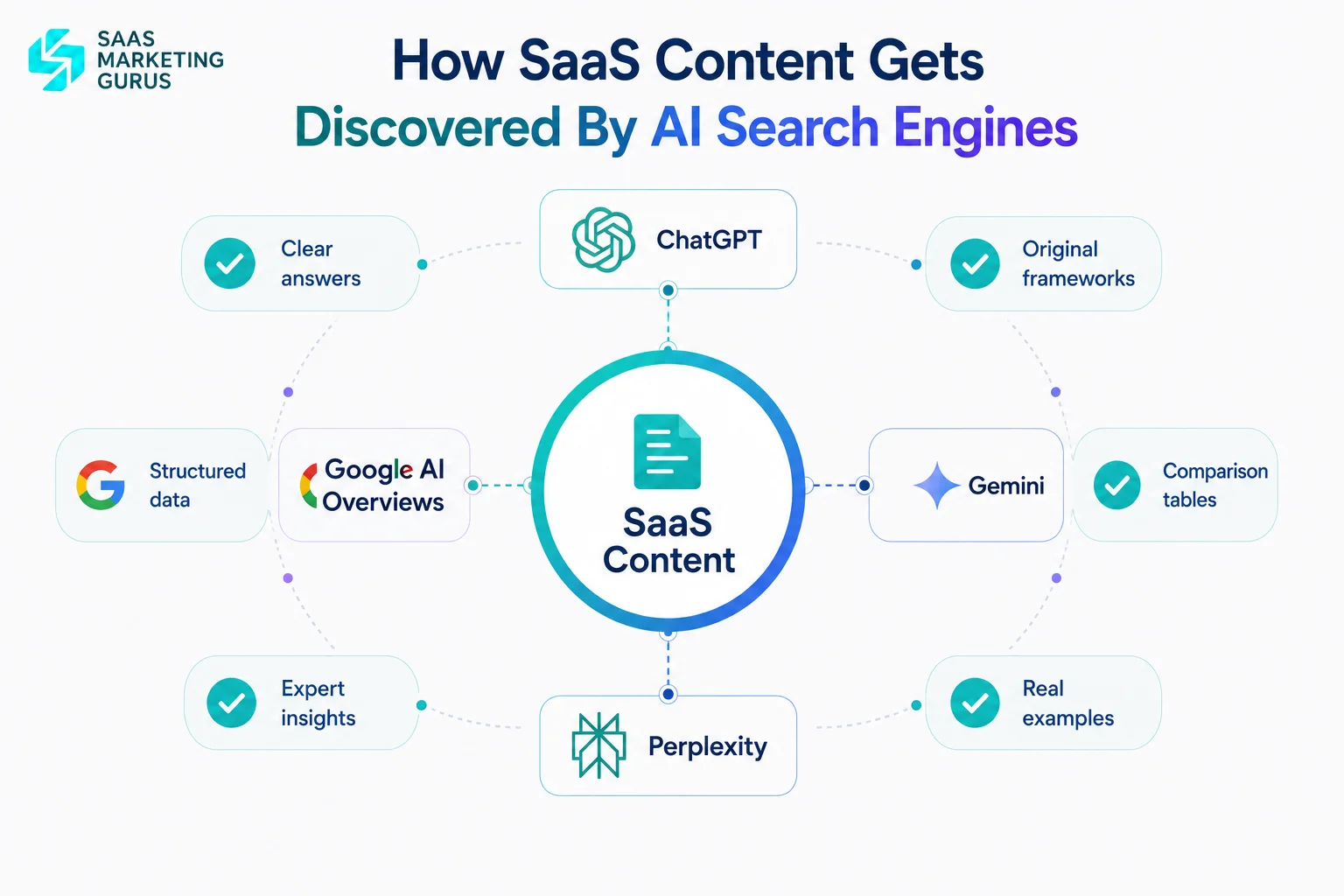
Search is changing. Users are discovering SaaS solutions through traditional search results as well as AI-powered experiences such as Google AI Overviews, ChatGPT, Gemini, and Perplexity.
SaaS companies should not treat AI search as a replacement for SEO fundamentals. The strongest approach is to create useful, well-structured content that clearly answers user questions, demonstrates real expertise, and is easy for search systems to understand.
Google’s guidance for AI features emphasizes the same core principles used in traditional search: helpful, reliable, people-first content, strong technical SEO, internal linking, accessible text, and structured data that accurately represents visible content. There are no additional special technical requirements or special AI schema required for eligibility in AI Overviews or AI Mode.
Read – How to Rank SaaS Content in AI Search
For SaaS content, this means focusing on:
| Content element | Why it matters |
|---|---|
| Clear definitions | Helps readers and search systems understand the topic quickly |
| Direct answers | Satisfies specific questions without unnecessary explanation |
| Structured information | Makes complex topics easier to scan and interpret |
| Original experience | Adds information that is not simply a restatement of existing content |
| Relevant evidence | Supports important claims and strengthens trust |
The goal is not to write for an AI system instead of a person. It is to make useful information clear, specific, and easy to verify.
Want to improve your SaaS visibility across search and AI platforms?
SaaS Marketing Gurus helps brands build content strategies designed for modern search behavior.
How SaaS Marketing Gurus Help BRAVO Improve Organic Growth Through SEO
BRAVO, an employee recognition and rewards platform, partnered with SaaS Marketing Gurus to improve organic visibility and generate qualified leads.
Challenge
BRAVO wanted to increase search visibility and generate more demo requests through organic traffic.
Approach
The strategy focused on:
- High value keyword research
- Content optimization
- Technical SEO improvements
- Keyword clustering
- Strategic content planning
The focus was attracting users searching for employee recognition and employee experience solutions.
Results
BRAVO achieved:
- 30% month over month organic traffic growth
- 1,000+ daily organic visitors
- 20+ weekly demos after three months
Measurement context: Results were measured during the three months following the implementation of the SEO and content strategy. Traffic and demo performance may vary based on the client’s starting visibility, content production, technical SEO, and market conditions.
The campaign also helped BRAVO convert Metro, a company with 10k+ global employees. Check BRAVO SEO case study.
Keyword research works best when it connects customer problems with business outcomes. Ranking for more keywords is not the goal. Attracting the right audience is.
What Are the Most Common SaaS Keyword Research Mistakes?
Choosing Keywords Only by Search Volume
High-volume keywords may attract traffic without attracting qualified buyers.
Evaluate:
- Search intent
- Product fit
- Customer needs
- Conversion potential
- Competitive difficulty
Ignoring Comparison and Alternative Keywords
Many SaaS companies focus only on educational content and miss users actively evaluating solutions.
Look for:
- Product alternatives
- Software comparisons
- Feature comparisons
- Pricing searches
- Use-case searches
Creating Content Without Customer Research
Keyword tools provide search data, but customers reveal the language behind their problems.
Review:
- Sales conversations
- Support tickets
- Customer interviews
- G2 and Capterra reviews
- Relevant Reddit discussions
Publishing Content Without a Conversion Path
A strong journey looks like:
Educational content → Comparison content → Product or service page → Demo or trial
Each page does not need to push the same CTA. The conversion path should match the user’s level of intent.
How Should SaaS Companies Measure Keyword Research Success?
Rankings and traffic matter, but SaaS companies should also measure whether organic search attracts the right audience and contributes to business outcomes.
| Metric | What it shows |
|---|---|
| Organic impressions | Whether content is gaining search visibility |
| Organic clicks | Whether searchers are choosing the result |
| Keyword rankings | Whether target opportunities are improving |
| Qualified organic traffic | Whether the audience matches the ICP |
| Demo requests | Whether content generates buyer interest |
| Trial signups | Whether users take a product action |
| Pipeline influenced by SEO | Whether organic search contributes to revenue |
The right measurement model depends on the SaaS business model and sales cycle. A high-volume informational page may contribute to awareness, while a lower-volume comparison or pricing page may generate more direct conversion opportunities.
SaaS Keyword Research Checklist
- Understand customer problems
- Research customer language
- Find seed keywords
- Expand keyword opportunities
- Analyze search intent
- Review the current SERP
- Identify high-intent keywords
- Evaluate product fit
- Analyze competitor keyword gaps
- Check ranking difficulty
- Map keywords to buyer stages
- Group related keywords into clusters
- Map keywords to existing or new pages
- Build comparison and alternative content where relevant
- Create topic clusters
- Add a clear conversion path
- Optimize content for helpful, accessible search experiences
- Track rankings, qualified traffic, trials, demos, and pipeline
FAQs
What Is SaaS Keyword Research?
SaaS keyword research is the process of finding and evaluating the search terms potential software buyers use to research problems, discover solutions, compare products, and make purchasing decisions. It focuses on search intent, product fit, and business value—not just search volume.
How Do SaaS Companies Find High-Intent Keywords?
SaaS companies can find high-intent keywords by researching customer problems, analyzing sales and support conversations, reviewing competitor keywords, studying search results, and using tools such as Google Search Console, Ahrefs, and Semrush. The best opportunities usually combine strong buyer intent with clear product relevance.
What Are the Best Types of Keywords for SaaS Companies?
The most valuable SaaS keywords typically include problem-based, category, feature, comparison, alternative, and pricing keywords. Their value depends on the searcher’s intent and how closely the keyword matches the SaaS product and its target audience.
How Do You Do Competitor Keyword Research for SaaS?
Analyze competitor product, feature, comparison, alternative, and integration pages to identify the keywords they rank for. Then compare those opportunities with customer questions, product capabilities, and content gaps to find keywords your SaaS brand can target with a more useful result.
How Can SaaS Companies Improve Visibility in AI Search?
SaaS companies can improve content for AI-powered search by providing clear answers, covering topics thoroughly, using structured content, adding relevant internal links, demonstrating first-hand expertise, and supporting important claims with reliable sources. Strong SEO fundamentals remain important for both traditional and AI-powered search.
How Should SaaS Companies Measure Keyword Research Success?
SaaS companies should measure more than rankings and organic traffic. Important metrics include qualified organic traffic, keyword visibility, demo requests, trial signups, conversion rates, and pipeline influenced by organic search. The goal is to connect keyword opportunities with measurable business outcomes.
Turn Search Intent Into Your Next SaaS Growth Opportunity
The best SaaS keyword strategy is not about chasing the biggest search volumes. It is about understanding what your customers need, answering their questions, and creating content that moves them closer to a decision.
SaaS Marketing Gurus helps SaaS companies uncover high value search opportunities, build intent-driven content strategies, and turn organic visibility into qualified growth opportunities.
Ready to find the keywords your competitors are missing? Partner with SaaS Marketing Gurus to build an intent-driven SaaS keyword strategy that attracts the right audience and supports measurable growth.