SEO for technology companies works when it gets the right buyer to the right page while they are evaluating vendors. That takes three things, in order: a site Google can crawl and render, page types that match buyer intent, and measurement tied to demos and pipeline instead of rankings.
Generic SEO skips most of this. It chases search volume, publishes more blog posts and reports traffic, while the product, integration and comparison pages buyers actually need stay thin or buried.
This guide from SaaS Marketing Gurus (SMG), a B2B SaaS marketing agency specializing in Reddit marketing, Quora marketing, Generative Engine Optimization (GEO), SaaS SEO and Product Hunt launches, covers the technical fixes, the intent-to-page map, the AI search layer, a 90-day roadmap and the metrics that prove it worked.
What Is SEO for Technology Companies?
SEO for technology companies is the practice of making SaaS, software, developer tool and IT services websites visible for the searches buyers run while they assess fit and compare vendors. It differs from general B2B SEO in three ways: more complex site architecture, more technical buyers, and longer, committee-driven sales cycles.
A technology buyer rarely converts from a single article. They check integrations, security answers, pricing logic and alternatives, often across several visits and several people. Your site needs a page for each of those checks.
| Factor | Generic SEO | SEO for technology companies |
|---|---|---|
| Keyword target | High-volume informational terms | Evaluation queries: integrations, alternatives, use cases, security |
| Main page type | Blog post | Product, integration, comparison and solution pages, supported by the blog |
| Biggest site risk | Thin content | JavaScript rendering, app and docs subdomains, duplicate URLs |
| Success metric | Sessions and rankings | Demo requests, trials and pipeline by page type |
If you need the broader B2B foundation first, our B2B search engine optimization guide covers it. This article focuses on what changes when the product itself is technical.
Why Does Generic SEO Fail Technology Companies?
Generic SEO fails technology companies because it optimizes for traffic volume, not for the queries buyers run when they compare products. A site can rank for “what is endpoint monitoring” and still be invisible for “endpoint monitoring for healthcare,” “[your tool] vs [competitor]” or “[your tool] Okta integration.”
At SMG, we treat comparisons, alternatives and integrations as the priority searches, because buyers run them right before they book a demo. Rankings on broad terms rarely convert unless those evaluation pages exist and are easy to reach.
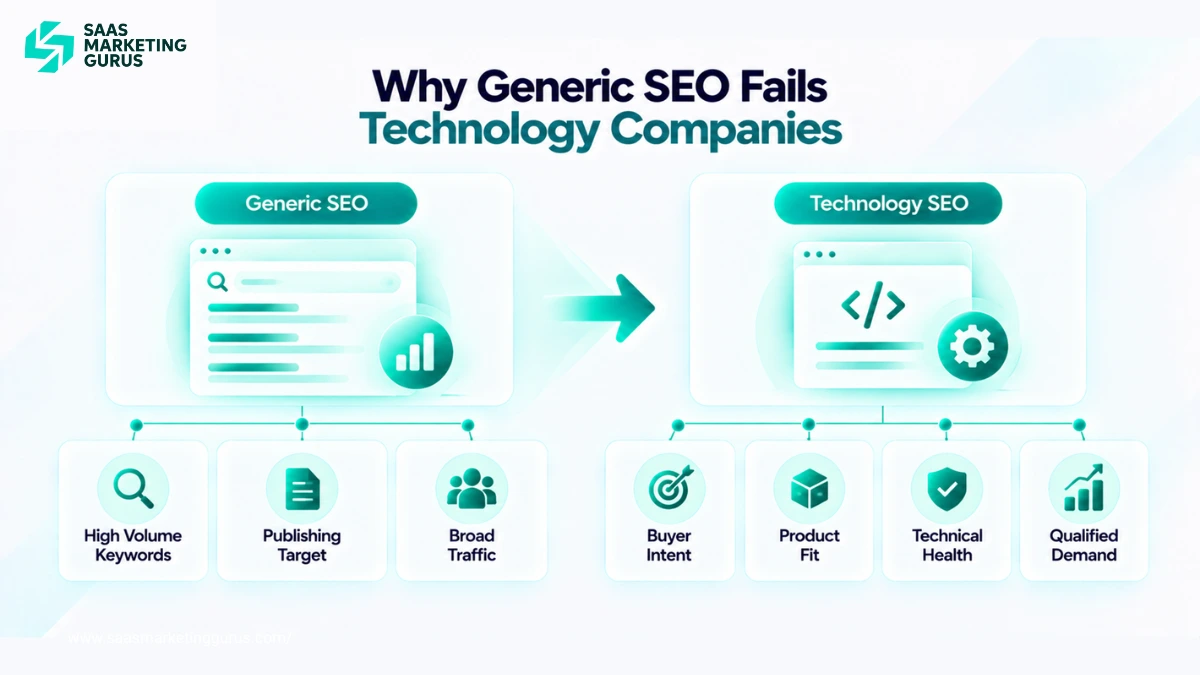
Take an illustrative example. A cybersecurity SaaS company publishes a strong article on endpoint monitoring, but the article never links to the product, integration or comparison pages. The buyer learns something, then leaves to evaluate vendors elsewhere.
Use this three-question check when a technology site ranks but books few demos:
- Where are the impressions? In Google Search Console, find pages with impressions but positions beyond page one.
- Does the page type match the stage? A comparison query needs a comparison page, not a blog post.
- Is there a path to a demo? Every evaluation page needs a clear, relevant next step.
If the answer to question 2 or 3 is “no,” publishing more articles will not fix the problem.
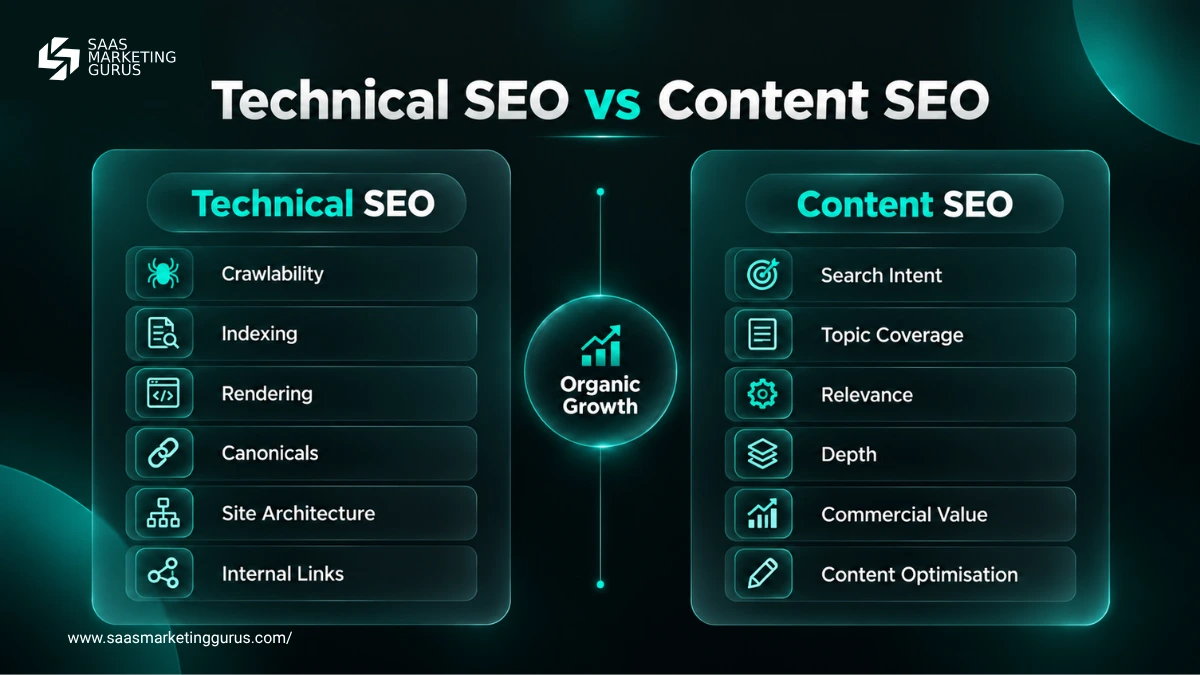
Which Technical SEO Issues Should Technology Companies Fix First?
Technology companies should fix indexability and rendering first, because content and links cannot help a page Google cannot see. JavaScript frameworks, app and documentation subdomains, and parameter URLs cause most of these problems on software sites.
Google processes JavaScript pages in three phases: crawling, rendering and indexing. According to Google Search Central’s JavaScript SEO documentation (2026), pages can wait in a render queue, Google only follows links built as real anchor elements with an href, and server-side or pre-rendering is still recommended.
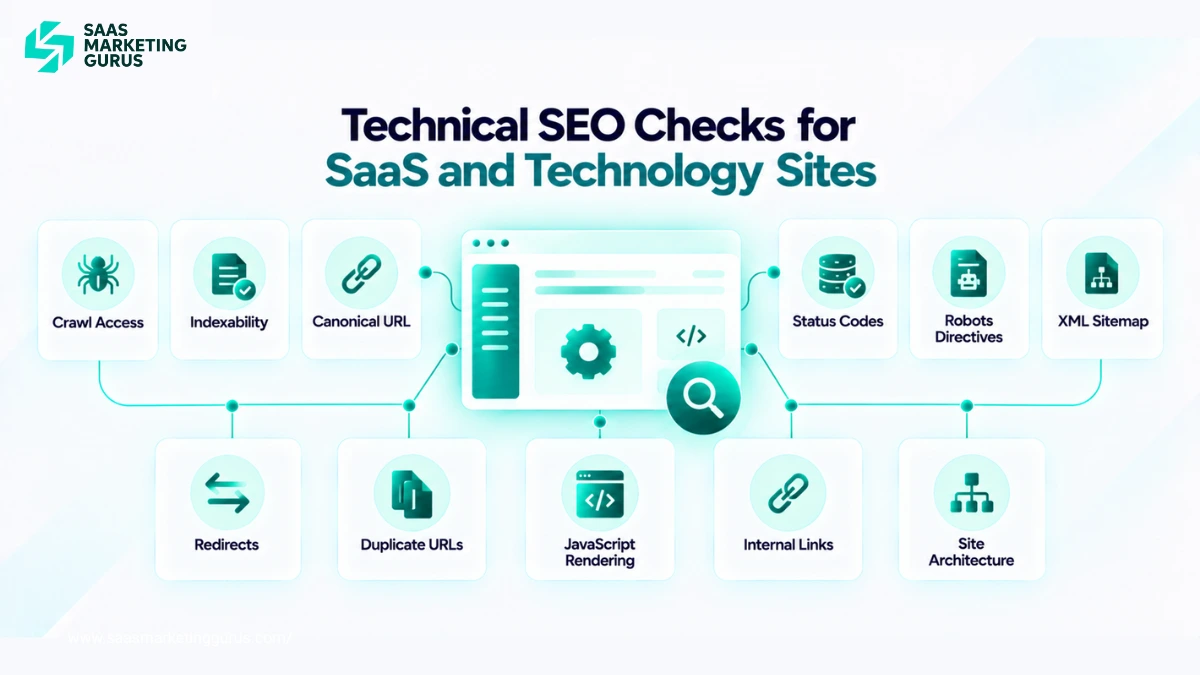
Canonical tags need the same care. Google’s canonicalization guidance (2026) states that a canonical preference is a hint, not a rule, so conflicting signals from redirects, sitemaps and tags can lead Google to pick a different URL.
| Common technology-site pattern | Risk | Fix |
|---|---|---|
| Marketing site built as a single-page app | Content and links load only after JavaScript runs | Server-side render or pre-render; use the History API and real links, not hash routes |
| app., docs. and status. subdomains | Login screens and old docs versions get crawled or indexed | Return 401 for logged-in areas; canonicalize docs to the current version |
| Filter, sort and UTM parameters | Duplicate URLs split signals | Canonical to the clean URL; list only canonical URLs in the sitemap |
| Canonical tags injected by JavaScript | Multiple or conflicting canonicals | Set one rel=”canonical” in the HTML and keep it consistent |
| Commercial pages four or more clicks deep | Weak internal signals and poor discovery | Link them from navigation, solution hubs and relevant posts |
To confirm a fix, run the URL Inspection tool in Search Console and check the rendered HTML, not just the source. For a full checklist, use our B2B SEO audit for SaaS.
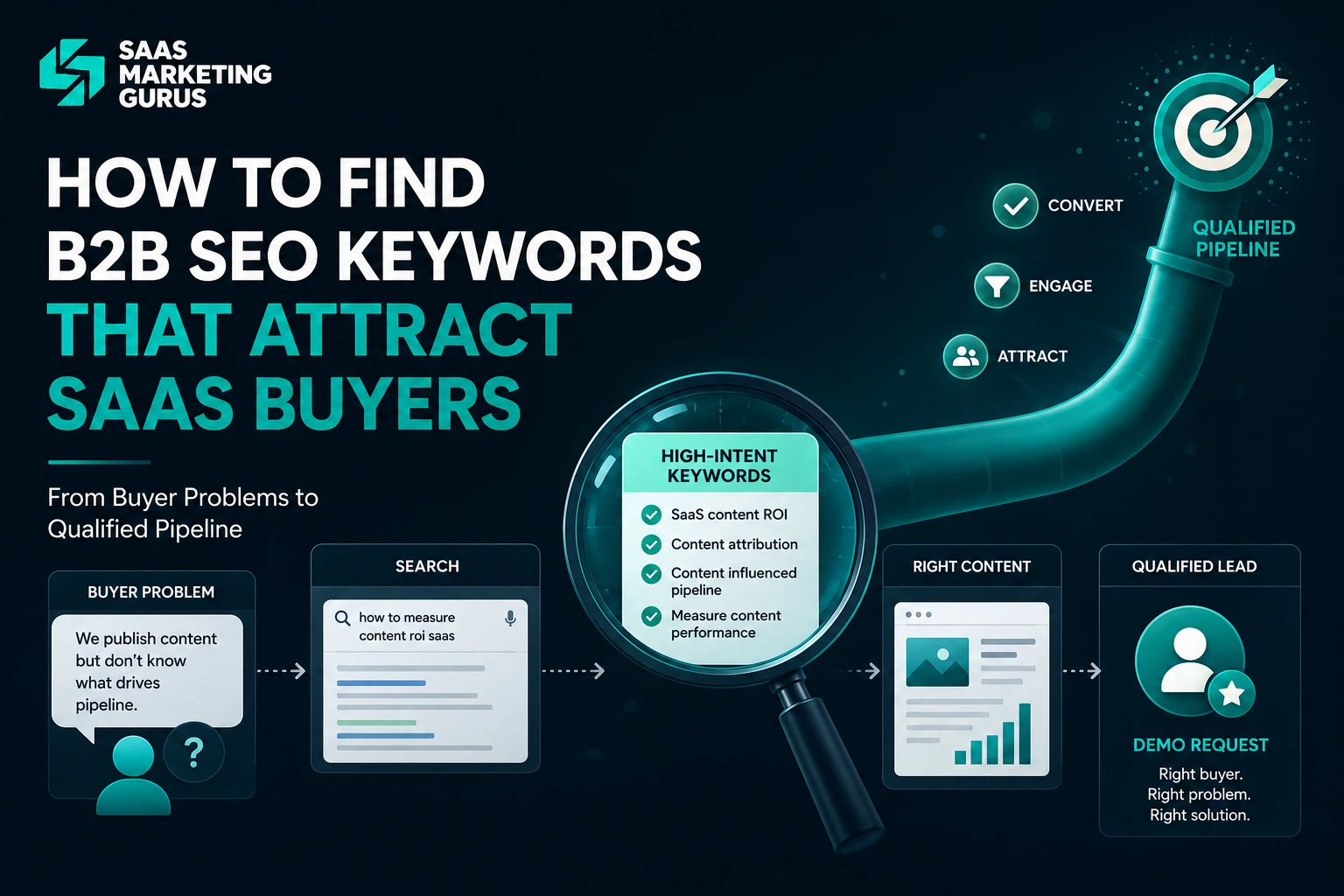
How Should Technology Companies Match Buyer Intent to Page Types?
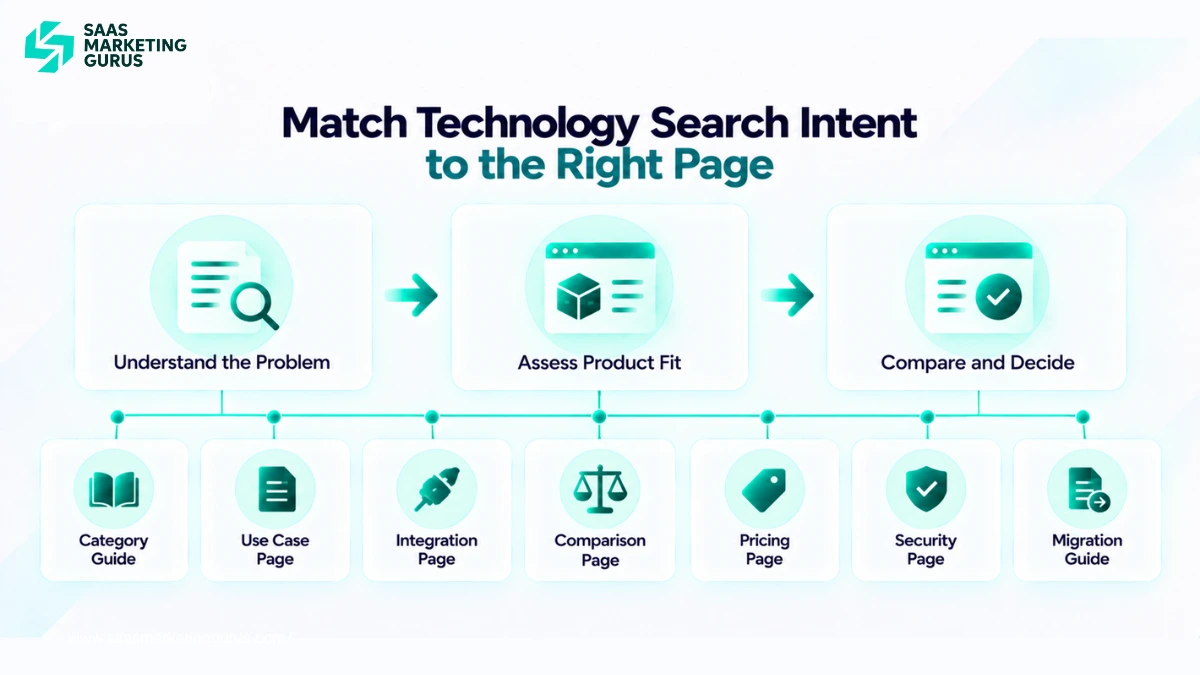
Technology companies should give every major buyer intent its own page type, then connect those pages with internal links. Forcing comparison, integration and pricing queries into blog posts creates weak intent matches that rarely rank or convert.
| Query pattern | Buyer stage | Page type | Proof the page needs | Measure |
|---|---|---|---|---|
| “what is [category]”, “[problem] causes” | Learning | Guide or explainer | Clear definition and examples | Visits to commercial pages |
| “[category] for [industry]”, “[use case] software” | Assessing fit | Use case or industry page | Workflow and customer example | Demo requests |
| “[tool] [other tool] integration” | Assessing fit | Integration page | Setup steps, data synced, limits | Demo or trial starts |
| “[competitor] alternatives”, “[A] vs [B]” | Narrowing options | Comparison page | Fair criteria table and who each option fits | Demo requests, win rate |
| “[tool] pricing”, “SOC 2”, “SSO”, “migrate from [tool]” | Validating | Pricing, security or migration page | Plans, certifications, migration steps | Sales-qualified leads |
Two rules keep this map clean. First, one intent gets one URL: if two pages target the same query, merge them and 301 the weaker one. Second, every guide links forward to the evaluation page that matches its topic.
For prioritization, SMG uses its CLARITY framework: Customer Problem, Level of Intent, Alignment With SERP, Revenue Potential, Independent Page Value, Topic Connection and Yield Measurement. Our AI keyword clustering guide explains how it scores each topic, and our SaaS keyword research guide shows how to build the keyword list behind it.
How Does AI Search Change SEO for Technology Companies?
AI search moves part of vendor evaluation into assistants such as ChatGPT, Perplexity and Google AI Overviews, so technology companies need pages those systems can quote and third-party mentions that confirm them. Traditional SEO still matters, because AI answers draw on content that is crawlable, clear and consistent.
The shift is already large. Forrester (2026) reports that 94% of business buyers in its 2025 Buyers’ Journey Survey used AI in the buying process, and twice as many named generative AI or conversational search as more meaningful than any other information source.
Buyers still verify. A Gartner survey (2026) of 645 B2B buyers, run in August and September 2025, found they used an average of seven information sources, 45% used GenAI mainly to research vendors and products, and 69% prefer to validate AI-generated insights with sales reps.
For a technology company, that means three practical changes:
- Answer first. Open each product, integration and comparison section with a two-sentence answer an AI system can lift intact.
- Keep facts consistent. Pricing model, integrations and certifications should match across your site, review platforms and partner listings.
- Show up where buyers discuss tools. Reddit and Quora threads rank in Google and feed AI answers.
SMG’s community work shows the effect: a Series A FinTech CRM client reached 20+ qualified demo bookings per week through targeted “alternative to” threads, as documented on our Reddit marketing service page. Our answer engine optimization guide for SaaS covers the on-page side.
How Do You Build a 90-Day SEO Roadmap for a Technology Company?
A technology SEO roadmap should run in three phases: diagnose and fix blockers, build the missing evaluation pages, then expand coverage based on conversion data. Skipping the first phase wastes the work done in the next two.
- Days 1 to 30: diagnose. Crawl the site, compare source and rendered HTML, review Search Console indexing, list every commercial page, and confirm demo and trial events reach GA4 and your CRM.
- Days 31 to 60: build. Map queries to page types, merge overlapping pages with 301 redirects, create or upgrade the three to five evaluation pages with the clearest buyer demand, and link the blog to them.
- Days 61 to 90: expand. Add integration and use case pages, refresh aging posts, check how AI assistants describe your product, and compare conversion rates by page type.
Pick tools to match the phase, not the other way around. Our best SaaS SEO software comparison covers the minimum stack. Rankings on competitive commercial terms usually take longer than 90 days; the roadmap sets up the pages and tracking that make those gains measurable.
How Should Technology Companies Measure SEO Success?
Technology companies should measure SEO by qualified organic pipeline per page type, with rankings and traffic as supporting signals. Search Console shows queries, impressions and indexing; analytics shows behavior; your CRM shows whether organic visitors become opportunities.
Track three layers:
- Visibility: impressions and non-branded clicks on evaluation queries, and the share of commercial pages indexed.
- Conversion: demo requests and trial starts by landing page type.
- Revenue: sales-qualified leads, pipeline and win rate sourced from organic search.
If analytics reports zero key events, fix tracking before judging the SEO program. For proof of what this approach can produce, SMG reports a 400% SEO ROI for a DevOps tooling company through its SaaS SEO services.
Conclusion
SEO for technology companies comes down to one sequence: make the site renderable, give each buyer intent the right page, and judge the program on pipeline. AI search adds a layer on top, but it rewards the same clear, consistent pages.
Your next move depends on where the site stands. If crawl or rendering issues exist, fix them first. If the site is healthy but ranks mainly for broad topics, build comparison, integration and use case pages before publishing another article.
Start this week: export 90 days of Search Console queries, tag each by buyer stage, and list the stages with no matching page. Success looks like rising demo requests from evaluation pages; review it at day 90.
If you want a team to build and run that plan with you, book a free strategy call with SMG and we will map your highest-intent page gaps first.
Frequently Asked Questions
How long does SEO take to work for a technology company?
SEO for a technology company has no fixed timeline, because results depend on domain authority, competition and technical health. Indexing fixes can show in Search Console within weeks. Rankings for competitive commercial terms usually take several months. Judge progress by demo requests from evaluation pages, not by early traffic alone.
Should a SaaS company target top-of-funnel or bottom-of-funnel keywords first?
Most SaaS companies should start with bottom-of-funnel keywords such as comparisons, alternatives, integrations and pricing, because buyers searching them are already evaluating vendors. Top-of-funnel guides still help, but they work best when they link forward to those evaluation pages. Build the commercial pages first, then expand educational content around them.
Is technical SEO different for JavaScript-heavy SaaS websites?
Technical SEO for JavaScript-heavy SaaS websites adds a rendering step, because Google must execute JavaScript before it sees some content and links. Use server-side rendering or pre-rendering, real anchor links instead of hash routes, and one canonical tag set in HTML. Check rendered HTML with Search Console’s URL Inspection tool.
Should software documentation be indexed by Google?
Public product documentation should usually be indexed, because developers search for setup steps, API references and error messages during evaluation. Keep only the current version indexable, canonicalize older versions to it, and link docs pages to relevant product and integration pages. Logged-in app areas should return a 401 status instead.
How is SEO for technology companies different from general B2B SEO?
SEO for technology companies adds technical site risks and more evaluation page types than general B2B SEO. Software sites often run on JavaScript frameworks with app and docs subdomains, and buyers expect integration, security, comparison and migration pages. General B2B SEO usually centers on service pages and thought leadership content.
Do technology companies need GEO as well as SEO?
Technology companies benefit from Generative Engine Optimization (GEO) alongside SEO, because many buyers now research vendors in AI assistants before visiting websites. GEO builds on SEO rather than replacing it: answer-first pages, consistent product facts across the web, and credible third-party mentions help both rankings and AI answers.