Discover what SaaS SEO services include and how working with an SEO company for SaaS can boost your search engine visibility. Learn strategies, benefits, and FAQs.
SaaS SEO services are the keyword research, technical fixes, page production, link acquisition and conversion work that turns search demand into demos for a software company. Most providers sell them as a monthly retainer, and the price depends on your category’s competition, your site size, the content you need and the technical work in the way.
This guide explains what the services include, how to measure them, what they cost and how to choose a provider. SaaS Marketing Gurus (SMG), a B2B SaaS marketing agency specializing in Reddit marketing, Quora marketing, Generative Engine Optimization (GEO), SaaS SEO, and Product Hunt launches, wrote it for SaaS founders who have paid for traffic reports and still lack pipeline. If you want SMG to run it for you, see the SaaS SEO service.
Key Takeaways
- SaaS SEO targets buyers, not visitors. Each buyer stage needs a different page: education, category, comparison, product.
- A retainer should name its deliverables. Keyword research, technical fixes, pages, links and reporting, with counts per month.
- Scope sets the price. Competition, site size, content volume and technical debt move a quote. A traffic target does not.
- Judge return on demos and pipeline. Payback needs your close rate, deal size and margin.
- No honest provider guarantees a ranking or a date.
What Are SaaS SEO Services?
SaaS SEO services are specialized SEO strategies designed for software companies to improve organic visibility, attract qualified buyers, and generate business growth through search.
A successful SaaS SEO program focuses on connecting search intent with the customer journey, helping users discover, evaluate, and choose software solutions.
Why Is SaaS SEO Different From Traditional SEO?
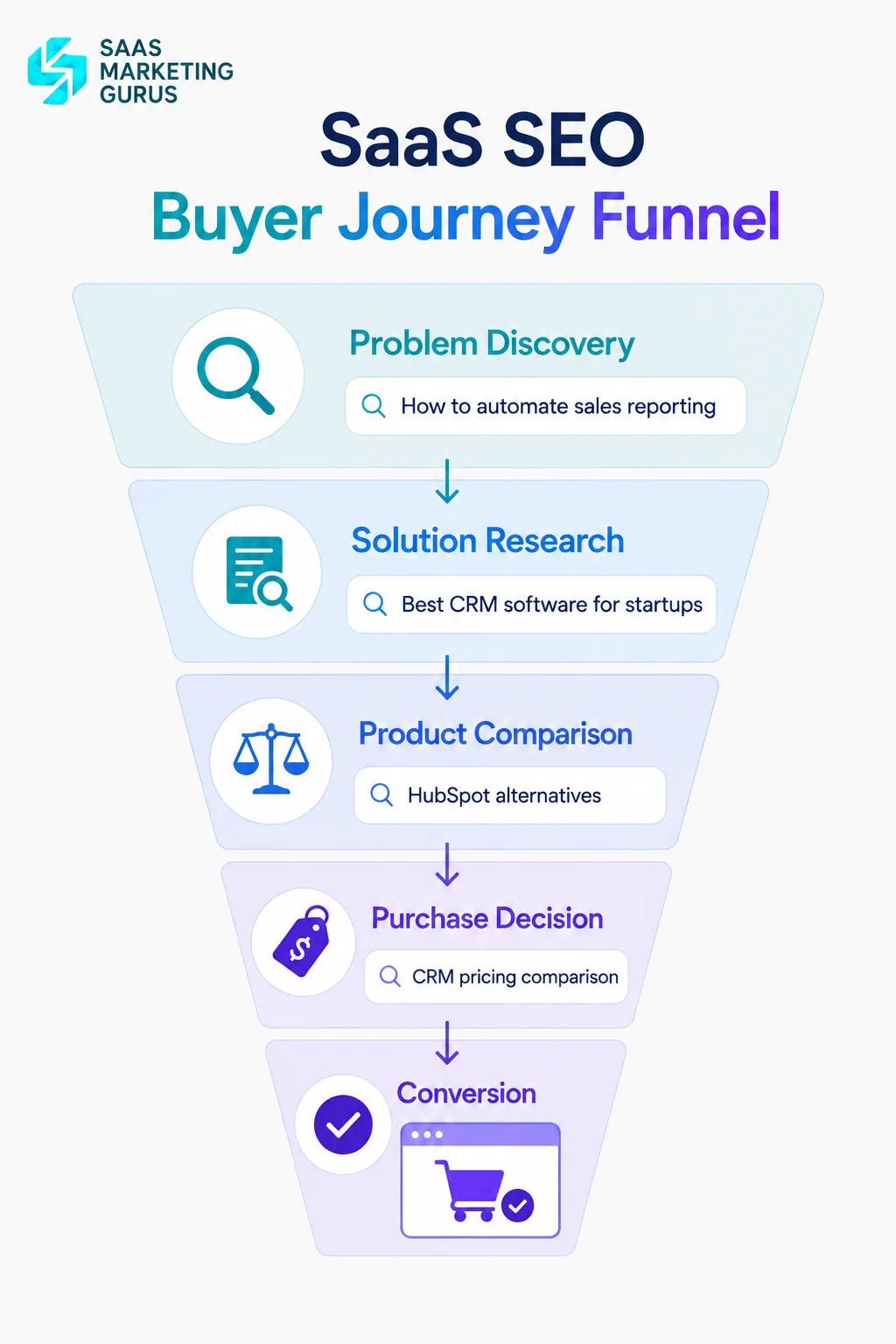
SaaS buyers rarely purchase after a single search. They compare products, research alternatives, evaluate features, and look for proof before making a decision.
A SaaS SEO strategy should support every stage of this journey.
| Buyer Stage | Search Example | Best SEO Asset |
|---|---|---|
| Problem discovery | How to automate sales reporting | Educational content |
| Solution research | Best CRM software for startups | Category pages |
| Product comparison | HubSpot alternatives | Comparison pages |
| Purchase decision | CRM pricing comparison | Product pages |
The goal is not only to attract visitors. It is to attract the right users at the right stage.
What Do SaaS SEO Services Include?
A complete SaaS SEO service combines technical optimization, content strategy, product-focused pages, and authority building.
SaaS Keyword Research Based on Buyer Intent
The best SaaS keywords are not always the ones with the highest search volume. They are the ones connected to customer problems and buying decisions.
Examples:
- Best customer support software for startups
- Salesforce alternatives
- Marketing automation tools comparison
- HR software for growing companies
Effective SaaS keyword research helps companies find searches where potential customers are actively evaluating solutions.
Learn more about building a focused keyword strategy through SaaS keyword research.
Product-Led SEO for SaaS Growth
Many SaaS companies create educational content but ignore pages that directly influence conversions.
High-value SaaS SEO assets include:
- Alternative pages
- Comparison pages
- Integration pages
- Feature pages
- Industry solution pages
For example, a CRM company should not only target “what is CRM.” It should also create pages around “CRM software for startups” and “CRM alternatives for small businesses.”
These pages capture users who are already closer to choosing a solution.
Technical SEO for SaaS Websites
Technical SEO helps search engines crawl, understand, and index important SaaS pages correctly.
A SaaS technical SEO review should check:
- Crawlability and indexation
- Site architecture
- Internal linking
- Canonical tags
- XML sitemaps
- Core Web Vitals
- Duplicate or low value pages
- JavaScript rendering issues
Technical problems become especially important as SaaS websites expand through integrations, comparison pages, product features, resources, and programmatic pages.
Authority Building and SaaS Link Acquisition
Strong content still needs authority to compete in difficult SaaS markets.
Authority building can include:
- Relevant industry backlinks
- Digital PR
- Partner and integration links
- Original research
- Expert contributions
- Product mentions on trusted websites
The goal should not be generating the highest number of links. SaaS companies should earn relevant links and mentions from sources that strengthen topical authority and brand trust.
Conversion Optimization for SaaS SEO
Organic traffic creates more value when visitors take meaningful actions after reaching the website. SaaS SEO should guide users toward demo requests, free trials, pricing pages, product exploration, or other conversion points based on their stage in the buying journey.
This can include improving calls to action, page structure, internal links, product messaging, and conversion paths so qualified search traffic has a clear next step.
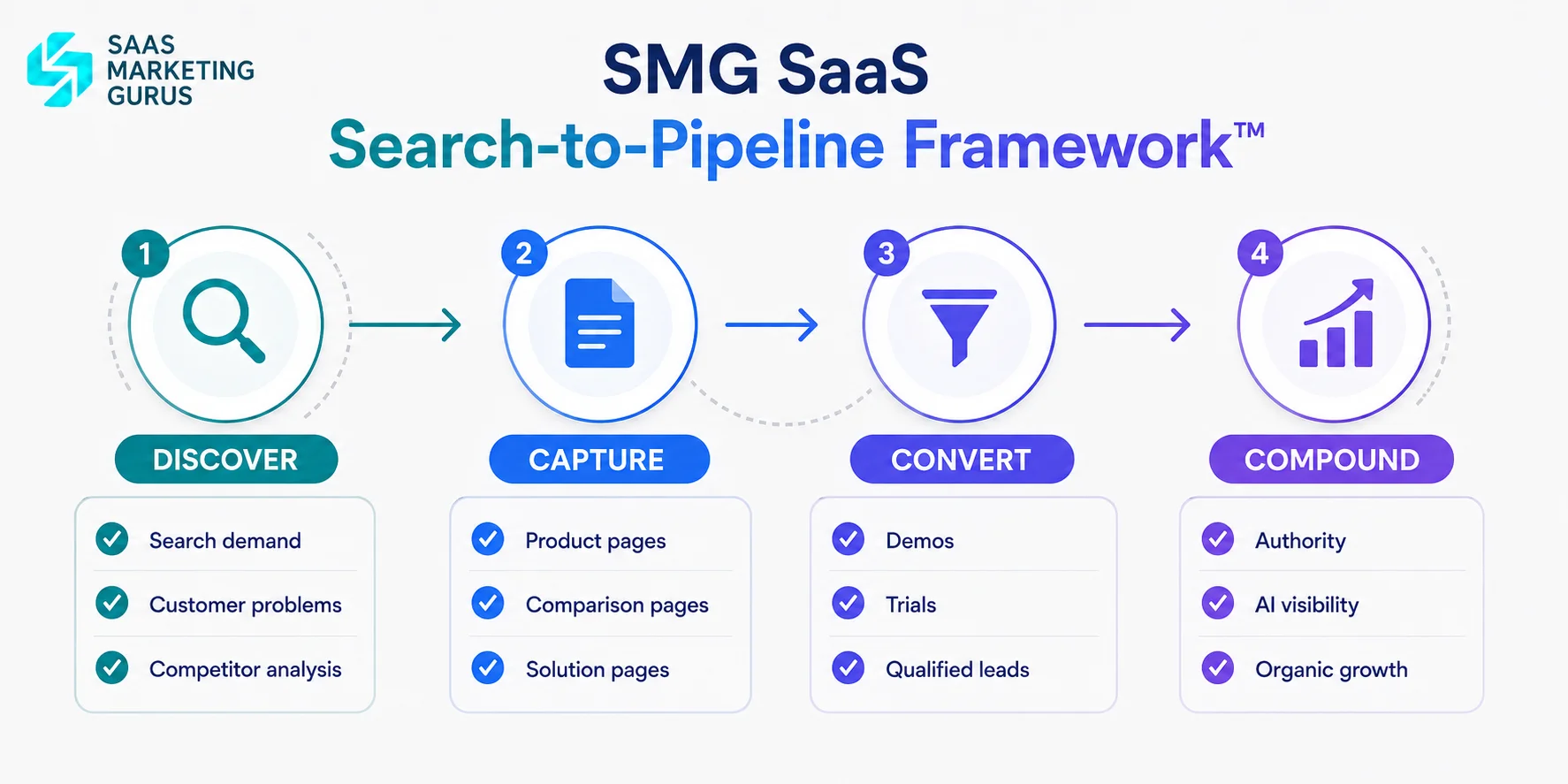
The SMG SaaS Search-to-Pipeline Framework
The SMG SaaS Search-to-Pipeline Framework
At SaaS Marketing Gurus, we run SaaS SEO through four growth stages: Discover, Capture, Convert and Compound. Each stage answers a different question about where your search growth is stuck.
| Stage | What it covers | What it tells you |
|---|---|---|
| Discover | Customer problems, search demand, competitor opportunities and content gaps | Where your buyers already search |
| Capture | Comparison, solution, product and use case pages built for high-intent searches | Which pages should exist to meet that demand |
| Convert | Demo requests, trial signups, qualified leads and pipeline contribution | Whether search traffic becomes revenue, not only visits |
| Compound | Content quality, authority, internal linking, brand visibility and AI search presence | What to improve next for long-term growth |
The framework shows what to do next instead of treating every SaaS website the same. For example, a company with strong traffic but few demos needs stronger commercial pages and clearer conversion paths, not more educational content. A company with strong product pages but weak rankings needs technical fixes and more authority.
See how SMG delivers each stage on the SaaS SEO service page.
Explore SMG’s broader SaaS growth approach through SaaS marketing strategies.
Which SaaS Pages Drive The Most Growth?
Different SaaS companies require different search strategies.
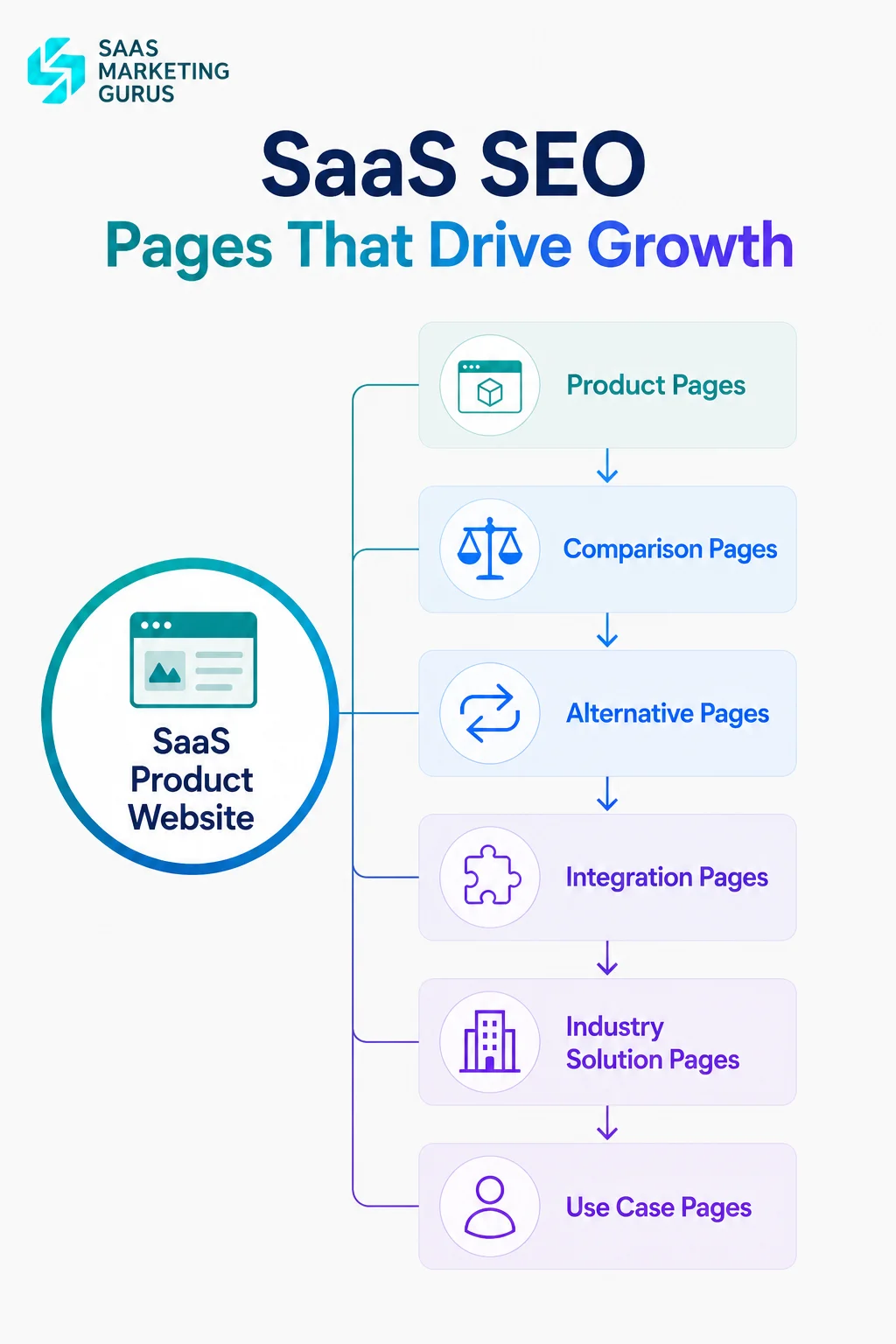
Examples:
CRM SaaS
High-value pages:
- CRM software for startups
- Salesforce alternatives
- CRM integrations
Cybersecurity SaaS
High-value pages:
- Security software comparisons
- Compliance solution pages
- Product alternatives
HR SaaS
High-value pages:
- Employee engagement software
- Recruitment automation solutions
- HR software comparisons
The best SaaS SEO strategies focus on how customers search, compare, and evaluate products.
How Should SaaS Companies Measure SEO Success?
One of the biggest mistakes SaaS teams make is measuring SEO only through rankings and traffic.
Important metrics include:
| SEO Activity | Business Impact |
|---|---|
| Product page optimization | More demos and trials |
| Comparison content | Higher purchase intent traffic |
| Solution pages | More qualified leads |
| Organic growth | Lower acquisition costs |
SaaS teams should connect search data with analytics and CRM data wherever possible.
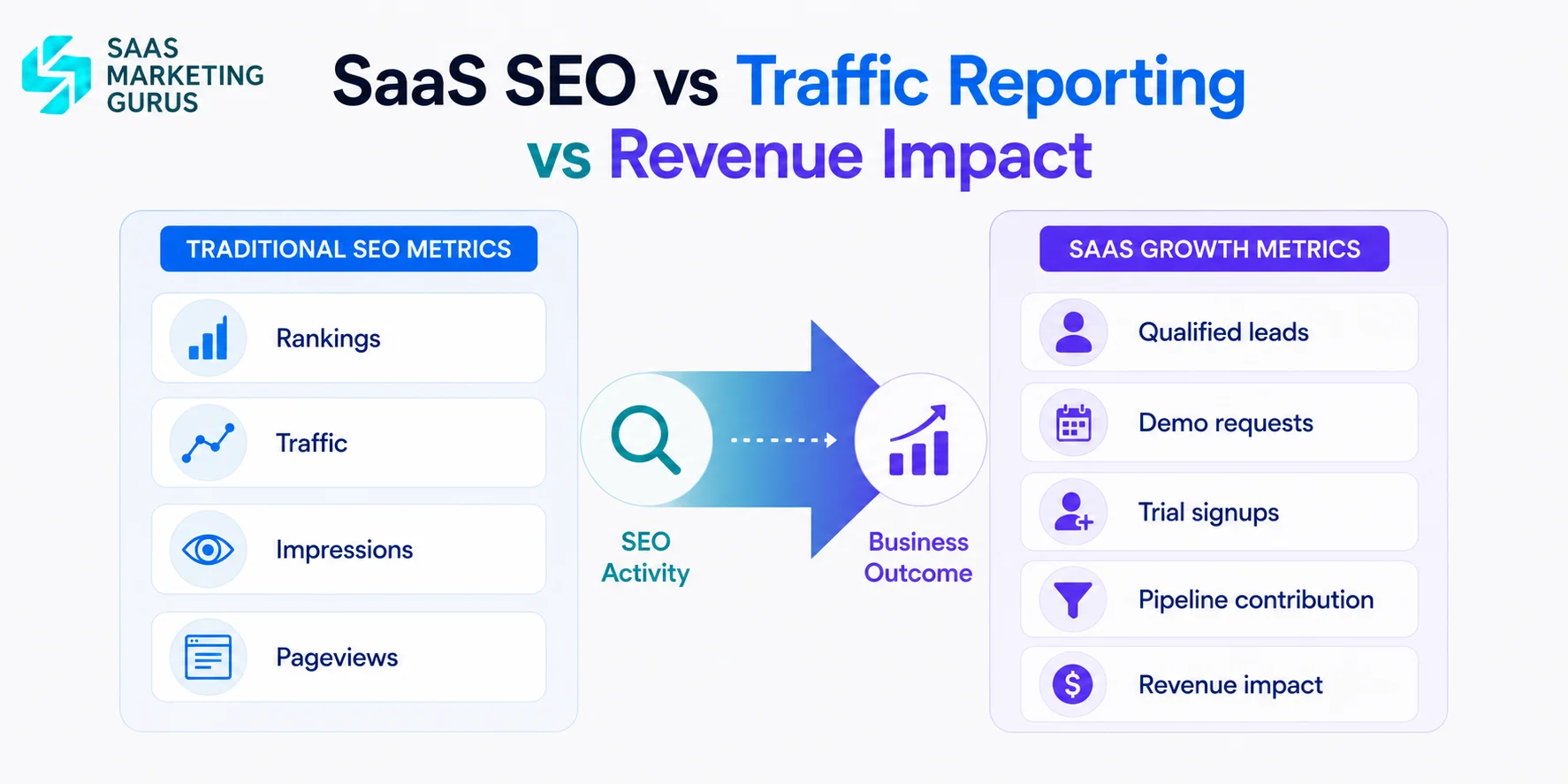
A practical measurement system can track:
- Organic impressions and clicks through Google Search Console
- Organic conversions through analytics
- Trial and demo submissions
- Marketing qualified leads from organic search
- Sales opportunities influenced by organic visits
- Organic pipeline and revenue
This makes it easier to identify which keywords and pages create business value rather than simply generating traffic.
SEO performance should connect with business outcomes, not only visibility metrics.
Google recommends creating helpful, people-first content that provides value rather than content created only to manipulate rankings. Google Search Central
Common SaaS SEO Mistakes That Limit Growth
Publishing Generic Content
Many SaaS companies create content that attracts visitors but does not influence buying decisions.
Instead of:
“What is automation?”
Create:
“Sales automation software for SaaS teams.”
The second targets users who are closer to finding a solution.
Ignoring Bottom-of-Funnel Pages
Comparison pages, alternatives, integrations, and solution pages often attract users with stronger purchase intent.
Ignoring these pages means missing valuable opportunities.
Measuring Traffic Instead of Revenue
Traffic is useful, but qualified opportunities matter more.
Buying on Price Alone
Buying SaaS SEO on price alone fails because two quotes rarely cover the same work. A lower monthly fee often means fewer pages, no technical fixes or no reporting. Compare quotes by deliverables per month first, then compare the price. The cost section below shows how.
A successful SaaS SEO strategy should connect organic performance with leads, pipeline, and revenue impact.
How Does SaaS SEO Support AI Search Visibility?
Strong SEO fundamentals also help SaaS companies become easier for AI search systems to discover, understand, and retrieve.
SaaS companies should make important information easy to identify, including:
- What the product does
- Who the product is built for
- Key features and use cases
- Integrations
- Pricing information where appropriate
- Comparisons and alternatives
- Expert insights and original research
- Trusted third party references
Technical accessibility also matters. Important pages should be crawlable, indexable, clearly structured, and internally connected.
Google states that established SEO fundamentals continue to apply to its AI search experiences. OpenAI also provides crawler controls for websites that want their content to appear in ChatGPT search experiences.
For SaaS brands, AI search optimization should therefore build on strong SEO rather than operate as a completely separate strategy.
SMG helps SaaS companies improve visibility across modern search environments through AI search optimization.
What Affects the Cost of SaaS SEO Services?
SaaS SEO services cost whatever the scope requires, because competition and deliverables differ across SaaS categories and no flat market price exists. Five factors move a quote, and the pricing model changes how you pay for it.
How Much Do SaaS SEO Services Cost?
Compare quotes by deliverables per month, not by headline price. This table shows what each budget level should buy. The scope split is standard. Prices are SMG’s to fill in.
| Budget level | Who it fits | What the month should include | Monthly price |
|---|---|---|---|
| Foundation | Early-stage SaaS with a small site and few ranking pages | Technical audit and fixes, buyer-intent keyword map, 2 to 4 priority pages built or rewritten, search and CRM tracking set up | Contact |
| Growth | SaaS with product-market fit and a keyword map that wants more ranking pages | Everything in Foundation, plus a steady schedule of comparison, alternative and use-case pages, internal linking and link acquisition | Contact |
| Scale | SaaS in a competitive category with a large site or several products | Everything in Growth, plus programmatic or integration pages, higher-volume authority building and monthly pipeline reporting to leadership | Contact |
What Pricing Models Do SaaS SEO Providers Use?
SaaS SEO providers price work four ways: monthly retainer, fixed project, hourly and performance-based. The right model depends on whether you need ongoing growth, a defined fix or advice.
| Model | How it works | Best for | Watch for |
|---|---|---|---|
| Monthly retainer | Fixed monthly fee for a stated set of deliverables | Ongoing growth. SEO compounds over months | No named deliverables, or a long lock-in with no exit |
| Fixed project | One fee for a defined output such as an audit, a migration or a content cluster | One-time fixes and launches | Scope creep. Ask what counts as done |
| Hourly | You pay for time | Advice, second opinions, coaching an in-house team | No cap on hours and no deliverable at the end |
| Performance-based | Fee tied to rankings, traffic or leads | Rarely a good fit, because rankings and traffic are not revenue | Agree in writing what counts. A ranking for a term nobody buys on pays out and produces nothing |
What Drives the Price of SaaS SEO?
Five factors move a SaaS SEO quote: category competition, site size and technical debt, content volume, the authority gap and reporting depth.
| Factor | Why it moves the price | What to tell the provider |
|---|---|---|
| Category competition | Crowded categories need more pages and more authority to reach page one | Your top 3 competitors and the 5 to 10 terms you most want to win |
| Site size and technical debt | A large or slow site needs audit work before content can rank. A B2B SEO audit sizes it | Page count, CMS, known indexing or speed problems |
| Content volume and depth | Product-led pages (comparisons, alternatives, integrations) and original research cost more than generic posts | Which page types you already have. A keyword research pass shows the gaps |
| Authority gap | Fewer relevant links than competitors means link acquisition must be in scope | Your referring domains versus the competitors above |
| Reporting depth | Pipeline reporting needs CRM and analytics integration, not a traffic dashboard | Your CRM, and whether demo bookings are tracked today |
Not included in a standard SaaS SEO retainer: paid ads, email campaigns and social media. Those are separate scopes with separate prices.
How Do You Calculate SaaS SEO Payback?
SaaS SEO payback equals total spend to date divided by the monthly gross profit that organic demos produce. Rankings and traffic do not enter the formula.
| Input | Where to get it |
|---|---|
| Qualified demos booked from organic search per month | CRM, filtered by source = organic |
| Demo-to-close rate | CRM closed-won divided by demos held |
| First-year contract value | Billing or CRM |
| Gross margin | Finance |
Monthly SEO gross profit = demos x close rate x first-year contract value x gross margin
Payback (months)         = total SEO spend to date / monthly SEO gross profit
If your CRM does not record the traffic source for demos, fix that first. Without it, no provider can show payback. The SEO conversion funnel guide shows where to add the tracking. No provider can state a payback date honestly, because it depends on your starting authority, category and sales cycle. Track the stages instead: fixes shipped, target pages indexed, target terms in the top 20, organic demos in the CRM, then monthly gross profit above monthly spend.
How To Choose A SaaS SEO Agency
Choose a SaaS SEO provider by asking each one the same five questions and scoring the answers against a good and a weak response. Compare price last, once the scopes match.
| Question | Good answer | Weak answer |
|---|---|---|
| What exactly is delivered each month? | A count and a type of page, link and fix | “Content, links and optimization” |
| Who writes the pages, and who reviews them? | A named writer or editor with SaaS experience | An unnamed team, or AI-only drafts |
| What does a sample report show? | Demos, qualified leads and pipeline by organic source | Rankings and traffic only |
| Which results can you name? | Named clients with verified results | Anonymous “a SaaS client saw 300%” |
| What are the exit terms? | A review after a stated period and a clear notice period | A long lock-in with no review |
Whether to buy at all is a separate question. Read agency vs in-house marketing for the cost comparison, and best SaaS marketing agencies for how to shortlist.
Red flags that end the conversation: a guaranteed ranking or date, no named deliverables, traffic as the only KPI, bulk templated content, paid link networks, and no CRM connection.
Frequently Asked Questions
What are SaaS SEO services?
SaaS SEO services help software companies improve organic visibility, attract qualified buyers, and generate trials, demos, and pipeline through search. They typically include keyword research, technical SEO, content strategy, product page optimization, authority building, and conversion optimization.
How is SaaS SEO different from traditional SEO?
SaaS SEO focuses heavily on buyer intent, longer sales cycles, product comparisons, integrations, use cases, and recurring revenue. The goal is not just more traffic, but attracting users who are researching, comparing, and evaluating software solutions.
How long does SaaS SEO take to show results?
It depends on starting authority, category and sales cycle, and you track fixes shipped, pages indexed, terms in the top 20 and organic demos in the CRM.
How should SaaS companies measure SEO success?
SaaS companies should measure SEO through qualified leads, trial signups, demo requests, sales opportunities, organic pipeline, and revenue. Rankings and traffic are useful indicators, but they should not be the main measure of business impact.
How much do SaaS SEO services cost?
The cost depends on scope, not a flat rate. Category competition, site size, content volume and technical work set the price. Most providers charge a monthly retainer, with project and hourly options for audits and advice.
Is a retainer or a project better for SaaS SEO?
A retainer fits ongoing growth, because rankings build over months. A fixed project fits one defined job such as an audit, a migration or a single content cluster. If you are unsure, buy an audit as a project first, then decide on a retainer.
Can a provider guarantee SaaS SEO rankings?
No. Google decides rankings and no provider controls them. Treat a guaranteed ranking or date as a red flag. Ask instead for named deliverables, a sample report with demos and pipeline, and an exit clause after a review period.
Turn SaaS Search Demand Into Your Next Growth Channel
SaaS SEO works best when keyword strategy, technical SEO, content, product pages, authority, and conversion paths support the same business goal.
At SaaS Marketing Gurus, we build SaaS SEO strategies around buyer intent and pipeline rather than traffic alone.
If your website is generating traffic without enough qualified opportunities, an SMG SaaS SEO consultation can help identify where search demand exists, which pages deserve priority, and where your current SEO strategy is losing potential buyers.
Request a SaaS SEO consultation and identify your highest value search opportunities.