Learn how Product Hunt featured status affects traffic, signups, rankings, and whether a non-featured launch is still worth it.
You spend weeks preparing your Product Hunt launch. The product is ready. The assets are polished. Launch day arrives, but instead of appearing in the “Top Products Launching Today” section, your product is buried behind a “See all of today’s products” link that most users never click.
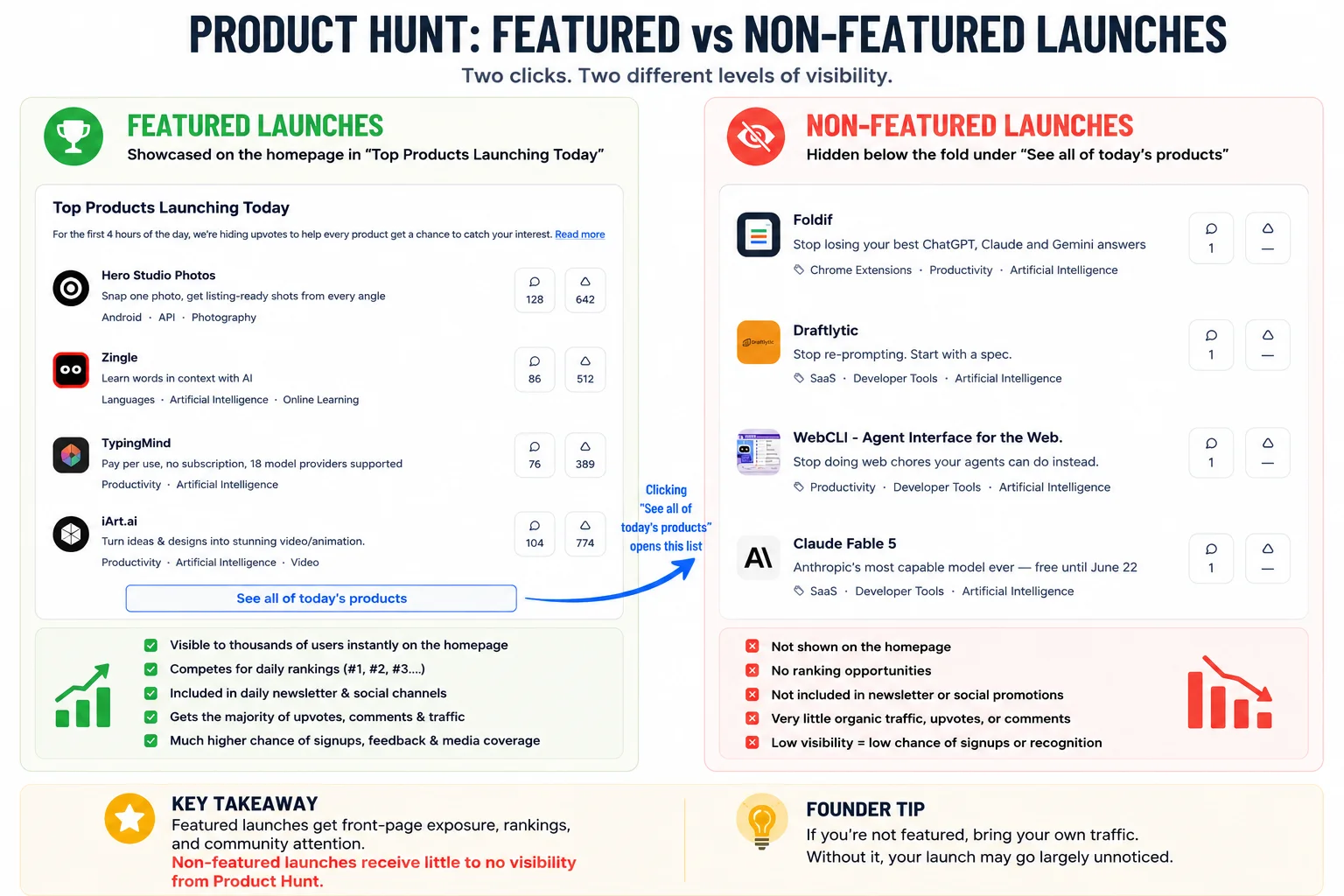
That single difference changes the outcome of many launches. Featured products get homepage visibility, compete for rankings, and attract attention from the Product Hunt community.
Non-featured products stay live on the platform, but receive little organic exposure. Before launching, founders need to understand what featured status actually means, why some products earn it while others don’t, and whether Product Hunt is worth the effort if their launch never reaches the homepage.
1. Why Most Product Hunt Launches Never Get Featured
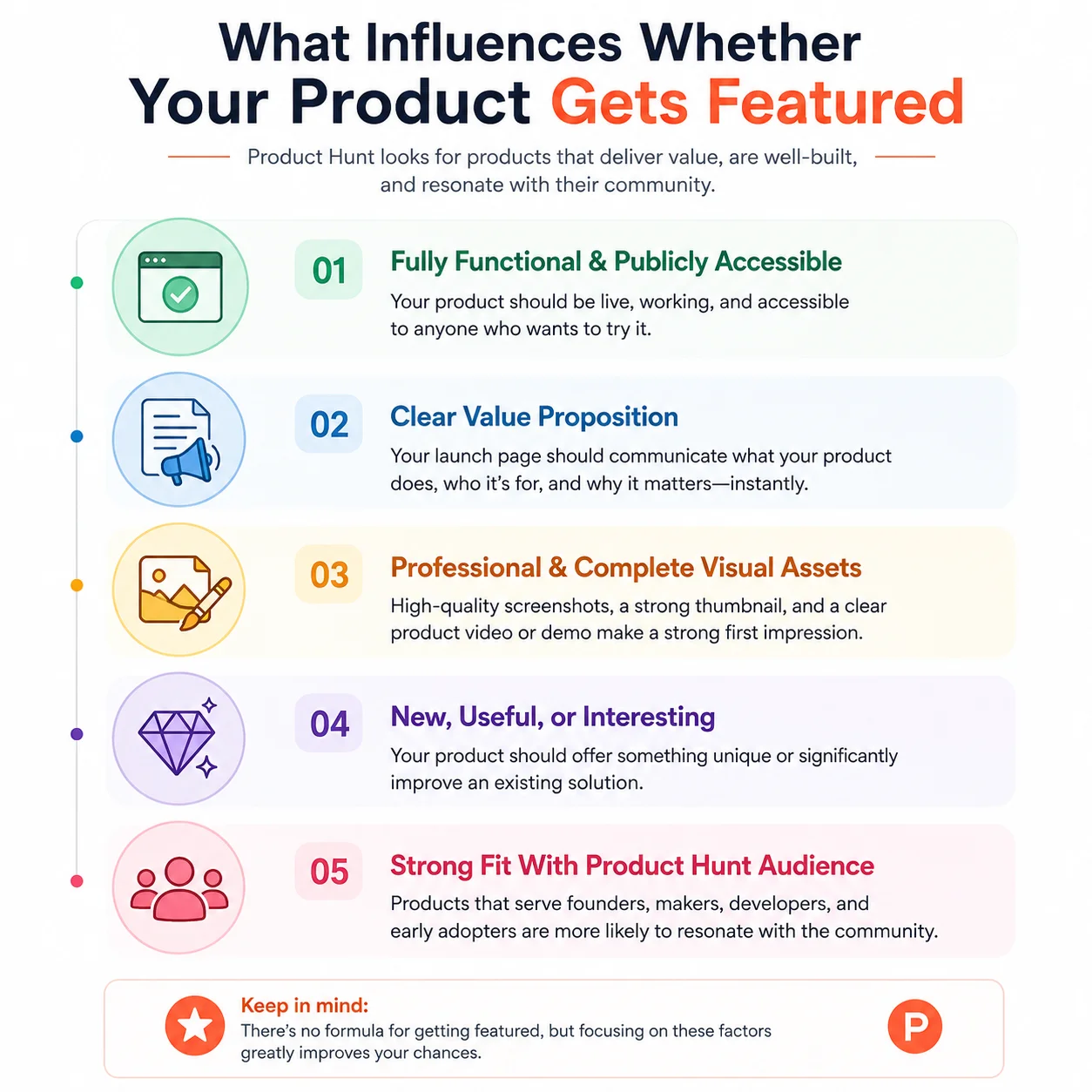
Product Hunt reviews every submission, but only a small percentage receive featured placement. The platform prioritizes products that are live, testable, well-designed, and likely to generate interest from the Product Hunt community.
Products are less likely to be featured when they consist of simple landing pages, unfinished concepts, heavily monetized offers, or products that provide little differentiation from existing alternatives.
The challenge for founders is that Product Hunt does not publish a scoring system or guarantee featured placement. A strong product improves your chances, but no launch is entitled to a homepage position. That’s why understanding the visibility gap between featured and non-featured launches is so important.
2. Why Some Products Get Featured and Others Don’t
If you look at Product Hunt’s guidelines, it clearly states that a product must be useful, novel, well-crafted, or creative to be featured. The priority in PH is given to:
- Digital & Live: Only digital products that are live and testable get chosen.
- High Standards: Products must be built with high quality and offer real value (vs. minimal, undifferentiated ideas).
- User Focus: Product Hunt is unlikely to feature if your product looks like another monetization-focused products (e.g. generic subscription sites).
- No Vaporware: If your product is just a landing page or not ready to use, it is unlikely to be featured.
- Community Interest: Product Hunt tends to favor software products, AI tools, SaaS platforms, developer tools, and innovative consumer apps over static content products such as courses, podcasts, or simple template bundles.
Does Launching With a Well-Known Hunter Increase Your Chances?
Many founders believe that launching with an established Product Hunt hunter improves their chances of getting featured. While Product Hunt does not officially state that featured decisions are based on who hunts a product, experienced hunters often understand what performs well on the platform and how to position a launch for the Product Hunt audience.
Well-known hunters also bring their own audience, credibility, and network, which can help generate early engagement during the launch window. This doesn’t guarantee a featured placement, but it may improve the overall quality and visibility of a launch.
If you’re considering this approach, you can explore a list of experienced Product Hunt hunters.
Why Many Products Are Not Featured
Many founders are surprised when their launch isn’t featured because Product Hunt worked differently before 2024.
Previously, most products appeared on the homepage automatically. Today, Product Hunt reviews launches and only features products it believes are most relevant and valuable to its community.
As a result, many launches now remain in the broader feed instead of receiving homepage visibility. This doesn’t mean your product is bad. It simply means it wasn’t selected for featured placement.
If your launch isn’t featured, improve your product, messaging, and launch assets, then consider relaunching after meaningful updates.
3. The Visibility Gap Between Featured and Non-Featured Launches
Visibility is one of the biggest concerns for founders launching on Product Hunt, and it matters!
If your launch is featured, you’re on the front page of a site with millions of monthly visitors. If not, it’s going to be buried beneath the featured listings.
- Daily Traffic: A typical featured launch drives about 1000 visitors on launch day. Getting a featured status multiplies your views by 10× or more.
- Engagement: Product Hunt hides vote counts during the first four hours of a launch. After that, products compete for rankings based on community engagement. Because featured products already have homepage visibility, they are more likely to attract comments, discussions, and votes as the competition unfolds.
When Does the Competition Begin? All products launch at midnight PT, but vote counts remain hidden for the first four hours. Once votes become visible, products begin competing for leaderboard positions and daily rankings.
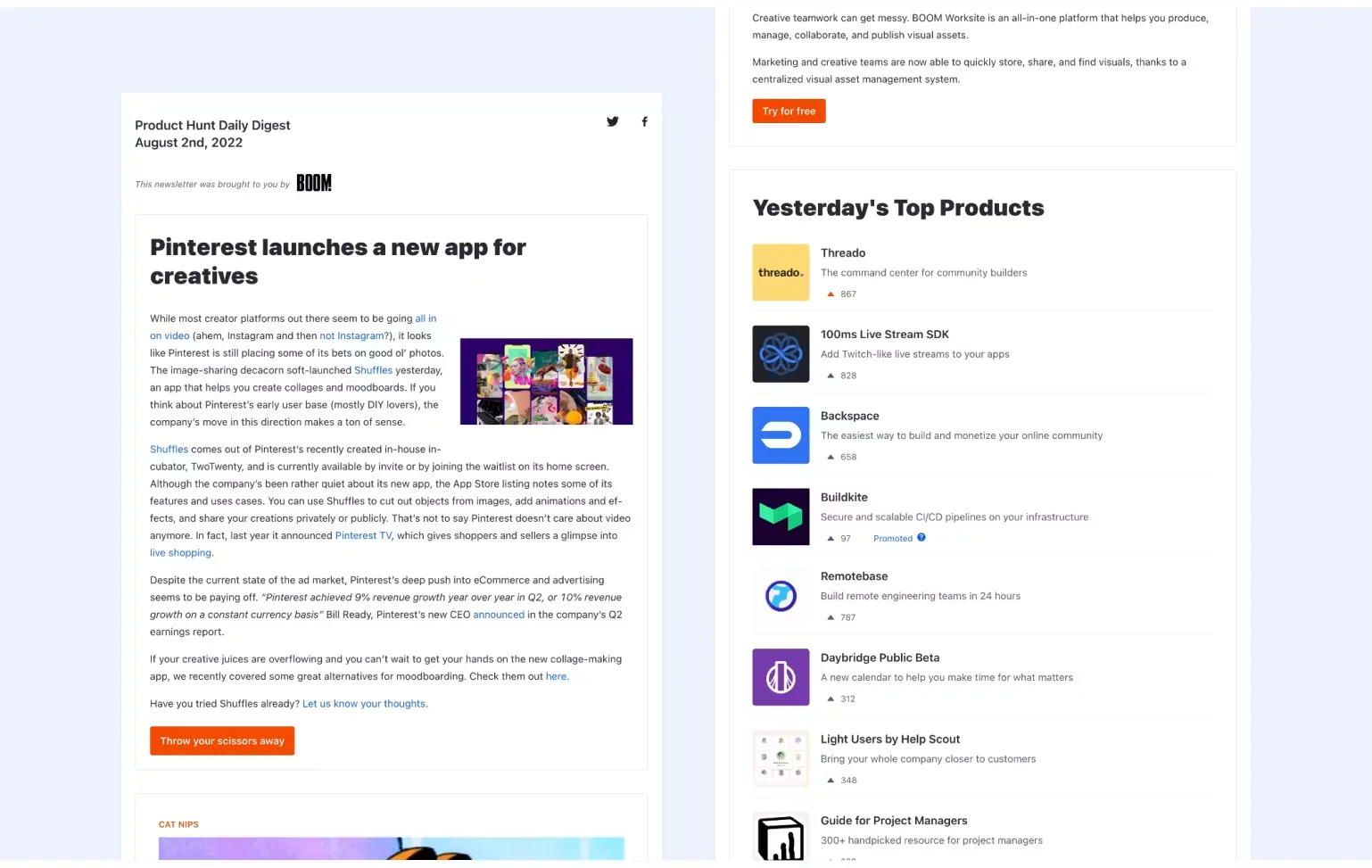
- Community Connection: Because featured launches get on the homepage, they can go viral more easily. Once the launch day competition is over, the best ones are included in PH’s daily newsletter and social posts. Non-featured launches get none of that built-in publicity.
Comparison: Featured vs Non-Featured Launch Metrics
| Metric | Featured Products | Non-Featured Products |
|---|---|---|
| Homepage visibility | Appears on the Product Hunt homepage and app feeds | Listed under “All Launches” with lower visibility |
| Launch Day Visitors | Often hundreds to several thousand visitors | Often tens to a few hundred visitors without external promotion |
| Launch Day Signups | Higher signup potential due to increased exposure | Usually depends on existing audience and external traffic sources |
| Upvotes for Top Ranks | Easier to gain traction and climb rankings | More difficult to sustain momentum |
| Traffic lift factor | Can generate multiples of a typical non-featured launch | Often limited unless supported by your own marketing |
| SEO Backlinks (DA) | Receives the same Product Hunt backlink plus greater chance of secondary coverage | Receives the same Product Hunt backlink but less secondary exposure |
4. What Featured Status Actually Delivers
If you make it to the homepage, what do you get? The short answer: growth. Featured launches see a big spike of interest on launch day. You can expect:
- Social Proof: Social Proof: Products that finish among the top-ranked launches of the day can showcase Product Hunt badges such as Product #1, #2, or #3 of the Day. These badges act as social proof, helping build trust with potential customers, investors, and partners. A strong ranking also increases visibility throughout launch day, creating more opportunities for engagement and discovery.
- Press and Partnerships: It’s a big opportunity if you get featured. While it is not guaranteed, notable products sometimes receive media coverage after going #1 on PH. The PH team also highlights featured products in newsletters or Spotlights (and on X). Plus, as a founder, you can use launch momentum to secure meetings.
- SEO and Backlinks: Every PH launch, featured or not, generates a high-quality backlink. But featured products often get even more: they are more likely to be reposted on tech blogs or aggregators.
5. The Honest Case for Non-Featured Launches
If your product is not featured, is launching still worth it? It won’t benefit you.
- Not Invisible, But Quiet: The only thing a non-featured launch will do is to give your product a backlink.
- Niche Audiences and Feedback: Even without a front-page boost, launching can attract a few dozen to a few hundred visitors if you tap your own network. For example, one founder reported 96 upvotes, 68 comments, and even 4 on a non-featured Product Hunt launch. What was different? He actively reached out.
- Building Early Traction: You can gather early user feedback, build an initial user list, and identify potential sales.
- SEO Value: Never underestimate the backlink. PH is an SEO powerhouse, so your PH page and any reposts will raise your site’s authority. Even if only a handful of people click through on day one, web crawlers will see your PH link and pass some link equity.
- Encourage Relaunch: Finally, a flop isn’t final. Founders often consider it as a “soft launch” approach to see how it performs, then iterate and try again later after 6 months.
6. The ROI Reality Check
As a founder, you need to balance effort versus payoff. Product Hunt can be valuable, but it isn’t free if you count your time. Here’s the realistic ROI calculation:
- Time Investment: A good launch takes weeks of preparation (Ship page, assets, email list) and one full day of engagement. Expect to spend 10 to 40 hours in prep and launch-day activity. That’s your cost before any traffic arrives.
- Traffic and Conversion: If your product is featured, you might get thousands of visitors. If not, you might get a few hundred. According to surveys, only about 10 to 26% of launches hit 500+ visitors, and just 5% hit 2,000 to 5,000. For every 1,000 PH visitors, expect roughly 10 to 30 signups. So, in the best case a big featured launch, maybe 50 signups. In a modest case a non-featured launch with 300 visitors, maybe 3 to 9 signups.
- Cost per Acquisition: If those signups eventually convert into customers, PH is actually very cost-effective. The cost per acquisition (CPA) on PH is approximately about $3 to $5 during launch day. Compare that to $15 or more for paid ads. Of course, if many signups never convert, the real cost-per-customer can be higher.
- Conversion Reality: Consider PH as top of the funnel. As a startup, you might only see a fraction of PH signups become paying customers. Some launches saw 20-30% higher than expected conversion while some got even 50% lower to expectation.
- When It’s Not Worth It: If launching distracts from product quality or if your product isn’t ready, PH launch time might be better spent elsewhere.
Mini Summary: Product Hunt can be worth it if you value exposure and feedback, especially for B2C and developer tools. It’s free in dollars but not in labor. If your product is niche or very technical, PH might yield only marginal gains. But for consumer or broad-market tools, landing on PH’s radar (featured or not) can be a low-cost marketing push.
8. What Happens After a Launch That Doesn’t Land
If your launch flops and results in no feature or few votes, don’t panic or disappear. We’ve consistently found that post-launch strategy matters as much as launch day itself.
- Analyze and Learn: Review your launch metrics. How many visitors did you get? How many signed up or clicked? Use these numbers to calculate your cost per signup. Compare the landing page funnel: did people drop off before signing? Use any analytics you have to find leaks.
- Follow Up with Leads: Email everyone who showed interest (collected via Ship or signups). We can do this for you! Thank them, ask for feedback, and keep them engaged. Even a small group of interested users can become loyal fans or beta testers.
- Product Improvements: Use the feedback from any comments or emails. Fix bugs, polish features, and perhaps relaunch.
- Relaunch Timing: If you plan to relaunch on PH, pick a better launch day (Tues-Thurs are busiest, but also toughest competition) and ensure you have more momentum pre-built (email list, press, partnerships).
- Mental Switch: PH may drive a spike, but sustainable growth comes from consistent marketing. Many successful startups didn’t achieve overnight success on PH, they used it as one channel among many.
Final Verdict: Should Founders Worry About Being Featured?
Being featured on Product Hunt does matter. A featured launch can drive 10× the traffic and signups of a non-featured one. But featured status is not under your control. You can’t buy it; you can only maximize your chances by having a great product and launch plan.
Instead of focusing on that badge, founders should focus on what they can control: building an audience before launch, writing a killer Ship page, preparing assets, and engaging their network on launch day. A strong launch strategy (good messaging, timing, outreach) improves both your chance of being featured and your results if you’re not.
SaaS Marketing Gurus helps SaaS companies plan and execute Product Hunt launches through positioning, messaging, launch asset creation, Ship page optimization, launch day strategy, outreach planning, and post-launch promotion.
We don’t focus solely on earning a featured badge. We focus on building a launch that generates meaningful traffic, signups, feedback, and long-term growth. Whether you’re launching for the first time or trying again after a previous attempt, a structured launch strategy helps you get more value from the attention Product Hunt can bring.