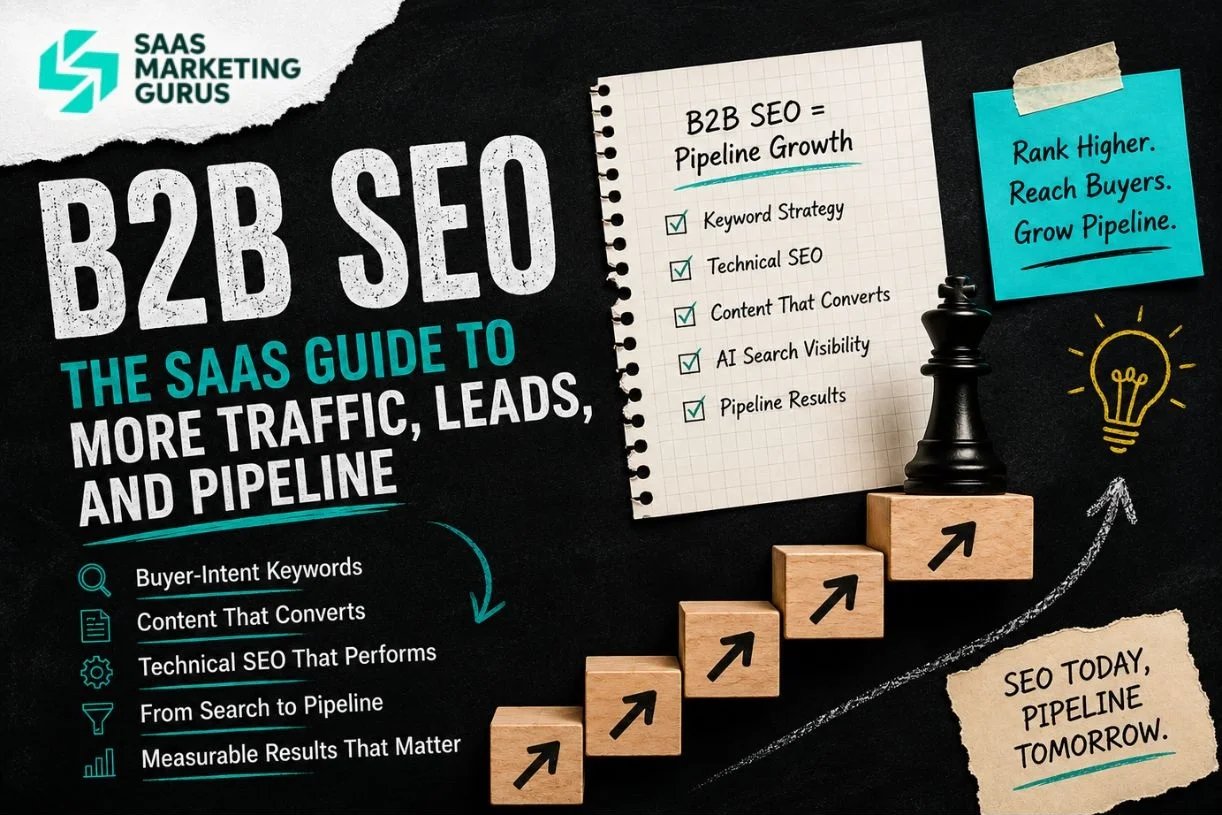
B2B search engine optimization, or B2B SEO, is the process of improving a business website so it ranks for searches made by potential business buyers researching products, services, problems, and solutions.
The goal is not simply more organic traffic. B2B SEO helps you reach relevant decision-makers, capture buyer intent, generate qualified leads, and turn organic search into a pipeline.
For B2B SaaS companies, this requires more than targeting high-volume keywords. Your buyers often include multiple stakeholders, each searching for different information before they book a demo or start a trial.
That means your SEO strategy needs to connect buyer intent, keyword research, content, technical SEO, commercial pages, and conversion tracking.
This guide explains how to build that system, from B2B SEO keyword strategy and technical foundations to AI search visibility and pipeline measurement.
How B2B SEO Compares to Other SEO Models
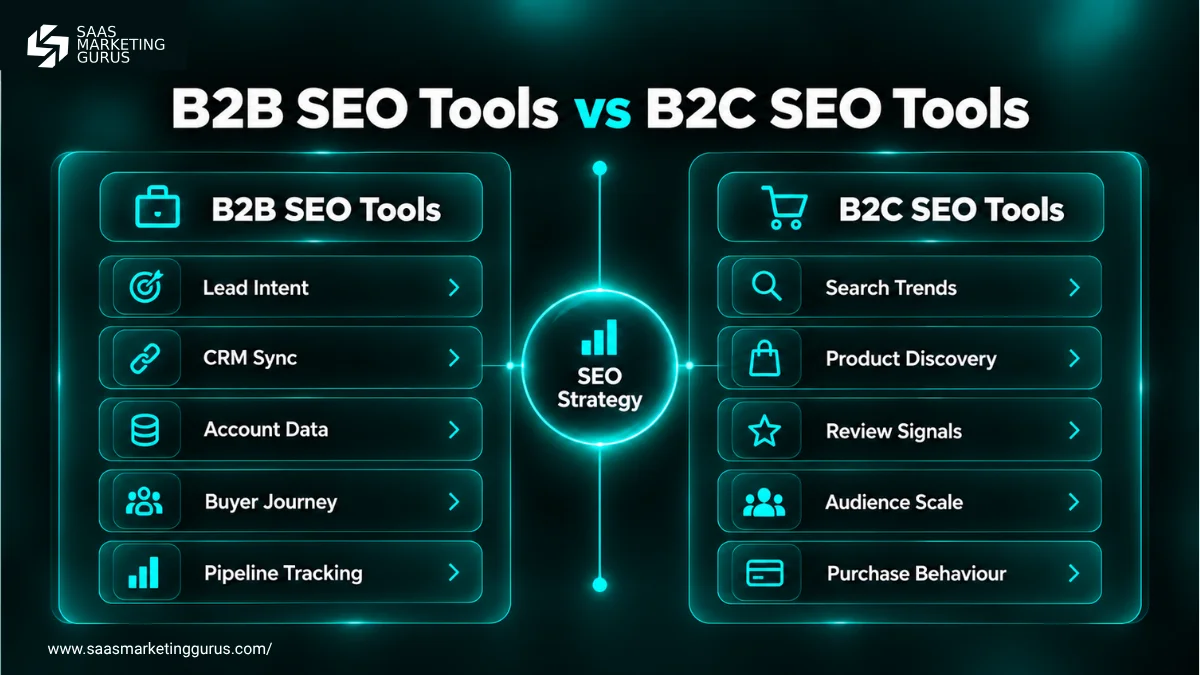
SEO strategies differ based on who is searching, what they are looking for, and how they make purchase decisions. B2B SEO focuses on reaching business buyers who usually research extensively before choosing a solution.
Unlike B2C SEO, where users often make faster purchase decisions, B2B SEO supports longer buying cycles, multiple stakeholders, and higher-value conversions.
| SEO Type | Target Audience | Search Intent | Content Focus | Main Goal |
|---|---|---|---|---|
| B2B SEO | Businesses, decision-makers, buying teams | Research, evaluation, comparison | Industry guides, comparison pages, use cases, solution content | Qualified leads and pipeline |
| B2C SEO | Individual consumers | Quick discovery and purchase | Product pages, reviews, guides, offers | Sales and transactions |
| Ecommerce SEO | Online shoppers | Product discovery and buying | Category pages, product pages, reviews | Product revenue |
| Local SEO | Customers searching nearby businesses | Location-based intent | Location pages, reviews, business profiles | Store visits and calls |
For B2B SaaS companies, SEO success depends on connecting search visibility with buyer intent. The goal is not only ranking for keywords but creating the right content for every stage of the buying journey.
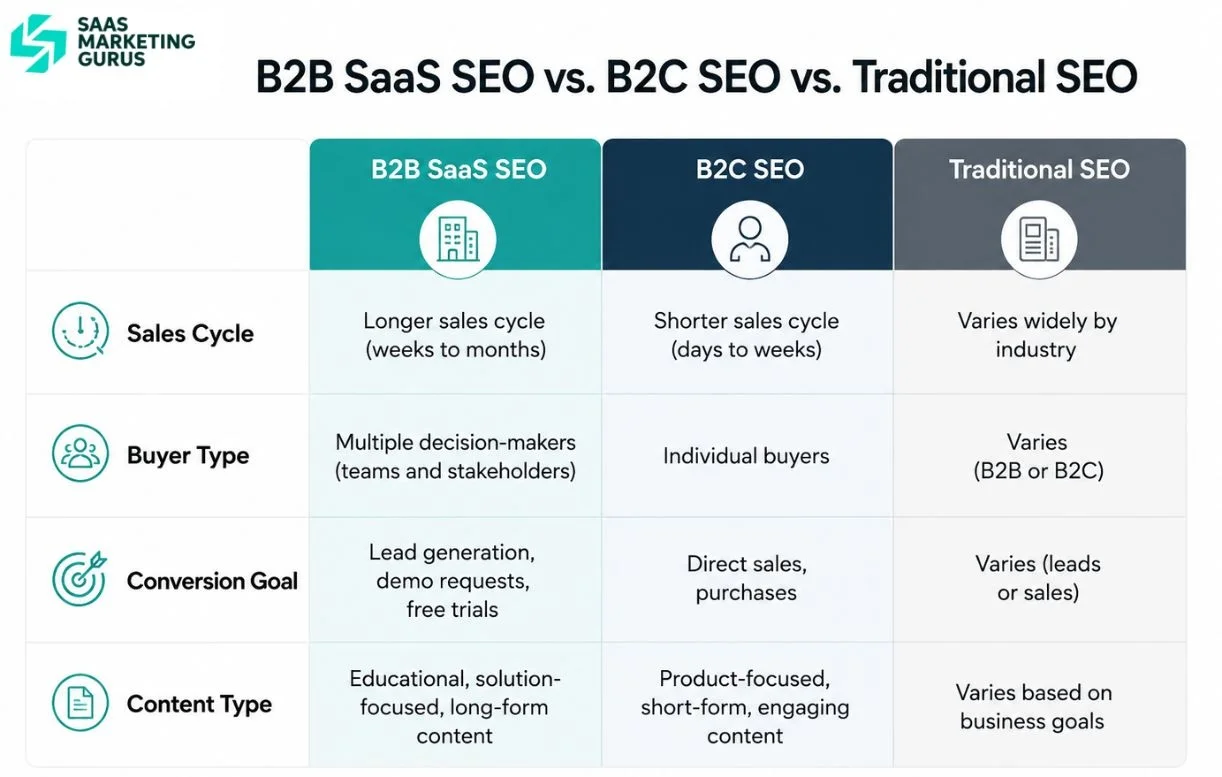
How B2B SEO Differs From Generic SEO
B2B tech SaaS has an additional layer most SEO guides ignore: your buyers are not one person. A CFO evaluating spend, a CMO evaluating adoption, and an IT lead evaluating integrations all search differently, read differently, and need different content to move forward.
Generic SEO treats the buyer as a single persona. B2B tech SEO builds content for the full buying committee and ranks for the queries each stakeholder runs independently.
According to the 6sense 2025 B2B Buyer Experience Report, 94% of B2B buyers reported using LLMs during their buying journey.
B2B SEO Keyword Strategy That Fills the Pipeline
The most common B2B SEO mistake is starting with a keyword tool and sorting by search volume. High-volume keywords often attract broader audiences. For B2B SaaS, the priority should be keywords connected to a specific problem, solution, use case, or buying decision.
Start with your buyer’s job to be done, not search volume.
The 4 B2B SaaS Keyword Types Across the Funnel
A successful B2B SEO strategy targets keywords based on buyer intent rather than search volume alone. Different searches represent different stages of the buying process.
| Keyword Type | Buyer Stage | Search Intent | Example Keywords |
|---|---|---|---|
| Problem-Based Keywords | Awareness | User is identifying a challenge | “how to reduce SaaS churn”, “payment failures solution” |
| Solution-Based Keywords | Consideration | User is researching possible solutions | “subscription billing software”, “AI customer support platform” |
| Comparison Keywords | Evaluation | User is comparing vendors | “Stripe alternatives”, “HubSpot vs Salesforce” |
| Commercial Keywords | Decision | User is ready to take action | “SaaS SEO agency”, “enterprise SEO services” |
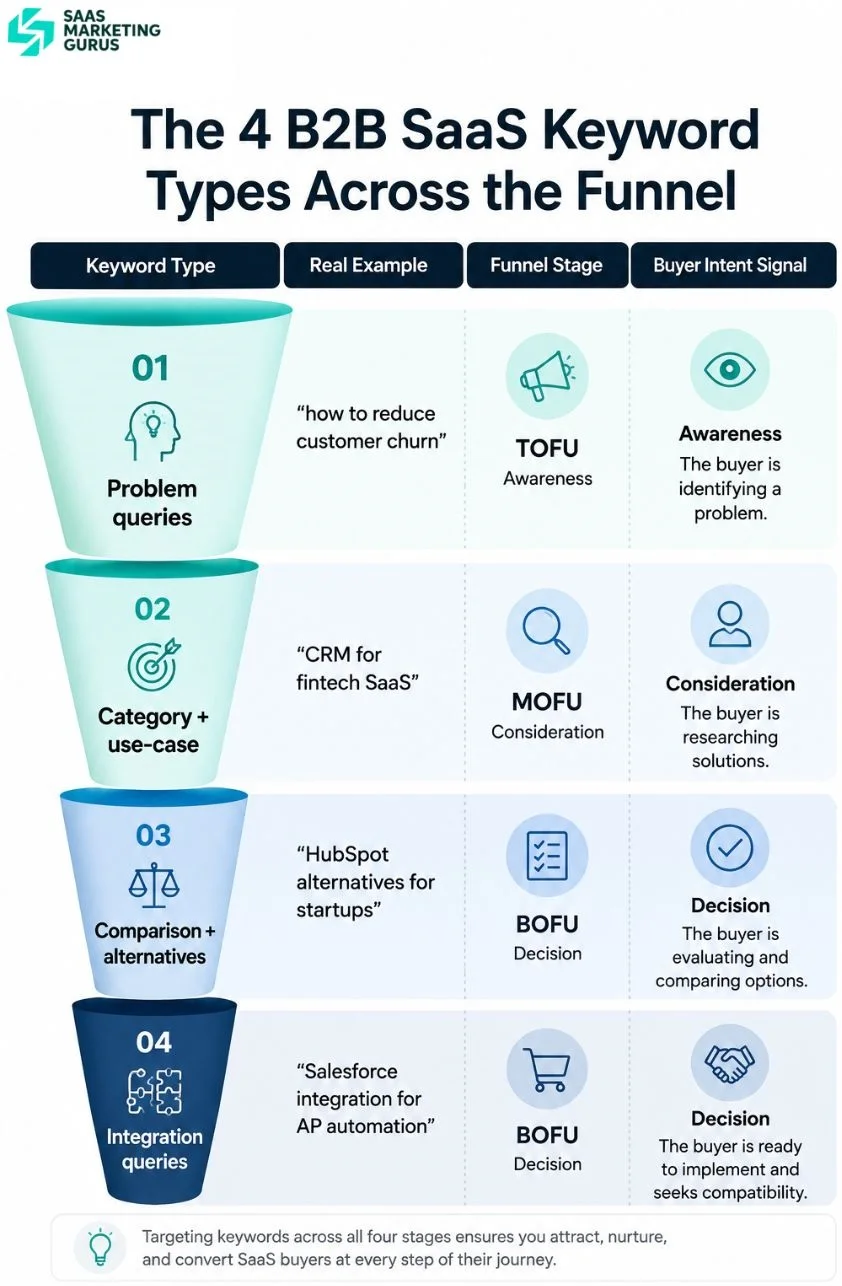
The goal is not to rank for every possible keyword. Build topic clusters around the problems your customers face, the solutions they evaluate, and the decisions they make before buying.
Long-Tail Is Where B2B Wins
“CRM software” is broad and can attract people with very different needs.
“Compliance CRM for fintech SaaS” is more specific and signals a clearer business use case.
More specific queries often have lower search volume but stronger relevance and clearer intent.
Use keyword research tools to find vertical-specific, role-specific, and problem-specific long-tail terms your ICP actually searches, then build a cluster around each one.
→ See how SMG executes buyer-intent keyword strategy for B2B SaaS clients
A Practical B2B SEO Strategy Framework
A complete B2B SEO strategy connects research, content, technical optimization, authority, and measurement.
Follow this framework:
1. Define Your ICP and Buying Committee
Identify who influences the purchase decision.
Example:
- Founder cares about growth and cost
- Marketing leaders care about pipeline and acquisition
- Technical teams care about integrations and security
2. Map Keywords to Buyer Intent
Connect every keyword with a business goal.
Example:
Problem search → educational content
Solution search → solution pages
Comparison search → comparison pages
Commercial search → service or product pages
3. Build Topic Clusters
Create connected content around important themes.
Example:
Main topic:
B2B SaaS SEO
Supporting topics:
- SaaS keyword research
- SaaS content strategy
- Technical SEO
- AI search optimization
- SaaS SEO measurement
4. Create Commercial Pages
Do not depend only on blogs.
Important B2B SaaS pages include:
- Alternative pages
- Comparison pages
- Integration pages
- Use case pages
- Industry pages
- Solution pages
5. Measure SEO Against Revenue
Track:
- Qualified organic leads
- Demo requests
- Sales opportunities
- Pipeline influenced by SEO
- Revenue from organic search
The strongest B2B SEO programs connect every activity back to business growth.
Content and Technical SEO for B2B SaaS
Ranking is only half the equation. The page your buyer lands on must convert them, or at minimum, move them one step closer to a demo.
The Page Types That Drive B2B Demos
Comparison pages, alternative pages, use-case landing pages, and integration guides are important page types for B2B SaaS SEO. They target buyers who are evaluating solutions, comparing options, or checking whether a product fits a specific business need.
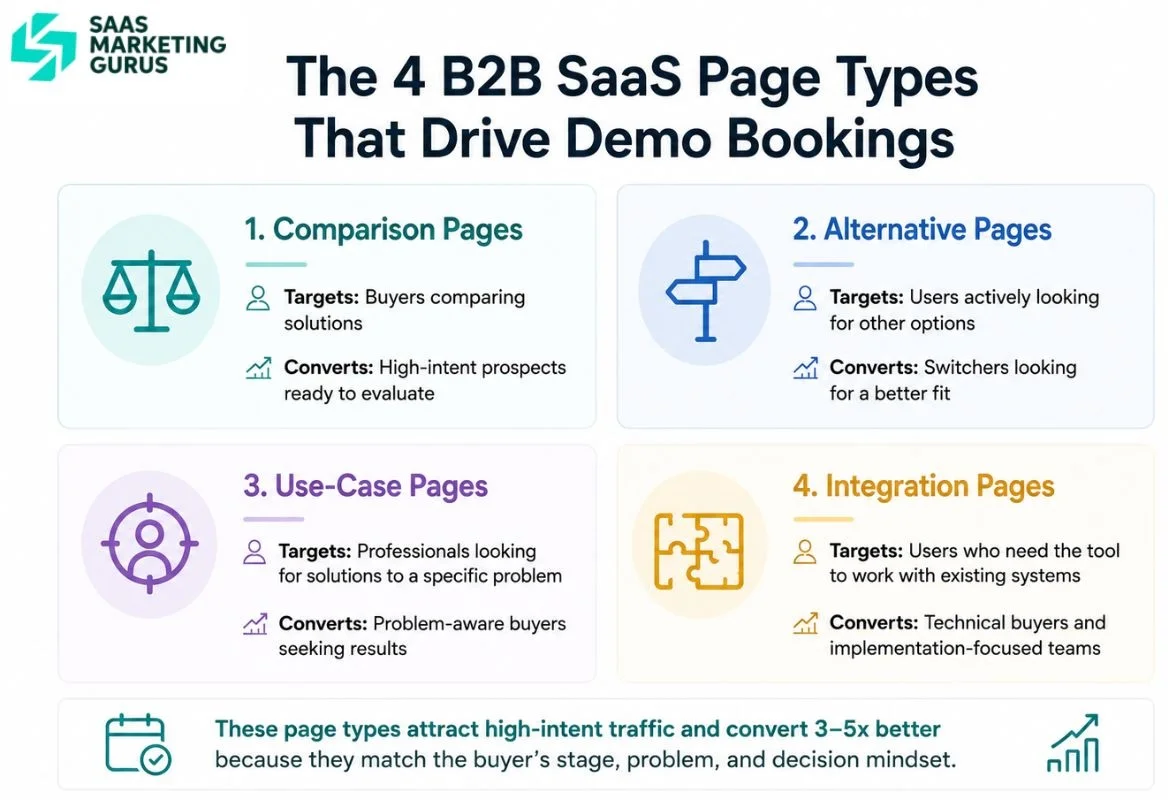
These pages can attract higher-intent organic visitors because the search itself often signals an active evaluation process. The goal is to give those visitors enough information to make the next decision, whether that means comparing products, checking an integration, exploring a use case, or booking a demo.
A structured content system should therefore include both educational content and commercial pages. Educational content builds topic coverage and addresses early-stage questions. Comparison, alternative, use-case, and integration pages address more specific evaluation needs.
Technical SEO Must-Haves for SaaS Websites
Technical SEO is the foundation on which every other effort depends. If Google cannot crawl, understand, and index your important pages, strong content will struggle to perform.
That is why the technical priorities for B2B SaaS SEO include:
- Core Web Vitals: Aim for LCP under 2.5 seconds, INP under 200 milliseconds, and CLS below 0.1.
- Indexation: Make sure important product, service, use-case, comparison, and integration pages are indexable.
- Canonicals: Use canonical URLs to help search engines understand which version of a page should be indexed.
- Internal linking: Connect related product, service, use-case, comparison, and educational pages.
- Schema markup: Use relevant structured data to help Google understand your content and qualify for supported search features. Do not treat schema as a guaranteed ranking or AI citation factor.
- SaaS-specific issues: Check for login-protected pages, duplicate feature pages, app subdomain issues, and crawl conflicts.
- XML sitemaps: Include important canonical URLs and keep low-value URLs out where appropriate.
Google states that structured data is not required for AI Overviews or AI Mode. Standard SEO fundamentals still apply, including crawlability, internal linking, textual content, and accurate structured data.
Why Authority Matters in B2B SEO
Content quality alone is not enough in competitive B2B markets. Search engines also evaluate signals that demonstrate trust, expertise, and authority.
B2B companies can strengthen authority through:
- Industry research and original data
- Expert contributions
- Digital PR campaigns
- Relevant industry publications
- Customer case studies
- Strategic partnerships
- High-quality backlinks
The goal is not collecting links. The goal is building a reputation that search engines, AI systems, and buyers can verify.
B2B SEO in the Age of AI Search
B2B buyers increasingly use AI tools alongside traditional search during the buying process. According to 6sense‘s 2025 B2B Buyer Experience Report, 94% of B2B buyers reported using LLMs during their buying journey.
Google also says its standard SEO best practices remain relevant for AI Overviews and AI Mode. There are no separate technical requirements for appearing in these AI search features.
AI search optimization also changes how organic visibility translates into clicks. An Ahrefs study using December 2025 data found that the presence of an AI Overview correlated with a 58% lower average click-through rate for the top-ranking page.
For B2B companies, this makes clear, useful, well-supported content more important. Your content needs to answer buyer questions directly while giving search engines and AI systems enough context to understand the topic.
What Makes B2B SaaS Content Easier for AI Search to Understand?
AI search systems need clear, trustworthy, and well-structured information to understand a brand, topic, and relationship between concepts.
For B2B SaaS companies, AI visibility depends on three factors:
- Clear entity information
- Complete topic coverage
- Evidence supported content
Content that answers specific buyer questions, explains concepts clearly, and connects related topics through internal links is easier for both search engines and AI systems to understand.
1. Keep your brand and entity information consistent
Use consistent company, product, category, and industry information across your website and relevant third-party profiles.
This helps users and search systems understand what your company does and which topics it covers.
2. Answer important questions directly
Put a concise answer near the beginning of sections where users have a clear question.
Then provide the supporting explanation, examples, data, or context below it.
3. Make sections understandable on their own
Use descriptive headings and give each section enough context to make sense without requiring the reader to interpret the surrounding page first.
This also makes individual sections easier to reference when search systems retrieve relevant passages.
4. Support claims with evidence
Use original research, named sources, customer examples, expert commentary, and specific data where available.
Do not make statistics or performance claims without evidence.
5. Keep important information in text
Do not place critical explanations only inside images or graphics.
Google specifically recommends making important content available in textual form for AI search features.
6. Build clear relationships between related topics
Use internal links to connect related pages covering the same subject.
For example:
B2B SEO → B2B keyword research → technical SEO → AI search optimization → B2B SEO services.
This gives users and search systems clearer context about how your content fits together.
How Reddit Supports B2B SEO and AI Visibility
Reddit can support B2B SEO by helping brands understand customer questions, objections, and buying discussions happening in real communities.
Many buyers use community discussions when comparing software, looking for recommendations, or validating purchasing decisions.
For B2B SaaS companies, Reddit can provide:
- Real customer language for keyword research
- Insights into buyer pain points
- Content ideas based on recurring questions
- Opportunities to build brand trust through helpful participation
The goal is not promotional posting. The focus should be contributing useful answers where potential customers are already discussing problems and solutions.
→ See how SMG uses Reddit as an SEO amplifier for B2B SaaS brands
5 B2B SEO Mistakes SaaS Companies Keep Making
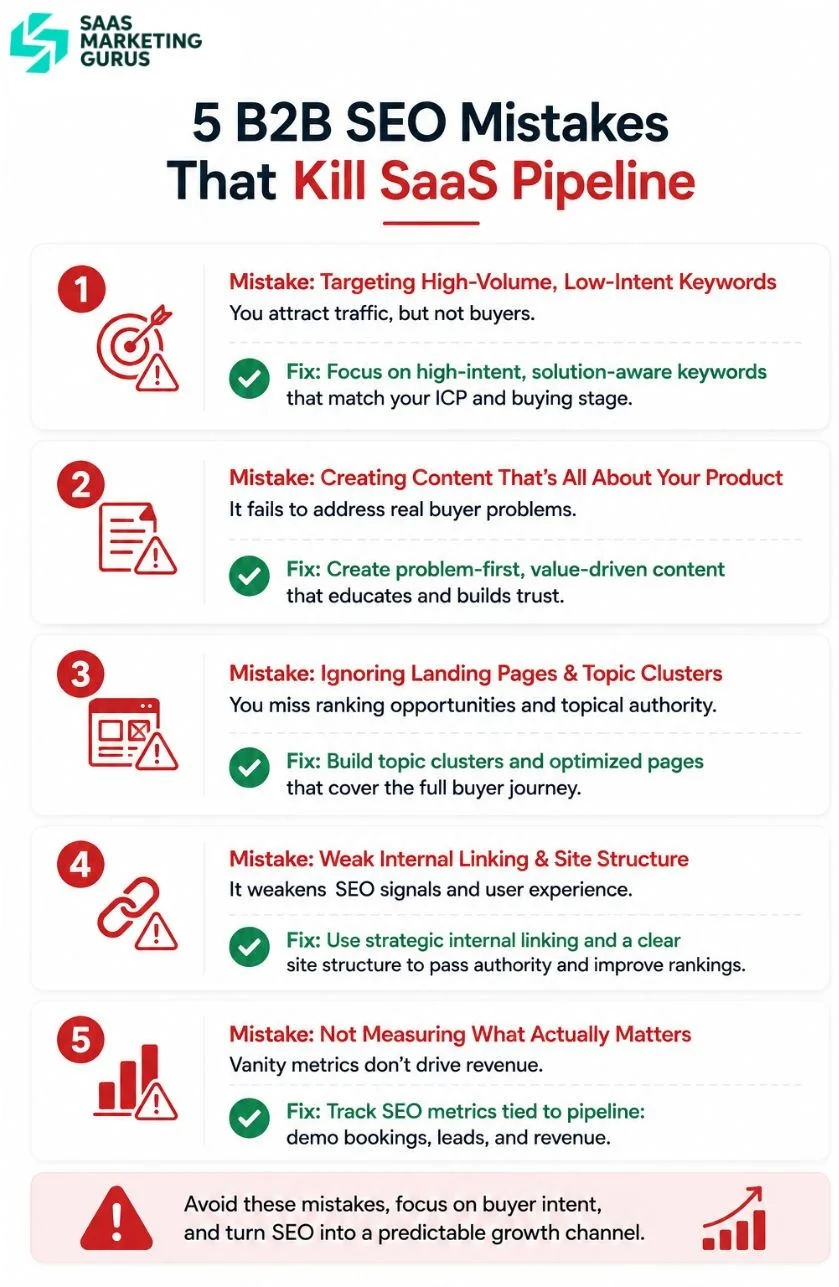
1. Targeting keywords your buyers never search: Ranking for broad informational terms does not guarantee qualified leads or demos. Build your keyword strategy around what buyers search for when they are evaluating, not when they are learning.
2. Building TOFU content only: Educational blog posts build awareness. Comparison and alternative pages can capture buyers who are already evaluating solutions. Many SaaS blogs focus heavily on educational content but underinvest in comparison, alternative, and commercial pages.
3. Writing for one persona when three are involved The CMO, CTO, and founder all influence the purchase. A single content strategy rarely speaks to all three. Map your content to each stakeholder’s specific questions.
4. Measuring traffic instead of demos Organic sessions are not a business outcome. Demo requests from organic search, visitor-to-call rate, and CAC from organic versus paid these are the metrics that matter.
5. Not updating content B2B buyers check publish dates. Stale content signals stale expertise. Track which pages are losing rankings and refresh them before they drop off page one.
→ Get a free audit of your current B2B SEO setup
How to Measure B2B SEO Success
Traffic is an input. Pipeline is the output.
For B2B companies, measure SEO across three levels: search visibility, website conversions, and business outcomes.
Search visibility metrics
Track:
- Organic impressions.
- Organic clicks.
- Click-through rate.
- Commercial keyword rankings.
- Non-branded search visibility.
- Pages gaining or losing organic traffic.
- Queries generating relevant traffic.
Google Search Console provides impressions, clicks, queries, CTR, and page-level search performance data. Google Analytics adds information about what visitors do after they reach your website.
Conversion metrics
Track:
- Demo requests from organic search.
- Free trial signups.
- Organic lead conversion rate.
- Visitor-to-demo rate.
- Marketing-qualified leads from organic search.
- Sales-qualified leads from organic search.
Pipeline metrics
The most important B2B SEO metrics connect organic search to revenue:
- Pipeline sourced from organic search.
- Pipeline influenced by organic search.
- Customers acquired through organic search.
- Organic customer acquisition cost.
- Revenue attributed to organic search.
A page generating thousands of visits but no qualified opportunities is less valuable than a page attracting fewer visitors who match your ICP and enter the sales pipeline.
AI search visibility
AI search introduces additional visibility questions for B2B brands:
- Is your brand mentioned when buyers ask category questions?
- Which pages or sources appear in AI-generated answers?
- Which competitors appear alongside your brand?
- Which topics generate AI visibility for your company?
- Are your important product, use-case, and comparison pages being referenced?
Treat AI visibility as a complementary measurement layer rather than a replacement for traditional SEO metrics.
→ See how SMG tracks performance against pipeline, not vanity metrics
FAQs
What is B2B SEO?
B2B SEO is the process of optimizing a business website to attract potential customers searching for products, services, solutions, and industry information. The goal is to generate qualified leads, sales opportunities, and revenue from organic search.
How is B2B SEO different from regular SEO?
B2B SEO usually involves longer sales cycles, multiple decision-makers, and more complex buying journeys. Instead of targeting only high-volume keywords, B2B SEO focuses on buyer intent, commercial pages, educational content, and pipeline generation.
What are the most important B2B SEO strategies?
The most effective B2B SEO strategies include buyer-intent keyword research, topic clusters, commercial landing pages, technical SEO, internal linking, authority building, AI search optimization, and conversion tracking.
Which pages are most important for B2B SaaS SEO?
Important B2B SaaS SEO pages include solution pages, comparison pages, alternative pages, use case pages, integration pages, industry pages, and educational content that answers customer questions.
How long does B2B SEO take to show results?
B2B SEO timelines depend on competition, website authority, technical health, content quality, and execution speed. Some improvements can appear within weeks, while significant traffic and pipeline growth usually require several months of consistent work.
How do you measure B2B SEO success?
B2B SEO success should be measured through business outcomes, including qualified organic leads, demo requests, sales opportunities, pipeline influenced by SEO, customer acquisition cost, and revenue generated from organic search.
Can AI search replace traditional B2B SEO?
No. AI search changes how users discover information, but strong technical SEO, useful content, clear entities, internal linking, and trustworthy sources remain important for visibility across both traditional search and AI platforms.
Build the SEO System That Fills Your Demo Calendar
Rankings are not the goal. Demos are.
At SaaS Marketing Gurus, we build B2B SEO strategies around buyer-intent keyword research, commercial content, technical SEO, AI search visibility, and conversion tracking tied to business outcomes.
Our approach focuses on the full journey from search visibility to qualified opportunities, rather than measuring success through organic sessions alone.
SaaS Marketing Gurus helps SaaS companies build SEO systems focused on buyer intent, technical foundations, AI visibility, and measurable pipeline growth.
“Clear system. Consistent execution. Real visibility where it matters.”
— Nazareno, Rankprompt