SaaS content marketing is the practice of publishing content that helps software buyers research, compare, and choose a product, then measuring it by demos and pipeline instead of traffic. A SaaS content marketing strategy is the plan behind it: which buyer questions to answer, in which formats, on which channels, and how each piece leads to a demo request.
Most SaaS blogs fail on that last part. They publish for volume, rank for low-intent topics, and report visits. A page with 10,000 visitors can produce fewer customers than a comparison page with 500, because the second page meets a buyer who is already choosing.
This guide covers the definition, the five-step plan, a fill-in template, how to get cited in AI answers, and how to measure the result.
What Is SaaS Content Marketing?
SaaS content marketing is product-led education aimed at people who are evaluating software. It covers the full buying journey: problem-aware guides, comparison and alternative pages, integration and use-case pages, case studies, and onboarding content for retention.
It differs from general B2B content in three ways:
- Longer evaluation. Several people review the tool, so one article has to serve a founder, a marketer, and a finance approver.
- Proof before contact. Buyers look for reviews, benchmarks, and real customer results before they talk to sales.
- Trial and demo as the goal. The metric is a booked demo or a started trial, not a pageview.
B2B technology content marketing, meaning content written for software, infrastructure, or developer-adjacent buyers, follows the same rules with one addition: the reader expects technical specifics. Name the integration, show the workflow, state the limit.
What Makes SaaS Content Marketing Different?
SaaS content marketing is different from traditional content marketing because software buyers usually need more education before making a decision. They compare solutions, evaluate features, understand implementation requirements, and look for proof before investing in a product.
A successful SaaS content strategy connects three areas:
Customer Problems → Content Solutions → Product Value
For example, a CRM company should not only create content around “What is CRM software?” It should also create content around:
- Best CRM for sales teams
- CRM implementation checklist
- CRM vs spreadsheets
- CRM integrations for automation
- How companies improve sales processes with CRM
This approach helps SaaS companies attract users at different stages of the buying journey and create content that supports both organic growth and revenue.
Why SaaS Companies Need a Scalable Content Strategy
B2B buyers now do most of the work before a sales call. In a Gartner survey of 646 B2B buyers run in August and September 2025, 67% said they prefer a rep-free buying experience, and 45% used AI during a recent purchase.
For a SaaS company this has one consequence: your content is the first sales conversation. If a buyer cannot find a clear answer, a comparison, and proof on their own, they build a shortlist without you.
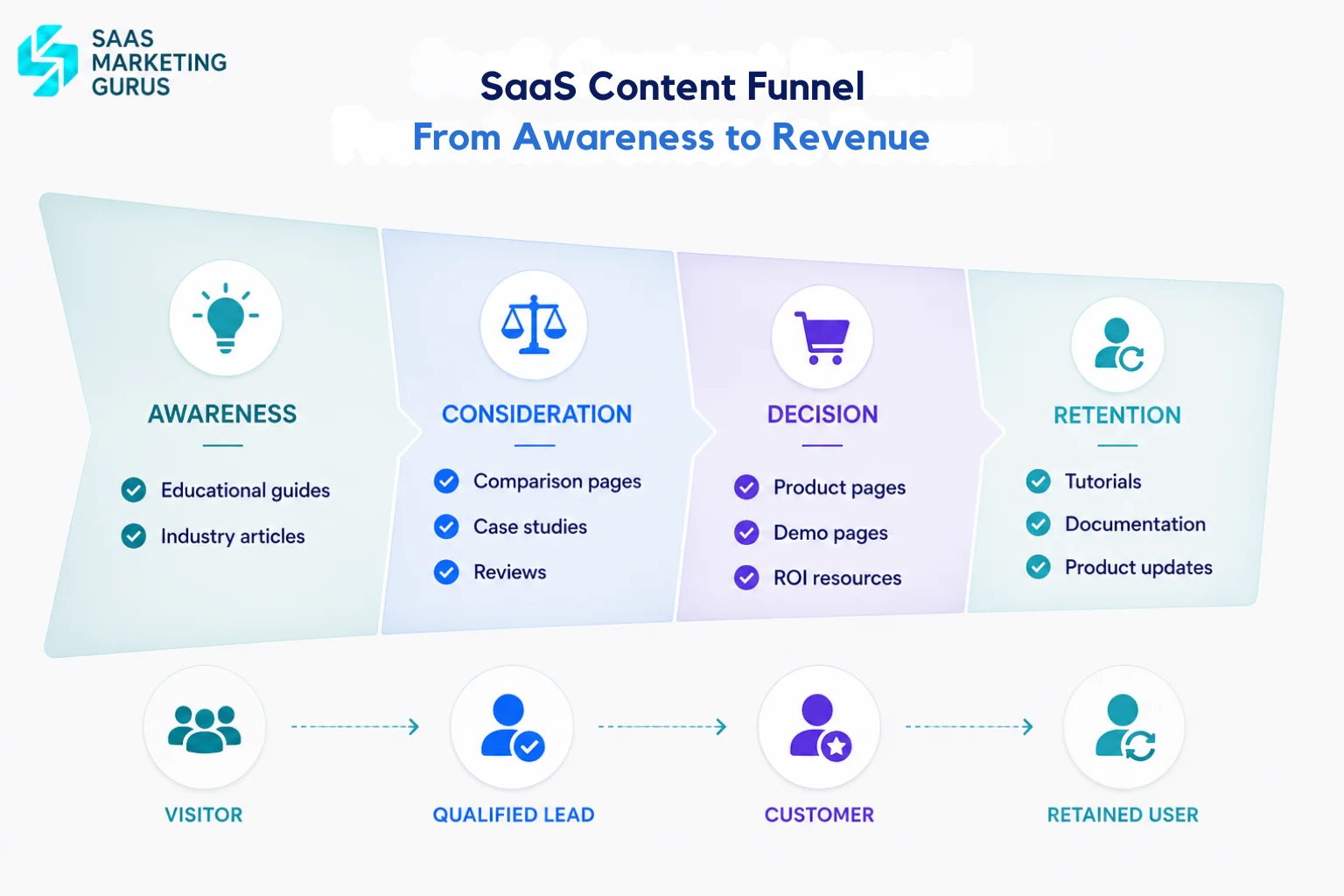
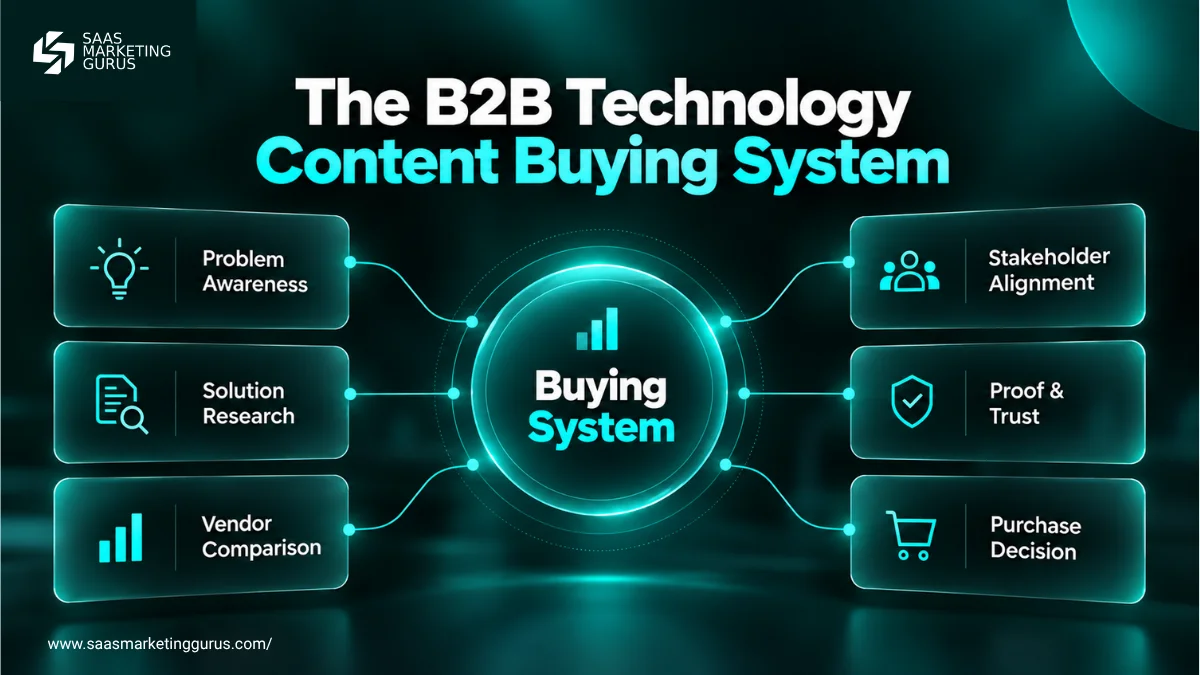
A scalable strategy matches content to the stage the buyer is in:
| Buyer stage | Content that works | Goal | Metric to track |
|---|---|---|---|
| Awareness | Guides, educational articles | Attract the right visitors | Non-brand organic clicks from target countries |
| Consideration | Comparisons, alternatives, case studies | Build buying confidence | Assisted conversions, time on comparison pages |
| Decision | Product pages, demo pages, ROI content | Generate conversions | Demo requests from organic |
| Retention | Tutorials, documentation | Improve adoption | Activation rate, support tickets deflected |
How Can SaaS Brands Build a Content Marketing System That Scales?
At SaaS Marketing Gurus, we use the SMG SaaS Content Growth Framework to build scalable content systems:
Research → Create → Connect → Convert → Optimize
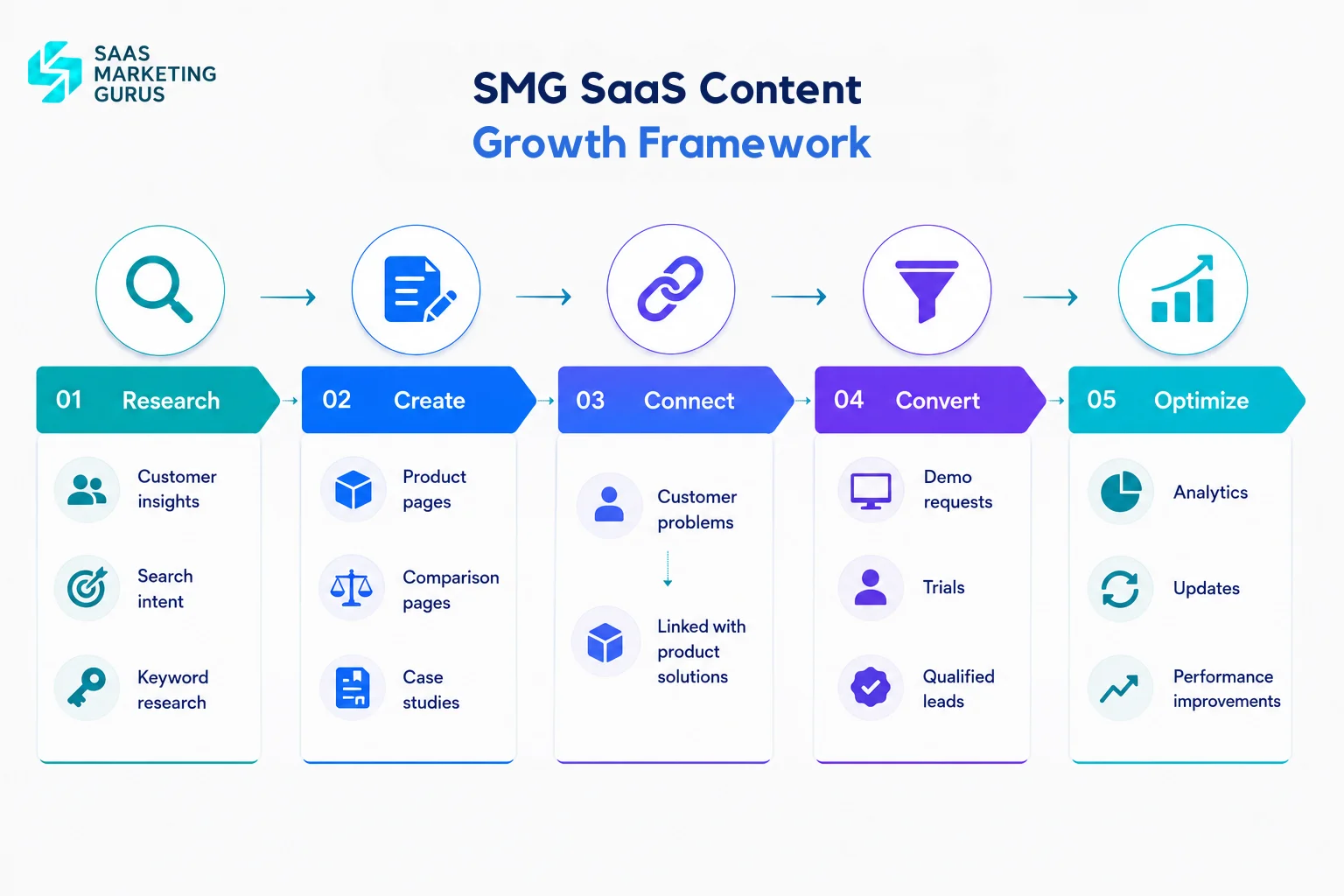
Research
Identify:
- Customer pain points
- Search intent
- Competitor content gaps
- High-value SaaS keywords
Using a structured approach to SaaS keyword research helps companies discover topics connected with real customer needs instead of publishing content based only on assumptions.
Create
Develop content that supports real buying decisions:
- Product pages
- Comparison pages
- Integration pages
- Case studies
- Industry guides
For example, Zapier built strong organic visibility through integration-focused content around user workflows. HubSpot grew authority by connecting educational content with marketing and sales challenges.
Connect
Content should naturally connect customer problems with product solutions.
A CRM SaaS company should not only publish “what is CRM.” It should also create content around CRM comparisons, sales workflows, integrations, and implementation challenges.
Convert and Optimize
Content should support actions such as:
- Demo requests
- Free trials
- Newsletter signups
Measure performance through:
- Organic conversions
- Qualified leads
- Pipeline influence
- Content engagement
How to Build a SaaS Content Marketing Strategy Step by Step
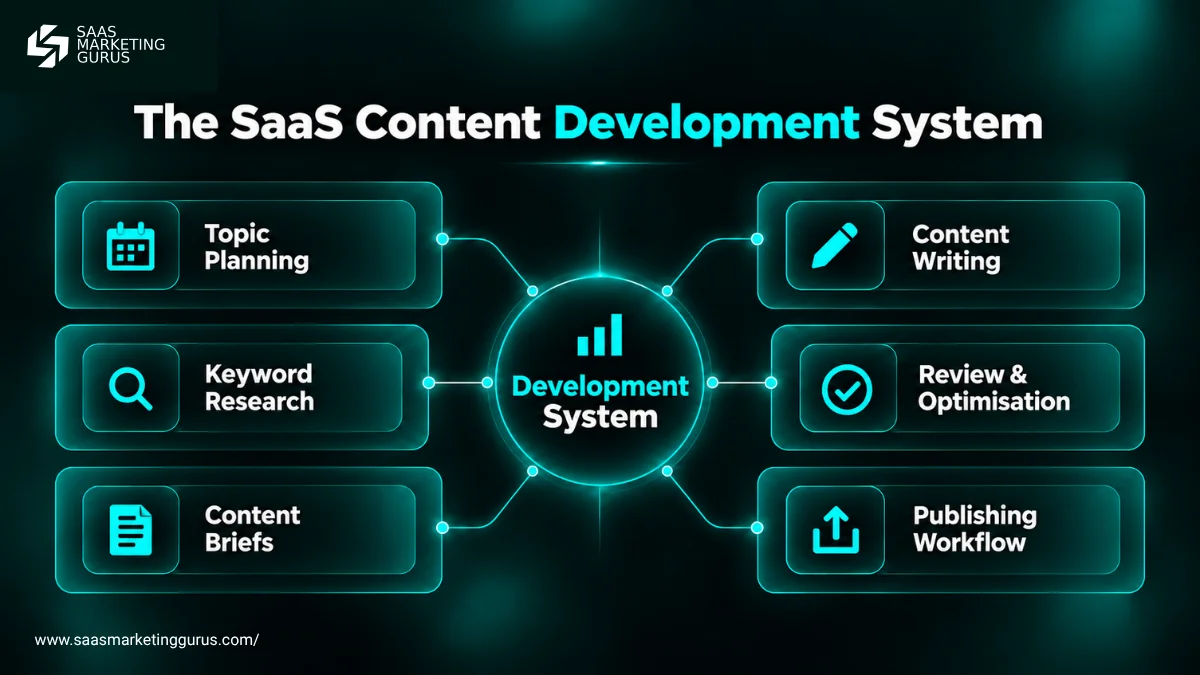
A scalable SaaS content strategy requires more than publishing blog posts. It requires a system that connects customer research, search demand, product knowledge, and business goals.
While the SMG framework explains the overall content system, the following steps explain how SaaS teams can execute this process.
Step 1: Understand Your Target Customers
Start by identifying:
- Ideal customer profile (ICP)
- Customer pain points
- Common objections
- Buying triggers
- Questions customers ask before purchasing
Customer insights help create content that solves real problems instead of targeting keywords without context.
Step 2: Map Content to the Buyer Journey
Different customers search for different information depending on where they are in the buying process.
Awareness Stage
Users are looking for education.
Examples:
- What is marketing automation?
- How does CRM software work?
Consideration Stage
Users compare possible solutions.
Examples:
- Best marketing automation tools
- HubSpot alternatives
- CRM comparison guides
Decision Stage
Users are ready to evaluate products.
Examples:
- Product demos
- Pricing pages
- ROI calculators
- Implementation guides
Step 3: Create Content Clusters
Instead of publishing random articles, SaaS companies should build topic clusters.
Example:
Main Topic:
CRM Software
Supporting Content:
- What is CRM software?
- Best CRM for startups
- CRM implementation guide
- CRM integrations
- CRM alternatives
This structure helps search engines understand topical authority and improves internal linking opportunities.
Step 4: Connect Content With Product Value
The strongest SaaS content does not only educate users. It helps them understand how a product solves their problem.
Examples:
Instead of:
“How to Manage Customer Data”
Create:
“How CRM Software Helps Sales Teams Manage Customer Data”
The second approach connects educational value with product relevance.
Step 5: Measure Business Impact
SaaS content success should be measured through business outcomes.
Track:
- Organic traffic
- Demo requests
- Free trial registrations
- Marketing qualified leads (MQLs)
- Sales qualified leads (SQLs)
- Pipeline contribution
- Revenue influenced by content
Which SaaS Content Types Drive Traffic, Leads, and Revenue?
Different content formats support different stages of SaaS growth. The best SaaS content marketing strategy combines educational content with product-focused resources.
| Content Type | Purpose | Example |
|---|---|---|
| Educational Content | Build awareness and attract new audiences | What is CRM software? |
| Comparison Pages | Capture users evaluating solutions | Salesforce vs HubSpot |
| Alternative Pages | Target competitor searches | Best HubSpot alternatives |
| Integration Pages | Capture solution-focused searches | Slack CRM integrations |
| Use Case Pages | Connect problems with solutions | CRM for SaaS sales teams |
| Product Guides | Support evaluation and adoption | How to automate sales workflows |
| Case Studies | Build trust through proof | How a company improved sales efficiency |
High-performing SaaS companies usually prioritize content that supports buying decisions rather than focusing only on high-volume informational keywords.
How Does SaaS Content Strategy Drive Leads and Revenue?
Successful SaaS content strategy focuses on business impact, not only traffic.
Important metrics include:
- Demo requests
- Free trial signups
- Marketing qualified leads (MQLs)
- Sales qualified leads (SQLs)
- Customer acquisition cost (CAC)
- Content-influenced revenue
A comparison page may attract fewer visitors than a general blog post, but it often reaches users who are closer to making a purchase decision.
From our work with SaaS companies, we have seen that high-intent content such as comparison pages, alternative pages, and integration pages often plays an important role in generating qualified opportunities.
How Can SaaS Brands Improve Visibility in AI Search?
AI assistants now sit before Google in many software searches. G2’s March 2026 survey of 1,076 B2B software buyers found that 51% start research with an AI chatbot more often than with Google, up from 36% seven months earlier. In the same survey, 69% ended up choosing a different vendor than they first expected, and 33% bought from a brand they had never heard of because a chatbot recommended it. G2 runs a review platform, so read the figures as one vendor’s survey, not a neutral census.
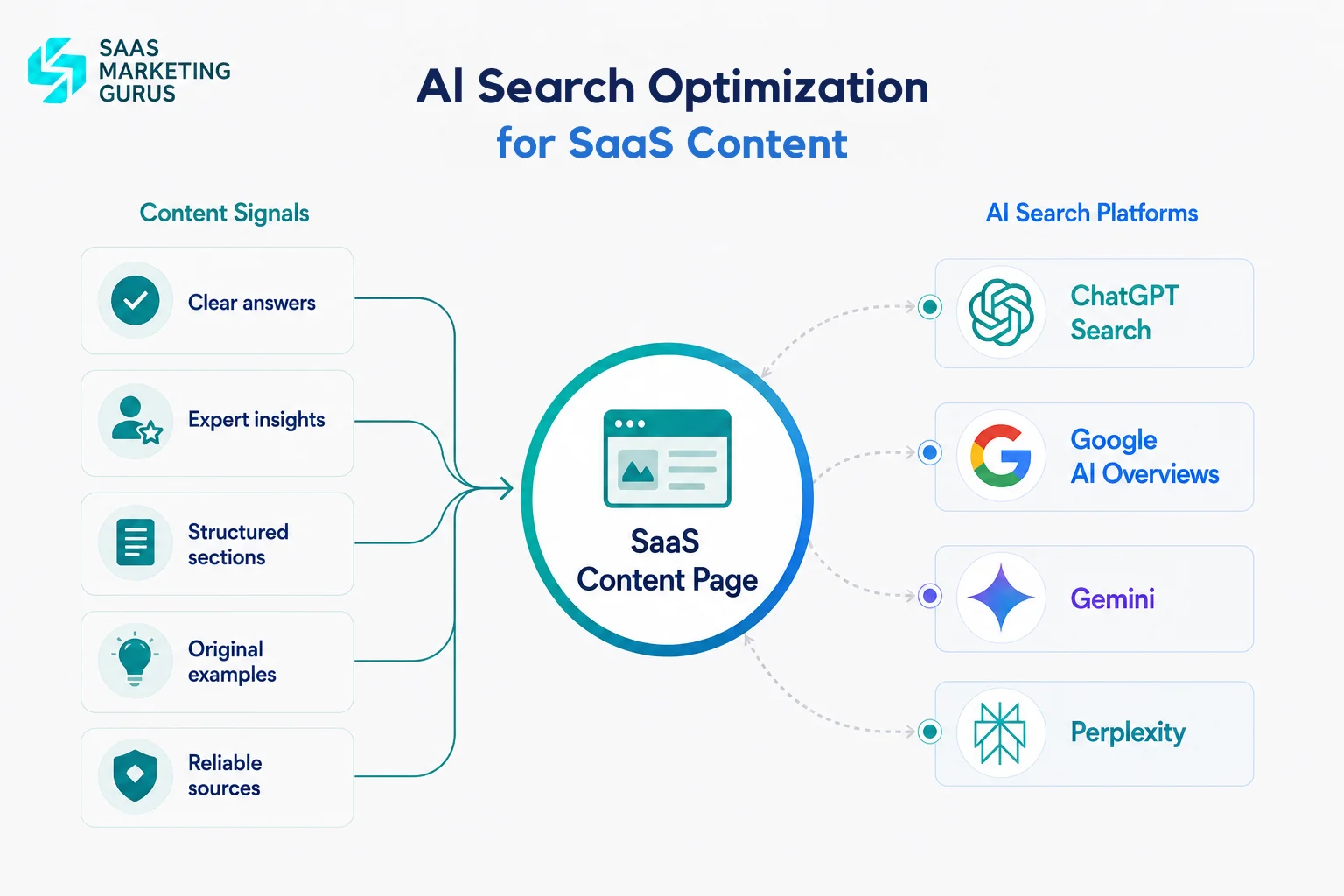
The point for content: AI answers decide who gets considered. Five changes make a page easier for AI engines to cite:
- Put the definition in the first sentence of each section. Engines lift short, self-contained answers.
- Write one claim per paragraph, with a number and a named source. Vague paragraphs are not quoted.
- Use tables for comparisons. Pricing tiers, feature differences, and fit-by-company-size are easy to extract.
- Mirror real prompts in your headings and FAQ. “Best CRM for a 10-person SaaS team” beats “CRM overview”.
- Build third-party proof. G2 found that 45% of buyers rate a review-site citation as the most confidence-inspiring signal in an AI answer. Reviews on G2 and Capterra, and honest participation on Reddit and Quora, feed the same answers.
Your blog alone will not carry this. For how engines pick sources, read how generative search engines rank content. To have SMG run it, see our Generative Engine Optimization services.
What Is the Difference Between SaaS Content Strategy and SaaS Content Marketing Strategy?
A SaaS content strategy decides what you publish and why. A SaaS content marketing strategy adds how it reaches buyers and how you measure it. Most teams have the first and skip the second, which is why good posts sit unread.
| SaaS content strategy | SaaS content marketing strategy | |
|---|---|---|
| Question it answers | What topics, formats, and voice support our positioning? | How does this content reach buyers and turn into demos? |
| Core output | Topic map, editorial standards, content types | Channel plan, distribution, conversion paths, reporting |
| Owner | Head of content or founder | Marketing lead, with sales input |
| Review cycle | Quarterly | Monthly |
| Failure sign | Posts off-brand or off-topic | Posts published, no traffic, no demos |
Build the content strategy first, then the marketing layer on top. The steps below cover both.
SaaS Content Marketing Mistakes That Limit Growth
Creating Content Without Buyer Intent
Many SaaS companies create content based only on search volume. However, traffic does not always translate into customers.
A better approach is to prioritize topics connected to buying decisions.
Examples:
Low intent:
“What is project management?”
High intent:
“Best project management software for remote teams”
Publishing Generic Content
Many SaaS articles fail because they provide information that users can find anywhere.
Strong SaaS content should include:
- Product expertise
- First-hand experience
- Real examples
- Practical recommendations
- Original frameworks
Ignoring Content Distribution
Publishing content is only one part of content marketing.
SaaS companies should also use:
- Internal linking
- Email distribution
- Community engagement
- Social sharing
- Sales enablement
Measuring Traffic Instead of Revenue
A page with 10,000 visitors may generate fewer customers than a comparison page with 500 visitors.
Focus on:
- Qualified leads
- Demo requests
- Pipeline contribution
- Revenue impact
Search behavior changes over time. SaaS companies should regularly update existing content with new examples, statistics, product changes, and search insights.
When Should SaaS Companies Hire a Content Marketing Agency?
A SaaS company may benefit from an agency when:
- Internal teams lack SaaS SEO expertise
- Content generates traffic but has limited qualified leads
- The company needs a scalable content system
- Marketing teams need strategic support
An agency can be useful when a SaaS team needs additional expertise, resources, or a structured content process.
A specialized SaaS marketing agency can help with:
- SaaS SEO strategy
- Content planning
- AI search optimization
- Conversion-focused content
- Content operations
Before hiring an agency, SaaS companies should evaluate:
- Experience with SaaS businesses
- Understanding of customer journeys
- Ability to connect content with revenue goals
- Reporting and measurement process
The best results come when agency expertise combines with the company’s product knowledge and customer data.
SaaS Content Marketing Checklist
Before publishing SaaS content, review:
Strategy
- Target audience identified
- Customer problem defined
- Search intent analyzed
- Content goal selected
SEO
- Primary keyword included
- Related keywords covered
- Internal links added
- Title and meta description optimized
Content Quality
- Clear answer provided early
- Examples included
- Expert insights added
- Data and references included
Conversion
- Relevant CTA added
- Product connection included
- Next step is clear
AI Search Optimization
- Direct answers included
- Structured sections used
- Original insights provided
- Questions answered naturally
How SaaS Marketing Gurus Develop Content Strategies
SaaS Marketing Gurus (SMG) is a B2B SaaS marketing agency specializing in Reddit marketing, Quora marketing, Generative Engine Optimization (GEO), SaaS SEO, and Product Hunt launches. We build content around demos and qualified pipeline, then distribute it where SaaS buyers actually research: search, Reddit, Quora, review platforms, and AI answers.
| Step | What we do | What you get |
|---|---|---|
| 1. Content analysis | Audit current rankings, competitor content, keyword gaps, and pages competing with each other | A keep, merge, update, or delete list |
| 2. Intent mapping | Match every keyword to a buyer stage and a service or demo path | A keyword map scored on business value, intent match, and difficulty |
| 3. Content planning | Build the roadmap of educational, comparison, and product-led pages | A sequenced calendar with owners |
| 4. Distribution | Seed each priority page into Reddit and Quora threads and AI-answer sources | Citations and referral traffic beyond Google |
| 5. Performance tracking | Report organic visibility, demos, and AI citations | A monthly report tied to pipeline, not visits |
Want this built for your product? Book a free 30-minute growth strategy call and we will show you which of your pages to fix first.
FAQs
What is SaaS content marketing?
SaaS content marketing is the practice of publishing content that helps software buyers research, compare, and choose a product, measured by demos and pipeline. It includes guides, comparison pages, case studies, integration pages, and onboarding content.
What is the difference between a SaaS content strategy and a SaaS content marketing strategy?
A content strategy decides what to publish and why. A content marketing strategy adds distribution, conversion paths, and measurement. You need both: the first without the second produces posts nobody reads.
Why is content marketing important for SaaS companies?
Buyers research before they talk to sales. Gartner’s survey of 646 B2B buyers found 67% prefer a rep-free experience. Your content decides whether you make the shortlist before a rep is involved.
What type of content works best for SaaS companies?
Decision-stage content converts best: comparison pages, alternatives pages, pricing explainers, and case studies with real numbers. Educational guides bring the top of the funnel, but a small number of high-intent pages usually produces more demos.
How long does SaaS content marketing take to work?
Expect early ranking movement within 3 to 6 months for a new topic cluster, and measurable demo impact within 6 to 12 months. Pages competing for one keyword, or pages not indexed, slow this down.
How can SaaS companies get cited in AI search?
Put a direct definition at the start of each section, add comparison tables, answer real buyer prompts in your FAQ, and build proof on third-party sites such as G2, Capterra, Reddit, and Quora. G2’s 2026 survey found 45% of buyers trust a review-site citation most in an AI answer.
How do SaaS companies measure content marketing success?
Track demo requests from organic, qualified leads, pipeline influenced by content, and AI citation rate for your priority prompts. Traffic alone is a supporting metric. A rising visit count with flat demos means the content targets the wrong intent.
Do I need a SaaS content marketing template?
Yes, if you are starting or resetting a program. A one-page template that fixes the goal, buyer, topic clusters, proof, channels, and metrics prevents the common failure of publishing without a plan. Use the template earlier on this page.
Build a SaaS Content Engine That Creates Long-Term Growth
SaaS content marketing works best when it becomes a repeatable growth system instead of a collection of individual blog posts.
Successful SaaS brands combine customer research, SEO strategy, product knowledge, and conversion-focused content to attract the right audience and support revenue growth.
The strongest SaaS content programs focus on:
- Creating content around real customer problems
- Targeting high-intent search opportunities
- Building product-led resources that support buying decisions
- Optimizing content for both search engines and AI platforms
- Measuring success through qualified leads and business impact
At SaaS Marketing Gurus, we help SaaS companies build scalable content strategies focused on organic visibility, AI search presence, and qualified pipeline growth.
If your SaaS brand wants to turn content into a predictable acquisition channel, start with a strategy built around customer intent, product value, and measurable results.