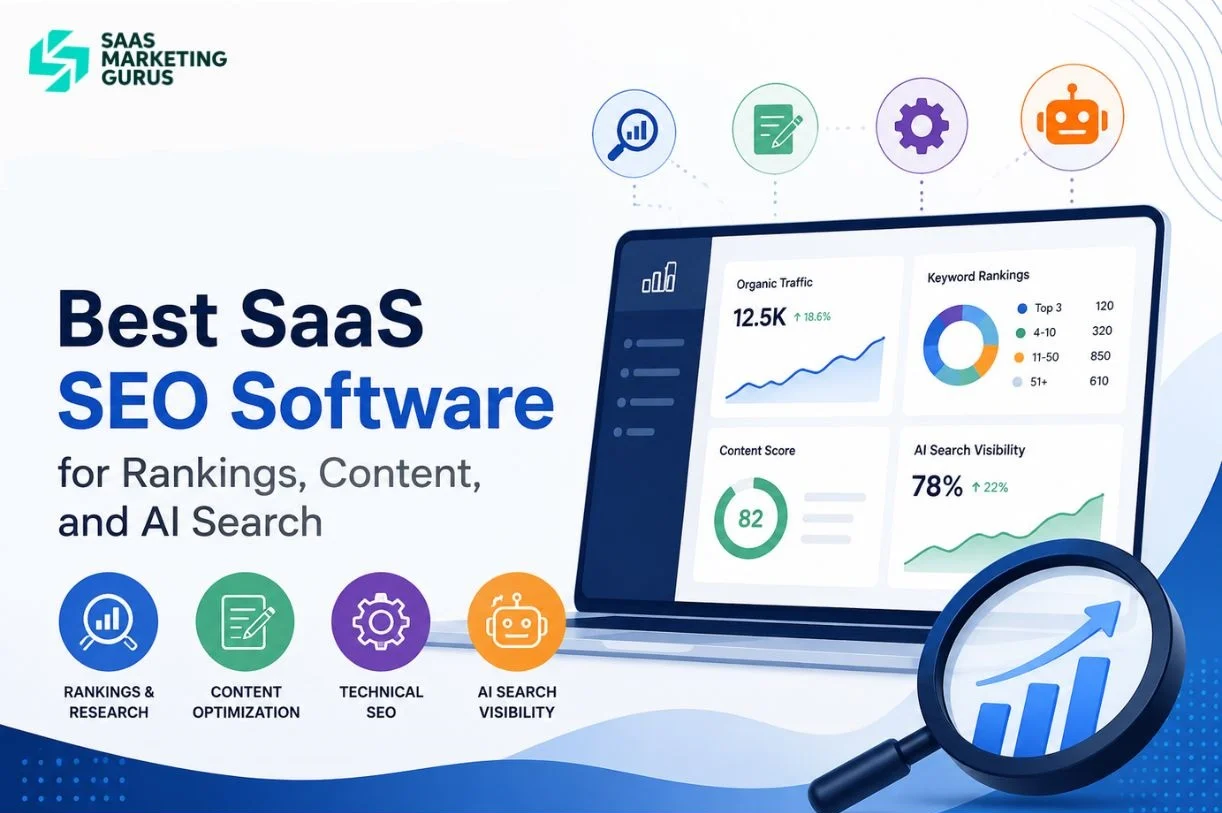
The best SaaS SEO software isn’t necessarily the platform with the longest feature list. It is the tool that solves the specific search problem holding your SaaS company back.
For most SaaS teams, that means combining tools for keyword research, competitor analysis, content optimization, technical SEO, performance tracking, and increasingly, AI search visibility.
Our recommendations are simple:
- Google Search Console for first party Google Search performance data
- Semrush for an all in one SEO and AI visibility platform
- Ahrefs for competitor research, backlinks, and search intelligence
- SE Ranking for teams that want SEO and AI visibility in one platform
- Surfer for content optimization
- Screaming Frog for technical SEO crawling
- OtterlyAI for lower cost AI search monitoring
- Profound for advanced AI visibility programs
You probably don’t need all of them.
A startup publishing two articles a month has very different needs from a SaaS company competing for hundreds of product, comparison, integration, and alternative keywords.
The goal of this guide is therefore not to build the biggest SEO stack. It is to help you build the smallest stack that gives your team the data needed to make better decisions.
If you need the strategy behind the tools first, start with our B2B search engine optimization guide.
What Is SaaS SEO Software?
SaaS SEO software is a tool used by software companies to research search demand, analyze competitors, optimize content, identify technical problems, track rankings, measure conversions, and monitor visibility across traditional and AI powered search.
A good SaaS SEO stack should help answer questions such as:
- What are potential buyers searching for?
- Which competitors already rank for those searches?
- Which keywords have commercial value?
- Why isn’t a page ranking?
- Can Google crawl and index the site correctly?
- Which content needs improvement?
- Are rankings producing signups or demos?
- Is the brand appearing in ChatGPT, Google AI Overviews, Gemini, Perplexity, and other AI search experiences?
That last question matters more now because search visibility is no longer limited to ten traditional organic results.
Google itself says that its existing SEO best practices remain relevant to AI Overviews and AI Mode. It does not recommend a separate technical trick or special AI markup for inclusion in these experiences. Good crawling, useful content, internal linking, page experience, structured information, and trustworthy content still matter. Read Google’s guidance for AI features in Search.
That means SaaS companies need to extend SEO for AI search rather than abandon traditional SEO.
Best SaaS SEO Software at a Glance
| Tool | Best For | Main SaaS Use Case | Main Limitation |
|---|---|---|---|
| Google Search Console | Google performance data | Queries, clicks, indexing, and page performance | Limited competitor research |
| Semrush | All in one SEO | Keywords, competitors, rankings, audits, and AI visibility | Can become expensive as requirements grow |
| Ahrefs | Competitive research | Keywords, backlinks, content gaps, and AI visibility research | More functionality than smaller teams may need |
| SE Ranking | SEO plus AI tracking | Rank tracking, audits, competitor analysis, and AI visibility | Some advanced capabilities depend on plan or add ons |
| Surfer | Content optimization | Content briefs, optimization, and AI search guidance | Does not replace strategy or subject expertise |
| Screaming Frog | Technical SEO | Crawling, JavaScript rendering, links, metadata, and indexability | Requires technical SEO knowledge |
| OtterlyAI | AI visibility monitoring | Tracking mentions and citations across AI platforms | Not a complete traditional SEO platform |
| Profound | Advanced AI visibility | AI answers, citations, sentiment, and content visibility | Better suited to teams with larger AI search programs |
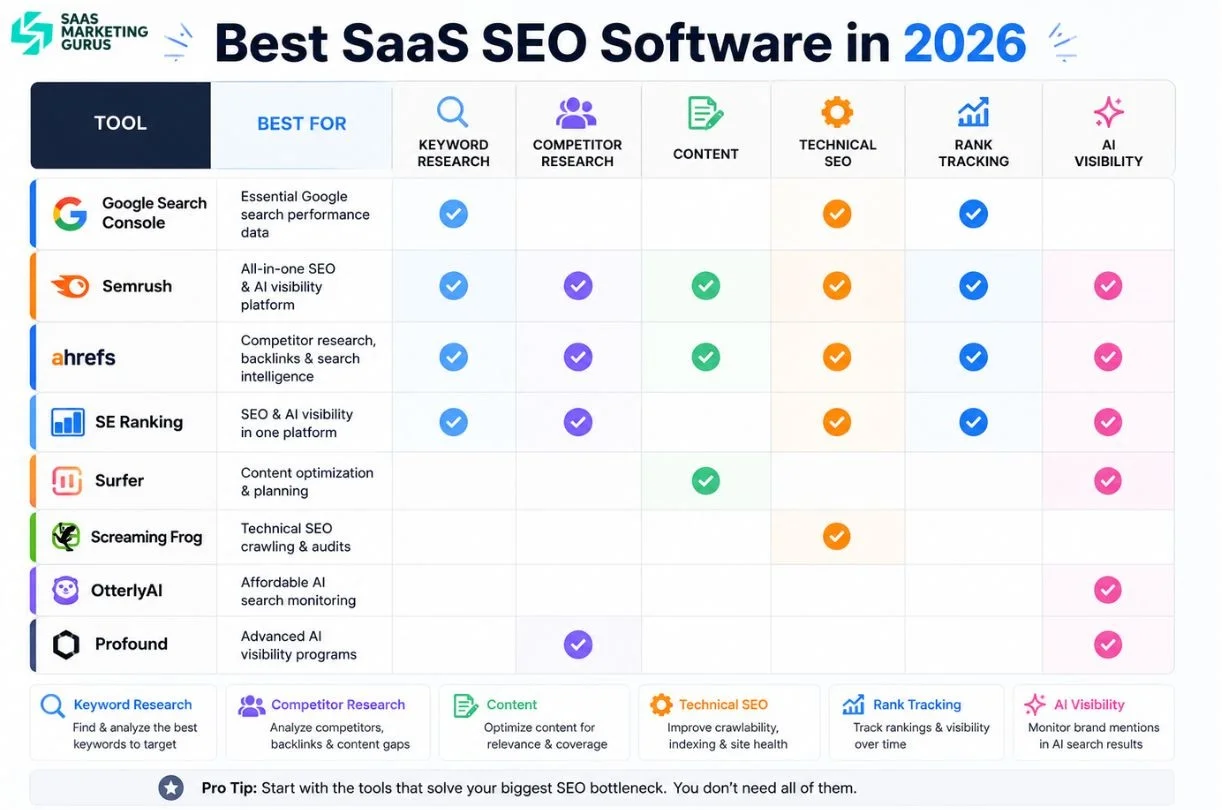
There is no universal winner because these products solve different parts of the SEO workflow.
How We Evaluated SaaS SEO Software
A SaaS SEO tool should be evaluated by what it helps your team accomplish, not by the number of features shown on its pricing page.
For this guide, the most important criteria are:
1. Keyword and competitor intelligence
Can the software identify relevant keywords, ranking competitors, content gaps, and commercial search opportunities?
Search volume by itself isn’t enough. SaaS companies need to distinguish general educational searches from high intent queries connected to product evaluation.
Our SaaS keyword research guide explains how we evaluate keywords using intent, product fit, business value, and conversion potential.
2. Content optimization
Can the software identify missing topics and help editors build more complete pages without turning content into keyword stuffing?
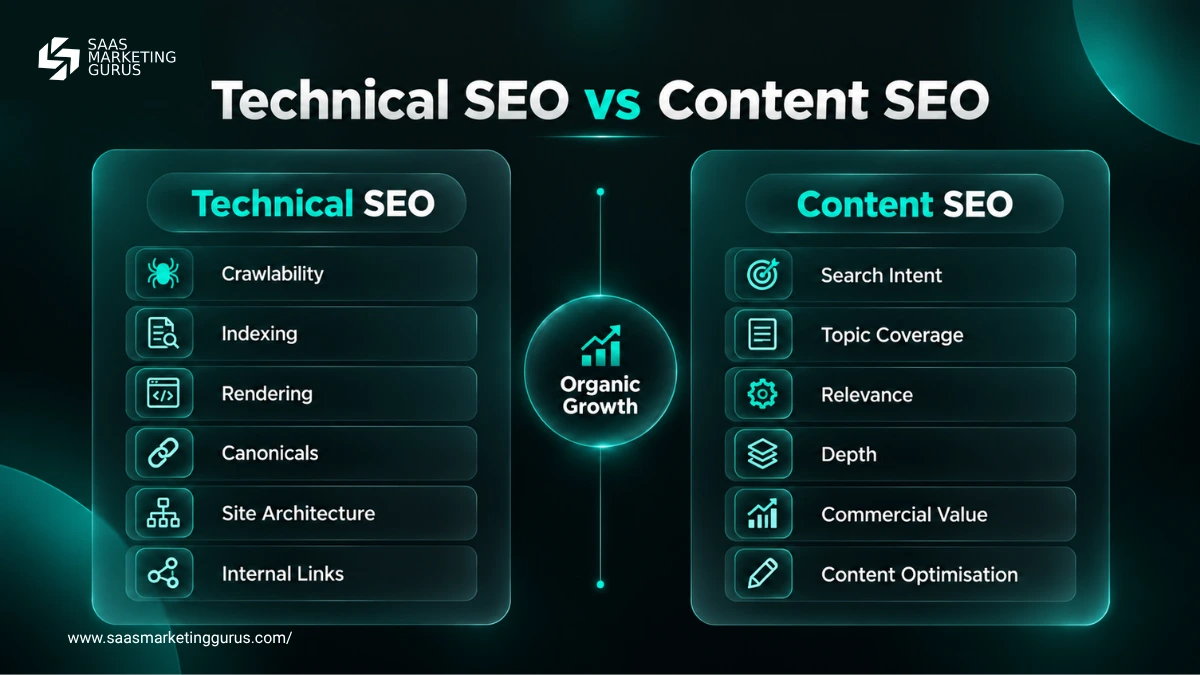
3. Technical SEO
Can it identify crawling, rendering, indexing, internal linking, duplicate content, metadata, canonicalization, and site architecture problems?
4. Measurement
Can you see whether improved visibility leads to meaningful business outcomes?
For a SaaS company, a position increase matters less if it doesn’t eventually contribute to product signups, trials, qualified demos, or pipeline.
5. AI search visibility
Can the tool show whether your company is mentioned or cited across AI search experiences?
This is increasingly useful for companies already investing heavily in organic acquisition.
6. Fit for your team
A five person SaaS startup shouldn’t copy the SEO stack of a public software company.
The right stack depends on your website size, competitive environment, publishing volume, internal expertise, and budget.
1. Google Search Console: Best Essential SEO Tool for Every SaaS Company
Every SaaS company doing SEO should use Google Search Console.
It provides information directly from Google about:
- Search queries
- Impressions
- Clicks
- Average positions
- Indexed pages
- Crawling and indexing issues
- Core Web Vitals
- Sitemap status
- Individual URL indexing
Google describes Search Console as a tool for understanding how a website performs in Google Search and how Google crawls, indexes, and serves its pages.
Where Search Console is especially useful for SaaS
Suppose you’ve built a page targeting:
project management software for agencies
Search Console might reveal that Google is already showing the page for related searches such as:
- agency project management platform
- project management tools for creative agencies
- software for managing agency projects
Those impressions can reveal new optimization opportunities that third party keyword databases may not show in exactly the same way.
Search Console is also useful when a page receives impressions but few clicks. That can point to a title, intent, positioning, or SERP problem rather than a simple ranking problem.
Where Search Console falls short
It isn’t a full competitor intelligence platform.
You won’t use Search Console alone to deeply analyze competitor backlinks, find thousands of new keyword opportunities, or build large competitive content gap reports.
Our verdict: Use Search Console regardless of which paid SaaS SEO software you choose.
2. Semrush: Best All In One SaaS SEO Platform
Semrush makes sense when a SaaS marketing team wants research, rank tracking, site auditing, competitor intelligence, backlinks, and AI visibility within the same broader ecosystem.
Its SEO tools cover areas such as:
- Keyword research
- Position tracking
- Competitor research
- Backlinks
- Site audits
- Content research
- Search visibility
- AI search monitoring
Semrush now also offers dedicated AI visibility capabilities for tracking brand visibility across AI search environments. Its current AI Visibility Toolkit includes prompt tracking and brand performance analysis, while its broader SEO and AI plans combine traditional search and AI visibility functions.
Best SaaS use case
Semrush is especially useful when one marketing team handles several search functions and wants fewer separate platforms.
For example, a B2B SaaS company could use it to:
- Find competitors ranking for high intent queries.
- Identify missing comparison and alternative keywords.
- Track target positions.
- audit technical issues.
- Monitor backlinks.
- Compare traditional search visibility with emerging AI visibility.
Where Semrush falls short
Breadth can become a disadvantage if your team only needs one specific function.
A small startup that only needs keyword research and basic monitoring may end up paying for far more functionality than it regularly uses.
Our verdict: A strong choice for growing SaaS marketing teams that want a broad SEO platform instead of several disconnected tools.
3. Ahrefs: Best for SaaS Competitor and Backlink Research
Ahrefs remains particularly useful when competitive research is central to your SEO strategy.
Its core use cases include:
- Keyword research
- Competitor keyword analysis
- Content gap research
- Backlink analysis
- Link opportunities
- Rank tracking
- Site auditing
- Content research
For SaaS teams, one of its most useful applications is studying which pages drive competitors’ organic visibility.
Imagine you’re competing in the CRM category.
Instead of only researching “CRM software,” you can study which competitors are gaining visibility from searches around:
- CRM alternatives
- CRM comparisons
- CRM for startups
- CRM for agencies
- CRM integrations
- CRM pricing
- Specific competitor alternatives
This helps turn keyword research into a map of the competitive buying journey.
Ahrefs has also expanded into AI visibility through Brand Radar, which analyzes brand presence across platforms including ChatGPT, Google AI features, Gemini, Perplexity, and Copilot.
Where Ahrefs falls short
It can overlap heavily with other full SEO platforms.
If you’re already paying for a complete Semrush or SE Ranking setup, buying Ahrefs should solve a specific additional need rather than simply duplicate reports.
Our verdict: Strongest fit for SaaS teams where competitor analysis, backlinks, and content opportunity research are core parts of the SEO workflow.
4. SE Ranking: Best for Combining Traditional SEO and AI Visibility
SE Ranking is worth considering if you want traditional SEO functions and AI search monitoring without building two completely separate reporting systems.
Its platform covers:
- Rank tracking
- Keyword research
- Competitor analysis
- Backlink monitoring
- Site auditing
- Google Analytics and Search Console integrations
- AI visibility tracking
Its AI search tools can monitor brand mentions and links across platforms such as ChatGPT, Google AI Overviews, AI Mode, Gemini, and Perplexity.
Best SaaS use case
SE Ranking fits a company that wants to answer two questions from the same overall SEO workflow:
How visible are we in Google?
and
How visible are we in AI generated answers?
That makes it useful for teams moving from conventional rank reporting toward wider search visibility reporting.
Where SE Ranking falls short
If backlink intelligence is your main priority, you may still prefer a more specialized research platform. Similarly, a company running a large enterprise AI visibility program may eventually need a more specialized AI search platform.
Our verdict: A practical option for growing SaaS teams that want SEO and GEO measurement without immediately building a large tool stack.
5. Surfer: Best SaaS SEO Software for Content Optimization
Surfer focuses much more heavily on content than platforms such as Ahrefs or Semrush.
It analyzes search results and provides optimization guidance around areas such as:
- Topics
- Terms
- Content structure
- Headings
- Coverage
- SERP patterns
- Content optimization
Surfer has also added AI search optimization guidance and AI visibility functions to its product.
Where Surfer helps SaaS teams
Consider a SaaS company writing a guide about:
customer onboarding software
The writer may understand the product, but competitors could be covering important related entities and questions that the first draft misses.
A content optimization tool can help reveal those gaps before publication.
Where teams misuse content scores
A high optimization score is not a ranking guarantee.
A page can be thoroughly optimized and still fail because:
- Search intent is wrong.
- The website lacks authority.
- The page provides nothing original.
- Internal linking is weak.
- The page doesn’t satisfy buyer needs.
- The topic doesn’t fit the company’s product.
- Competitors have much stronger evidence or experience.
Google’s current guidance continues to emphasize helpful, reliable, people first content rather than content created primarily to manipulate rankings.
Use optimization scores as diagnostic guidance, not a publishing target.
Our verdict: Best suited to SaaS teams producing enough content to justify a dedicated optimization workflow.
6. Screaming Frog: Best for Technical SaaS SEO Audits
Screaming Frog SEO Spider is different from the other products on this list.
It is primarily a website crawler.
It can help find issues involving:
- Broken links
- Redirects
- Metadata
- Canonical tags
- Internal links
- Duplicate pages
- Indexability
- Structured data
- Response codes
- JavaScript rendering
The free version can crawl up to 500 URLs, while its licensed version unlocks larger crawls and advanced features including JavaScript rendering.
Why this matters for SaaS websites
Modern SaaS marketing sites can contain content or navigation generated through JavaScript.
A crawler that can compare raw and rendered content is useful when checking whether important links, text, metadata, or other elements are available after rendering.
Screaming Frog can render client side JavaScript through a headless browser and extract content and links from the rendered HTML.
Where Screaming Frog falls short
It identifies technical information. It doesn’t decide your SaaS positioning, select commercial topics, create a buyer journey, or tell you why a competitor’s positioning converts better.
It also has a steeper learning curve than a basic site audit dashboard.
Our verdict: Essential for technical SEO specialists and larger SaaS sites, but unnecessary as a daily tool for every founder.
7. OtterlyAI: Best Lower Cost Tool for AI Search Monitoring
OtterlyAI focuses specifically on visibility inside AI search.
Instead of asking where your page ranks for a conventional keyword, you can monitor questions such as:
- What are the best customer support platforms for SaaS?
- Which HubSpot alternatives are best for startups?
- What software should an ecommerce company use for subscription billing?
- Which project management platform works best for agencies?
OtterlyAI tracks brand mentions and citations for user defined prompts across AI search platforms. Its current product covers systems including ChatGPT, Google AI experiences, Gemini, Perplexity, Microsoft Copilot, and Claude, depending on the plan and configuration.
Why this matters
Traditional keyword tracking tells you whether you occupy a search position.
AI visibility monitoring answers a different question:
When a prospect asks an AI system for recommendations, does your brand appear at all?
The two measurements should sit alongside each other.
For a deeper explanation of this distinction, read our guide to AEO vs GEO for SaaS.
Our verdict: A useful starting point for SaaS teams that specifically want AI visibility monitoring without buying an enterprise platform.
8. Profound: Best for Advanced AI Search Visibility Programs
Profound is designed around AI search rather than conventional keyword rankings.
Its platform focuses on areas such as:
- AI visibility
- Answer monitoring
- Source citations
- Brand sentiment
- Competitive AI visibility
- Content performance in answer engines
Profound positions its platform around understanding how brands appear in AI generated answers and which sources influence those answers.
Best SaaS use case
A mature SaaS company may already have:
- Strong Google rankings
- Hundreds of commercial pages
- An established content engine
- Dedicated SEO specialists
- Significant branded search demand
At that point, the company may need deeper visibility into prompts, citations, competitors, and brand representation across answer engines.
A specialist AI visibility platform becomes more useful at that stage.
Our verdict: Better suited to mature SaaS companies treating AI search as a serious acquisition and brand visibility channel.
Which SaaS SEO Software Should You Choose?
Use the problem you’re trying to solve as the starting point.
| If Your Main Problem Is | Start With |
|---|---|
| You don’t know what Google already ranks you for | Google Search Console |
| You need one broad SEO platform | Semrush or SE Ranking |
| You need deeper competitor and backlink research | Ahrefs |
| Your writers consistently miss content gaps | Surfer |
| You suspect technical crawling or rendering problems | Screaming Frog |
| You want affordable AI visibility tracking | OtterlyAI |
| AI search is becoming a major company initiative | Profound or an advanced AI visibility platform |
The mistake is starting with:
“Which tool has the most features?”
Start with:
“Which decision can’t we currently make because we don’t have the right data?”
That question usually cuts your shortlist quickly.
What Is the Best SaaS SEO Stack by Company Stage?
Your SEO stack should grow with your business, rather than starting with every tool at once. Use the roadmap below to see which tools and capabilities make sense at each stage of SaaS growth.
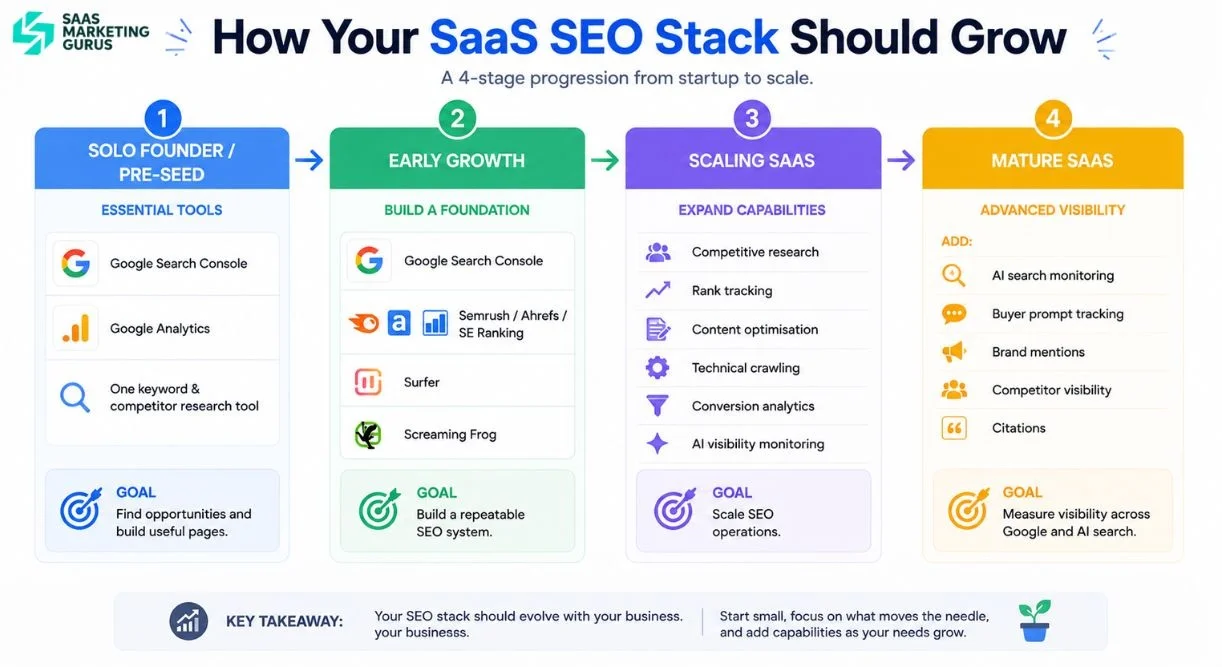
Solo Founder or Pre Seed SaaS
Keep the stack small.
Start with:
- Google Search Console
- Google Analytics
- One keyword and competitor research platform
At this stage, research and execution matter more than advanced reporting.
Your priority should be finding a small number of relevant opportunities and building pages that can actually contribute to acquisition.
Don’t buy four tools to manage a website with twenty pages.
Early Growth SaaS
Once you’re publishing consistently, consider:
- Google Search Console
- Semrush, Ahrefs, or SE Ranking
- Surfer or another content optimization tool
- Screaming Frog for periodic technical audits
Your biggest challenge at this stage is usually building a repeatable SEO system.
That includes identifying commercial topics, publishing useful content, strengthening internal links, fixing technical issues, and measuring which pages influence signups or demos.
Our SaaS SEO services guide explains what a complete SaaS SEO program should include beyond software.
Scaling SaaS Company
At greater scale, the stack can expand to include:
- Competitive research
- Dedicated rank tracking
- Content optimization
- Technical crawling
- Conversion analytics
- AI search visibility monitoring
But every additional platform should have an owner.
If nobody is responsible for acting on a dashboard, the dashboard isn’t solving anything.
Mature SaaS Company With Strong Google Visibility
This is where AI visibility monitoring becomes much more valuable.
Start tracking the questions prospects are likely to ask AI systems during product discovery and evaluation.
Examples include:
- Best tools for X
- Best X software for Y industry
- X vs Y
- Alternatives to X
- What software should I use for X?
- Which platform integrates with X?
- Best software for a specific company type
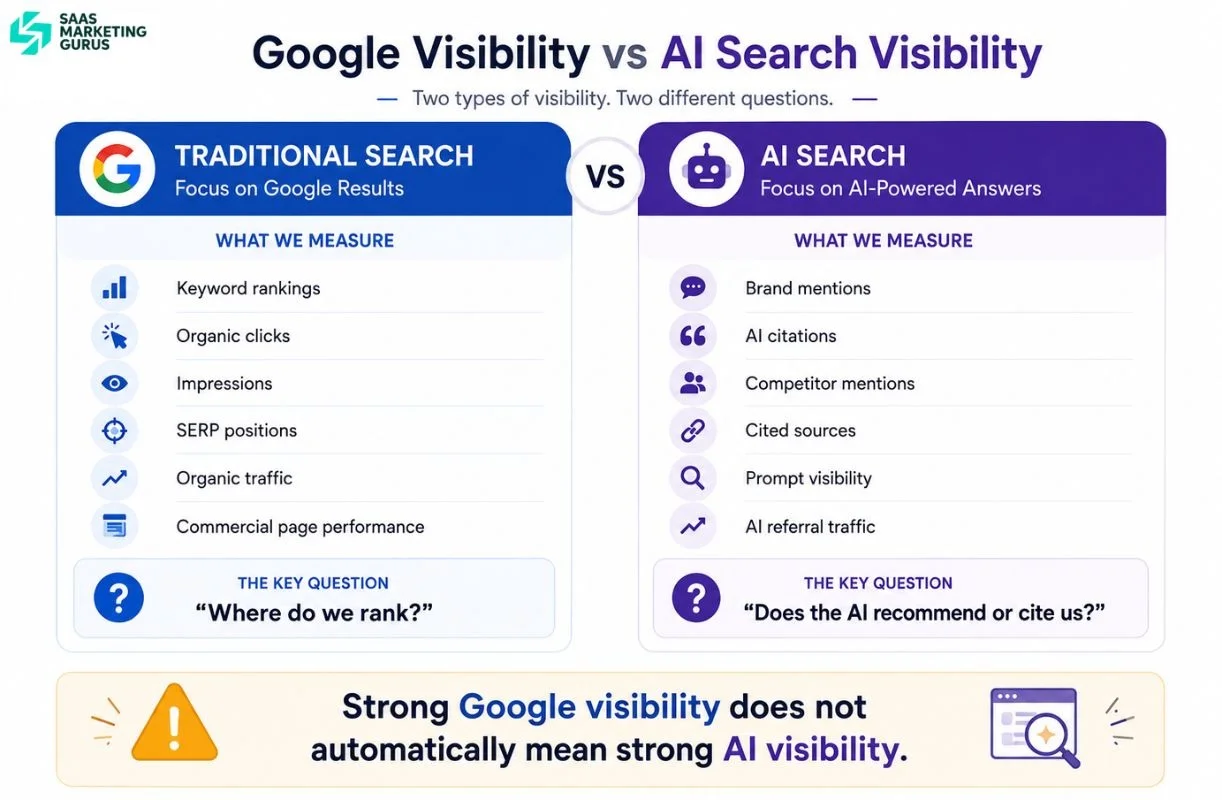
Then compare:
Google visibility
with
AI answer visibility
You may find that strong organic visibility and strong AI visibility don’t always look identical.
How Should SaaS Companies Use SEO Software?
A tool only becomes valuable when it changes what you do.
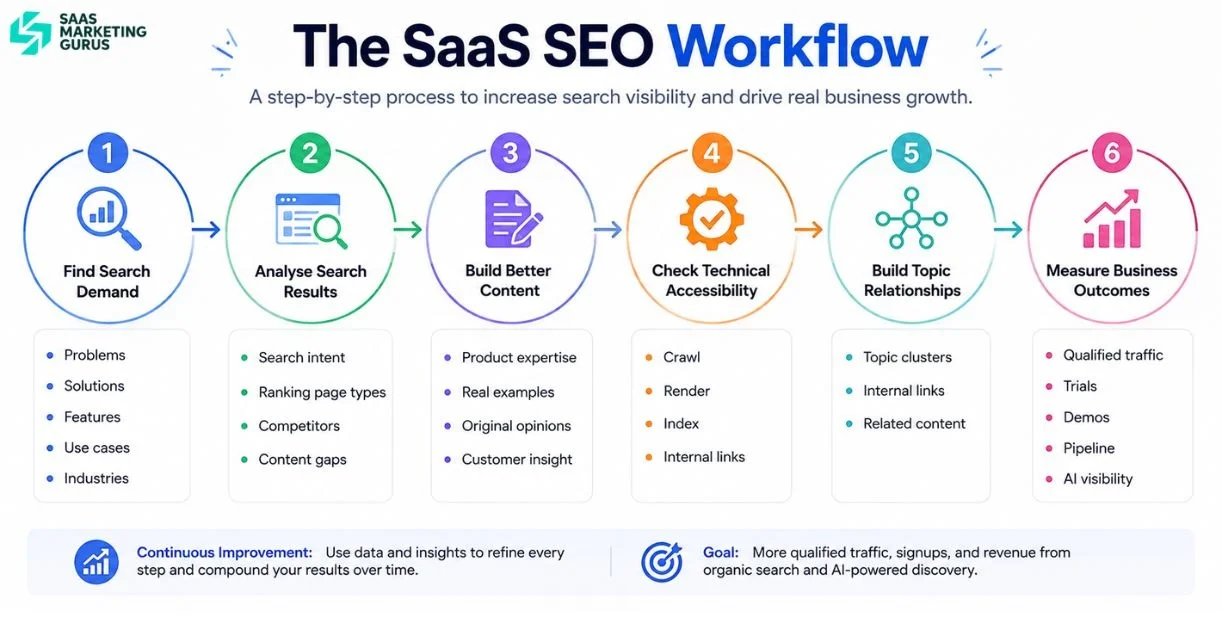
A practical SaaS SEO workflow looks like this:
Step 1: Find business relevant search demand
Don’t start by sorting thousands of keywords by search volume.
Map topics to:
- Problems
- Solutions
- Features
- Use cases
- Industries
- Integrations
- Comparisons
- Alternatives
Then prioritize topics based on search intent and product relevance.
Step 2: Analyze the actual search results
Look at the pages Google rewards.
Ask:
- What intent dominates?
- Are results educational or commercial?
- What page type ranks?
- Which companies appear repeatedly?
- What information do the strongest pages include?
- What do those pages fail to explain?
Your content should fill the gap rather than simply reproduce the current results.
Step 3: Build better content
Use content optimization software to identify missing coverage, but add what software cannot supply:
- Product expertise
- Real examples
- Original opinions
- Customer insight
- Internal data
- Comparisons
- Practical processes
- Screenshots
- Expert commentary
Google’s guidance on generative AI content is similar: AI can assist with research and structure, but generating pages at scale without adding value can conflict with its spam policies. See Google’s guidance on generative AI content.
Step 4: Check technical accessibility
Make sure search engines can crawl, render, index, and understand the important pages.
Use Search Console and a crawler to find problems before investing more money in content.
Step 5: Build topic relationships
Internal links help users and search systems understand how your pages relate.
For example, this article connects naturally with our guides covering:
- SaaS keyword research
- B2B search engine optimization
- Answer Engine Optimization for SaaS
- AEO vs GEO
- How generative search engines rank SaaS content
This builds a clearer SaaS SEO and AI search topic cluster instead of treating every article as an isolated page.
Step 6: Measure business outcomes
Don’t stop at rankings.
Track:
- Qualified organic traffic
- Trial registrations
- Demo requests
- Conversion rate
- Assisted conversions
- Commercial page performance
- Branded search
- AI referral traffic where measurable
- AI mentions and citations
A keyword moving from position nine to position four is useful.
A page producing qualified demos is more useful.
Common SaaS SEO Software Mistakes
Buying Ahrefs and Semrush without a reason
They overlap in several major areas.
Use both only if the additional research depth justifies the cost.
Treating content scores as Google’s ranking algorithm
They aren’t.
Optimization tools analyze patterns and provide recommendations. They don’t know the complete ranking system.
Tracking thousands of irrelevant keywords
A huge ranking report can hide weak commercial performance.
Track the topics that connect with how customers discover and evaluate your product.
Ignoring Google Search Console
Paying for expensive software while ignoring Google’s own performance data makes little sense.
Adding AI tracking too early
A pre seed startup with twelve pages doesn’t need an enterprise AI visibility system.
Build useful web visibility first.
Measuring AI visibility without analyzing citations
Knowing your brand appeared is only part of the picture.
You also want to understand:
- Which prompts trigger the brand?
- Which competitors appear?
- Which websites are cited?
- Which pages earn citations?
- How does the answer describe your product?
That gives you information you can actually use.
Expecting software to execute the strategy
This is the biggest problem.
SEO software can identify:
- A keyword opportunity
- A weak page
- A broken internal link
- An indexing problem
- A competitor advantage
- Missing content
- An AI citation gap
It cannot automatically turn all of those insights into an effective SaaS acquisition strategy.
Someone still needs to prioritize and execute.
So, What Is the Best SaaS SEO Software?
There isn’t one best SaaS SEO software platform for every company.
For most SaaS teams, our starting recommendations are:
Google Search Console if you need accurate Google performance data.
Semrush if you want a broad SEO and AI search platform.
Ahrefs if competitor and backlink research are central to your strategy.
SE Ranking if you want traditional SEO and AI visibility in one wider workflow.
Surfer if content optimization is your primary bottleneck.
Screaming Frog if technical SEO is your problem.
OtterlyAI if you want a focused entry point into AI search monitoring.
Profound if you need a more advanced AI search visibility program.
Start with the bottleneck.
Then buy the software that removes it.
Where SaaS Marketing Gurus Fits
SEO software gives your team information.
Growth still depends on what happens after the report.
A keyword research tool can identify a high intent opportunity, but it doesn’t decide how your product should be positioned on the page.
A crawler can identify broken internal links, but it doesn’t build your content architecture.
An AI visibility platform can show that competitors appear in ChatGPT while you don’t, but it doesn’t automatically create the authority, content, brand mentions, and third party signals needed to close that gap.
That execution layer is where SaaS Marketing Gurus’ B2B SaaS SEO services fit.
We focus on commercial SaaS search opportunities including comparisons, alternatives, use cases, and solution queries, while connecting SEO work to qualified acquisition rather than treating traffic as the final KPI.
For companies expanding their search strategy beyond Google, our Generative Engine Optimization services focus on improving SaaS visibility across AI generated answers and AI search experiences.
The principle is the same in both cases:
Don’t add another dashboard until you know what action the dashboard is supposed to drive.
If your SEO tools keep producing reports but your search visibility and pipeline aren’t moving, book a SaaS growth consultation and we’ll help identify whether the real constraint is research, content, technical SEO, authority, AI visibility, or execution.
Frequently Asked Questions
What is the best SaaS SEO software?
There is no single best option for every company. Semrush is strong for broad SEO workflows, Ahrefs for competitor and backlink research, Surfer for content optimization, Screaming Frog for technical audits, and tools such as OtterlyAI and Profound for AI search visibility.
What SEO tools should a SaaS startup use?
An early stage SaaS company can usually start with Google Search Console, Google Analytics, and one keyword and competitor research tool such as Semrush, Ahrefs, or SE Ranking. Add specialist software only when a specific need appears.
Is Ahrefs or Semrush better for SaaS SEO?
Semrush is generally better suited to teams that want many SEO functions in one platform. Ahrefs is particularly strong for competitor research, backlinks, keyword discovery, and content opportunity analysis. The better option depends on your workflow.
Do SaaS companies need AI SEO tools?
Not every SaaS company needs dedicated AI tracking immediately. Companies with established organic visibility should consider monitoring important buyer prompts, brand mentions, competitor mentions, and citations across AI search as an additional layer of search measurement.
Can AI SEO replace traditional SEO software?
No. Google states that core SEO practices still apply to its generative search features. SaaS companies still need crawlable websites, useful content, strong internal linking, clear site structure, relevant authority, and good technical SEO. AI visibility tools add another layer of measurement rather than replace those fundamentals.
How do you measure SaaS visibility in AI search?
Track whether your brand is mentioned or cited for important buyer prompts, how frequently competitors appear, which sources AI systems cite, which pages earn citations, and how that visibility changes over time. Where possible, connect this data with branded search, referral traffic, signups, and pipeline.
Is free SaaS SEO software enough?
Free tools such as Google Search Console can cover essential performance and indexing needs, especially for smaller SaaS sites. Paid software becomes useful when you need deeper competitor research, large-scale keyword analysis, content optimization, technical crawling, rank tracking, or AI search monitoring.