
A B2B SEO audit is a structured review of your SaaS website’s technical SEO, keyword targeting, content, site architecture, authority, internal links, and conversion paths.
For B2B SaaS companies, an audit also needs to examine how each page supports the buyer journey. A blog post, product page, comparison page, pricing page, and integration page serve different search intents and business goals.
At SaaS Marketing Gurus, we approach SEO audits as growth diagnostics. We identify what limits search visibility, qualified traffic, and pipeline growth, then create a prioritised roadmap for improvement.
What Is a B2B SEO Audit?
A B2B SEO audit evaluates whether your website is technically accessible, targeting the right searches, satisfying search intent, building authority, and turning organic traffic into qualified business opportunities.
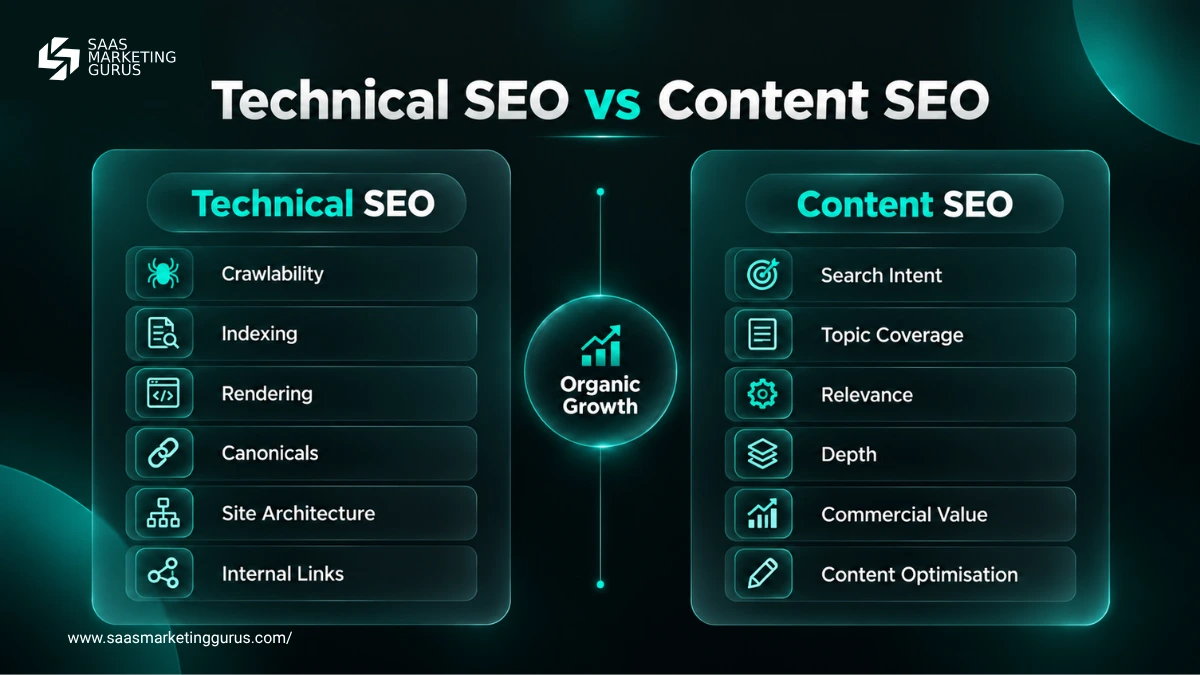
A technical SEO audit focuses mainly on crawlability, indexing, rendering, site performance, redirects, canonicals, XML sitemaps, and other technical factors.
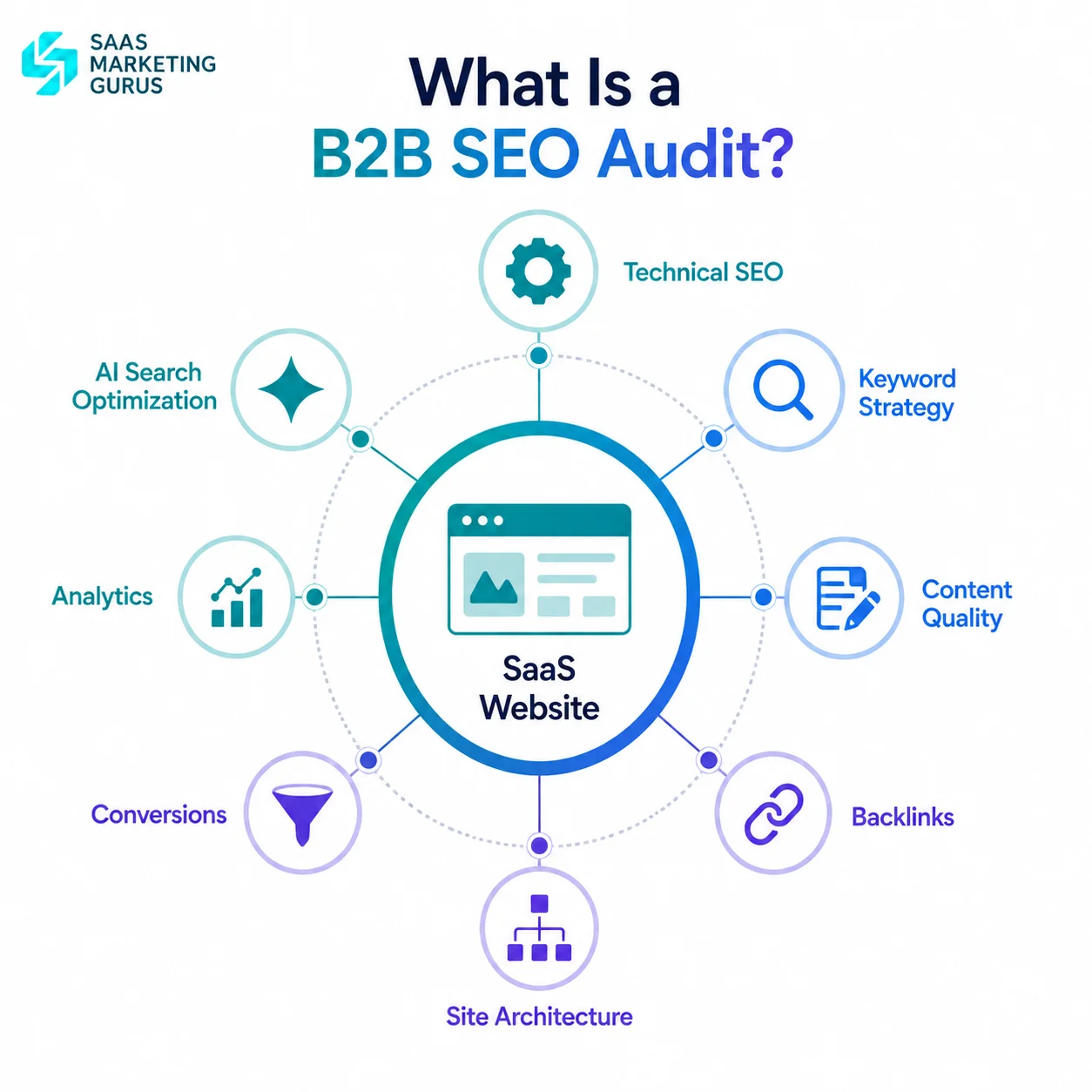
A B2B SEO audit goes further with SaaS keyword research. It also reviews:
- Keyword targeting and search intent
- Product and solution pages
- Content quality and content gaps
- Internal linking
- Competitor visibility
- Backlinks and authority
- Conversion paths
- AI search visibility
For SaaS companies, the audit should also review important page types such as pricing, integrations, comparisons, use cases, documentation, and programmatic pages.
The key question is:
“Can the right buyer find the website, understand the solution, trust the brand, and take the next step?”
What Makes a B2B SaaS SEO Audit Different?
A B2B SaaS SEO audit goes beyond checking technical issues and keyword rankings. SaaS websites often have complex structures, multiple customer segments, and different page types that support each stage of the buyer journey.
A traditional SEO audit may focus on fixing crawl issues or improving rankings. A SaaS SEO audit also evaluates whether important revenue pages are attracting the right buyers and moving them toward a conversion.
Key differences include:
- SaaS websites have multiple page types: Product pages, feature pages, integrations, comparison pages, use cases, and documentation pages all target different searches.
- Product pages influence revenue: These pages need to rank for high-intent searches and clearly communicate product value.
- Comparison pages capture bottom funnel traffic: Pages comparing your solution with competitors can attract users who are close to making a purchase decision.
- Integration pages create scalable SEO opportunities: SaaS companies can capture demand from users searching for specific tools, platforms, or workflows.
- Content must support the buyer journey: Blog posts build awareness, comparison content supports evaluation, and product pages help users make decisions.
A strong B2B SaaS SEO audit reviews each page type based on its purpose, search intent, and contribution to business growth.
| Page Type | SEO Goal | Buyer Intent |
|---|---|---|
| Product Pages | Rank for solution and category searches | Decision stage |
| Comparison Pages | Capture competitor-related searches | Consideration stage |
| Integration Pages | Capture feature and workflow searches | Evaluation stage |
| Blog Content | Build awareness and answer industry questions | Awareness stage |
| Pricing Pages | Support purchase decisions and conversions | Purchase stage |
Why Is a B2B SEO Audit Important for SaaS Companies?
A successful audit should uncover opportunities that improve both search visibility and business outcomes.
| Objective | What the Audit Evaluates |
|---|---|
| Search Visibility | Can important pages be discovered, crawled, and indexed? |
| Keyword Alignment | Are pages targeting relevant buyer searches? |
| Content Performance | Does content answer user questions and support the funnel? |
| Website Authority | Does the brand demonstrate expertise and trust? |
| Conversion Growth | Can visitors easily move toward demos, trials, or sales conversations? |
| AI Search Visibility | Can search engines and AI systems clearly understand the brand and expertise? |
Many SaaS websites have technically healthy foundations but still struggle because their product pages, comparison pages, and solution pages are not aligned with commercial search intent.
B2B SaaS SEO Audit Checklist
Use this checklist to review the main factors affecting organic visibility, qualified traffic, and pipeline.
| Audit Area | What to Check | Business Impact |
|---|---|---|
| Technical SEO | Crawlability, indexing, robots.txt, XML sitemap, canonicals, redirects, HTTPS, JavaScript rendering | Ensures important pages are accessible and indexable |
| Website Performance | Core Web Vitals, page speed, mobile experience, page template performance | Improves page experience |
| Keyword Strategy | Search intent, keyword gaps, cannibalisation, competitor terms, buyer-stage mapping | Targets qualified demand |
| On-Page SEO | Titles, H1s, headings, URLs, schema, image alt text, internal links | Improves relevance and discoverability |
| SEO Content Audit | Thin content, outdated pages, content decay, duplicate content, missing topics | Improves topical coverage |
| SaaS Page Templates | Product, feature, pricing, integration, comparison, alternative, use-case, and industry pages | Captures commercial searches |
| Site Architecture | Navigation, page hierarchy, orphan pages, internal link depth | Helps users and search engines reach important pages |
| Authority | Backlinks, brand mentions, industry references, expert content | Strengthens trust and authority |
| Conversion SEO | CTAs, forms, demos, trials, pricing paths, conversion tracking | Connects organic traffic with pipeline |
| Analytics | Google Search Console, GA4, organic conversions, assisted conversions | Measures business impact |
| AI Search | Entity clarity, direct answers, structured content, source quality, crawl access | Improves machine understanding and AI search visibility |
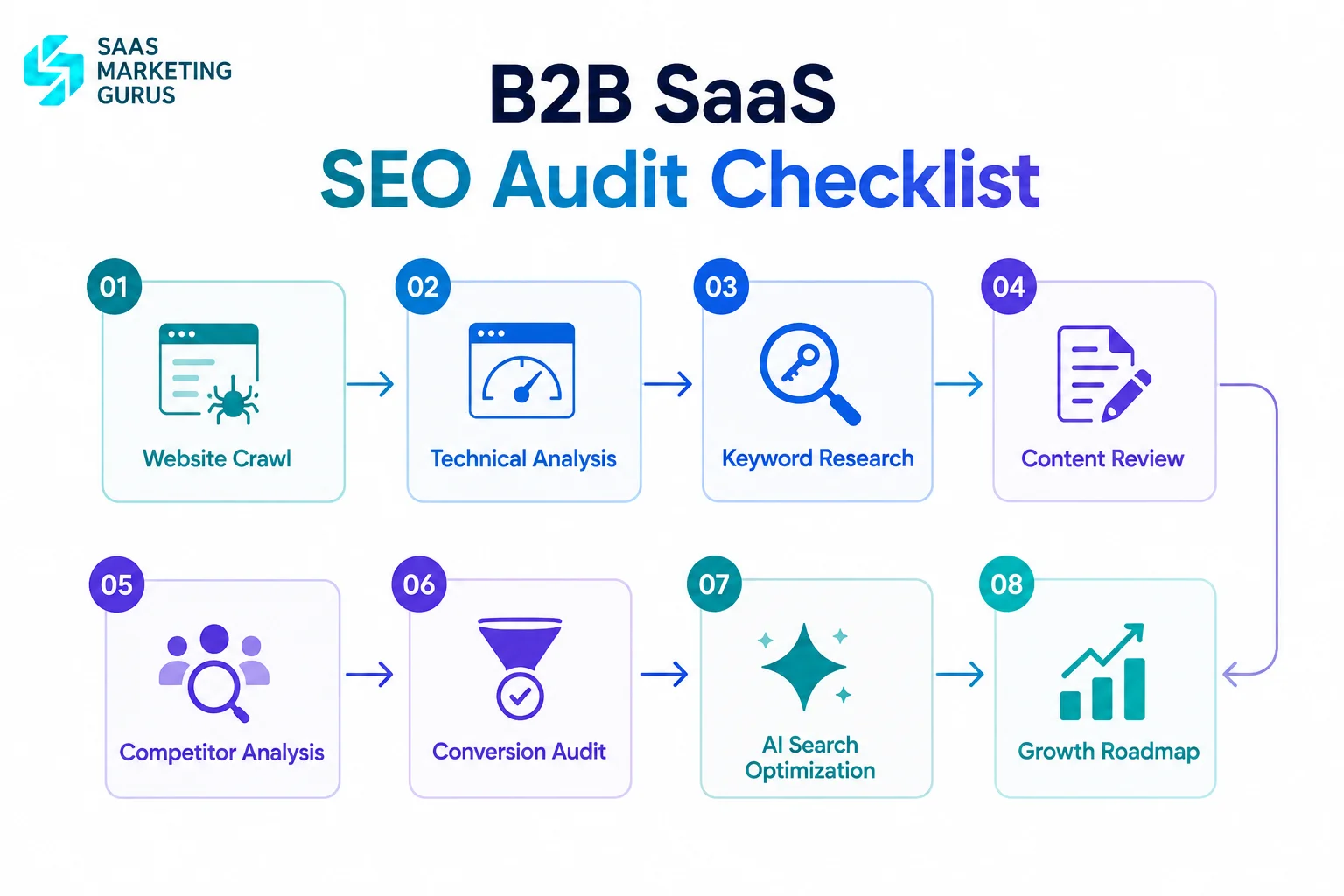
For SaaS websites, review these checks by page template rather than treating every URL the same. Pricing, product, integration, documentation, comparison, and programmatic pages often have different technical and search-intent requirements. AI search optimisation ensures LLM platforms learn about your website and add it to their databases.
B2B SEO Audit Framework for SaaS Companies
A complete SaaS SEO audit should not only identify problems. It should show how each issue affects visibility, user experience, and revenue growth.
Based on our experience auditing SaaS websites, the biggest growth blockers are usually not technical errors alone. They are often caused by poor keyword targeting, weak commercial pages, missing internal links, and content that does not match buyer intent.
The 5 Pillars of a SaaS SEO Audit
1. Technical Foundation
The technical foundation determines whether search engines can properly access, understand, and index your website.
Key checks include:
- Crawlability and indexing issues
- XML sitemap accuracy
- Site speed and Core Web Vitals
- JavaScript rendering problems
- Schema markup implementation
2. Search Demand Alignment
SEO success depends on targeting searches that match your audience’s needs and buying intent.
Key checks include:
- Keyword targeting
- Search intent alignment
- Buyer journey mapping
- Competitor keyword gaps
- Commercial search opportunities
3. Content Authority
SaaS websites need content that demonstrates expertise and answers customer questions at every stage.
Key checks include:
- Topic coverage
- Content quality
- E-E-A-T signals
- Content freshness
- Missing content opportunities
4. SaaS Website Architecture
The structure of a SaaS website affects both rankings and user journeys.
Key checks include:
- Product pages
- Integration pages
- Comparison pages
- Internal linking structure
- Page hierarchy
5. Revenue Conversion
Organic traffic only creates business value when visitors take meaningful actions.
Key checks include:
- Demo CTAs
- Free trial flows
- Lead tracking
- Conversion paths
- Landing page performance
What Should You Check First in a B2B SEO Audit?
Start with the highest-impact questions before reviewing smaller SEO issues:
- Can search engines crawl the important pages?
- Are the right pages indexed?
- Does each important page target a relevant search intent?
- Does the content satisfy the searcher’s needs?
- Are important pages connected through internal links?
- Do product and commercial pages support the buyer journey?
- Can organic visitors take a clear next step?
- Can your team measure leads, trials, demos, and other conversions?
If a page fails an earlier step, fix it before spending time on lower-impact optimisation.
How to Perform a B2B SEO Audit Step by Step
A successful B2B SEO audit follows a structured process that connects technical improvements with business goals.
Step 1: Technical SEO Analysis
Start by reviewing whether search engines can properly crawl and index your website.
Review:
- Crawl errors
- Index coverage
- XML sitemap issues
- Page speed
- Site structure
- Mobile performance
Step 2: Keyword and Competitor Research
Analyze whether your website targets the searches your potential customers use.
Review:
- Target keywords
- Search intent
- Competitor rankings
- Keyword gaps
- Missing commercial opportunities
Step 3: Content Audit
Evaluate whether existing content supports your audience and buyer journey.
Review:
- Existing blog content
- Content gaps
- Outdated pages
- Duplicate content
- Missing topic clusters
Step 4: Conversion Review
SEO traffic should support business growth, not only rankings.
Analyze:
- Landing pages
- Product pages
- Demo CTAs
- Trial flows
- Conversion tracking
Step 5: Create a Prioritized SEO Roadmap
The final step is turning findings into an actionable plan.
Organize recommendations into:
- Quick wins
- Medium-term improvements
- Long-term SEO strategies
What Tools Are Used for a B2B SaaS SEO Audit?
SEO professionals use multiple tools to evaluate technical health, search performance, competitors, and growth opportunities.
| Tool | Purpose |
|---|---|
| Google Search Console | Analyze indexing, search performance, and technical issues |
| Google Analytics 4 | Measure traffic quality, user behavior, and conversions |
| Screaming Frog | Identify crawl issues, broken links, and technical problems |
| Ahrefs | Analyze backlinks, keywords, and competitor opportunities |
| Semrush | Research competitors, rankings, and keyword gaps |
| PageSpeed Insights | Evaluate page performance and Core Web Vitals |
Using multiple tools provides a complete view of how a SaaS website performs across technical SEO, content, authority, and conversions.
What Should a B2B SEO Audit Report Include?
A professional B2B SEO audit report should do more than list technical errors. It should explain what needs to be improved, why it matters, and how it impacts business growth.
A complete audit report should include:
- Executive summary: Overview of the biggest SEO opportunities and challenges.
- Technical findings: Crawlability, indexing, performance, and website structure issues.
- Keyword opportunities: Missing keywords, search intent gaps, and competitor opportunities.
- Competitor analysis: Pages and keywords where competitors outperform your website.
- Content gaps: Topics, pages, and buyer questions your website does not currently cover.
- Internal linking recommendations: Opportunities to improve website navigation and authority flow.
- Conversion issues: Problems affecting demos, trials, and lead generation.
- Priority roadmap: A ranked action plan based on impact and effort.
The best SEO audit reports connect technical findings with measurable business outcomes.
What B2B SEO Audit Mistakes Should SaaS Companies Avoid?
Many SaaS marketing strategies teams perform audits but struggle to create meaningful improvements because they focus on the wrong areas. Common mistakes include:
| Mistake | Why It Creates Problems |
|---|---|
| Fixing only technical issues | Technical health alone does not create qualified demand, leads, or revenue opportunities. |
| Tracking rankings only | Rankings do not show whether organic traffic is generating demos, trials, or sales pipeline. |
| Ignoring product and pricing pages | Commercial pages often target high intent searches and directly influence buying decisions. |
| Creating more content without a gap analysis | Publishing more pages without strategy can create duplicate content, keyword cannibalisation, and wasted resources. |
| Ignoring JavaScript rendering | Important SaaS content may not be properly visible or accessible to search engines. |
| Treating AI search separately | AI visibility still depends on strong technical SEO, quality content, authority, and clear entity signals. |
| Ignoring conversion tracking | Without tracking, you cannot measure whether SEO efforts are improving demos, trials, and business outcomes. |
The best audits connect SEO findings with business metrics such as qualified traffic, demo requests, trial starts, and sales opportunities.
AI Search Optimization in a B2B SEO Audit
Search behavior is changing as users increasingly rely on AI-powered search experiences. A modern B2B SEO audit should evaluate whether AI systems can understand your brand, expertise, products, and content.
AI search optimization focuses on:
Entity Clarity
Make sure search engines and AI systems clearly understand:
- Who your company is
- What products you offer
- Which industries you serve
- What topics you have expertise in
Structured Content
Use clear structures that help machines understand information:
- Descriptive headings
- Tables
- FAQs
- Schema markup
- Clear definitions
Direct Answers
Create content that directly answers customer questions.
Example:
“An SEO audit is a structured review of a website’s technical health, content performance, authority, and conversion opportunities.”
Expert Authorship
Show real experience through:
- Author profiles
- Expert opinions
- First-hand insights
- Practical examples
Citations and References
Support important claims with trusted sources such as Google documentation, industry research, and recognized SEO studies.
First-Hand Experience
AI systems and users trust content that demonstrates real knowledge.
Include:
- Case studies
- Original frameworks
- Audit examples
- Lessons learned from real projects
AI search systems need clear relationships between your brand, products, services, expertise, and supporting content to understand when your website is relevant for user questions.
How Do You Run a Better B2B SEO Audit?
- Start with revenue-driving pages, not only blog content.
- Map keywords to buyer stages: awareness, consideration, and decision.
- Compare competitor pages to find missing topics and search opportunities.
- Review organic traffic quality, not only traffic volume.
- Connect content pages with product and solution pages through internal links.
- Review AI search visibility by improving entity clarity, structured information, and trustworthy content.
A complete audit should usually be reviewed every 6 to 12 months. Additional audits are recommended after website migrations, redesigns, major traffic drops, or large product changes.
Want to know how generative search engines rank content? Learn how to optimize your SaaS content for ChatGPT, Google AI, and Perplexity visibility.
How to Score and Prioritize Audit Findings
An SEO audit can produce hundreds of recommendations. The challenge is knowing what to fix first.
Score each finding using four factors:
| Factor | Question |
| Impact | How strongly does the issue affect visibility, traffic, leads, or revenue? |
| Reach | How many important pages or users does it affect? |
| Effort | How much development, content, or marketing work is required? |
| Urgency | Is the issue blocking an important page, campaign, or business goal? |
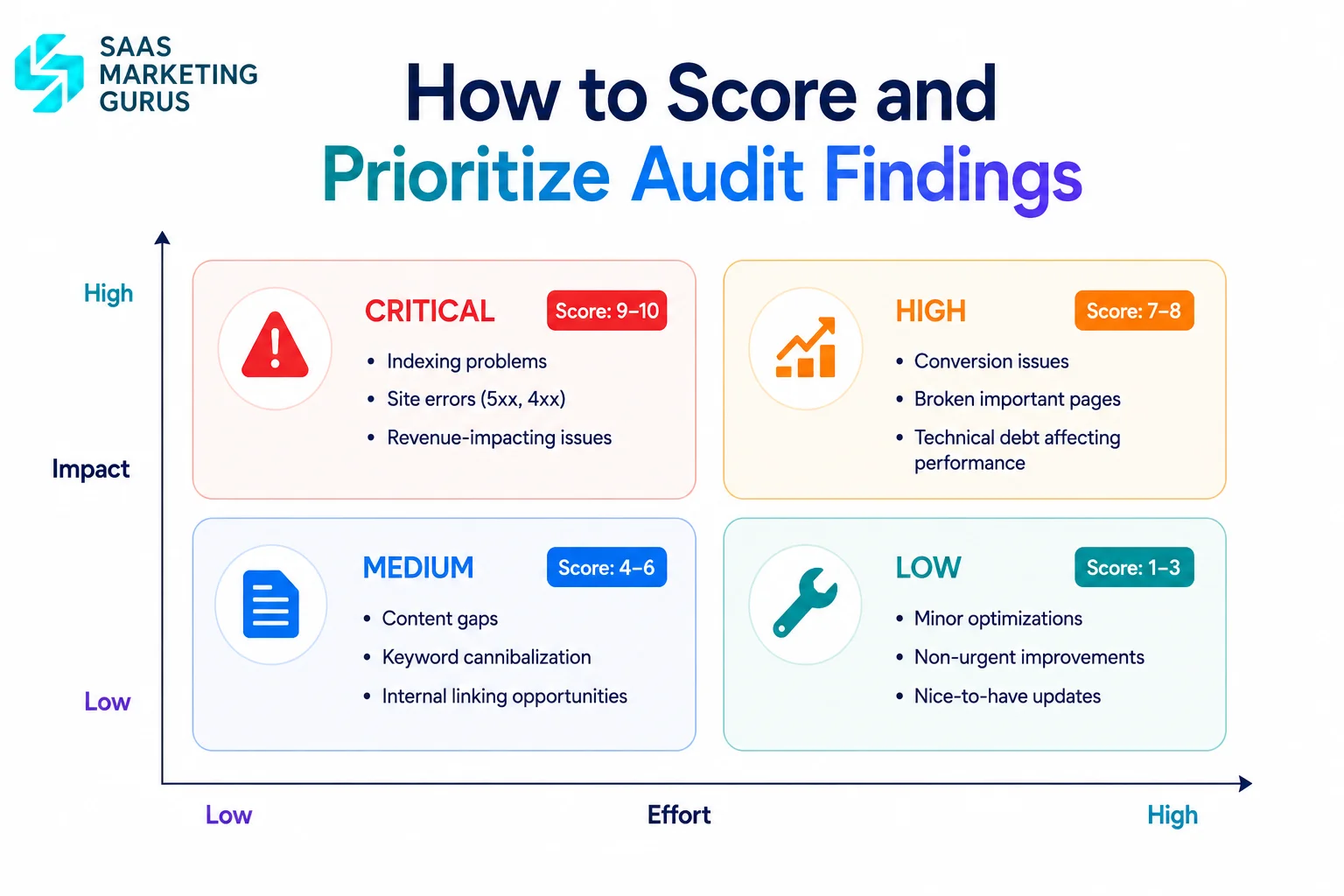
At SMG, we prioritize issues based on business impact rather than the number of warnings generated by SEO tools.
“The best SEO audits do not simply identify problems; they create a roadmap that connects technical improvements, content opportunities, and search visibility with measurable business outcomes. A website is only successful when organic traffic turns into meaningful customer actions.”
Hamza Afzal, SaaS SEO Consultant, SaaS Marketing Gurus
A broken demo flow can affect revenue more than dozens of small metadata issues.
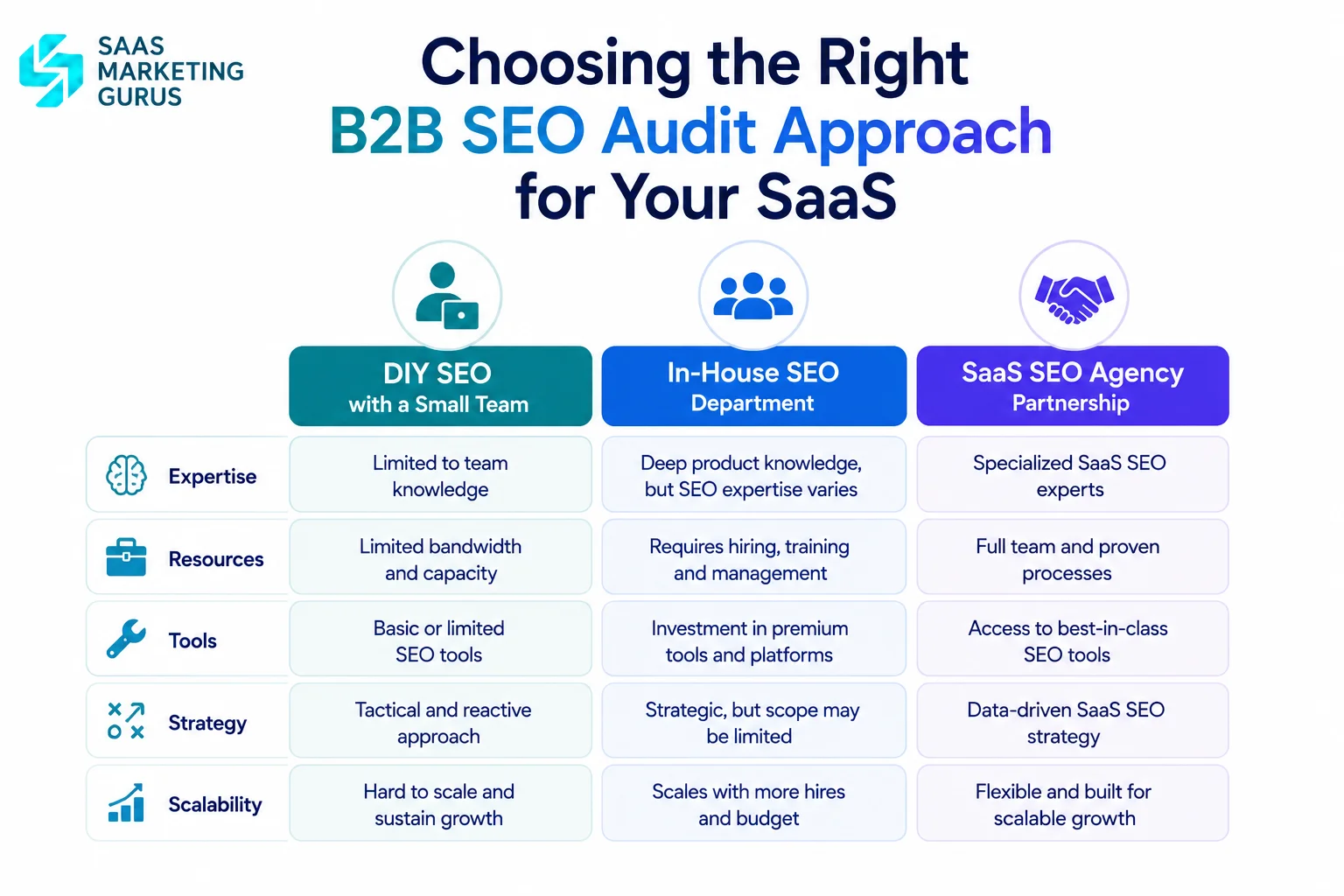
Choosing the Right B2B SEO Audit Approach for Your SaaS
The right audit approach depends on website complexity, internal expertise, budget, and growth goals.
| Approach | Best For | Limitation |
|---|---|---|
| DIY Audit | Small websites with basic SEO needs | Limited expertise and time |
| In House Team | Companies with SEO resources | May lack specialized skills |
| SEO Agency | SaaS companies needing strategy and execution support | Higher investment |
An experienced SaaS SEO agency can provide technical analysis, content strategy, competitive research, and an implementation roadmap.
If you are evaluating agencies, our guide on SaaS SEO agencies explains what factors matter beyond rankings and traffic.
What Does a SaaS SEO Audit Deliver?
A professional SaaS SEO audit should provide more than a list of technical issues. It should give your team a clear understanding of what is limiting organic growth, where opportunities exist, and what actions should be prioritized.
A complete B2B SaaS SEO audit typically delivers:
- Technical SEO analysis: Identification of crawlability, indexing, performance, JavaScript rendering, and website structure issues.
- Keyword opportunity analysis: Insights into keyword gaps, search intent alignment, and opportunities to attract qualified buyers.
- Competitor analysis: Comparison of competitor rankings, content strategies, and search opportunities your website may be missing.
- Content gap analysis: Identification of missing topics, outdated content, and pages that need improvement to support the buyer journey.
- Internal linking recommendations: Suggestions to improve website navigation, distribute authority, and connect important commercial pages.
- Conversion review: Analysis of product pages, landing pages, CTAs, demos, and trial flows that influence lead generation.
- Prioritized SEO roadmap: A clear action plan that organizes recommendations based on business impact, effort, and growth potential.
The goal of an SEO audit is not only to find problems. It is to create a practical roadmap that helps SaaS companies improve visibility, attract qualified traffic, and turn organic growth into measurable business results.
Key Takeaways
- A B2B SEO audit reviews technical SEO, content, keywords, authority, internal linking, conversions, and AI search visibility.
- A technical SEO audit focuses on the website’s technical foundation. A broader B2B SEO audit also evaluates search intent, content, authority, and business outcomes.
- SaaS SEO requires alignment between search intent, buyer journey, page templates, and revenue goals.
- The most valuable audit findings are not always the biggest technical problems. Prioritise issues with the strongest business impact.
- A successful audit ends with a prioritised action plan, owners, and measurable outcomes.
Find What Is Limiting Your SaaS Growth
A successful B2B SEO audit should answer three questions:
- Where are you losing search visibility?
- Why are qualified buyers not converting?
- What should your team fix first?
SaaS Marketing Gurus helps SaaS companies identify SEO gaps across technical performance, content strategy, conversions, and AI search visibility.
If your website attracts organic traffic but struggles to generate qualified opportunities, a focused B2B SEO audit can help you identify the issues worth fixing first.
Get a SaaS SEO audit that identifies technical issues, keyword opportunities, content gaps, competitor insights, and a prioritized roadmap to improve organic growth.
FAQs
What is a B2B SEO audit?
A B2B SEO audit is a complete review of a business website to identify technical issues, keyword gaps, content opportunities, authority problems, and conversion barriers that affect organic growth.
What does a B2B SEO audit include?
A B2B SEO audit includes technical SEO analysis, keyword research, competitor analysis, content evaluation, internal linking review, backlink assessment, conversion analysis, and AI search visibility checks.
How is a B2B SEO audit different from a technical SEO audit?
A technical SEO audit focuses on crawlability, indexing, speed, redirects, and website performance. A B2B SEO audit includes technical SEO but also evaluates content strategy, search intent, buyer journeys, authority, and revenue opportunities.
How often should SaaS companies perform an SEO audit?
SaaS companies should perform a complete SEO audit every 6 to 12 months. Additional audits are recommended after website migrations, redesigns, major traffic drops, or significant product changes.
What tools are used for a B2B SEO audit?
Common SEO audit tools include Google Search Console, Google Analytics 4, Screaming Frog, Ahrefs, Semrush, PageSpeed Insights, and Looker Studio for reporting.
How long does a B2B SEO audit take?
The timeline depends on website size and complexity. A small SaaS website may take a few days, while larger SaaS platforms with thousands of pages can require several weeks for a detailed audit.
How can a B2B SEO audit improve SaaS growth?
A B2B SEO audit helps SaaS companies identify ranking opportunities, improve important pages, attract qualified traffic, fix conversion issues, and create a roadmap that connects SEO efforts with demos, trials, and revenue.
How much does a B2B SEO audit cost?
The cost of a B2B SEO audit depends on website size, complexity, and audit depth. A basic audit may review technical issues, while a complete SaaS SEO audit includes keyword research, competitor analysis, content gaps, conversion review, and an implementation roadmap.