Learn how to choose the best SaaS SEO agency to boost growth, improve SEO performance, and drive targeted leads for long-term success.
Choosing between SaaS SEO agencies is an important decision for a SaaS company. The right partner should do more than increase traffic or rankings. It should connect SEO strategy to your growth model and help turn organic search into qualified pipeline, trials, demos, product adoption, or revenue.
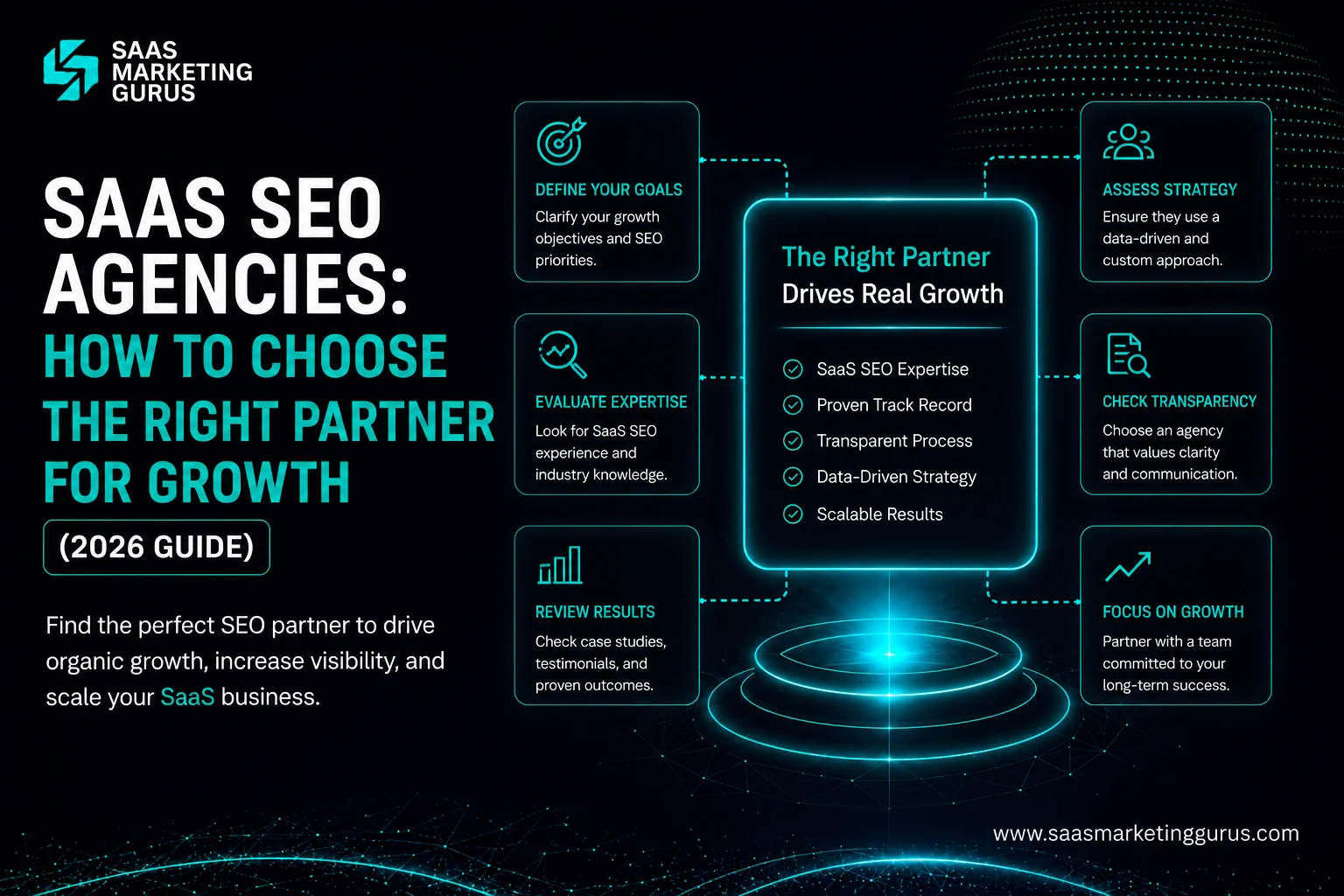
The best SaaS SEO agency is not necessarily the one that promises the most traffic. Look for a partner with relevant SaaS experience, a clear keyword-to-funnel strategy, strong technical and content execution, transparent measurement, and evidence that its work can support business outcomes.
The wrong agency can waste budget and time, while the right one can build a more reliable organic acquisition channel.
At SaaS Marketing Gurus, we’ve run SaaS SEO programs that produced a 400% SEO ROI for a DevOps tooling company and supported +20 demo bookings per week for a FinTech CRM client. That work confirmed the same pattern every time: SaaS SEO succeeds when strategy, content, technical optimization, and conversion focus are built as one system, not run separately.
Key takeaways
- The best SaaS SEO agency connects keywords to your funnel, not just to search volume.
- Pricing ranges from $500/month for freelancers to $25,000+/month for enterprise-scale programs.
- Ask for SaaS-specific case studies with a clear timeframe, not just a final percentage increase.
- Expect strategy and technical fixes in the first 30 days, first content clusters live by day 60, and early ranking signals by day 90.
- Full revenue impact takes longer than 90 days. Anyone promising otherwise is selling, not planning.
What Does an SEO Agency for SaaS Companies Actually Do?
A SaaS SEO agency helps software companies generate customers from search by aligning content, keywords, and technical SEO with product growth.
Unlike general SEO teams, SaaS-focused agencies connect search visibility directly to:
- free trials
- demo requests
- product signups
- subscription revenue (MRR)
They build systems, not just blog posts.
Core work includes:
- SaaS keyword strategy based on intent (trial, comparison, pricing)
- Content clusters built around product use cases
- Technical SEO for SaaS platforms
- Conversion-focused landing pages
- Authority building through backlinks and digital PR
Why SaaS SEO Services Are Different From General SEO Services
General SEO and SaaS SEO share the same technical foundations, but SaaS SEO usually requires a closer connection between search intent, the product funnel, and business outcomes.
A general SEO program may focus heavily on visibility and traffic. A SaaS SEO program should also ask what happens after the click: Does the visitor start a trial, request a demo, activate the product, or become a qualified opportunity?
The difference becomes clearer when you compare the typical priorities:
| Area | General SEO Services | SaaS SEO Services |
|---|---|---|
| Primary goal | Organic visibility and traffic | Qualified pipeline, trials, demos, and revenue contribution |
| Content | Broad informational content | Funnel-driven, use-case, comparison, and product-led content |
| Keywords | Often prioritized by volume | Prioritized by intent, audience, business value, and conversion potential |
| Conversion path | Lead form or contact action | Trial, demo, signup, activation, or sales opportunity |
| Measurement | Rankings and organic traffic | Organic conversions, qualified leads, pipeline, and other agreed business KPIs |
The right metrics depend on the SaaS business model and attribution setup. An agency should be able to explain how its SEO work supports the specific conversion path your company uses.
A SaaS SEO agency should understand what happens after the search click, not just how to increase the number of clicks.
Ahrefs’ research on SaaS content marketing shows that SaaS companies ranking well tend to build topic clusters around product use cases rather than isolated blog posts, reinforcing why intent-mapping matters more in this space than in general SEO.
How SaaS SEO Agencies Drive Growth- Simple Model
A strong SaaS SEO program connects search intent to the buyer journey instead of publishing unrelated blog posts.
Step 1: Map keywords to intent
Keywords should be grouped by what the searcher is trying to do.
- Awareness: “what is CRM software”
- Consideration: “best CRM tools for startups”
- Evaluation: “HubSpot alternatives”
- Conversion: “CRM pricing” or “CRM demo”
The exact keywords will vary by product, audience, and business model. The goal is to identify which searches are most likely to support the next stage of the buyer journey.
Step 2: Build topic clusters
Instead of publishing random articles, the agency builds connected content around important topics and use cases.
This may include:
- Pillar pages
- Supporting articles
- Comparison pages
- Alternative pages
- Use-case pages
- Product and feature pages
- Internal linking networks
Step 3: Align content with conversion paths
Each page should have a clear purpose.
Depending on the SaaS business, that may be:
- Starting a free trial
- Booking a demo
- Creating an account
- Requesting pricing
- Exploring a product feature
- Moving to another stage of the buying journey
Step 4: Build authority and trust
A SaaS SEO program may also support authority through:
- Relevant backlinks
- Industry mentions
- Digital PR
- Expert contributions
- Original research
- Strong product and company information
The objective is not simply to generate more pages. It is to build a search presence that helps the right audience discover, evaluate, and act on the product.
SaaS SEO works best when keyword strategy, content architecture, conversion paths, and authority building are planned as one system.
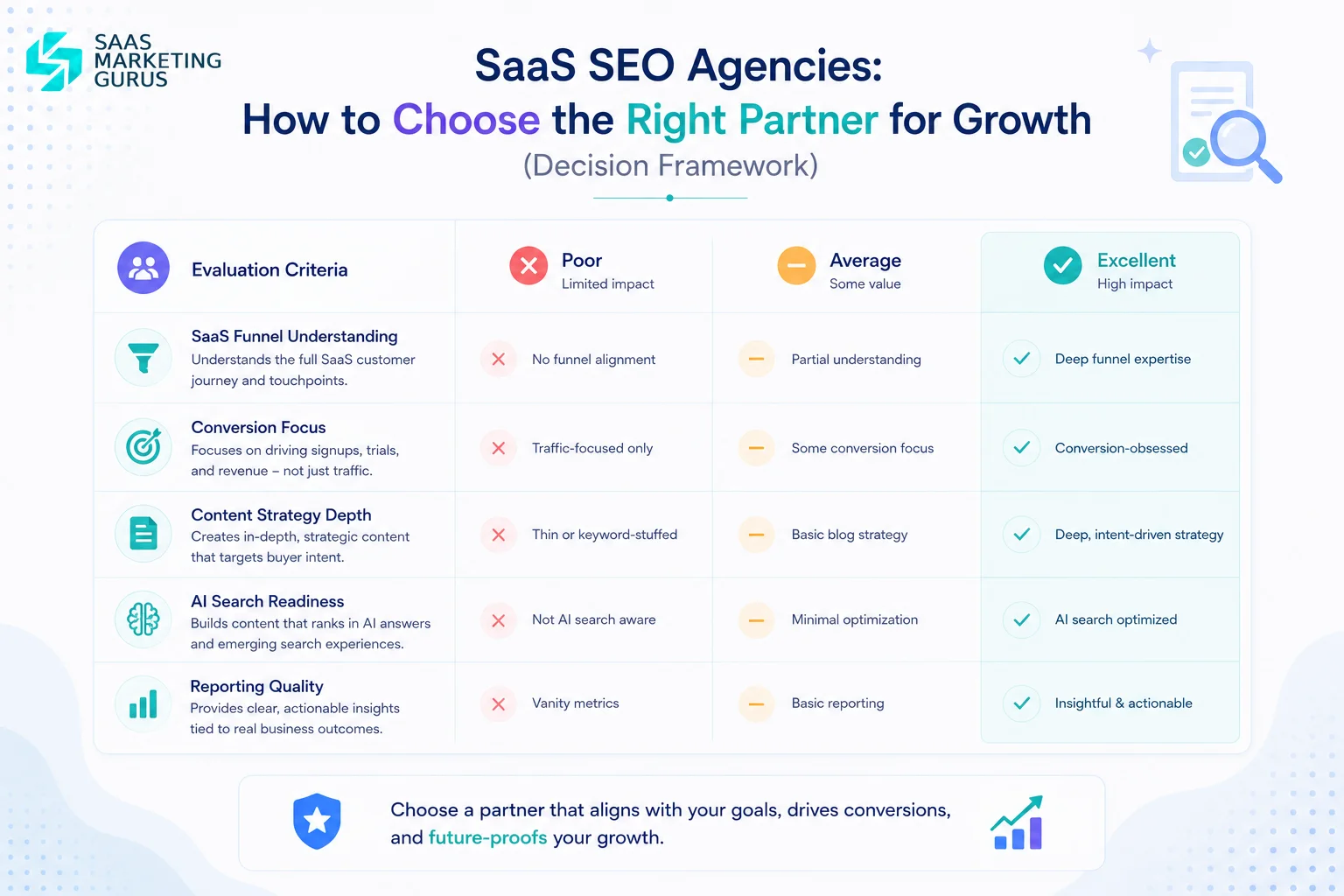
How to Choose the Right SaaS SEO Agency: A Practical Decision Framework
Use this framework to compare agencies based on fit, capability, and evidence rather than presentation quality or price alone.
Step 1: Check SaaS stage and business-model fit
Different SaaS companies may need different SEO priorities.
- Early stage: Positioning, keyword discovery, technical foundations, and initial commercial content
- Growth stage: Content clusters, conversion optimization, internal linking, and scalable execution
- Scale stage: Category authority, international or programmatic opportunities, technical complexity, and broader authority building
Also consider whether the agency understands your growth model:
- Product-led growth
- Sales-led growth
- Hybrid growth
A strategy that works for a self-serve product may not be the right approach for a high-ACV enterprise SaaS company.
Step 2: Test funnel alignment
Ask:
- Can you map target keywords to specific conversion paths?
- Can you explain what happens after an organic visitor lands on the site?
- Which pages are expected to support trials, demos, or qualified opportunities?
- How will you measure progress?
If the agency cannot connect SEO activity to your customer journey, ask for more detail before moving forward.
Step 3: Test revenue thinking
A strong agency should understand the business metrics that matter to your company.
Depending on the business, that may include:
- Organic conversions
- Qualified leads
- Pipeline contribution
- Customer acquisition cost
- Trial-to-paid conversion
- Activation rate
- Revenue contribution
The agency does not need to promise a specific revenue outcome. It should be able to explain how SEO fits into the measurement system.
Step 4: Evaluate execution depth
Ask the agency to explain how it handles:
- Technical SEO
- Information architecture
- Keyword research
- Content briefs
- Content production
- Internal linking
- Conversion optimization
- Link acquisition
- Reporting and prioritization
The answer should be specific enough for you to understand what the agency will actually do each month.
Related: How a SaaS marketing agency compares to building an in-house team
Step 5: Verify the evidence
Do not rely only on logos or traffic screenshots.
Ask:
- Does the agency have relevant SaaS case studies?
- Can it explain what changed?
- Can it show the time period?
- What metrics improved?
- What did not work?
- Who actually performed the work?
The best case studies explain the work and the limitations, not just the final percentage increase.
Step 6: Score the shortlist
A simple scorecard can help reduce bias:
| Evaluation Area | Suggested Weight |
|---|---|
| SaaS experience and business-model fit | 20% |
| Strategy and funnel alignment | 20% |
| Measurement and reporting | 20% |
| Execution capability | 15% |
| Technical SEO | 10% |
| Content quality | 10% |
| Commercial fit | 5% |
The weights can change depending on your company’s priorities.
The right SaaS SEO agency should be able to explain the strategy, show relevant evidence, describe the execution, and define how progress will be measured.
SaaS SEO Agency Pricing: What Should You Expect to Pay?
Pricing varies significantly based on the agency’s experience, the size and complexity of the website, the amount of content required, technical SEO needs, link acquisition, and the level of strategic involvement.
The following ranges should be treated as illustrative examples rather than fixed market rates:
| Type of Provider | Illustrative Monthly Range | Typical Scope | Best Fit |
|---|---|---|---|
| Freelancer | $500–$2,000 | Basic consulting, audits, or limited content support | Very early startups |
| Small agency | $2,000–$5,000 | Strategy, content, and foundational SEO | Early SaaS companies |
| SaaS SEO agency | $5,000–$12,000 | Integrated strategy, content, technical SEO, and measurement | Growth-stage SaaS |
| Enterprise agency | $10,000–$25,000+ | Larger-scale strategy, authority building, and complex execution | Mature or enterprise SaaS |
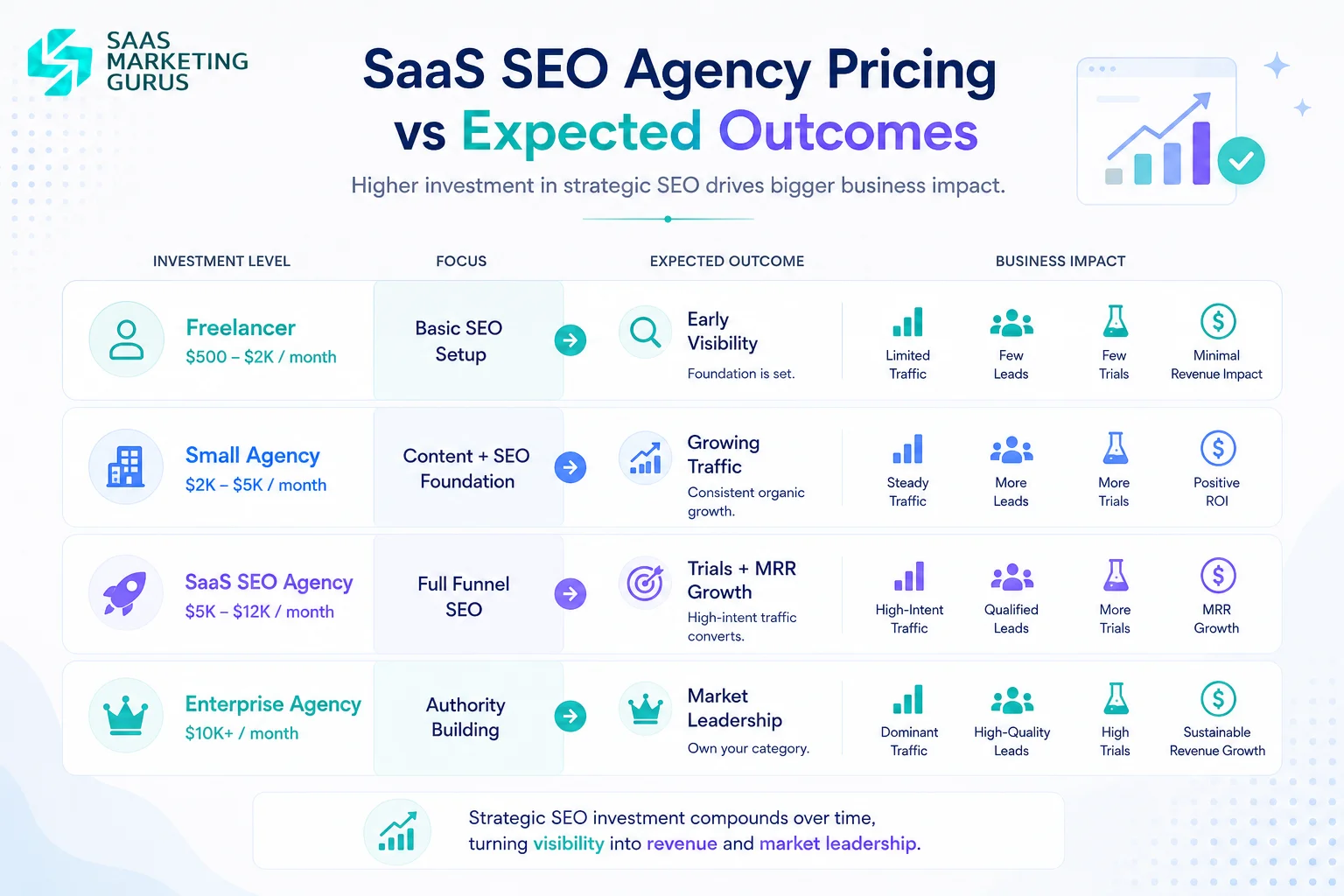
The right question is not simply, “Which agency costs the least?”
Ask:
- What is included in the monthly scope?
- Who performs the work?
- Is content production included?
- Are technical fixes implemented or only recommended?
- Is link acquisition included?
- How often will reporting and strategy reviews happen?
- What resources are expected from your internal team?
A lower-cost provider may be the right choice for a focused project. A more expensive agency may be justified when the engagement requires broader strategy, technical work, content production, and ongoing execution.
Not sure where your budget should land? Talk to SMG about what a scoped SaaS SEO program actually costs for your stage and goals.
SaaS SEO Agency Evaluation Checklist
Before hiring an agency, verify the following.
Strategy
- Can they explain SaaS funnel SEO clearly?
- Can they map keywords to your buyer journey?
- Do they understand your product-led, sales-led, or hybrid growth model?
- Can they explain what they would prioritize first?
Experience
- Do they have relevant SaaS experience?
- Have they worked with companies at a similar stage?
- Can they show SaaS-specific case studies?
- Can they explain the actual work behind the results?
Execution
- Do they build topic clusters instead of publishing random blogs?
- Can they handle technical SEO?
- Do they understand internal linking and site architecture?
- Can they support commercial, comparison, alternative, and use-case content?
Measurement
- Do they track more than rankings?
- Can they measure organic conversions?
- Can they connect SEO reporting with analytics or CRM data where appropriate?
- Do they define what success looks like before work begins?
Commercial fit
- Is the scope clear?
- Do you know who will work on the account?
- Are content and SEO assets clearly owned by the client?
- Are expectations about timelines realistic?
AI-search readiness
- Do they understand how AI search changes the way users discover information?
- Do they focus on clear, useful, well-structured content?
- Can they explain how they will measure AI-search visibility without promising guaranteed citations?
The strongest agency is the one that can show relevant experience, explain its process clearly, and connect its work to the metrics your business actually uses.
What to Expect in the First 90 Days
SEO is not instant. A good agency sets realistic expectations.
Days 1–30: Strategy phase
- SaaS audit
- keyword mapping
- competitor analysis
- content roadmap
Days 30–60: Execution starts
- first content clusters go live
- technical SEO fixes
- internal linking setup
Days 60–90: Early signals
- first ranking improvements
- early traffic-to-trial movement
- optimization based on data
You should NOT expect full revenue impact in 90 days, but you should see direction and traction signals.
Want a 90-day plan built around your product instead of a generic timeline? Book a call with SMG.
Hypothetical Example: Choosing the Right SEO Partner for SaaS Growth
Imagine a SaaS CRM startup evaluating three agencies.
Agency A: Freelancer
- Low cost
- Publishes blog content
- No clear funnel strategy
- Limited conversion measurement
Likely outcome: Traffic may increase, but the company has little visibility into how that traffic supports trials or pipeline.
Agency B: General SEO Agency
- Decent content production
- Strong focus on rankings
- Limited SaaS-specific experience
Likely outcome: Organic visibility may improve, but the strategy may not fully reflect the SaaS buying journey.
Agency C: SaaS SEO Agency
- Maps keywords to the SaaS funnel
- Builds content clusters
- Improves commercial and product-led pages
- Aligns SEO reporting with conversion goals
Likely outcome: The strategy has a clearer path from organic search to business outcomes.
Agency C may cost more, but the decision should ultimately depend on scope, evidence, capability, and fit—not price alone.
Business Impact of SaaS SEO Strategies
A strong SaaS SEO system can support several business outcomes when the strategy is aligned with the product, audience, and conversion path.
1. Lower customer acquisition costs over time
Organic search reduces dependence on paid acquisition once content ranks, because you stop paying per click for traffic that’s already finding you. The size of that reduction depends on content investment, competition, conversion rates, and the value of the customers acquired, but the direction is consistent: paid channels cost the same on visit 1,000 as visit 1, organic content doesn’t.
2. More qualified organic opportunities
Commercial and problem-aware searches attract users who are actively evaluating solutions, not just learning about a category. The quality of that traffic still depends on how closely the content matches the audience and search intent, but commercial-intent content converts at meaningfully higher rates than top-of-funnel informational content.
3. Better conversion opportunities
SEO converts when traffic lands on pages that match the searcher’s need and offer a clear next step: a trial, demo, signup, or product walkthrough. Pages without a next step waste the visit regardless of how well they rank.
4. A compounding acquisition asset
Unlike a paid campaign that stops the moment spending stops, organic content keeps attracting visitors after it’s published. That said, maintaining rankings still requires updates, technical maintenance, and continued investment. Compounding isn’t free, it’s just cheaper than restarting from zero every month.
SaaS SEO Agency vs. General SEO Agency: Which Should You Choose?
The right choice depends on your company’s needs, but SaaS companies should look for an agency that understands the relationship between organic search and the SaaS customer journey.
| Factor | SaaS SEO Agency | General SEO Agency |
|---|---|---|
| Best fit | Companies with a software product and defined growth goals | Businesses across many industries |
| Strategy | Funnel and use-case driven | Often broader and industry-agnostic |
| Content | Product, comparison, alternative, and use-case content | May focus more heavily on informational content |
| Measurement | Can include conversions, pipeline, and other business KPIs | Often centered on traffic and rankings |
| Key evaluation question | Can they explain how SEO supports the SaaS funnel? | Can they adapt their process to your SaaS business model? |
A general agency can still be a good fit if it has relevant SaaS experience and can demonstrate that it understands your product, audience, funnel, and measurement needs.
How AI Search Is Changing SEO for SaaS Companies
Search is no longer limited to traditional search result pages. Users can now ask AI systems such as ChatGPT, Claude, Gemini, and Perplexity to research products, compare software, and summarize options. Those same AI systems also pull heavily from Reddit discussions and review platforms like G2 and Capterra when forming answers about software tools, so a company’s visibility on those platforms increasingly feeds its visibility in AI search.
For SaaS companies, this creates another discovery environment to consider.
AI systems may:
- Summarize product categories
- Compare software tools
- Answer questions about features and use cases
- Cite Reddit threads and review platforms as supporting evidence
- Direct users to supporting sources
A modern SaaS SEO agency should understand how users discover information across traditional search, Reddit, review platforms, and AI-powered search experiences.
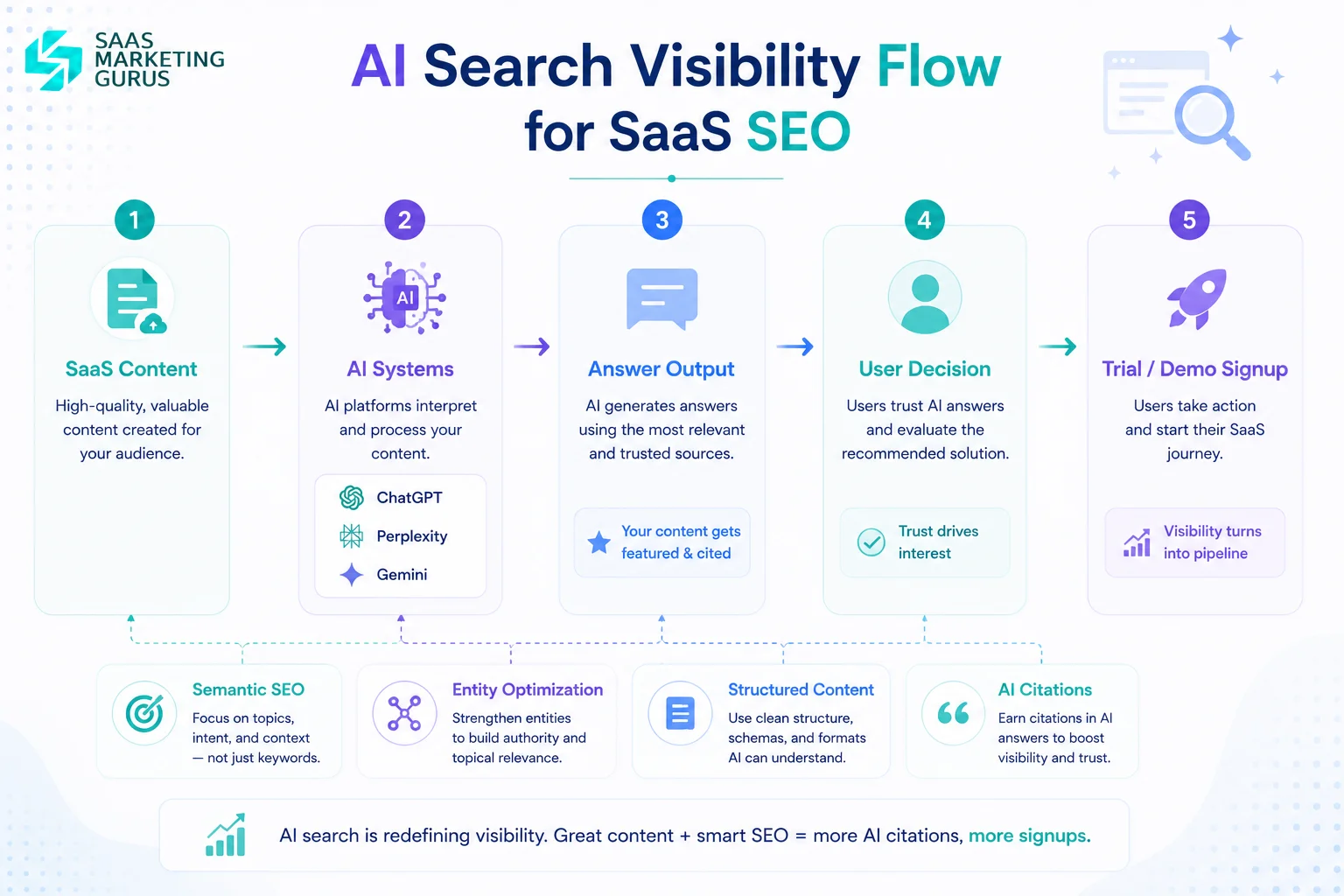
However, AI search should not be treated as a separate shortcut around fundamental SEO. Google’s guidance on AI features in Search states that the same core SEO best practices remain relevant for AI Overviews and AI Mode, including crawlability, indexability, helpful content, internal linking, textual content, and accurate structured data. There are no special technical requirements that guarantee inclusion in AI features.
A strong SEO consultant for SaaS should therefore focus on:
- Clear answers to real customer questions
- Strong topic and entity coverage
- Useful comparison and use-case content
- Accurate, up-to-date product information
- Clear site structure and internal links
- Trustworthy references where claims require evidence
For more on this topic, see our guide to AI search optimization for SaaS content.
AI search makes clear, useful, well-structured content more important—not less. Agencies should understand these changes without promising guaranteed AI citations or visibility.
Common Mistakes SaaS Companies Make
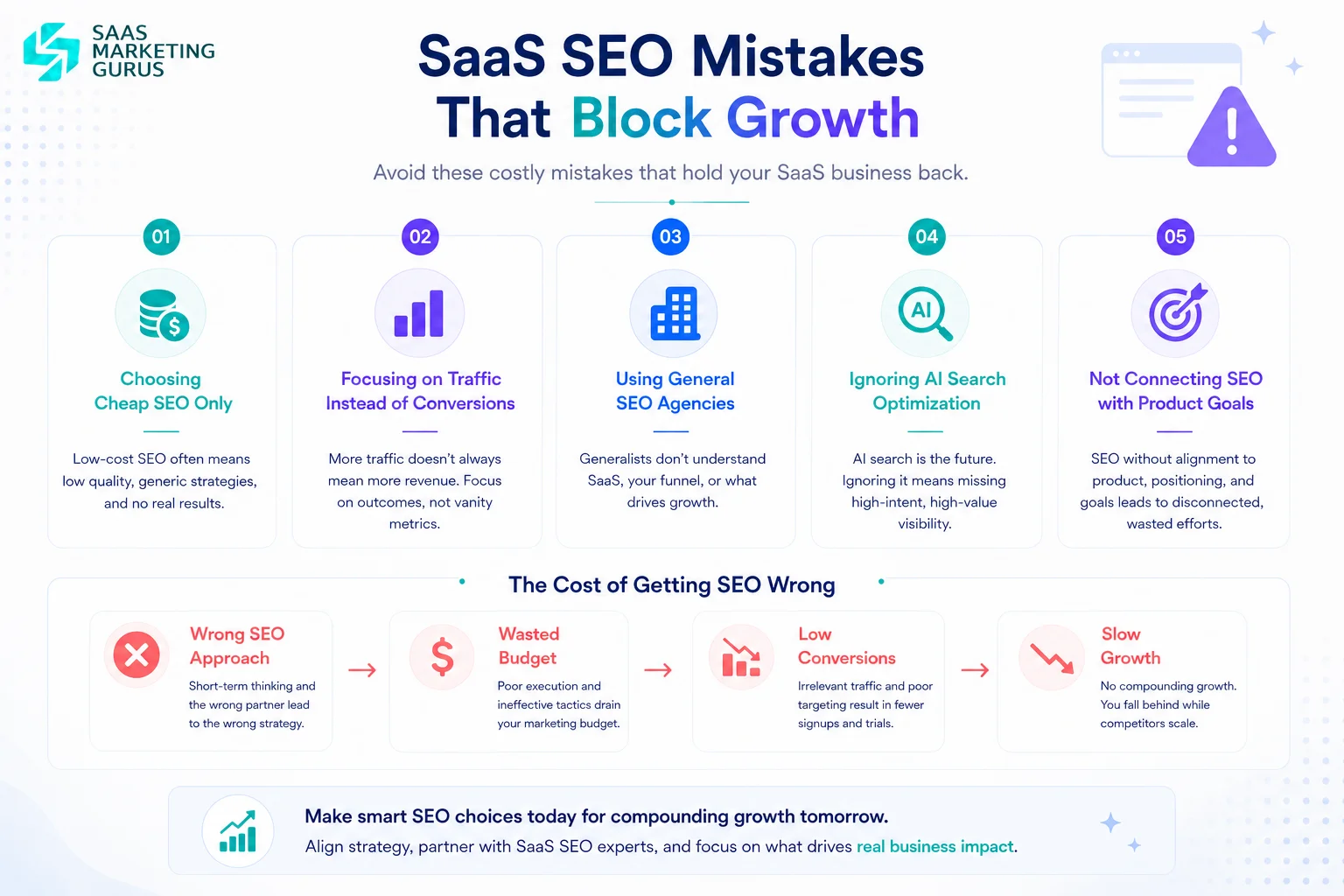
1. Choosing based on price only
Cheap agencies rarely understand SaaS funnels.
2. Focusing on traffic instead of conversions
Traffic without trials is wasted effort.
3. Hiring non-SaaS agencies
General SEO does not understand the SaaS lifecycle.
4. Expecting fast results
SEO compounds over time.
5. No alignment with product funnel
SEO must support onboarding and product activation.
FAQs
What does a SaaS SEO agency do?
A SaaS SEO agency helps software companies attract and convert customers from organic search. Its work typically includes keyword research, technical SEO, content strategy, content creation, internal linking, conversion optimization, and authority building.
How do I choose the right SaaS SEO agency?
Look for relevant SaaS experience, a clear connection between SEO and your customer funnel, strong technical and content capabilities, transparent reporting, realistic timelines, and relevant case studies. The agency should be able to explain how its work supports trials, demos, qualified leads, or other business goals.
How much does a SaaS SEO agency cost?
SaaS SEO agency pricing varies based on the scope of work, agency experience, website complexity, content requirements, technical SEO needs, and authority-building activities. Monthly costs can range from a few thousand dollars for focused support to $25,000 or more for complex enterprise SEO programs.
How long does SaaS SEO take to produce results?
Most SaaS SEO programs require several months to build meaningful momentum. The first 90 days typically focus on audits, research, strategy, technical improvements, content execution, and early performance signals. The timeline depends on competition, website authority, content quality, and execution speed.
What should I ask a SaaS SEO agency before hiring?
Ask about its SaaS experience, case studies, strategy, reporting process, team structure, deliverables, measurement approach, and pricing. You should also ask how it will connect target keywords and content to your specific customer journey and conversion goals.
How should I measure the success of a SaaS SEO agency?
Measure success using the metrics that match your SaaS growth model. These may include qualified organic traffic, conversions, free trials, demo requests, sales opportunities, pipeline contribution, customer acquisition cost, or revenue-related metrics. Rankings and traffic can be useful indicators, but they should not be the only measures of success.
Turn SaaS Search Traffic Into Real Business Growth
Choosing the right SEO partner can be the difference between getting traffic and generating consistent trials, demos, and revenue.
At SaaS Marketing Gurus, we help SaaS companies build growth-focused SEO strategies with technical optimization, content systems, AI Search Optimization, and proven SaaS marketing expertise.
Stop guessing what works. Build an SEO strategy designed to attract the right customers and support long-term growth.
Book a call today and discover how we can help your SaaS company grow through smarter SEO.