A B2B SaaS marketing strategy should answer one clear question: how will your company attract the right business buyers, turn their interest into revenue, and keep them as customers?
Many SaaS companies try SEO, paid ads, LinkedIn, email, and Product Hunt at the same time. These channels can create traffic, but they will not create steady growth unless they support the same buyer journey.
SaaS Marketing Gurus (SMG), a B2B SaaS marketing agency specializing in Reddit marketing, Quora marketing, Generative Engine Optimization (GEO), SaaS SEO, and Product Hunt launches, built this framework from what actually separates SaaS companies with predictable pipeline from ones chasing traffic.
That journey now begins long before a sales call. 6sense’s 2025 B2B Buyer Experience Report, which surveyed nearly 4,000 buyers, found that buyers now make first contact with sellers at 61% of the way through the buying journey (down from 69% the year before), yet the vendor on the Day One shortlist still wins the deal 95% of the time. The 6sense 2025 B2B Buyer Experience Report shows why your marketing needs to build trust before someone books a demo.
So, where should you begin? Start with the customer, then clarify your position, choose the right growth model, and select channels that support your main revenue goal. This guide takes you through that process in order.
What Is a B2B SaaS Marketing Strategy?
A B2B SaaS marketing strategy is a plan for attracting, educating, converting, retaining, and growing business customers for subscription software.
In simple terms, it connects your customer, message, channels, and revenue goals. A useful strategy defines:
- The companies and people the product serves
- The problem the product solves
- The reason buyers should choose it
- The channels used to reach and influence buyers
- The offers that move buyers toward a trial, demo, or purchase
- The metrics used to connect marketing with pipeline and recurring revenue
This is where strategy differs from tactics. Strategy decides what the business will focus on. Tactics are the actions used to carry out that decision.
For example, publishing four articles each month is a tactic. Becoming a trusted search resource for compliance leaders evaluating automation software is a strategy. The second statement identifies an audience, a need, and a position the brand wants to own.
Why B2B SaaS Marketing Is Different
B2B SaaS companies do not make money from one purchase alone. They need customers to understand the software, approve the investment, use the product, and renew their subscriptions.
This longer relationship changes what marketing needs to do:
| Characteristic | What It Means | Marketing Response |
|---|---|---|
| Recurring Revenue | Growth depends on renewals as well as new sales | Measure retention, expansion, and customer value alongside acquisition |
| Multiple Stakeholders | Users, managers, finance, security, and executives may influence the purchase | Create content and proof for each member of the buying group |
| Longer Evaluation | Buyers compare products, risks, integrations, and expected return | Support research with comparisons, case studies, demos, and technical resources |
| Intangible Product | Buyers cannot judge software like a physical item | Use product tours, trials, screenshots, use cases, and outcome-based proof |
| Customer Economics | High acquisition cost may be acceptable when retention and expansion are strong | Evaluate CAC with LTV, payback period, churn, and NRR |
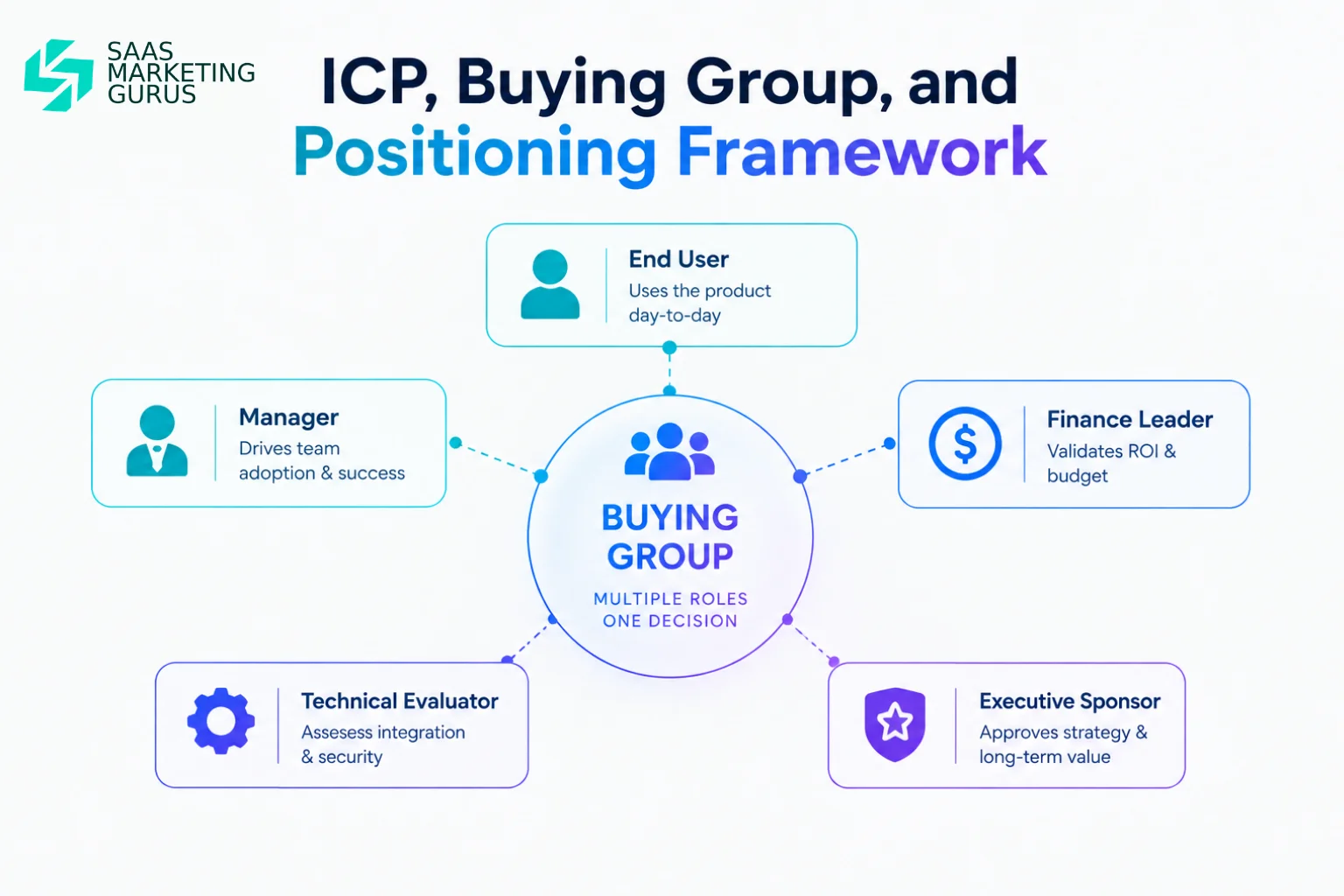
A buying group is the group of people who research, approve, buy, implement, or use a SaaS product. It may include an end user, manager, finance leader, technical reviewer, and senior decision maker.
Because each person looks for different information, one landing page is rarely enough. McKinsey found that B2B buyers use an average of ten interaction channels across their buying journey. Your website, search pages, AI answers, reviews, community discussions, and sales conversations should therefore communicate the same value. See McKinsey’s research on B2B buyer behavior.
Start With the ICP, Buying Group, and Positioning
Now that we know why SaaS marketing is different, the next step is to decide exactly who the strategy needs to reach. Choosing channels before answering that question usually leads to weak traffic and poor quality leads.
Define the ideal customer profile
Ideal customer profile definition for B2B SaaS: An ideal customer profile, or ICP, describes the type of company most likely to gain clear value from your software and remain a profitable customer.
Your B2B SaaS ICP may include:
- Industry and business model
- Company size or revenue
- Geography
- Technology environment
- Regulatory or operational requirements
- Problem urgency
- Ability to purchase
- Expected contract value
- Likelihood of retention and expansion
The goal is not to include every company that could use the product. It is to identify the companies your product can help best.
Map the buying group
Once you know which companies to target, identify the people involved in the purchase. This turns a broad company profile into useful content and messaging decisions.
| Role | Primary Question | Useful Content |
|---|---|---|
| End User | Will this make my work easier? | Product tours, templates, workflows, and tutorials |
| Champion | Can I convince others to support this? | Business cases, comparison pages, and internal presentation material |
| Economic Buyer | Will the return justify the cost? | ROI models, pricing explanations, and outcome-based case studies |
| Technical Evaluator | Will it integrate and meet our standards? | Security pages, documentation, integration guides, and implementation plans |
| Executive Sponsor | Does this support a strategic priority? | Industry insights, executive summaries, and risk analysis |
Clarify positioning
After mapping the buying group, you can decide what each person needs to understand about your product.
B2B SaaS positioning definition: Positioning explains who your SaaS product is for, which important problem it solves, how it differs from other options, and why that difference matters to the buyer.
Use this simple positioning structure:
For [specific customer], who struggles with [important problem], [product] is a [category] that helps them [valuable outcome]. Unlike [main alternative], it [credible difference].
Build this statement with language from sales calls, support tickets, reviews, and customer interviews. Customers often talk about lost time, higher cost, risk, and slow results. Their words will usually be clearer than an internal feature list.
For more help connecting product value with customer needs, read the SaaS product marketing guide.
Choose the Right SaaS Growth Motion
Once the audience and position are clear, you can choose how customers will enter and move through your sales process.
B2B SaaS growth motion definition: A growth motion is the main path a SaaS company uses to attract, convert, retain, and expand customers.
The right motion depends on price, product complexity, buying risk, and how much help a customer needs before deciding.
| Growth Motion | Best Fit | Marketing Priority | Main Conversion |
|---|---|---|---|
| Product led | Easy adoption and lower contract value | Search, product education, onboarding, and lifecycle messages | Signup or product qualified lead |
| Sales led | Higher contract value and complex buying decisions | Demand generation, ABM, proof, and sales enablement | Qualified opportunity |
| Hybrid | Self service entry followed by larger account expansion | Product acquisition plus sales support | Activated account and expansion opportunity |
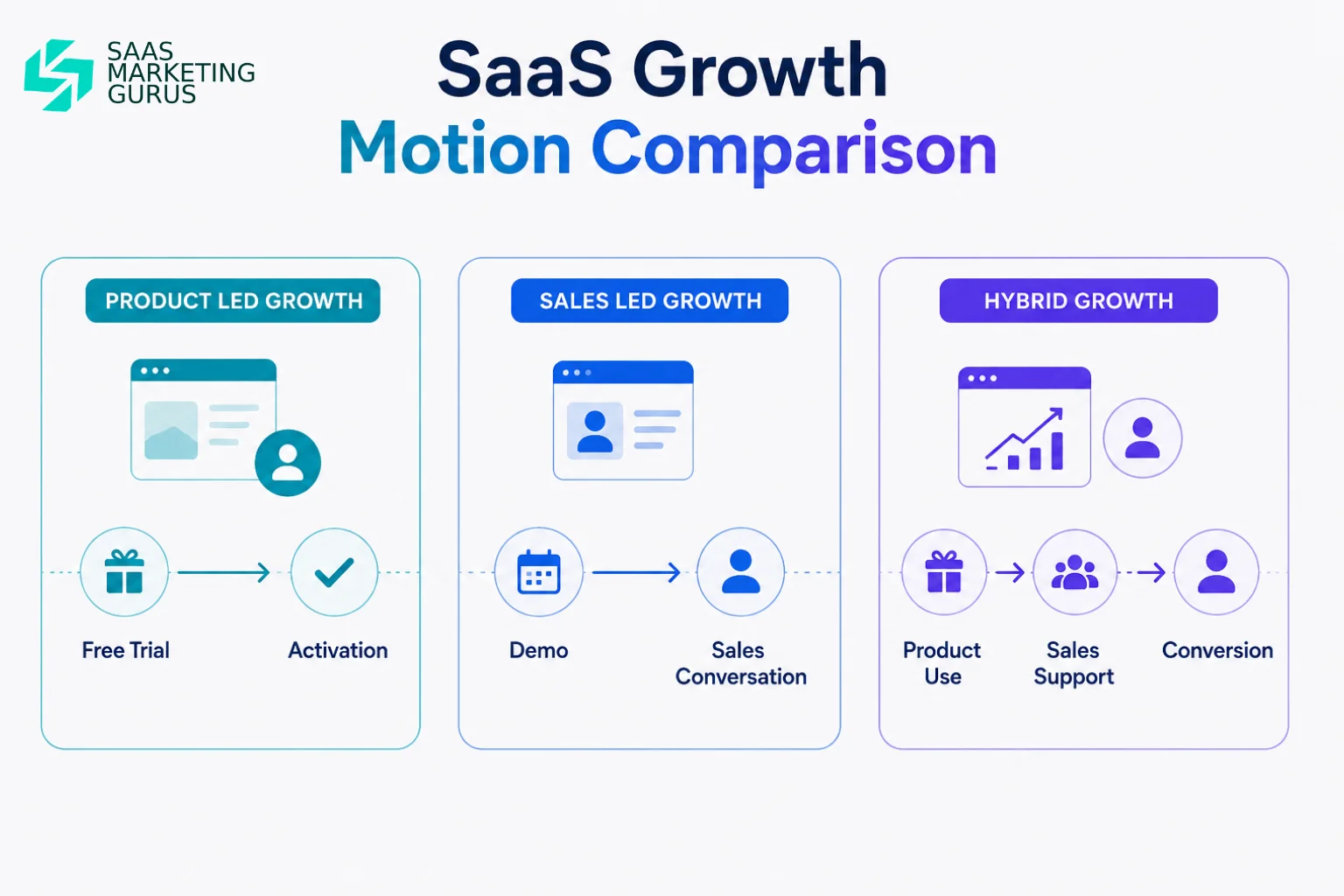
The key is to match the marketing plan to the product economics. Enterprise software may need account research, executive content, and security proof. A lower priced tool may grow faster through search, templates, free tools, and simple onboarding.
Find the Main Growth Constraint
After selecting the growth motion, do not immediately add more channels. First, find the part of the customer journey that is holding back revenue.
A growth constraint is the biggest current problem stopping a SaaS company from reaching its next revenue goal.
Use this table to find the likely constraint:
| Observed Problem | Likely Constraint | First Response |
|---|---|---|
| Few qualified visitors | Demand or discoverability | Improve category education, SEO, AI visibility, community presence, and targeted distribution |
| Traffic but few demos | Positioning or conversion | Clarify value, strengthen proof, improve offers, and remove form friction |
| Many demos but few wins | Targeting, qualification, or sales alignment | Refine the ICP, review objections, and create better decision content |
| Many signups but weak usage | Activation | Improve onboarding, lifecycle messages, templates, and time to value |
| Customer growth but weak revenue | Retention or expansion | Analyze churn, adoption, pricing, customer education, and expansion triggers |
This diagnosis keeps the strategy focused. For example, if traffic is already strong but demos are weak, buying more traffic will only make the problem more expensive.
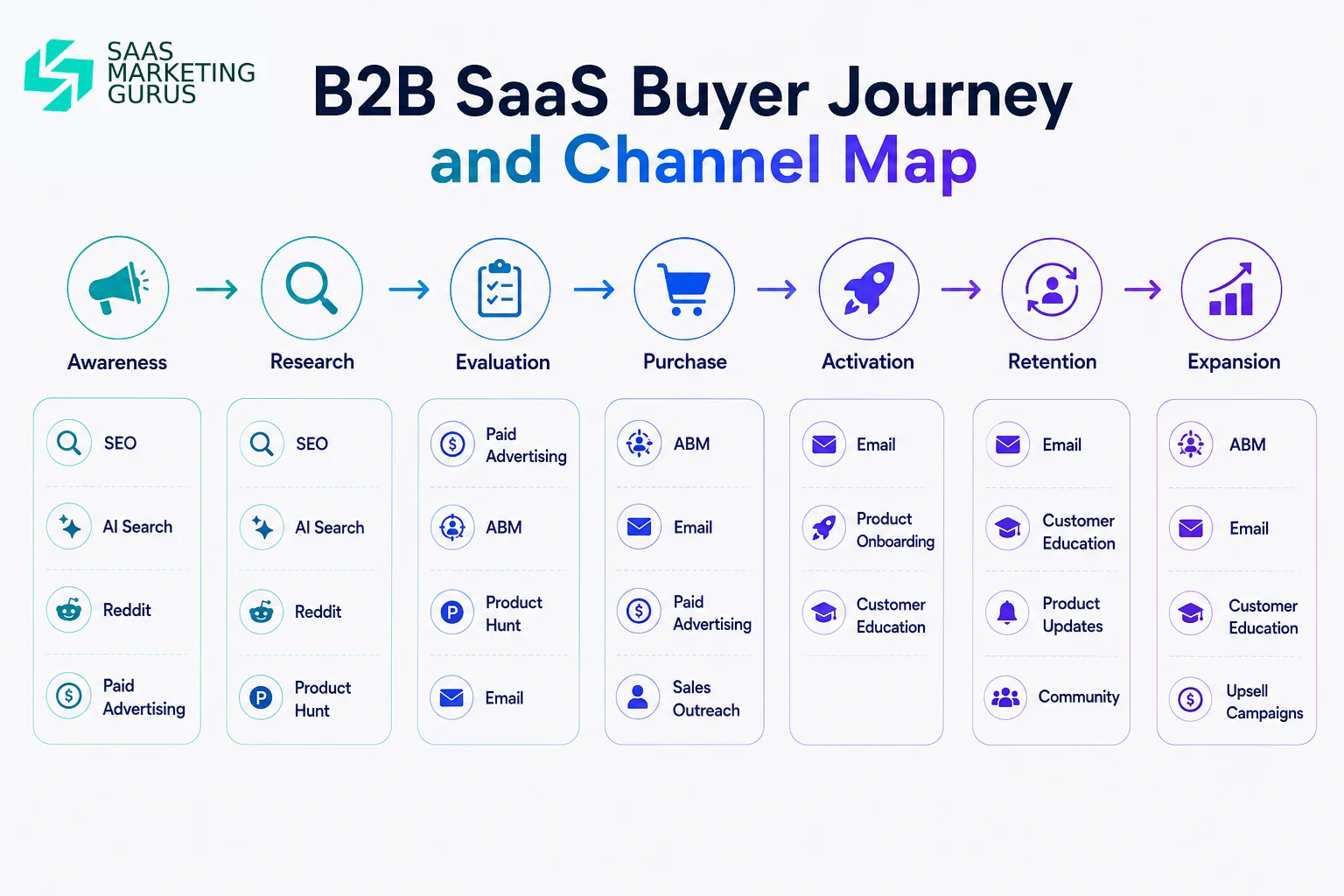
Map Channels to the Buyer Journey
Once the main constraint is clear, you can choose channels for a specific reason. One channel may create awareness, another may capture active demand, and another may improve retention. They do not all need to generate an immediate demo.
Search and content
SEO helps your company appear when buyers search for answers, products, comparisons, integrations, alternatives, and pricing. Educational content builds early trust, while commercial content supports buyers who are closer to a decision.
SMG’s SaaS SEO service covers this at the keyword and technical level. The SaaS content marketing strategy guide explains how content can support organic visibility, AI discovery, product education, and pipeline.
AI search visibility
GEO definition for B2B SaaS marketing: Generative engine optimization, or GEO, is the process of making your SaaS brand easier for AI search tools to understand, trust, and mention in generated answers.
Clear answers, original evidence, expert authors, consistent brand details, and mentions on trusted websites can improve AI visibility. SMG explains this process through its generative engine optimization service.
Community marketing
Community marketing helps your team learn how buyers describe their problems and answer questions in places they already trust. Useful and transparent participation can also build brand familiarity before a buying decision.
For Reddit specifically, the Reddit marketing agency guide explains how relevant discussions can support buyer research, search visibility, and AI discovery.
Paid acquisition
Paid search captures active demand, while paid social reaches selected accounts and supports retargeting. Track pipeline quality, not only cost per lead.
Account based marketing
ABM definition for B2B SaaS: Account based marketing, or ABM, brings marketing and sales together to target a selected group of valuable business accounts.
ABM makes sense when the expected customer value can support personalized research, advertising, outreach, events, and sales content.
Product launches
Product Hunt can generate visibility, feedback, early users, and social proof. However, launch traffic only becomes valuable when it connects with onboarding, follow up, and conversion tracking.
SMG states that it has executed more than 1,500 Product Hunt launches, including a launch for a DevOps tooling company that generated more than 4,500 signups in 24 hours. Its Product Hunt launch service explains the preparation, positioning, launch execution, and follow up involved.
SMG experience note: A launch traffic problem is not always an awareness problem. SMG addresses the disconnect by defining positioning, preparing the audience, managing engagement, and tracking signups and feedback after launch rather than treating upvotes as the final result.
Lifecycle and retention marketing
Lifecycle marketing uses customer behavior to deliver relevant messages across onboarding, adoption, renewal, and expansion. Segment by the desired next action, not only by signup date.
Build a Full Funnel Measurement System
After choosing the channels, decide how you will measure their contribution. Traffic matters, but it must eventually lead to product use, pipeline, retention, or revenue.
Leading indicator definition for SaaS marketing: A leading indicator is an early sign that your B2B SaaS marketing strategy is moving in the right direction. Examples include qualified traffic, product activation, and pipeline creation.
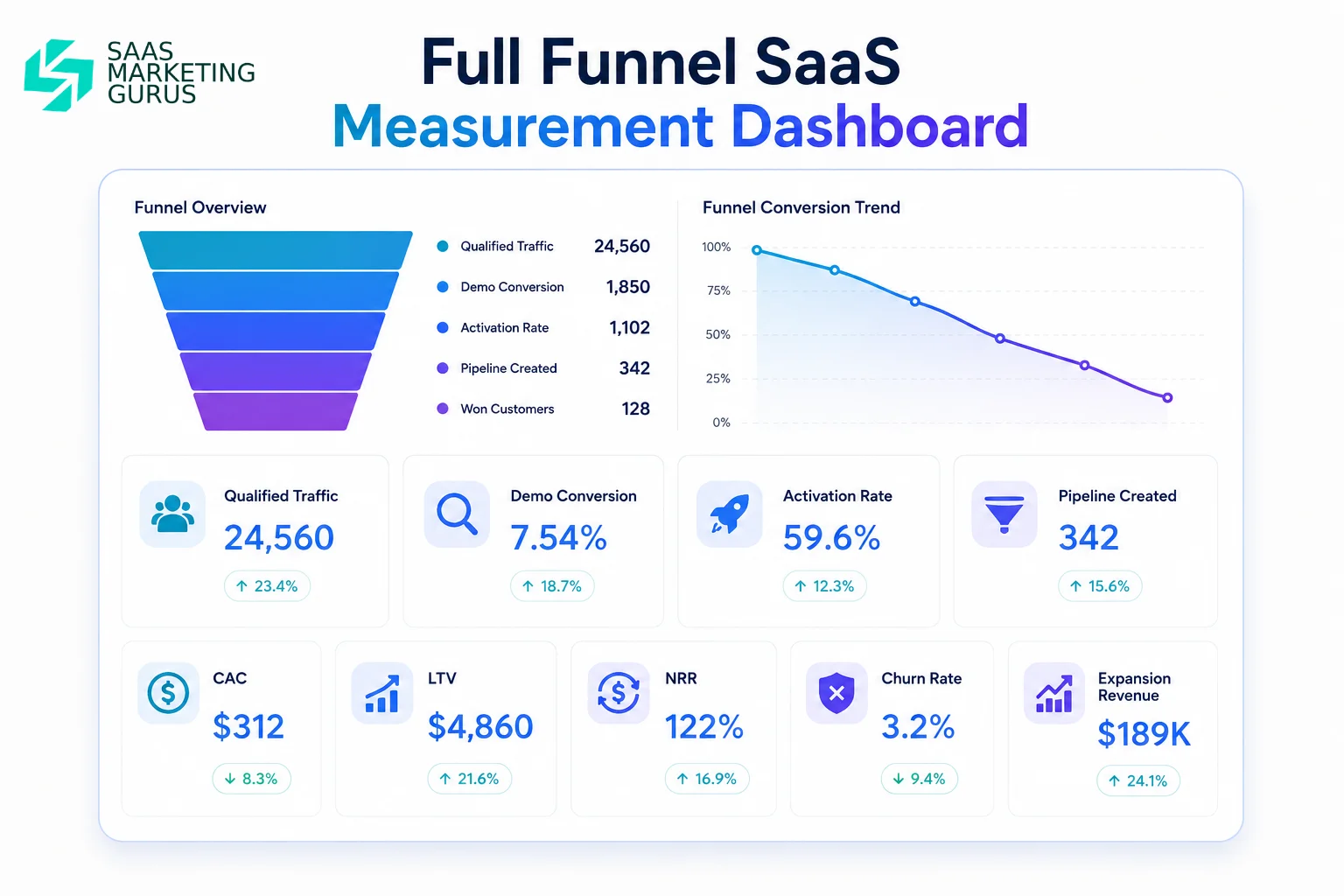
Lagging indicator definition for SaaS marketing: A lagging indicator shows the final business result after marketing and sales activity has taken place. Examples include revenue, retention, and profit.
| Stage | Useful Metrics | Core Question |
|---|---|---|
| Awareness | Relevant reach, branded search, target account engagement | Are the right buyers becoming familiar with us? |
| Acquisition | Qualified traffic, demos, signups, visitor conversion | Are we attracting likely customers? |
| Activation | Time to value, key action completion, PQL rate | Do new users experience meaningful value? |
| Pipeline | Qualified opportunities, pipeline created, win rate, sales cycle | Is marketing contributing to viable revenue? |
| Retention | Logo churn, revenue churn, adoption, renewal | Do customers continue receiving value? |
| Expansion | Expansion revenue, NRR, account growth | Does customer value increase over time? |
Four B2B SaaS marketing metrics deserve special attention:
- Customer acquisition cost, or CAC: the total sales and marketing cost needed to gain one new customer.
- Customer lifetime value, or LTV: the estimated gross profit a customer produces during the relationship.
- CAC payback period: the time needed to recover the cost of acquiring a customer.
- Net revenue retention, or NRR: the recurring revenue kept from existing customers after expansion, reduced spending, and churn.
These metrics show whether growth is financially healthy. Attribution still needs care because a buyer may interact with many pages and channels before converting. According to 6sense attribution research, buying groups may have 100 to 200 vendor interactions, with at least 70% taking place digitally and anonymously.
A Practical 90 Day B2B SaaS Marketing Plan
A strategy becomes useful only when it leads to action. The following 90 day plan moves from research to testing and then improvement.
| Period | Priority | Actions | Output |
|---|---|---|---|
| Days 1 to 30 | Research and foundation | Interview customers, review sales calls, define ICP, map the buying group, audit funnel data, clarify positioning | Strategy brief and baseline dashboard |
| Days 31 to 60 | Build and launch | Create priority content, improve conversion paths, launch two channel tests, connect tracking, align sales follow-up | Campaigns and conversion assets |
| Days 61 to 90 | Measure and improve | Review quality, activation, pipeline, and cost; stop weak activity; expand the strongest message and channel | Quarterly learning report and next plan |
Keep major tests focused. Two well measured campaigns can teach more than eight poorly supported ones.
Match Strategy to SaaS Growth Stage
| Stage | Primary Objective | Suitable Priorities | Main Evidence |
|---|---|---|---|
| Early stage | Validate the ICP, problem, and positioning | Customer interviews, founder content, targeted outbound, communities, and product launches | Qualified conversations, activation, and retention signals |
| Growth stage | Build repeatable pipeline | SEO, comparison content, paid demand capture, lifecycle campaigns, and selected partnerships | CAC, pipeline, win rate, and payback |
| Scale stage | Increase efficiency and market coverage | ABM, brand, integrations, category leadership, expansion, and international growth | NRR, market penetration, revenue efficiency, and expansion |
Budget should follow the same logic. A startup that is still testing its message should not commit heavily to paid acquisition. A company with proven conversion and retention can invest more confidently in scalable demand.
Use the SaaS marketing budget guide to connect spending with growth stage and customer economics.
B2B SaaS Marketing Strategy Example
Here is how the full process works in practice.
Consider a fictional workflow platform selling to operations teams at companies with 100 to 1,000 employees. Its annual contract value is high enough to require a demo. Traffic is growing, but many demo requests are not a good fit.
The company reviews its funnel and finds the main problem: its ICP is too broad and its message is too general. It then builds this focused plan:
| Element | Decision |
|---|---|
| ICP | Operations teams at multisite service companies with manual approval workflows |
| Core Problem | Slow approvals create delays, poor visibility, and compliance risk |
| Positioning | Workflow control built for distributed operations, with fast implementation and clear audit history |
| Growth Motion | Sales-led |
| Priority Content | Industry use cases, workflow templates, alternative pages, ROI calculator, security material, and case studies |
| Channels | SEO, paid search, LinkedIn account targeting, partner webinars, and lifecycle email |
| Primary Conversion | Qualified workflow assessment |
| Metrics | Qualified demo rate, opportunity rate, pipeline created, win rate, CAC payback |
The team first updates positioning, narrows targeting, creates proof, and improves qualification. It increases traffic investment only after conversion quality improves.
That sequence is the difference between a channel plan and a strategy.
Common B2B SaaS Marketing Mistakes
Selecting channels before understanding the buyer
Channel popularity does not prove channel fit. Start with customer behavior, buying risk, contract value, and the information required for a decision.
Measuring leads instead of revenue quality
Form submissions can look positive while opportunity creation declines. Track what happens after acquisition.
Creating content for only one stakeholder
A user may love the product while security or finance blocks the deal. Support the full buying group.
Treating acquisition as the end of marketing
Activation, customer education, retention, advocacy, and expansion affect the value of every acquired account.
Spreading resources across too many priorities
Small teams often make more progress by owning one audience, one constraint, and a few connected channels.
Publishing claims without proof
Strong E E A T comes from visible experience, named authors, reliable sources, original examples, clear methodology, and honest limits. Unsupported statistics and vague claims weaken trust.
Key Takeaways
- A B2B SaaS marketing strategy must influence buyers before the demo. 6sense’s 2025 study found buyers now make first contact with sellers at 61% of the way through the buying journey, and the vendor on their Day One shortlist wins the deal 95% of the time. Use SEO, AI search content, comparisons, communities, and customer proof to build trust during this research stage.
- B2B SaaS marketing channels should support one connected buyer journey. McKinsey found that B2B buyers use an average of ten interaction channels. Keep your positioning and product value consistent across search, social platforms, review sites, community discussions, email, and sales conversations.
- B2B SaaS marketing success should be measured through pipeline and revenue. Buying groups may have 100 to 200 vendor interactions, and at least 70% may be digital and anonymous, according to 6sense. Measure qualified pipeline, activation, CAC, revenue, and retention instead of relying only on leads or final click attribution.
Turn Your SaaS Marketing Plan Into a Pipeline System
A successful B2B SaaS marketing strategy begins with a clear customer and an important problem. It then connects positioning, channels, content, and measurement around that buyer.
Following this order makes the strategy easier to manage. It also helps your team avoid spending more on traffic when the real issue is targeting, messaging, conversion, or retention.
SMG helps B2B SaaS teams turn scattered activity into a focused growth plan across SEO, content, GEO, Reddit, Product Hunt, paid acquisition, and conversion. The goal is to build stronger visibility, attract qualified demos, and connect marketing work with measurable pipeline.
Ready to find the problem limiting your SaaS growth? Book a Growth Strategy Call with SaaS Marketing Gurus and build a strategy around your buyers, revenue model, and next growth target.
FAQs
What’s the difference between B2B SaaS marketing and B2C SaaS marketing?
B2B SaaS marketing sells to buying groups, not individuals. It involves longer evaluation cycles, more stakeholders, and content built around ROI and risk reduction rather than emotional or impulse triggers.
How much should a B2B SaaS company spend on marketing?
There’s no universal number. It depends on growth stage, CAC, LTV, and growth motion. See the SaaS marketing budget guide for stage-by-stage allocation.
Is product-led or sales-led growth better for B2B SaaS?
Neither is universally better. Product-led fits low-complexity, lower-contract-value products with fast adoption. Sales-led fits higher contract value and complex buying decisions. Many companies land on a hybrid.
How long does a B2B SaaS marketing strategy take to show results?
SEO and content typically take 3 to 6 months to build traction. Paid acquisition and ABM can show pipeline signals within weeks, but retention and expansion metrics need a full customer lifecycle to read clearly.
What metrics matter most for B2B SaaS marketing?
CAC, LTV, CAC payback period, and net revenue retention (NRR) matter most because they connect marketing activity to revenue health, not just traffic or lead volume.