Growing a SaaS company requires more than increasing marketing spend. The real challenge is knowing where to invest, which channels drive revenue, and how to balance customer acquisition with long-term growth.
A SaaS marketing budget is a structured plan for allocating marketing investment across acquisition, activation, retention, and expansion to achieve predictable revenue growth. Most SaaS companies invest between 10% and 20% of annual revenue in marketing, but the ideal budget depends on growth stage, customer acquisition cost (CAC), lifetime value (LTV), and business goals.
With rising competition, increasing customer acquisition costs, longer sales cycles, and AI changing how buyers discover software, companies need a smarter approach to planning their investments.
A well-structured SaaS marketing budget helps businesses connect spending with measurable outcomes. It allows teams to prioritize the right channels, forecast growth more accurately, and avoid wasting resources on activities that do not contribute to revenue.
Whether you are building a startup, scaling a Product-Led Growth (PLG) company, or managing an established SaaS brand, your budget should align with your growth stage, customer journey, acquisition model, and revenue targets.
This guide explains how SaaS companies can plan, allocate, and optimize marketing investments in 2026 using practical frameworks, industry insights, and performance-driven strategies.
How Much Should a SaaS Company Spend on Marketing?
Most SaaS companies allocate 10% to 20% of their annual revenue to marketing. Early-stage startups often invest above this range to validate acquisition channels and build brand awareness, while mature SaaS businesses focus on improving marketing efficiency and maximizing return on investment.
The right budget depends on factors such as:
- Business growth stage
- Customer Acquisition Cost (CAC)
- Customer Lifetime Value (LTV)
- Sales cycle length
- Revenue goals
- Market competition
- Growth model (PLG, SLG, or hybrid)
A successful SaaS marketing budget should not rely on a single acquisition channel. High-performing SaaS companies typically balance investment across:
- SEO
- Content marketing
- Paid acquisition
- Lifecycle marketing
- Community marketing
- AI search optimization
- Product launches
The objective is not simply to increase spending. Build a repeatable growth system where every marketing dollar contributes to acquisition, retention, and revenue.
Budget percentages are useful benchmarks, but your ideal marketing investment should be based on CAC, LTV, growth stage, and revenue objectives—not industry averages alone.
What Is a SaaS Marketing Budget?
A SaaS marketing budget is the planned investment a software company allocates to acquire, retain, and expand customers over a defined period. It covers channels such as SEO, content marketing, paid advertising, lifecycle marketing, product marketing, community building, and customer retention initiatives.
Unlike traditional businesses that depend on one-time purchases, SaaS companies operate on recurring revenue models. This means budgeting decisions should prioritize long-term customer value rather than short-term conversions.
A typical SaaS marketing budget includes investments in:
- Search Engine Optimization (SEO)
- Content marketing
- Paid advertising
- Product marketing
- Email and lifecycle campaigns
- Community marketing
- Product launches
- Marketing technology
- Agency or in-house marketing support
- Customer retention initiatives
The purpose of a marketing budget extends beyond expense management. It provides a framework for deciding where to invest, how to measure success, and which activities should be optimized over time.
For example, a startup may prioritize customer research, SEO foundations, and product validation, while an enterprise SaaS company may allocate more budget to account-based marketing, brand awareness, and market expansion.
An effective SaaS marketing budget aligns investment with long-term customer value rather than individual marketing campaigns.
Why Does a SaaS Marketing Budget Matter?
A SaaS marketing budget helps companies allocate resources strategically, improve customer acquisition efficiency, and connect marketing investment directly to revenue growth. Instead of funding isolated campaigns, it creates a repeatable system for acquiring, retaining, and expanding customers.
Many SaaS companies struggle because they treat marketing as a collection of individual campaigns instead of a connected growth system.
Without a clear plan, companies often:
- Spend too much on channels with weak returns
- Increase paid advertising before improving conversion rates
- Ignore retention and expansion opportunities
- Track traffic instead of revenue impact
- Struggle to predict future growth
A strategic marketing budget helps teams make better decisions by aligning marketing activities with measurable business outcomes.
It enables companies to:
Improve Customer Acquisition Efficiency
Tracking Customer Acquisition Cost (CAC) helps identify whether marketing investments are attracting profitable customers or simply increasing acquisition costs.
Build Sustainable Growth Channels
Long-term investments such as SEO, content marketing, community marketing, and AI search optimization continue generating demand long after individual campaigns end.
Support Different Growth Models
Product-Led Growth (PLG) companies typically invest more in product education and self-service onboarding, while sales-led organizations often prioritize lead generation, account-based marketing, and sales enablement.
Align Marketing with Revenue Goals
Modern SaaS teams use metrics such as LTV, CAC, MRR, ARR, and revenue attribution to understand which marketing activities generate sustainable business growth—not just website traffic.
A well-planned B2B SaaS demand generation budget should support the entire customer journey, from awareness and acquisition to retention and customer expansion.
The most effective SaaS marketing budgets optimize customer lifetime value—not just lead volume.
At SaaS Marketing Gurus, we work with SaaS companies to improve growth through SEO, AI search optimization, Product Hunt launches, content strategy, community marketing, and revenue-focused campaigns.
How to Plan a B2B SaaS Marketing Budget Framework
An effective SaaS marketing budget starts with clear business goals, customer economics, and measurable growth targets—not fixed percentages or guesswork.
Creating a marketing budget is not about selecting a random percentage of revenue and distributing money across marketing channels. A successful plan begins by understanding business objectives, customer acquisition costs, growth stage, and the channels most likely to generate qualified customers.
A structured planning process helps SaaS companies decide:
- Where to invest
- How much to allocate
- Which channels deserve additional budget
- When to adjust spending based on performance
The following GROW Framework provides a practical way to build a marketing budget that supports predictable and scalable growth.
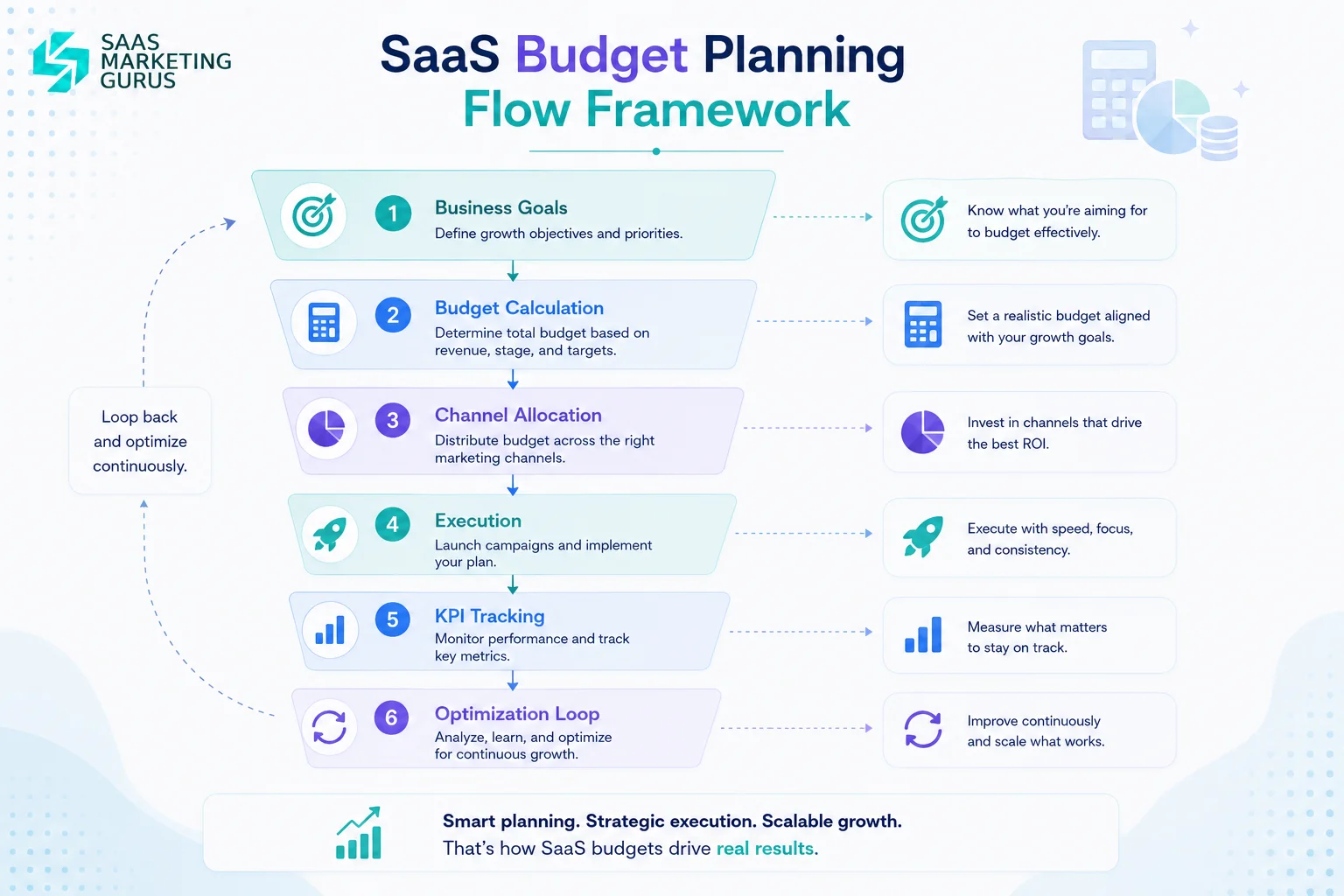
SaaS Marketing Investment Planning Flow Framework
The GROW Framework is a simple planning model that helps SaaS companies align marketing investment with business objectives. Instead of allocating budgets by intuition, it provides a structured process for setting priorities, evaluating performance, and continuously improving results.
G: Define Growth Goals
Every budget decision should start with a clear business objective.
Ask:
- Are you trying to increase Monthly Recurring Revenue (MRR)?
- Do you need more qualified leads?
- Are you entering a new market?
- Do you want to reduce customer acquisition costs?
- Are you focused on improving retention?
Your goals determine your priorities.
Example:
| Business Goal | Marketing Focus |
|---|---|
| Increase brand awareness | SEO, content marketing, digital PR |
| Generate qualified leads | Paid campaigns, landing pages, webinars |
| Improve retention | Email automation, customer education |
| Launch a new product | Product Hunt, community marketing |
| Expand into new markets | Localized content and demand generation |
R: Review Performance Data
Before increasing spending, analyze what is already working.
Review metrics such as:
- Customer Acquisition Cost (CAC)
- Customer Lifetime Value (LTV)
- Conversion rates
- Organic traffic growth
- Pipeline contribution
- Marketing-sourced revenue
- Channel performance
- Retention rate
Many companies increase their marketing budget before understanding which channels actually generate profitable customers.
Data helps identify where additional investment can create the highest return.
O: Organize Budget Across the Customer Journey
A common mistake is allocating most of the budget only toward customer acquisition.
A stronger approach distributes investment across the complete funnel.
| Funnel Stage | Goal | Marketing Activities |
|---|---|---|
| Awareness | Create demand | SEO, content, AI search optimization |
| Acquisition | Generate customers | Paid ads, landing pages, outbound campaigns |
| Activation | Improve onboarding | Product education, email sequences |
| Retention | Reduce churn | Customer marketing, webinars |
| Expansion | Increase account value | Upselling, referrals, customer advocacy |
This approach creates a healthier growth system instead of depending on one acquisition source.
W: Watch, Measure, and Optimize
Marketing budgets should not remain fixed throughout the year.
Successful SaaS teams review performance regularly and adjust spending based on results.
Monthly reviews should focus on:
- CAC changes
- Lead quality
- Conversion rates
- Channel performance
- Revenue contribution
Quarterly reviews should evaluate:
- Overall budget efficiency
- LTV: CAC ratio
- Growth opportunities
- Marketing channel expansion
The goal is continuous improvement, not simply spending the allocated amount.
Framework Summary
- G – Define measurable growth goals.
- R – Review performance before increasing spend.
- O – Organize investment across the customer journey.
- W – Watch performance and optimize continuously.
Companies that review budgets regularly and reallocate spending based on performance are more likely to improve marketing efficiency than those using fixed annual budgets.
SaaS Demand Generation Budget Allocation by Growth Stage
There is no universal SaaS marketing budget. Budget allocation should evolve as your company grows. Early-stage startups typically invest more in customer validation and acquisition, while mature SaaS businesses prioritize efficiency, retention, and expansion.
The following framework shows how marketing priorities change across each growth stage.
| Growth Stage | Primary Goal | Budget Priority |
|---|---|---|
| Pre-Product Market Fit | Validate demand | Customer research, landing pages, founder-led marketing |
| Startup | Build repeatable acquisition | SEO, content, paid acquisition |
| Growth | Improve efficiency | CRO, automation, lifecycle marketing |
| Enterprise | Scale revenue | ABM, brand, expansion, customer advocacy |
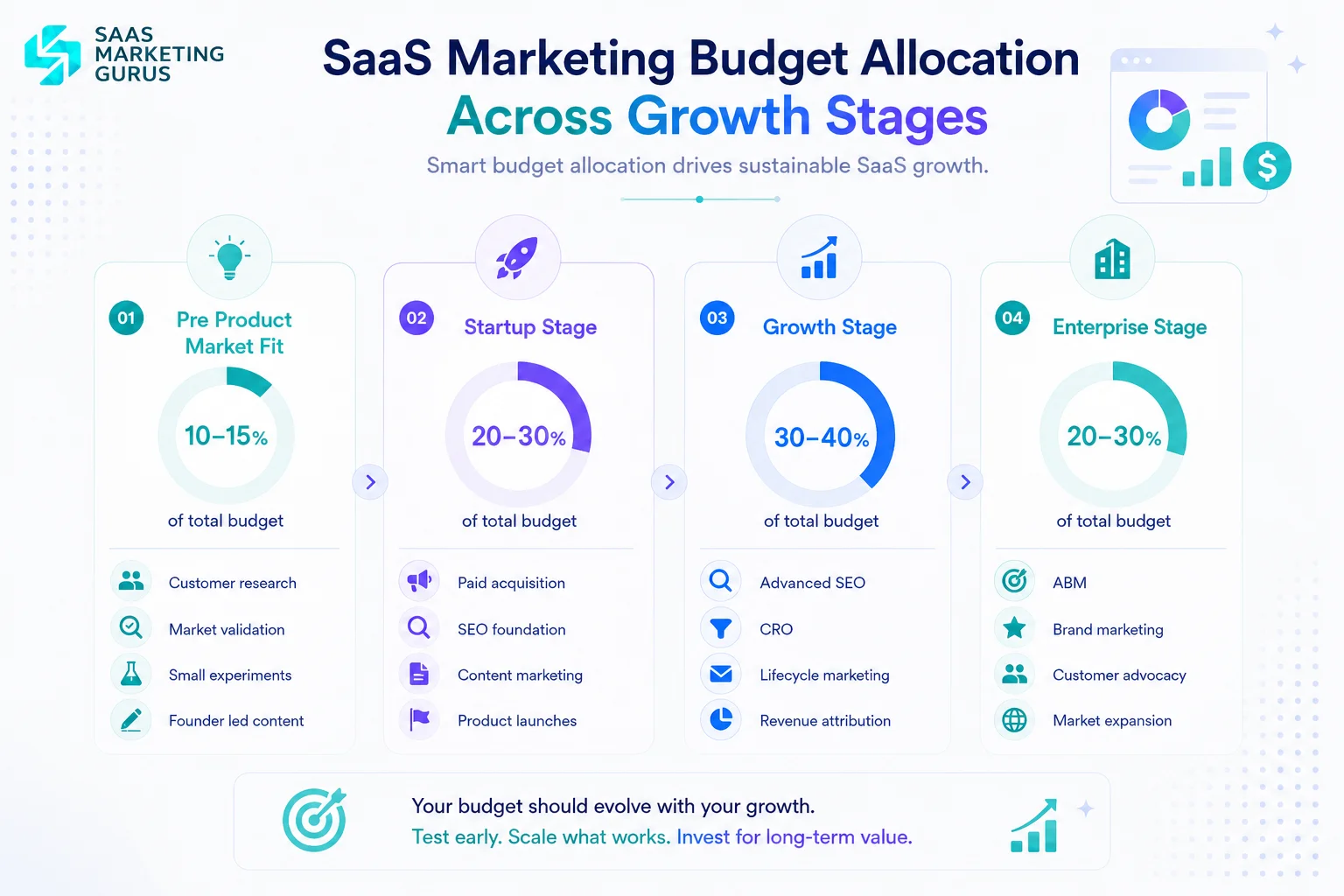
Pre Product Market Fit Stage
At this stage, the goal is learning and validation.
The focus should be:
- Customer interviews
- Market research
- Landing page testing
- Founder led content
- Small advertising experiments
- Community engagement
Avoid investing heavily in large campaigns before understanding your ideal customer profile.
Startup Stage
After finding early product market fit, companies need to build repeatable acquisition channels.
Typical priorities:
| Channel | Budget Focus |
|---|---|
| Paid advertising | Testing acquisition channels |
| SEO | Building long term visibility |
| Content marketing | Educating target customers |
| Email marketing | Nurturing leads |
| Product launches | Creating awareness |
| Analytics tools | Measuring performance |
At this stage, the goal is discovering which channels generate customers at an acceptable CAC.
Growth Stage
Growth stage companies should focus on improving efficiency rather than simply adding more channels.
Priorities usually include:
- Advanced SEO strategies
- Topic clusters
- Conversion optimization
- Lifecycle marketing
- Community building
- Marketing automation
- Revenue attribution
A mature marketing budget saas strategy focuses on improving returns from existing channels while expanding proven growth opportunities.
Enterprise Stage
Enterprise SaaS companies usually prioritize market expansion, retention, and brand authority.
Common investments include:
- Account-Based Marketing (ABM)
- Product marketing
- Customer advocacy
- Digital PR
- Executive thought leadership
- International campaigns
- Customer success programs
The focus shifts from acquiring more leads to acquiring better customers and increasing lifetime value.
Marketing budgets should evolve with your business. As your company matures, investment gradually shifts from customer acquisition toward retention, expansion, and operational efficiency.
SaaS Demand Generation Budget Formula
There is no single budgeting formula suitable for every SaaS company. The right approach depends on whether your business prioritizes revenue forecasting, customer acquisition, or growth efficiency.
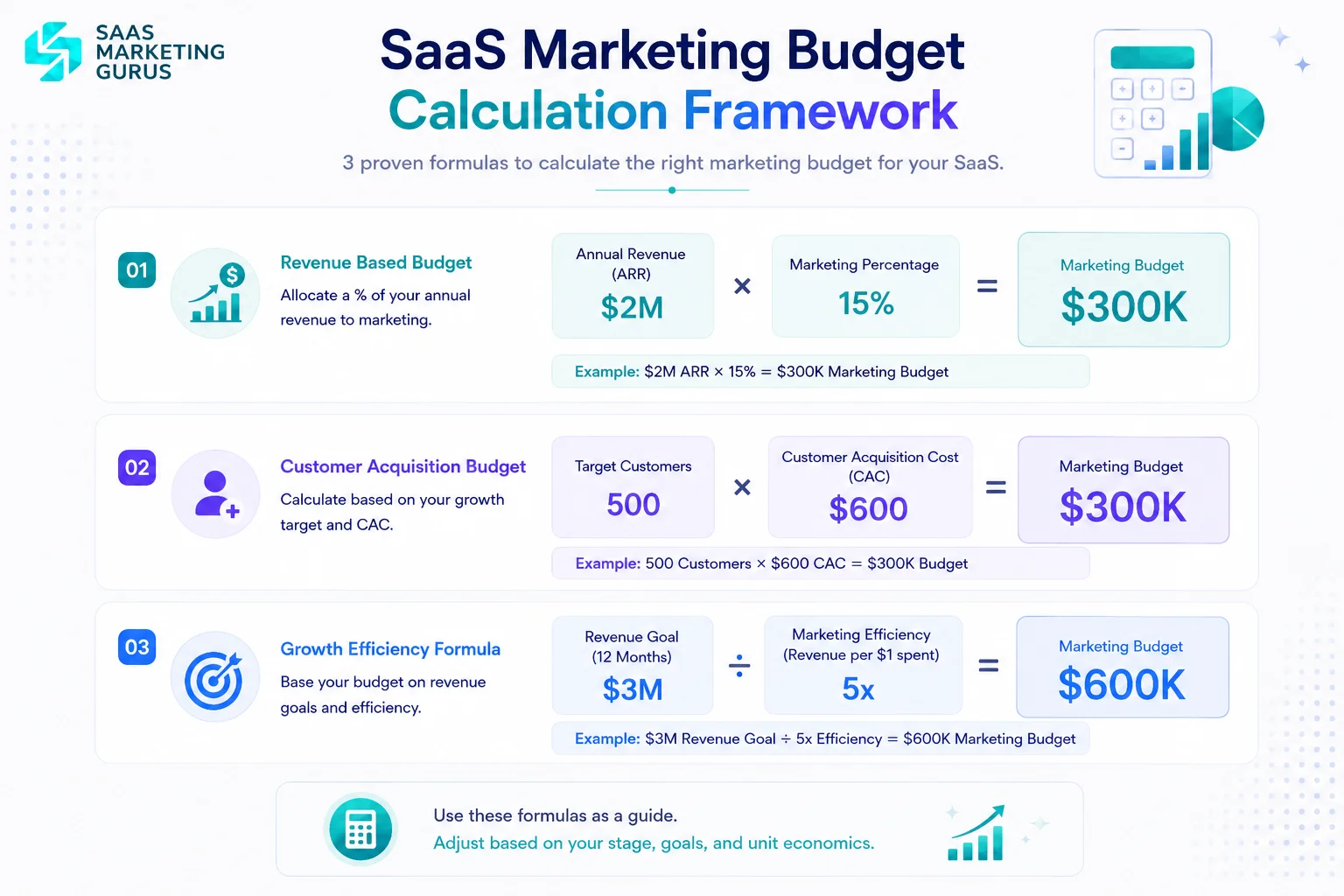
Formula 1: Revenue-Based Budget
Marketing Budget = Annual Revenue × Marketing Allocation Percentage
Example:
Annual Revenue: $2,000,000
Marketing Allocation: 15%
Annual Marketing Budget:
$300,000
This method works well for companies with predictable recurring revenue.
Formula 2: Customer Acquisition-Based Budget
Marketing Budget = Target Customers × Customer Acquisition Cost
Example:
Target Customers: 500
Target CAC: $600
Required Marketing Budget:
$300,000
This approach is useful for startups and companies focused on customer growth.
Formula 3: Growth Efficiency Formula
Required Marketing Investment = Desired Revenue Growth ÷ Current Marketing Efficiency
This helps companies understand whether additional spending can realistically support their growth targets.
| Formula | Best For | Limitation |
|---|---|---|
| Revenue-Based | Mature SaaS | Doesn’t consider CAC changes |
| CAC-Based | Startups | Requires accurate CAC estimates |
| Growth Efficiency | Scaling SaaS | Depends on reliable attribution |
The SaaS Growth Allocation Framework
The PACE Framework helps SaaS companies balance short-term pipeline generation with long-term customer growth. Instead of investing heavily in a single acquisition channel, it distributes marketing spend across four areas that support sustainable revenue.
These percentages are starting benchmarks and should be adjusted based on your company’s growth stage and acquisition strategy.
P: Pipeline Creation (40%)
Focus on activities that create new opportunities.
Includes:
- Paid acquisition
- SEO
- Content marketing
- Partnerships
- Community marketing
The goal is building consistent demand.
A: Activation and Conversion (25%)
Generating traffic is not enough. Visitors need to become users and customers.
Investment areas:
- Landing page optimization
- Product onboarding
- Conversion Rate Optimization (CRO)
- Demo experiences
- Sales enablement content
C: Customer Retention and Expansion (20%)
Recurring revenue depends on keeping customers successful.
Focus areas:
- Lifecycle emails
- Customer education
- Product adoption campaigns
- Customer communities
E: Experimentation and Innovation (15%)
SaaS markets change quickly. Companies need room to test new opportunities.
Examples:
- AI search optimization
- New content formats
- Emerging communities
- Product launch campaigns
- New acquisition channels
This framework helps companies balance immediate growth with long-term scalability.
PACE Framework Summary
| Area | Purpose |
|---|---|
| Pipeline | Generate demand |
| Activation | Convert visitors |
| Customer | Improve retention |
| Experimentation | Discover new growth opportunities |
How to Allocate Your SaaS Acquisition Strategy by Channel
A strong SaaS growth strategy does not depend on one marketing channel. The best performing companies create a balanced mix of demand generation, customer acquisition, retention, and brand-building activities.
Your channel allocation should depend on your growth stage, target audience, sales cycle, and customer acquisition model.
Paid Advertising
Paid channels such as Google Ads, LinkedIn Ads, and Meta Ads can generate immediate visibility and help test messaging quickly.
Best uses:
- Capturing high-intent searches
- Testing new markets
- Promoting product launches
- Generating qualified leads
However, paid advertising should not become the only growth engine. Increasing ad spend without improving conversion rates often leads to rising acquisition costs.
SEO and Content Marketing
SEO remains one of the strongest long-term investments for SaaS companies because it helps attract users who are already searching for solutions.
Effective SaaS SEO strategies include:
- Product comparison pages
- Educational content
- Industry-specific guides
- Topic clusters
- Technical SEO improvements
- AI search optimized content
A strong SEO foundation helps companies reduce dependency on paid acquisition and build consistent organic demand.
Product Launch and Community Marketing
Modern SaaS buyers often research products through communities, reviews, and peer recommendations before making decisions.
Platforms and activities such as:
- Product Hunt launches
- Reddit discussions
- Industry communities
- Customer review platforms
- Founder-led content
can help build credibility and attract high-intent users.
Community marketing works best when companies provide value instead of only promoting their products.
Email and Lifecycle Marketing
Email marketing supports the full customer journey.
It helps SaaS companies:
- Convert trial users
- Improve onboarding
- Increase product adoption
- Reduce churn
- Expand customer accounts
Lifecycle campaigns often deliver strong returns because they improve the value of customers already acquired.
Common SaaS Investment Framework Mistakes
Even companies with strong products can struggle to generate predictable growth if their marketing budget is allocated inefficiently. Reviewing these common mistakes can help you avoid wasted spend and improve marketing ROI.
Spending Before Finding Product Market Fit
Investing heavily in advertising before understanding customers often creates expensive experiments without predictable results.
First identify:
- Ideal customer profile
- Strong messaging
- Repeatable acquisition channels
Relying Only on Paid Acquisition
Paid ads can create fast growth, but depending only on advertising can increase costs over time.
A balanced strategy combines:
- Paid channels
- SEO
- Content
- Community
- Retention marketing
Ignoring Retention
Many companies focus heavily on acquiring customers while ignoring customer success.
For SaaS businesses, keeping customers is just as important as gaining new ones.
Improving retention increases LTV and makes marketing investments more profitable.
Tracking the Wrong Metrics
Traffic and impressions do not always equal business growth.
Companies should measure:
- Revenue contribution
- CAC
- LTV
- Conversion rates
- Pipeline impact
The goal is understanding which activities create customers, not just attention.
SaaS Marketing Investment Plan Checklist
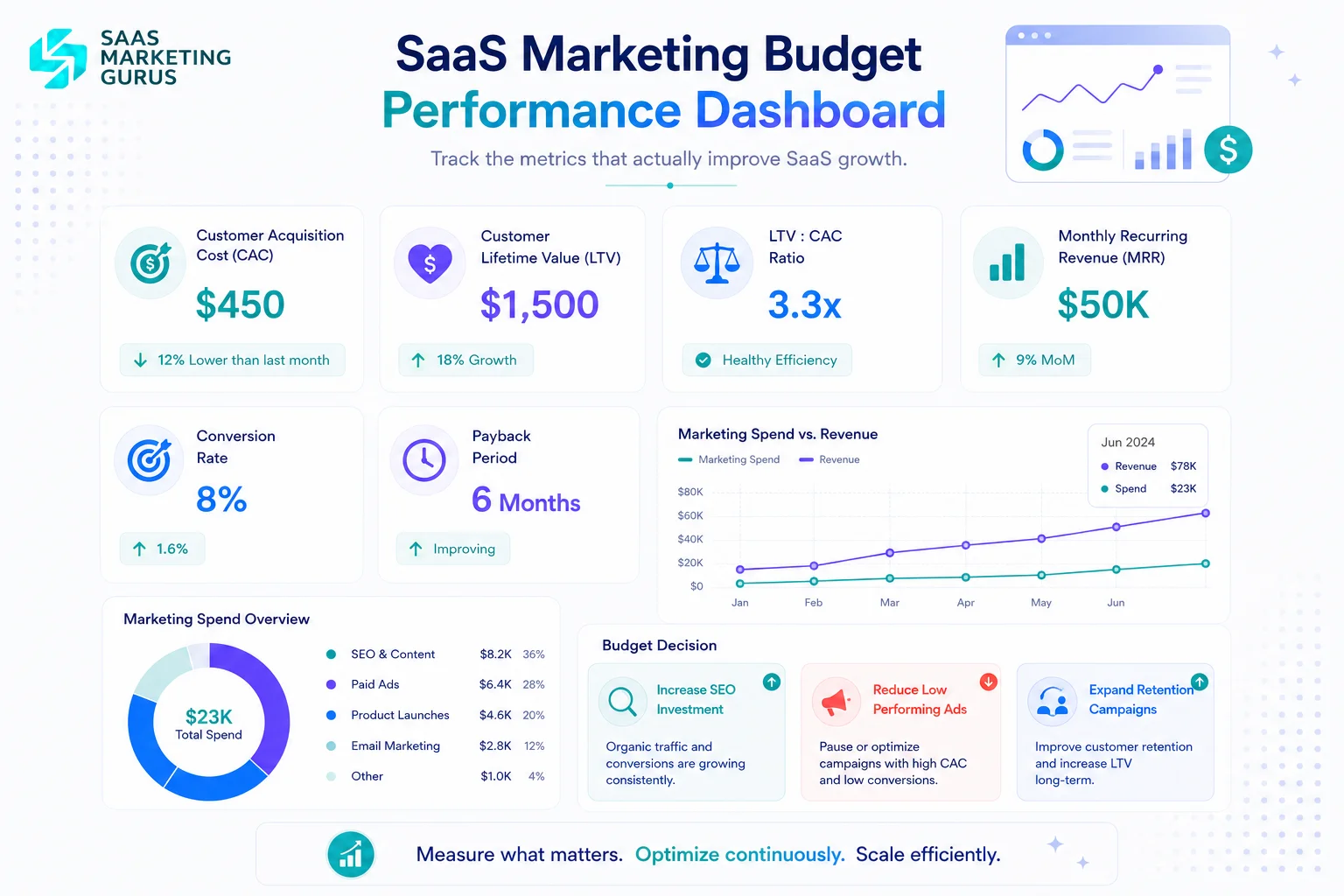
Before launching your marketing budget, confirm you have:
Strategy
- Clear revenue and growth targets
- Defined customer acquisition goals
- Documented ideal customer profile (ICP)
- Target CAC and LTV benchmarks
Channel Planning
- SEO and content investment plan
- Paid acquisition testing budget
- AI search optimization strategy
- Customer retention strategy
Measurement
- Marketing attribution system
- Monthly performance reviews
- Quarterly budget optimization process
- Budget allocated for experimentation
A structured budget is easier to optimize than one built around isolated marketing campaigns.
Essential SaaS Marketing KPIs
Tracking every marketing metric is unnecessary if you are not measuring the ones that directly influence growth. Start with the KPIs below to evaluate acquisition efficiency, customer profitability, and overall marketing performance.
| KPI | Why It Matters |
|---|---|
| CAC | Measures customer acquisition efficiency |
| LTV | Shows customer value over time |
| LTV:CAC Ratio | Evaluates profitability |
| MRR | Tracks recurring revenue growth |
| ARR | Measures company scale |
| Conversion Rate | Shows funnel performance |
| Churn Rate | Measures customer retention |
| Payback Period | Shows recovery time for acquisition costs |
| Marketing Attribution | Identifies revenue-generating channels |
A healthy SaaS company uses these metrics to decide where to increase, reduce, or redirect investment.
FAQs
How much should a SaaS company spend on marketing?
Most SaaS companies allocate 10% to 20% of annual revenue to marketing. Early-stage startups may invest more to validate acquisition channels and build market awareness, while mature SaaS companies typically focus on improving marketing efficiency and return on investment.
How do you calculate a SaaS marketing budget?
A SaaS marketing budget can be calculated using annual revenue, customer acquisition goals, or target CAC. The right approach depends on your growth stage, revenue objectives, and customer acquisition strategy. Most companies review and adjust their budget quarterly based on marketing performance.
Should SaaS companies invest more in SEO or paid advertising?
Both channels play different roles. Paid advertising generates immediate traffic and leads, while SEO builds long-term visibility and lowers customer acquisition costs over time. A balanced investment across both channels typically delivers the best results.
What are the most important SaaS marketing metrics to track?
The most important metrics include Customer Acquisition Cost (CAC), Customer Lifetime Value (LTV), LTV:CAC ratio, Monthly Recurring Revenue (MRR), Annual Recurring Revenue (ARR), conversion rate, churn rate, and marketing attribution. These KPIs help measure marketing efficiency and guide future budget decisions.
How often should a SaaS marketing budget be reviewed?
Marketing budgets should be reviewed monthly to monitor channel performance, CAC, and conversions. A more comprehensive quarterly review helps reallocate budget based on revenue contribution, growth goals, and overall marketing efficiency.
How does AI search affect SaaS marketing budgets?
AI-powered search is changing how software buyers discover products. Many SaaS companies are increasing investment in AI search optimization, authoritative content, SEO, and brand visibility to improve performance across AI-driven search experiences while reducing reliance on paid acquisition.
Build a SaaS Growth Budget That Drives Real Growth
A successful SaaS marketing budget is not about spending more money—it is about investing with purpose. Companies that consistently grow allocate their budgets based on customer acquisition economics, business goals, and measurable performance rather than assumptions.
By combining SEO, AI search optimization, content marketing, lifecycle campaigns, Product Hunt launches, and community marketing, SaaS businesses can build a balanced growth engine that supports both short-term pipeline and long-term revenue.
At SaaS Marketing Gurus, we help SaaS companies create data-driven marketing strategies tailored to their growth stage, acquisition model, and revenue objectives. From improving organic visibility to optimizing marketing investment, our focus is on helping businesses achieve predictable, sustainable growth.
Ready to build a SaaS marketing budget that supports predictable growth? Contact SaaS Marketing Gurus to develop a strategy aligned with your business goals, customer acquisition model, and long-term growth plans.