Compare SaaS marketing agency vs in-house marketing. Learn costs, ROI, scalability, and choose the best strategy for your SaaS growth.
Choosing between agency vs in house marketing is one of the most important decisions for any SaaS company trying to scale. At its core, this decision is about whether to build a team internally or rely on external experts to drive growth. SaaS companies often struggle with hiring the right talent, managing multiple channels like SEO and paid ads, and maintaining consistent growth while keeping costs under control.
This challenge has evolved significantly from 2018 to 2026. Remote work has made global hiring easier, AI tools have reduced dependency on large teams, and rising customer acquisition costs have forced companies to focus more on efficiency. In this context, understanding agency vs in house marketing is no longer optional, it is essential for making the right growth decisions.
What Is Agency vs In House Marketing in SaaS?
In SaaS, the difference between in-house and agency marketing comes down to how the growth engine is built, funded, and managed over time. An in-house marketing team consists of employees working directly inside the company, usually across roles like SEO, content, paid ads, product marketing, and lifecycle or retention marketing. That structure gives the business tighter control over messaging, faster internal collaboration, and deeper product understanding. It also comes with a serious cost commitment.
In the United States, the median annual pay for marketing managers reached $161,030 in May 2024, according to the U.S. Bureau of Labor Statistics, which shows how expensive senior internal hiring has become. From 2020 onward, this became even more relevant as SaaS companies had to compete harder for skilled marketers while also dealing with slower growth and more pressure on budgets.
A SaaS marketing agency, by contrast, works as an external growth partner that provides strategy, execution, and channel expertise without requiring the company to build every function from scratch. This became far more common after 2020, when remote work normalized distributed collaboration and SaaS companies became more comfortable hiring outside specialists instead of building large local teams.
Agencies also became more attractive as growth got harder. Public SaaS growth rates that were often around 30 to 40 percent in 2021 and 2022 cooled to roughly 15 percent in 2024 in one benchmark summary, which pushed many companies to prioritize efficiency, faster testing, and leaner team models. In practice, that is why agencies are often brought in for SEO, paid acquisition, content, launch campaigns, and community-driven channels like Reddit or Product Hunt, where specialist knowledge can shorten the learning curve.
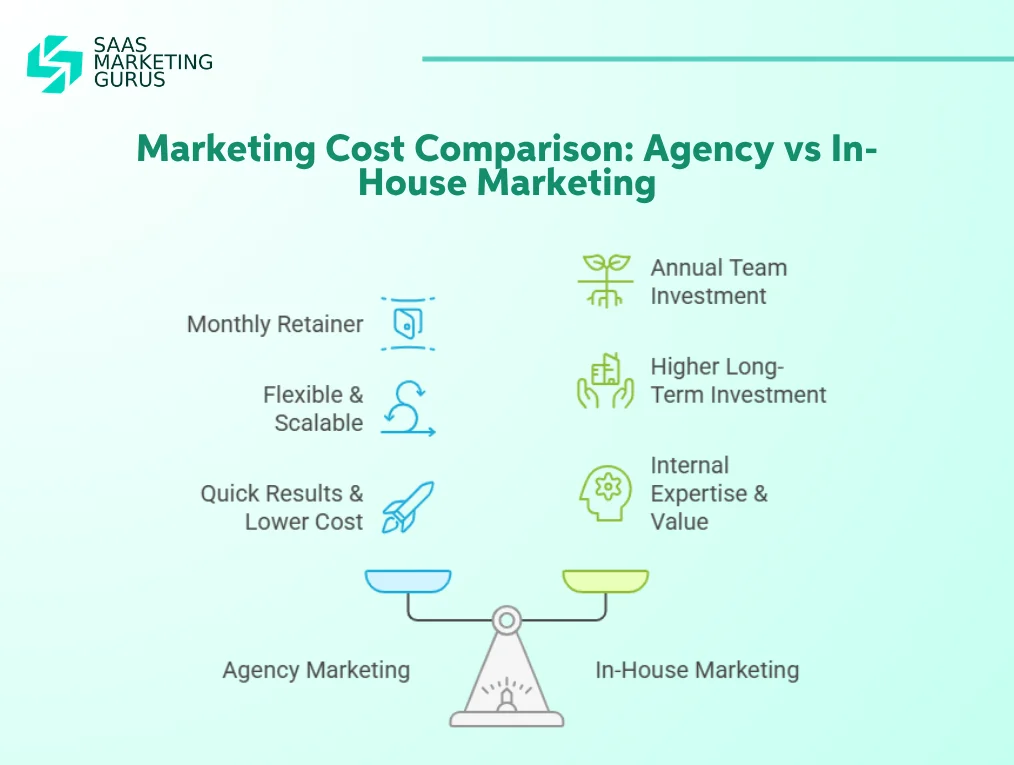
Marketing Cost Comparison: Agency vs In-House Marketing
| Factor | In-House Marketing Team | SaaS Marketing Agency |
|---|---|---|
| Annual Cost | Typically $250,000–$500,000+ for a team of 4–6 specialists | Typically $36,000–$180,000+ annually based on retainer |
| Cost Structure | Salaries, benefits, software, training, recruitment, and management costs | Fixed monthly retainer or project-based pricing |
| Hiring Expenses | Recruitment fees, onboarding, and employee retention costs | No hiring or recruitment costs |
| Software & Tools | Company pays separately for SEO, CRM, analytics, and marketing tools | Often included within agency services |
| Scalability | Requires additional hiring to expand capabilities | Services can be scaled up or down quickly |
| Speed to Execution | Slower due to hiring and onboarding timelines | Faster implementation with an established team |
| Expertise Access | Limited to skills of hired employees | Access to SEO, PPC, content, CRO, design, and strategy specialists |
| Knowledge Retention | Internal knowledge remains within the company | Knowledge primarily resides with the agency |
| Short-Term ROI | Longer ramp-up before results | Faster results and quicker revenue impact |
| Long-Term ROI | Stronger long-term value through internal systems and expertise | Effective for growth acceleration but may require ongoing investment |
| Customer Acquisition Cost (CAC) | Can be higher initially due to setup costs | Often lower during early-stage growth |
| Best For | SaaS companies with stable revenue and long-term growth plans | Startups and growth-stage SaaS companies needing rapid execution |
Bottom Line: Agencies generally offer better cost efficiency and faster execution in the early stages, while in-house teams become more economical and strategically valuable as SaaS companies scale. A hybrid model often delivers the best balance of expertise, control, and long-term ROI.
Growth Team Structure and Scalability
The structure of your growth team plays a direct role in how effectively you can scale a SaaS business, and one of the biggest challenges with in-house teams is simply the speed of hiring. Building the right team takes time, especially when you need people across SEO, content, paid media, lifecycle marketing, and analytics. Recent hiring benchmarks commonly place average time-to-fill around 44 days, and that can stretch further for specialized roles, which means growth plans often slow down before execution even begins.
At the same time, the broader talent market has remained difficult. ManpowerGroup’s 2024 global shortage data found that 76% of IT employers reported difficulty finding the skilled talent they needed, which helps explain why many SaaS companies struggle to fill key marketing and growth positions quickly. When smaller internal teams do get built, they often rely on a few people wearing multiple hats, which can create skill gaps, slower execution, and more risk if one strong performer leaves.
Agencies solve a different part of that problem by giving companies immediate access to specialists without forcing them through a long hiring cycle. Instead of spending weeks or months recruiting, onboarding, and training, SaaS companies can activate experienced support across channels much faster. This became even more practical after 2020, when remote collaboration became normal and working with outside specialists became easier across markets. There is also a productivity angle here.
LinkedIn’s 2024 recruiting research found that among recruiting professionals using generative AI, 57% said it helped them write job descriptions faster and 41% said it improved overall productivity, which reflects a broader shift toward leaner, more flexible operating models rather than large fixed teams. In growth terms, that is one reason agencies became more attractive from 2021 through 2026, especially for SaaS brands that wanted to scale campaigns quickly during launches, demand-gen pushes, or aggressive testing phases.
Marketing Efficiency and Performance Outcomes
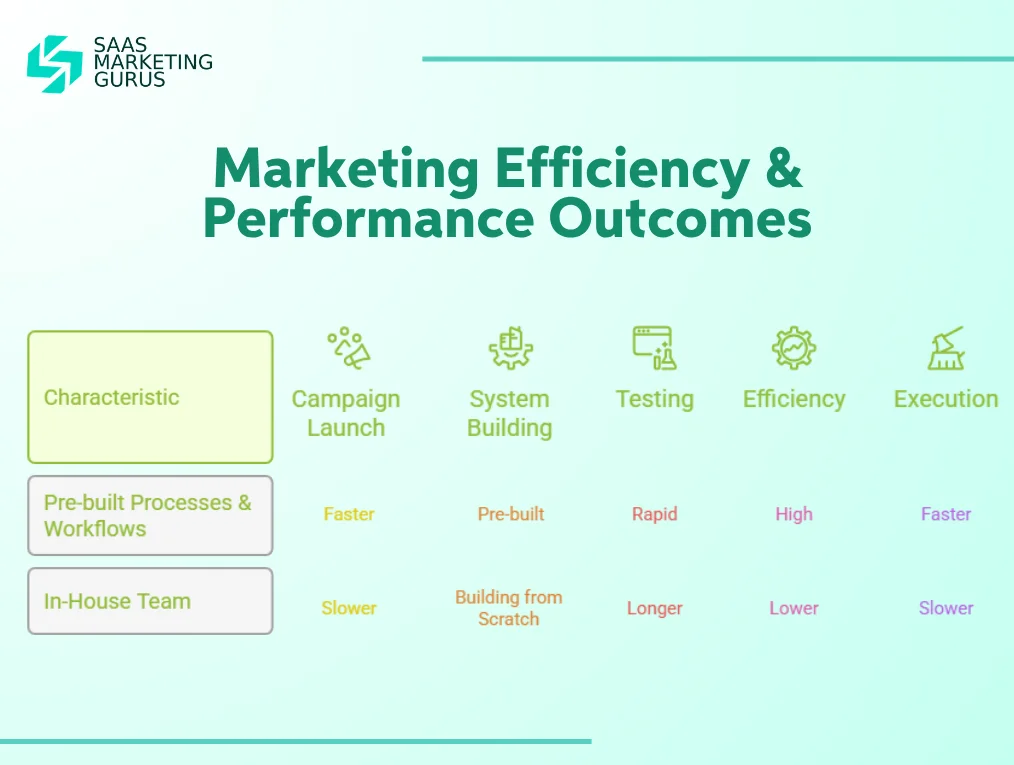
Marketing efficiency is a key factor in determining the success of any growth strategy. One of the main advantages of agencies is their speed of execution. Because they already have established processes and workflows, they can launch campaigns much faster than in-house teams. This speed allows for quicker testing and iteration, which is essential in today’s competitive SaaS environment.
Access to tools and expertise also plays a significant role in performance. Agencies often use advanced marketing tools for analytics, automation, and optimization, which may be too expensive for individual companies to maintain internally. This access enables them to deliver better insights and more effective campaigns. In-house teams, depending on budget constraints, may have limited access to such tools, which can impact overall performance and marketing efficiency.
Industry data from recent years highlights the importance of efficiency in SaaS marketing. Customer acquisition costs have increased significantly since 2019, making it more important than ever to optimize spending and improve conversion rates. Organic channels like SEO have become more valuable due to their long-term ROI, while paid channels require continuous optimization to remain profitable. Agencies often excel in short-term performance improvements, while in-house teams focus on building sustainable growth systems.
In-House vs Agency Marketing: Pros and Cons Comparison
| Factor | In-House Marketing | Marketing Agency |
|---|---|---|
| Control | Full control over strategy, campaigns, and execution | Less direct control; requires coordination and approvals |
| Brand Knowledge | Deep understanding of the product, customers, and company culture | Requires onboarding to learn the product and market |
| Messaging Consistency | Easier to maintain a consistent brand voice | May require additional oversight to ensure consistency |
| Expertise | Limited to the skills of the internal team | Access to specialists in SEO, PPC, content, design, CRO, and analytics |
| Scalability | Scaling requires additional hiring and training | Can quickly scale resources and services as needed |
| Speed of Execution | May be slower due to limited resources and internal processes | Faster campaign launches and implementation using established processes |
| Cost Structure | High fixed costs including salaries, benefits, software, and training | Flexible monthly retainers or project-based pricing |
| Innovation | May become limited by internal perspectives and experience | Brings fresh ideas, industry insights, and cross-market experience |
| Flexibility | Less flexible when rapid expansion is required | Easy to add or reduce resources based on business needs |
| Talent Management | Responsible for recruitment, training, and retention | Agency handles staffing and specialist management |
| Potential Risks | Skill gaps, hiring challenges, employee turnover | Reduced control, communication gaps, vendor dependency |
| Best For | Established SaaS companies seeking long-term control and alignment | Startups and growth-stage SaaS companies needing expertise and scalability |
When Should SaaS Companies Choose In-House Marketing?
SaaS companies should consider building an in-house marketing team when they are still close to product development and need constant feedback loops between marketing, product, and sales. This matters because poor product-market fit remains one of the biggest startup risks. CB Insights found that 43% of startups fail because there is no market need, which is a strong argument for keeping customer insight and messaging close to the business in the early stage. In-house teams also make sense when the company already has strong internal expertise and wants tighter control over positioning, testing, and iteration.
They are especially valuable for businesses focused on long-term brand building and content consistency. That aligns with broader marketing trends too: HubSpot reports that 35% of marketers say increasing brand awareness is their top goal, and Content Marketing Institute found that 87% of B2B marketers say content marketing helped create brand awareness in the last 12 months. For SaaS companies playing a long game, that makes internal ownership especially useful.
When Should You Choose a SaaS Marketing Agency?
Choosing a SaaS marketing agency makes sense when speed and flexibility are priorities. Companies that need to grow quickly or experiment with multiple channels can benefit from the expertise and resources that agencies provide. For businesses with limited budgets, agencies offer a cost-effective alternative to hiring a full SaaS marketing team. They are also valuable when expanding into new channels such as SEO, Reddit marketing, Product Hunt launches, or paid advertising, where specialized knowledge is required.
Hybrid Marketing Model: The Future of SaaS Growth
The hybrid marketing model is becoming the preferred approach for many SaaS companies as they try to balance speed, cost, and control. By combining internal strategy with external execution, businesses can maintain brand ownership while still benefiting from specialized expertise across channels. This shift has become more noticeable in recent years as companies move toward leaner teams. According to industry hiring data, 76% of employers report difficulty finding skilled talent, which makes building a fully in-house team slower and more expensive. At the same time, AI is changing how marketing teams operate. HubSpot reports that over 64% of marketers now use AI tools in their workflows, helping reduce manual work and improve output without increasing headcount.
Conclusion
The decision between agency vs in house marketing depends on your company’s stage, goals, and available resources. In-house teams offer control and long-term value, while agencies provide speed and flexibility. There is no one-size-fits-all solution, and the best approach often involves combining both models. By aligning your strategy with your growth stage, you can build a marketing system that supports sustainable success.
Take a moment to review your current marketing setup and identify areas where you can improve efficiency and performance. Whether you choose to build internally, outsource, or adopt a hybrid model, the key is to stay flexible and adapt based on results. If you’re unsure which model fits your SaaS, start with a hybrid approach and scale based on results.
FAQs
What is the difference between agency vs in house marketing in SaaS?
The main difference lies in how marketing is executed. In agency vs in house marketing, an in-house team works internally and focuses only on your product, while an agency brings external experts who handle strategy and execution across multiple clients. In-house teams offer more control and deeper product understanding, while agencies provide speed, flexibility, and access to specialized skills.
Which is better for SaaS startups: agency or in-house marketing?
For most SaaS startups, agencies are often a better starting point. They help you move fast, test different channels, and avoid the high cost of hiring a full SaaS marketing team. However, once you achieve product-market fit, building an in-house team becomes more valuable for long-term growth and brand consistency.
How much does in-house vs. agency marketing cost?
The cost varies significantly. An in-house team can cost anywhere from $150,000 to $500,000 per year, depending on roles and location. In contrast, agencies typically charge between $3,000 and $15,000 per month. This makes marketing outsourcing more cost-efficient in the early stages, while in-house teams may become more economical over time.
Can a SaaS company use both agency and in-house marketing together?
Yes, and this is becoming the most common approach. Many SaaS companies use a hybrid model where a small internal team handles strategy and brand direction, while agencies manage execution like SEO, paid ads, or product launches. This setup improves marketing efficiency and allows faster scaling without losing control.