Learn SaaS product marketing strategies to drive scalable growth, boost adoption, and build a strong revenue engine in 2026.
Let’s be honest. Most SaaS companies are not failing because of bad products. They are failing because their SaaS product marketing is either unclear, inconsistent, or completely disconnected from how modern buyers actually make decisions.
In 2026, the game has changed. Buyers do not want demos first. They want outcomes first. In fact, around 67% of SaaS buyers now prefer self-serve evaluation before ever talking to sales. That single shift has flipped how product marketing SaaS teams need to operate.
This is not about writing better landing pages or tweaking ad creatives. This is about aligning your product, messaging, and growth engine so tightly that your product basically sells itself. When all three are aligned, your funnel becomes smoother, your acquisition costs drop, and your retention improves naturally.
And if you get this right, you win big. The global SaaS market is already worth over $257 billion and is projected to hit $374 billion by 2028. There is opportunity everywhere, but only for teams that know how to position and distribute properly.
Why SaaS Product Marketing Is the Real Growth Lever
Most founders still think growth comes from ads, outbound, or hiring more sales reps. That thinking is outdated.
Today, SaaS marketing is less about pushing and more about pulling. If your positioning is strong, your funnel gets easier. If it is weak, everything becomes expensive and inefficient.
Here is the reality. The average B2B SaaS conversion rate is only 2.7%. That means 97% of your traffic does not convert. Not because they are bad leads, but because your messaging is not doing its job.
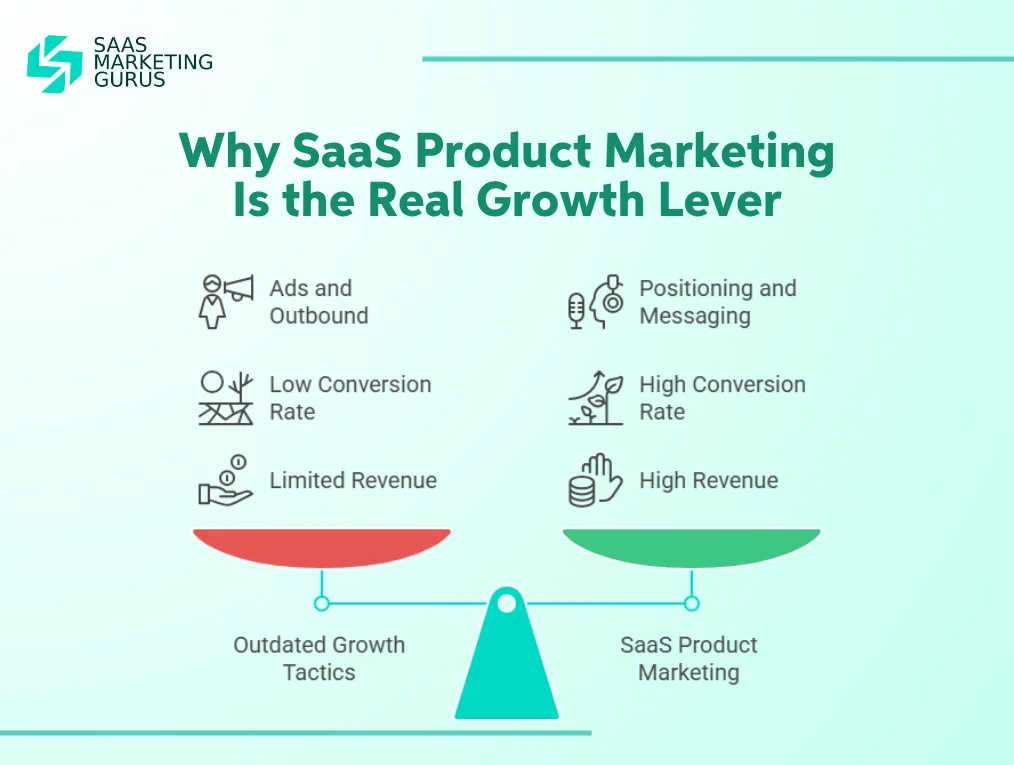
This is where product positioning becomes your unfair advantage.
You are not just selling features. You are selling clarity. You are answering one question better than anyone else:
“Why should I care right now?”
Companies that nail this see better conversion, better retention, and better expansion. And this is critical because around 70% of SaaS revenue actually comes from existing customers through upsells and expansion. So if your messaging stops after acquisition, you are leaking revenue without even realizing it.
Scale Your SaaS Product Growth
Struggling to position your SaaS product for consistent growth? Get a tailored product marketing strategy built for scale.
SaaS Marketing Strategy in 2026 Is Built Around the Product
The biggest shift in the last five years is simple. The product is now the main marketing channel.
This is where product-led growth comes in. Adoption of this model has jumped significantly, moving from 45% to 55% in just a few years, and over 91% of SaaS companies are now increasing investment in it.
Why? Because it works.
When users experience value first, everything else becomes easier. Conversion improves. Retention improves. Even pricing becomes easier to justify because users already understand the value before they are asked to pay.
But here is where most teams mess up. They think adding a free trial equals product-led growth. It does not.
Real product-led growth is about removing friction across the entire user journey. That includes onboarding, activation, and time-to-value. Platforms like Pendo help SaaS teams understand user behavior and guide users inside the product with in-app messaging and walkthroughs, making it easier to deliver value faster without relying heavily on engineering resources.
If your product takes too long to show value, users bounce. If onboarding is confusing, they churn before activation. If the experience feels complex, they never come back.
The companies winning today are not necessarily building more features. They are making it easier for users to experience value faster.
Building a Messaging Framework That Actually Converts
Let’s get practical. Your messaging framework is the backbone of your entire strategy.
Most SaaS companies talk about features. Winning companies talk about transformation.
Instead of saying:
“We have AI-powered dashboards”
You say:
“Make better decisions in 10 minutes, not 10 hours”
That is the difference between noise and clarity.
A strong messaging framework is built on three layers.
First, ICP targeting. If you are talking to everyone, you are converting no one. The more specific your ideal customer profile, the sharper and more relevant your message becomes.
Second, problem clarity. You need to define the problem better than your customer can. When they read your messaging, it should feel like you are describing their exact situation.
Third, outcome-driven positioning. Focus on results, not features. Customers do not buy tools. They buy outcomes, efficiency, growth, and certainty.
This is where most SaaS go-to-market strategies fail. They launch with generic messaging, then try to fix it later with ads. That is backwards.
Your SaaS go-to-market should start with messaging, not channels. Because if your message does not resonate, no amount of traffic will fix it.
Distribution Is Still King, but It Has Changed
Let’s talk about distribution, because even the best messaging fails without it.
Content and SEO are still dominant, but they are evolving fast. Companies investing in organic search see about 31% more qualified inbound traffic and 27% lower customer acquisition costs compared to paid-heavy strategies.
That is not just efficiency. That is compounding growth.
To execute this effectively, SaaS teams rely on tools like Ahrefs to identify high-intent keywords, analyze competitors, and uncover content opportunities that actually drive traffic. This ensures your messaging is not just clear, but also visible where your audience is actively searching.
But distribution in 2026 is not just about Google. It is about being present everywhere your audience is searching, including AI-driven platforms, communities, and niche ecosystems.
At the same time, paid channels still matter. Paid acquisition contributes roughly 20% to 40% of SaaS pipeline in early stages. The key is balance.
Smart teams combine inbound, outbound, partnerships, and product-led loops to create a diversified growth engine that does not rely on a single channel.
And do not ignore referrals. Referral-driven customers tend to have significantly lower churn and higher lifetime value, making them one of the most efficient growth channels available.
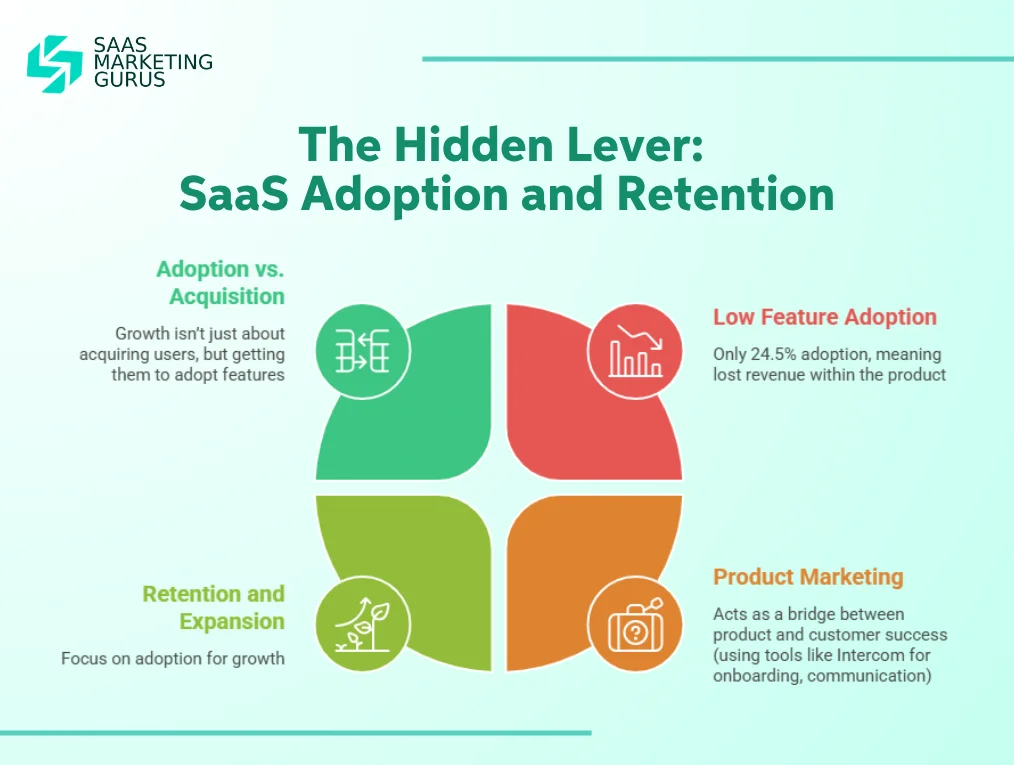
The Hidden Lever: SaaS Adoption and Retention
Here is something most founders ignore. Growth is not just acquisition. It is adoption.
The average feature adoption rate in SaaS is only 24.5%. That means most users are not even experiencing the full value of the product.
Think about that. You are losing revenue inside your own product.
This is where product marketing becomes a bridge between product and customer success. You need to guide users, educate them, and engage them at the right time. Tools like Intercom enable real-time communication through chat, onboarding flows, and automated messaging, helping SaaS companies support users proactively and reduce churn.
Companies that focus on SaaS adoption see better retention, higher expansion revenue, and stronger customer loyalty.
In a market where competition is increasing and switching costs are decreasing, retention is no longer optional. It is your moat.
The Future of SaaS Product Marketing
If you zoom out, one trend is clear. SaaS is becoming more competitive, not less.
AI is accelerating product development. New tools are launching faster than ever. At the same time, customer expectations are rising. Users expect instant value, seamless onboarding, and personalized experiences.
This means average products will struggle to survive.
Winning companies will be the ones that combine strong positioning, clear messaging, and seamless product experience into one unified system.
It is not about doing more. It is about doing the right things better.
Your product needs to deliver value fast. Your messaging needs to communicate that value instantly. And your distribution needs to ensure the right people see it at the right time.
If one of these breaks, your growth stalls.
Final Take
If you take one thing from this, let it be this.
SaaS product marketing is not a department. It is the system that connects your product, your customer, and your revenue.
You cannot fake it with ads. You cannot shortcut it with hacks.
You build it by understanding your customer deeply, positioning your product clearly, and delivering value consistently across every touchpoint.
Do that, and growth becomes predictable.
Ignore it, and you will keep wondering why your product is not scaling.
Now the question is simple.
Are you just marketing your SaaS, or are you actually building a system that sells it for you?
Ready to turn your SaaS product into a scalable revenue engine?
Let experts build your growth blueprint for 2026.