SaaS marketing challenges usually trace back to six problems: an unclear ideal customer profile (ICP), weak positioning, rising customer acquisition cost (CAC), low trial activation, incomplete attribution, and early churn. Fix the weakest revenue metric first, then add traffic.
Most teams do the opposite. They see a flat pipeline, buy more ads or publish more posts, and pay to push more of the wrong buyers into the same leak.
SaaS Marketing Gurus (SMG) is a B2B SaaS marketing agency based in Magdeburg, Germany, specializing in SaaS SEO, Generative Engine Optimization (GEO), Reddit marketing, Quora marketing, and Product Hunt launches. This guide gives the warning sign, first fix, and success metric for each challenge, drawn from the funnel audits SMG runs for SaaS clients.
Key takeaways
- Poor targeting raises CAC and churn at the same time.
- A trial signup counts only once the user reaches a first value event.
- Traffic and rankings matter only when they connect to demos, revenue, or retention.
- Half of B2B software buyers now start research in an AI chatbot, so part of your pipeline begins where analytics can’t see it.
What Are the Biggest SaaS Marketing Challenges?
The biggest SaaS marketing challenges are an unclear ICP, weak positioning, rising CAC, low activation, incomplete attribution, and early churn. Each one shows a warning sign in your data before it shows up in revenue.
| Challenge | Warning sign | First action | Metric to watch |
|---|---|---|---|
| Unclear ICP | Sales rejects marketing leads | Review won and lost accounts from the last 12 months | Lead-to-opportunity rate |
| Weak positioning | Buyers compare you on price only | Interview your five best-fit customers | Win rate against named competitors |
| Rising CAC | Spend grows faster than pipeline | Audit every funnel stage, not just the channel | CAC payback in months |
| Low activation | Trials never reach the product’s value | Define one activation event | Activation rate |
| Weak attribution | You can’t say which channel drives demos | Add a “How did you hear about us?” field to demo forms | Self-reported source mix |
| Early churn | Customers leave in the first 90 days | Compare churn by acquisition source | Net revenue retention (NRR) |
How Do You Fix Each SaaS Marketing Challenge?
Fix each challenge at its root cause, then measure the change against one metric. The six fixes below run in funnel order, from who you target to who stays.
How Do You Fix an Unclear ICP?
Fix an unclear ICP by building it from closed-won and closed-lost data, not from a persona workshop. List the firmographics, trigger events, and buying roles your best accounts share, then list what your churned accounts had in common.
An unclear ICP produces broad campaigns and weak leads. An ebook might pull 500 downloads while only 20 contacts match your real buyer, and sales ignores the other 480.
Once the ICP is written down, build your SaaS content marketing strategy around the customers who buy and stay. Success looks like a rising lead-to-opportunity rate within one quarter.
How Do You Fix Weak SaaS Positioning?
Fix weak positioning by stating five things in plain words: who the buyer is, the problem they have, the alternative they use today, the outcome you deliver, and your proof. If buyers compare you only on price, one of those five is missing.
Take the words from customers, not from your team. Interview your strongest accounts and reuse their language on your homepage, pricing page, and comparison pages.
Track win rate against named competitors. A positioning fix that works shows up there before it shows up in traffic.
How Do You Reduce SaaS Customer Acquisition Cost?
Reduce CAC by fixing the funnel steps that waste paid-for demand, not by cutting spend first. Weak landing pages, slow sales follow-up, thin onboarding, and early churn all stretch CAC payback.
The median B2B SaaS company needs 16 months to recover its CAC, according to the 2026 SaaS and AI Performance Benchmarks from Aleph and Benchmarkit, based on 2025 data from 342 companies. That is better than the prior year’s 18 months, but it still means more than a year of revenue goes to paying back each new customer.
Compare activation, win rate, and retention by source before you blame a channel. If you need to reset spend by funnel stage, our SaaS marketing budget guide shows how to allocate it.
How Do You Improve Trial Activation?
Improve activation by defining one event that proves a user got value, then removing every step between signup and that event. For a project management tool, that event might be creating a project and assigning the first task.
Registration alone is not activation. A trial that ends before the first value event will not convert, however much traffic brought it in.
Measure activation rate weekly, and review the onboarding path whenever it drops.
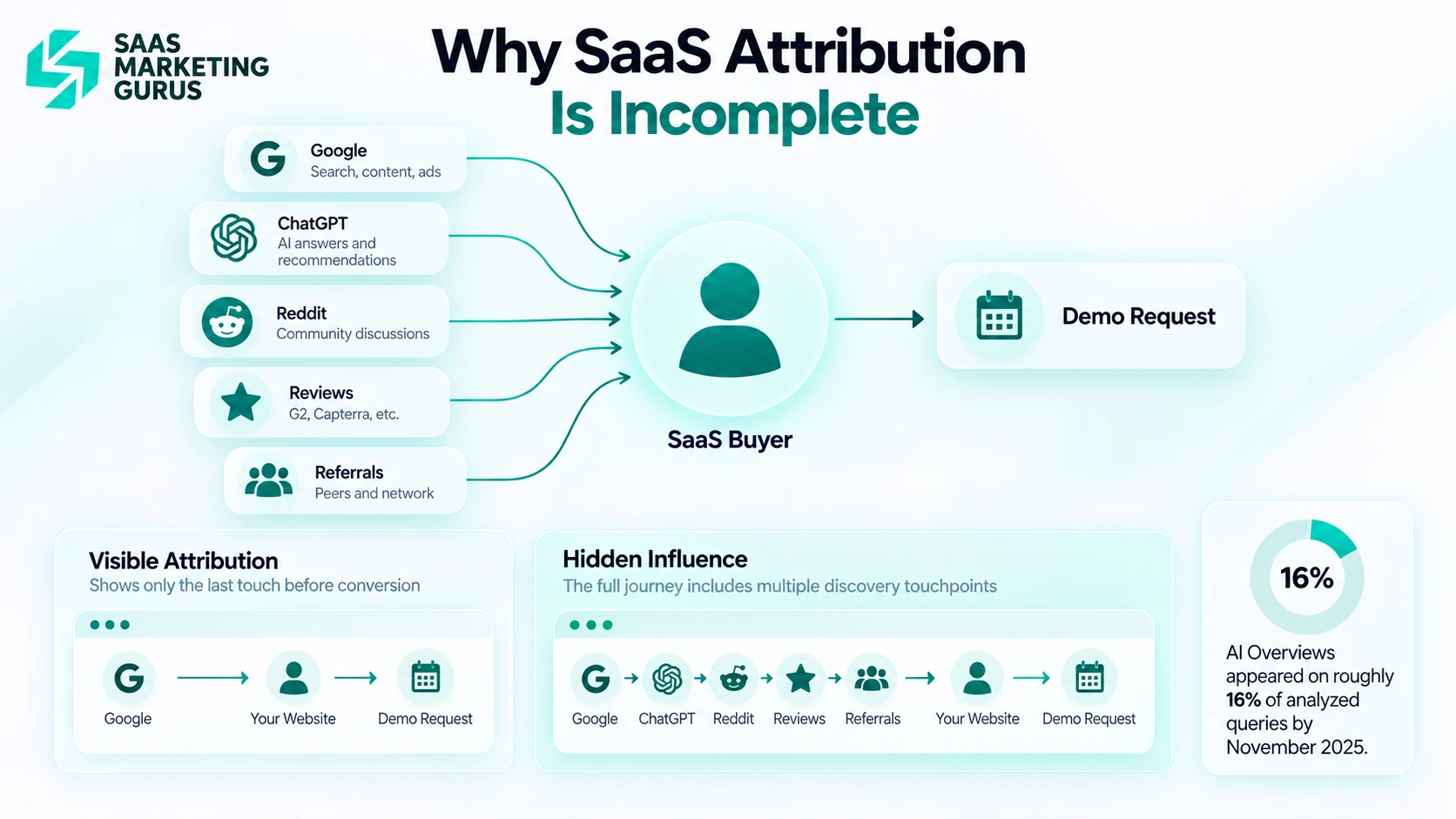
Why Is SaaS Attribution Often Incomplete?
SaaS attribution is incomplete because buyers research across Google, AI chatbots, Reddit, review sites, and peer referrals before they fill in a demo form. Most of those touchpoints never reach your analytics.
The shift is measurable. G2’s 2026 Answer Economy survey of 1,076 B2B software buyers found that 51% now start research with an AI chatbot more often than with Google, and 69% chose a different vendor than planned because a chatbot recommended it. On Google itself, Semrush’s study of 10 million-plus keywords found AI Overviews on 15.69% of queries in November 2025, down from a 24.61% peak that July.
Fix it by pairing analytics with self-reported attribution and short customer interviews. Then judge SaaS SEO and answer engine optimization by the demos and pipeline they produce, not by rankings alone.
How Do You Reduce Early Churn?
Reduce early churn by tracing it back to acquisition. Compare churn and expansion by source, campaign, and segment, and you will often find one channel that brings buyers who never fit.
Churn that clusters around one source is a targeting problem, not a product problem. Reshape or cut that source, and feed the churn reasons back into your ICP.
Net revenue retention ties this together, and the metrics section below shows the current benchmark.
What Should Your SaaS Team Fix First?
Fix the challenge closest to lost revenue first. Use the symptom to choose where to start:
- If sales rejects most marketing leads, fix the ICP.
- If buyers stall on price comparisons, fix positioning.
- If trials sign up but never convert, fix activation.
- If customers leave in the first 90 days, fix retention and trace churn to its source.
- If you can’t say which channel drives demos, fix attribution before you move budget.
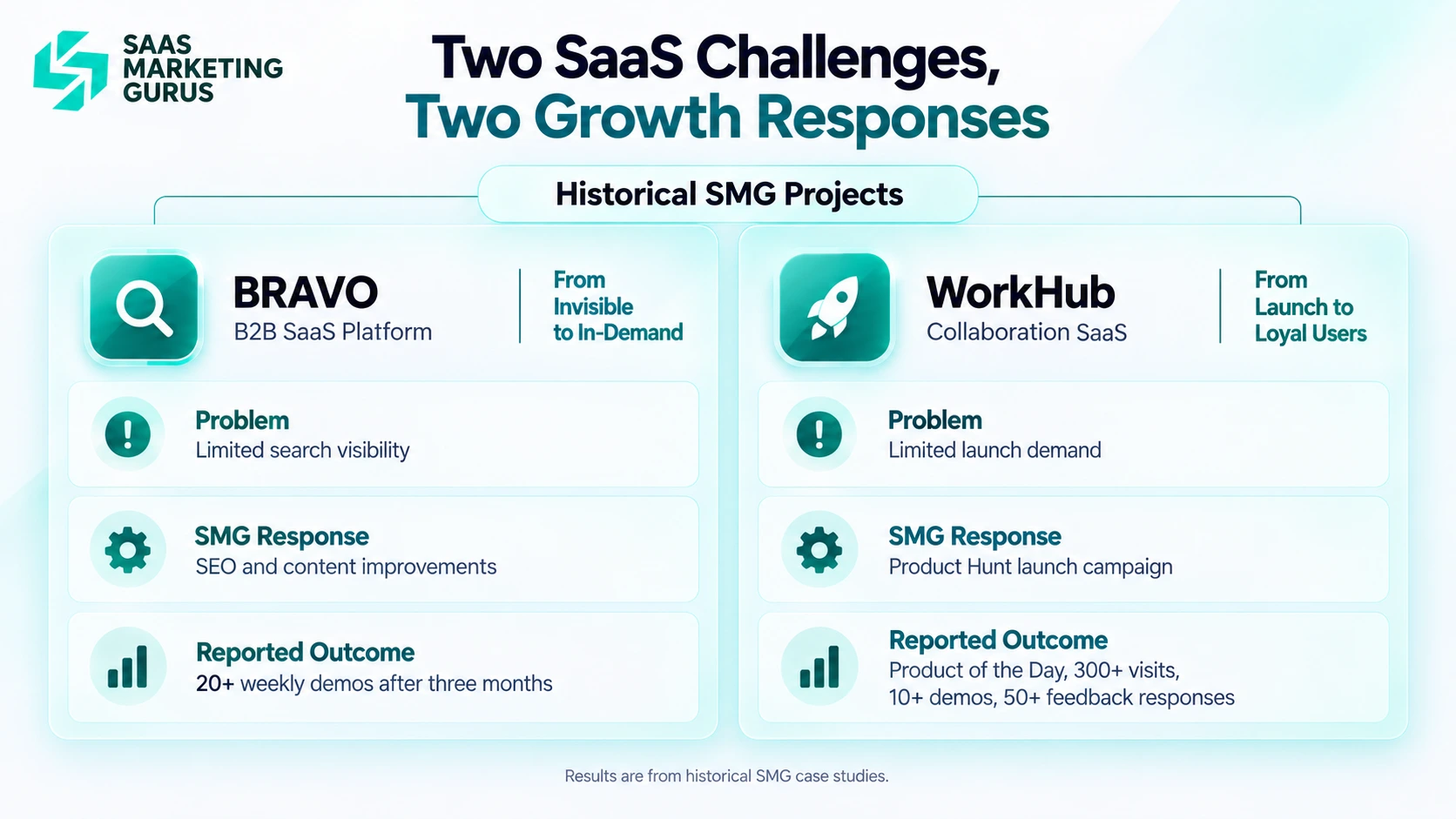
Two SMG engagements show this order in practice.
BRAVO: Qualified Search Visibility
BRAVO, an employee recognition platform, had limited search visibility that was slowing demo generation. After SMG rebuilt its keyword research, content, and technical SEO, the BRAVO SEO case study reports 20-plus demos per week after three months.
WorkHub: Launch Demand
WorkHub wanted visibility, demos, and product feedback from a single launch. The WorkHub Product Hunt case study records a Product of the Day finish, 300-plus visits, 10-plus demos, and 50-plus feedback responses.
Which SaaS Marketing Mistakes Make These Challenges Worse?
Four mistakes turn a fixable challenge into an expensive one: scaling before the ICP is confirmed, measuring traffic instead of pipeline, selling features instead of outcomes, and stopping marketing once the deal closes.
Scaling Before the ICP Is Confirmed
Scaling too early multiplies the wrong leads. Every extra dollar on ads or content buys more of the accounts sales already rejects.
Measuring Traffic Instead of Pipeline
Traffic reports hide the leak. A post can rank on page one and still produce zero demos if it answers a question your buyer never asks, while buyers comparing tools in Reddit threads never appear in that report at all. That gap is where Reddit marketing for SaaS earns demos.
Selling Features Instead of Outcomes
Feature-led messaging pushes buyers to compare on price. Outcomes give them a reason to pay more.
Stopping Marketing at the Closed Deal
Stopping at the sale leaves expansion revenue on the table. Onboarding content, customer marketing, and review requests keep accounts growing after the contract is signed.
Which SaaS Marketing Metrics Matter Most?
Track six metrics that tie marketing to revenue: qualified pipeline, CAC payback, activation rate, win rate, customer lifetime value (LTV), and net revenue retention (NRR). Traffic, rankings, and MQLs are supporting indicators, not proof of health.
| Metric | What it tells you | Reference point |
|---|---|---|
| Qualified pipeline | Whether marketing creates real sales opportunities | Your own quarter-over-quarter trend |
| CAC payback | How many months a customer takes to repay acquisition cost | 16-month median (Aleph and Benchmarkit, 2026) |
| Activation rate | Whether trials reach first value | Your own baseline by signup cohort |
| Win rate | Whether positioning holds against competitors | Track by named competitor |
| LTV | Total revenue a customer brings over its lifetime | Compare against CAC, since the ratio matters more than the total |
| NRR | Whether existing customers grow or shrink revenue | 102% median (Aleph and Benchmarkit, 2026) |
A 102% median means the typical SaaS company grows revenue from its existing base by only about 2% a year. Usage-based companies reach 108% while seat-based companies sit at 98%, according to Aleph and Benchmarkit’s 2026 NRR data, so your pricing model shapes how much retention work marketing has to carry.
Fix the Bottleneck Before Adding Traffic
Most SaaS marketing challenges share one cause: teams treat symptoms instead of the bottleneck. More traffic will not fix a weak ICP, and more leads will not fix a trial that never reaches value.
Pick the weakest metric from the table above, trace it through the customer journey, and give it one owner. Run one fix for a full quarter, and keep it only if pipeline, activation, or retention improves against your baseline.
If you want an outside read on where your pipeline breaks, book a free consultation with SMG. We will review your funnel stages and channels, including search, AI answers, and Reddit, and tell you which fix to run first. Our SaaS marketing services cover each stage.
Frequently Asked Questions
What Is the Biggest SaaS Marketing Challenge?
The biggest SaaS marketing challenge for most B2B companies is an unclear ideal customer profile. It raises CAC, lowers win rates, and increases churn at the same time, because every campaign reaches buyers who were never a good fit. Fix the ICP before you add channels or budget.
Why Is Customer Acquisition Cost So High in SaaS?
SaaS CAC runs high because long sales cycles, several decision-makers, and free trials all add cost before revenue arrives. Weak landing pages, slow follow-up, and early churn stretch it further. The median B2B SaaS company takes 16 months to recover its CAC, according to Aleph and Benchmarkit’s 2026 benchmarks.
How Do You Measure SaaS Marketing ROI When Attribution Is Incomplete?
Measure SaaS marketing ROI by combining analytics data, a self-reported “How did you hear about us?” field on demo forms, and short customer interviews. Compare pipeline and CAC payback by source across a full quarter. Self-reported answers catch AI chatbot, Reddit, and word-of-mouth influence that analytics miss.
How Does AI Search Change SaaS Marketing?
AI search moves part of the buyer’s research into ChatGPT, Perplexity, and Google AI Overviews, where your analytics can’t see it. G2’s 2026 research found 51% of B2B software buyers start research with an AI chatbot more often than with Google. SaaS teams now need content that AI tools can cite, alongside classic SEO.
How Long Does It Take to Fix a SaaS Marketing Challenge?
Most single-metric fixes show a measurable change within one quarter. ICP and activation changes often move lead quality or activation rate within weeks, while positioning and churn fixes need a full sales or renewal cycle to confirm. Run one fix at a time so you can tell what worked.