The right B2B SaaS marketing team structure depends on four factors: company stage, go-to-market motion, the current growth constraint, and proven marketing capabilities. Together, these factors determine which functions you need, who should own them, and which role to hire next.
Your go-to-market, or GTM, motion describes how customers discover, evaluate and buy your product. Key performance indicators, or KPIs, are the measures you use to track progress toward a defined outcome.
A company can hire talented marketers and still leave important work without an owner. This guide provides four stage-based planning tables, reporting options, hiring triggers and KPI responsibilities to help you identify the capability your team needs next.
Key Takeaways
- Cover essential marketing functions before creating separate job titles for each one.
- Hire against the current growth constraint, not a standard list of roles.
- Use company stage to judge management needs and GTM motion to decide which skills deserve more weight.
- Keep strategy, customer knowledge, and KPI ownership inside the company. Use outside specialists for focused execution when needed.
What Is the Ideal B2B SaaS Marketing Team Structure?
The ideal B2B SaaS marketing team structure gives every important growth outcome one accountable owner. Small companies normally use generalists who cover several functions. As the company grows, those functions become dedicated roles and then managed teams.
There is no universal org chart. A product led business needs stronger lifecycle and product analytics skills. An enterprise business with a long sales process needs more demand generation, product marketing, sales enablement, and operations support.
Company stage matters, but it is not enough by itself. Two companies with the same annual recurring revenue can have different prices, sales cycles, products, budgets, and buyers. The useful question is not, “Which role do companies our size usually hire?” It is, “Which missing capability is limiting growth now?”
Marketing Functions Versus Marketing Roles
A marketing function is an area of work the company needs to cover. A marketing role is a defined set of responsibilities assigned to a person. One person can cover several functions, and a larger function can contain several roles.
For example, an early SaaS company needs product marketing even without a Product Marketing Manager. The founder or Head of Marketing may own research, positioning, messaging and sales materials until the work exceeds their capacity.
This distinction helps small companies cover essential work without creating a separate position for every function.
The SMG Four Factor Team Design Framework
This guide introduces a four-factor planning framework from SaaS Marketing Gurus (SMG), a B2B SaaS marketing agency. It organizes the questions to answer before drawing an org chart or opening a role.
For each factor, record the evidence you have, the capability you need and the person responsible for the next decision. Use the framework as a planning aid, then test the proposed structure against your workload and results.
1. Company Stage and Revenue Maturity
Before product-market fit, marketing should help identify the buyer, problem, message and promising channels. Early growth requires repeatable acquisition. Scaleups need clearer functional ownership, while companies serving several products or markets need coordination across those groups.
Annual recurring revenue, or ARR, provides context. It does not establish how many marketers a company should employ.
High Alpha’s 2025 SaaS Benchmarks Report includes more than 800 respondents. It reports that over one-quarter of respondents reduced headcount due to AI in each of three areas: engineering, customer success and support, and marketing. This describes reported changes within the sample, not a universal staffing recommendation.
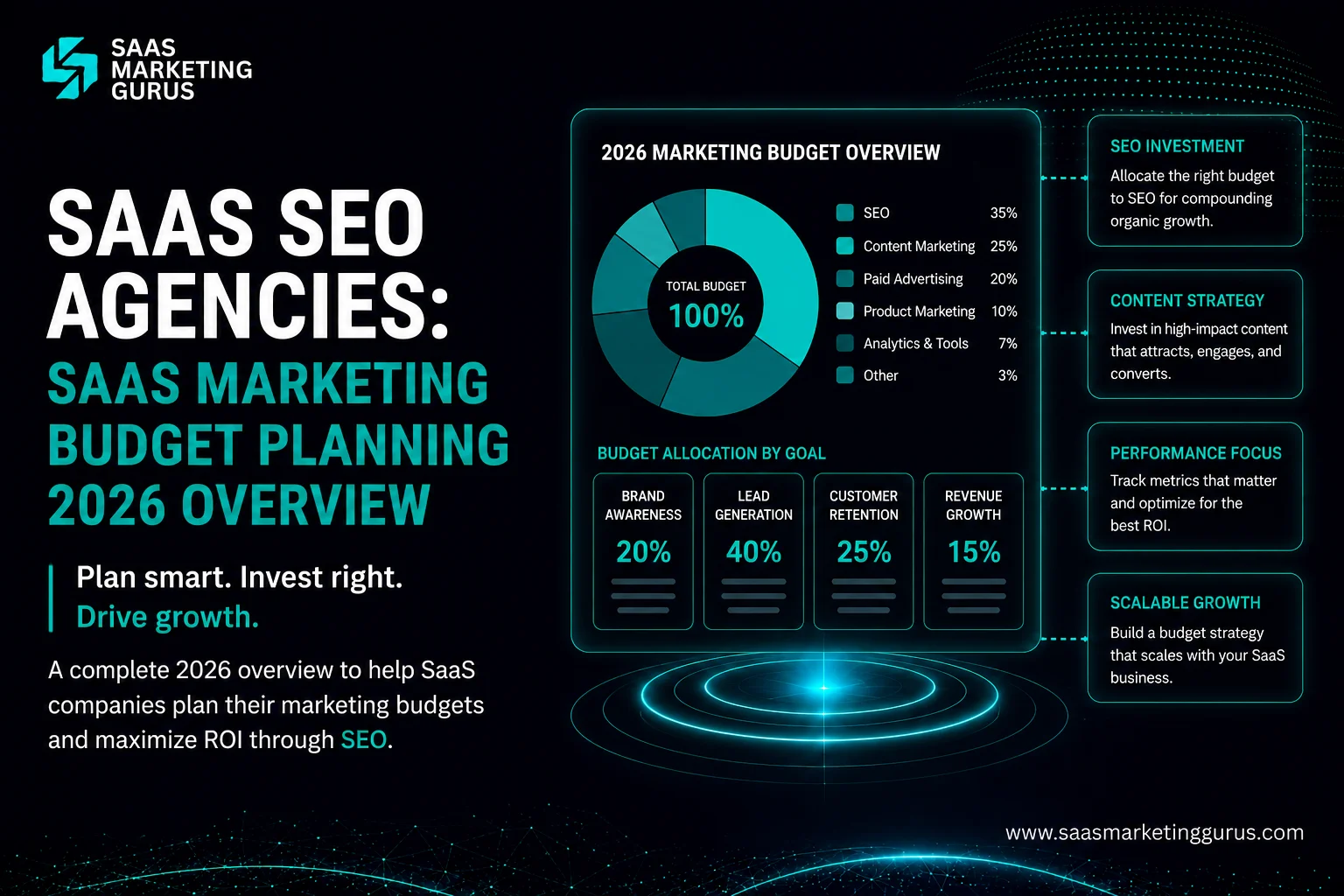
Compare workload, delivery capacity and the full cost of a hire with your available budget. Our SaaS marketing budget guide can help connect staffing decisions to the broader marketing plan.
2. Go to Market Motion
A sales-led company should prioritize the capabilities needed to create and convert qualified opportunities. A product-led company may place more emphasis on onboarding, activation and product analytics. A partner-led company needs clear ownership of partner enablement and joint campaigns.
Channel evidence can help refine those priorities. High Alpha’s January 2026 analysis of its 2025 survey found that founder-led evangelism was rated effective by 37% of respondents in the $1 million to $5 million ARR group, compared with 10% in the $20 million to $50 million group. Account-based marketing moved from 23% to 45% across those same groups.
These are self-reported channel assessments. They do not show that adopting a channel or hiring a specialist will produce the same outcome for your company.
3. Current Growth Constraint
Identify why growth is slowing before deciding that another marketer is the answer.
Weak pipeline may reflect unclear positioning, poor audience fit, limited reach or slow sales follow-up. Low activation may come from onboarding communication, product friction or customers buying for the wrong use case. Unreliable reports may require clearer definitions before another tool or employee.
Review the affected journey with Marketing, Sales, Product and Customer Success. Name the cause you can support with evidence, then decide whether the next step is a process change, product improvement, specialist project or permanent hire.
4. Proven Channels and Internal Capability
Build internal capacity around important, frequent work that supports your strategy. Keep an accountable internal owner for customer knowledge, positioning, priorities and business results.
Outside specialists can contribute strategy and execution while that owner remains responsible for decisions. Consider a permanent hire when the work requires sustained capacity, close product access or frequent coordination that your current arrangement cannot provide.
If organic growth is a priority, connect hiring to a documented SaaS content strategy and a process for finding B2B SEO keywords that attract SaaS buyers.
Core Functions Every B2B SaaS Marketing Team Needs
Not every function needs a separate employee. Every function that supports the growth model does need a named owner.
Marketing Leadership
The marketing leader sets priorities, allocates budget, hires the team, and connects marketing goals to company goals. Scope matters more than title.
Product Marketing
Product marketing owns buyer research, ideal customer profile development, positioning, messaging, launches, competitive intelligence, and sales enablement.
Demand Generation
Demand generation creates qualified commercial interest through paid media, organic programs, events, email nurture, and account based marketing. Measure it against qualified pipeline and acquisition efficiency, not lead volume alone.
Content, SEO, and Brand
This function supports discovery and trust through articles, landing pages, comparison pages, customer stories and brand programs.
Its owner should also decide who checks factual accuracy, maintains published content and evaluates visibility in AI-generated answers. Treat AI mentions as visibility indicators and assess whether the content also supports qualified visits and buyer actions.
A B2B SEO audit can help determine whether the constraint involves content, technical implementation, authority or conversion.
Growth and Lifecycle Marketing
Growth and lifecycle marketing support onboarding, activation, nurture, product adoption and trial conversion. They work with Product and Customer Success because communication alone cannot resolve every activation or retention problem.
A product-qualified lead is a user or account whose product behavior meets agreed readiness criteria for a sales conversation. Define those criteria jointly rather than treating every signup as qualified.
Customer Marketing
Customer marketing supports retention, expansion, advocacy, reviews, referrals, and customer proof. It works closely with Customer Success and Sales, but customer campaigns still need one accountable owner.
Marketing Operations and Analytics
Marketing operations owns systems, automation, data quality, attribution, and reporting. Add a dedicated owner when poor data or system complexity slows campaigns.
Need specialist help with a marketing capability your team cannot currently cover? Get a free consultation with SaaS Marketing Gurus to discuss your growth priorities and potential scope of support.
B2B SaaS Marketing Team Structure by Company Stage
The following tables are illustrative planning models. Their headcount ranges are editorial examples, not survey benchmarks or recommended staffing ratios.
Use the reporting lines as starting options. Before adding a role, check the workload, budget, management capacity and hiring trigger. Product complexity and sales motion can justify a different structure at the same revenue level.
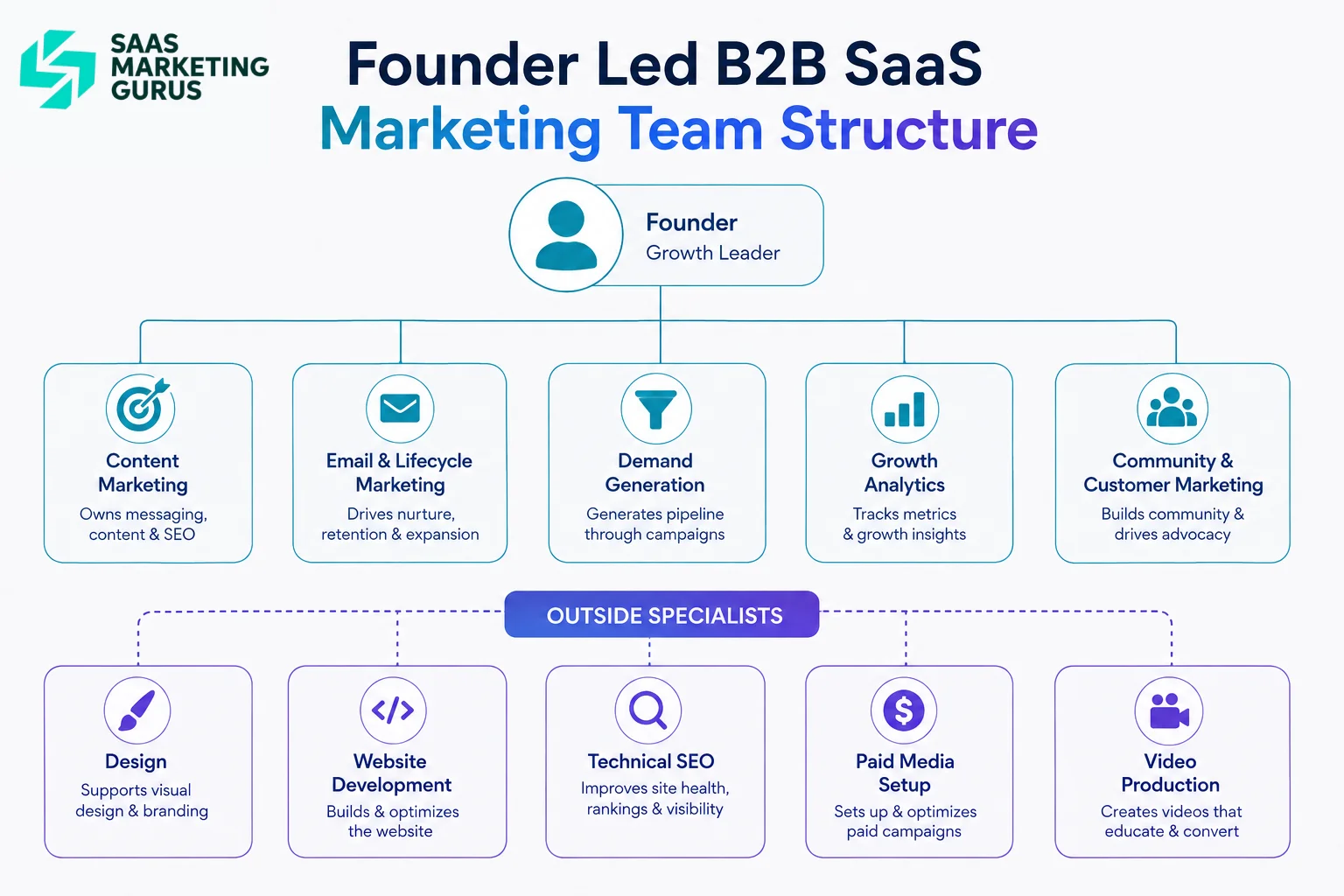
Stage 1: Founder Led Marketing
| Decision | Recommendation |
|---|---|
| Required outcome | Learn who buys, improve the message, support early sales, and test a few channels |
| Planning range | Founder plus 0 to 2 internal marketers |
| Recommended roles | Founder or CEO and one experienced marketing generalist or fractional leader |
| Reporting line | The marketer reports to the founder |
| What can be combined | Product marketing, content, basic demand generation, and measurement |
| What can be outsourced | Design, development, video, paid setup, and technical SEO |
| Hiring trigger | The company understands its buyer well enough to run repeatable tests |
| KPIs | Qualified conversations, demo requests, activation signals, message response, and documented learning |
| Common mistake | Hiring several narrow specialists before the message or channel is proven |
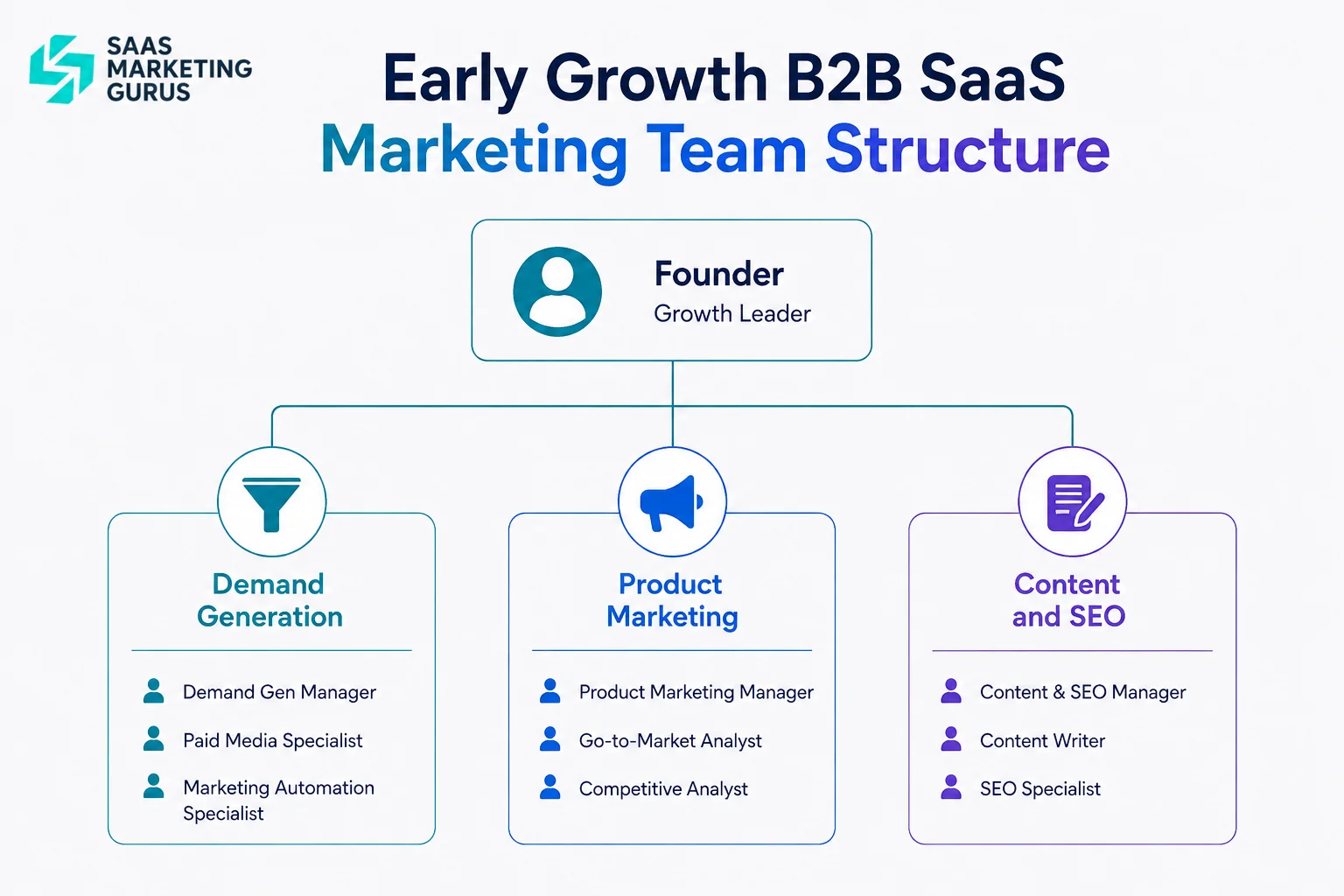
Stage 2: Early Growth Marketing Team
| Decision | Recommendation |
|---|---|
| Required outcome | Turn early success into repeatable qualified pipeline |
| Planning range | About 3 to 5 internal marketers |
| Recommended roles | Head of Marketing, Demand Generation Manager, Product Marketer, and Content and SEO Manager |
| Reporting line | Functional marketers report to the Head of Marketing, who reports to the CEO |
| What can be combined | Content with SEO, product marketing with content, or demand generation with paid media |
| What can be outsourced | Specialist channels, design, development, research, and production |
| Hiring trigger | A proven function has more valuable work than the current owner can complete |
| KPIs | Qualified pipeline, funnel conversion, acquisition cost, organic conversions, and sales asset usage |
| Common mistake | Scaling channels before positioning and KPI ownership are clear |
Stage 3: Scaleup Marketing Team
| Decision | Recommendation |
|---|---|
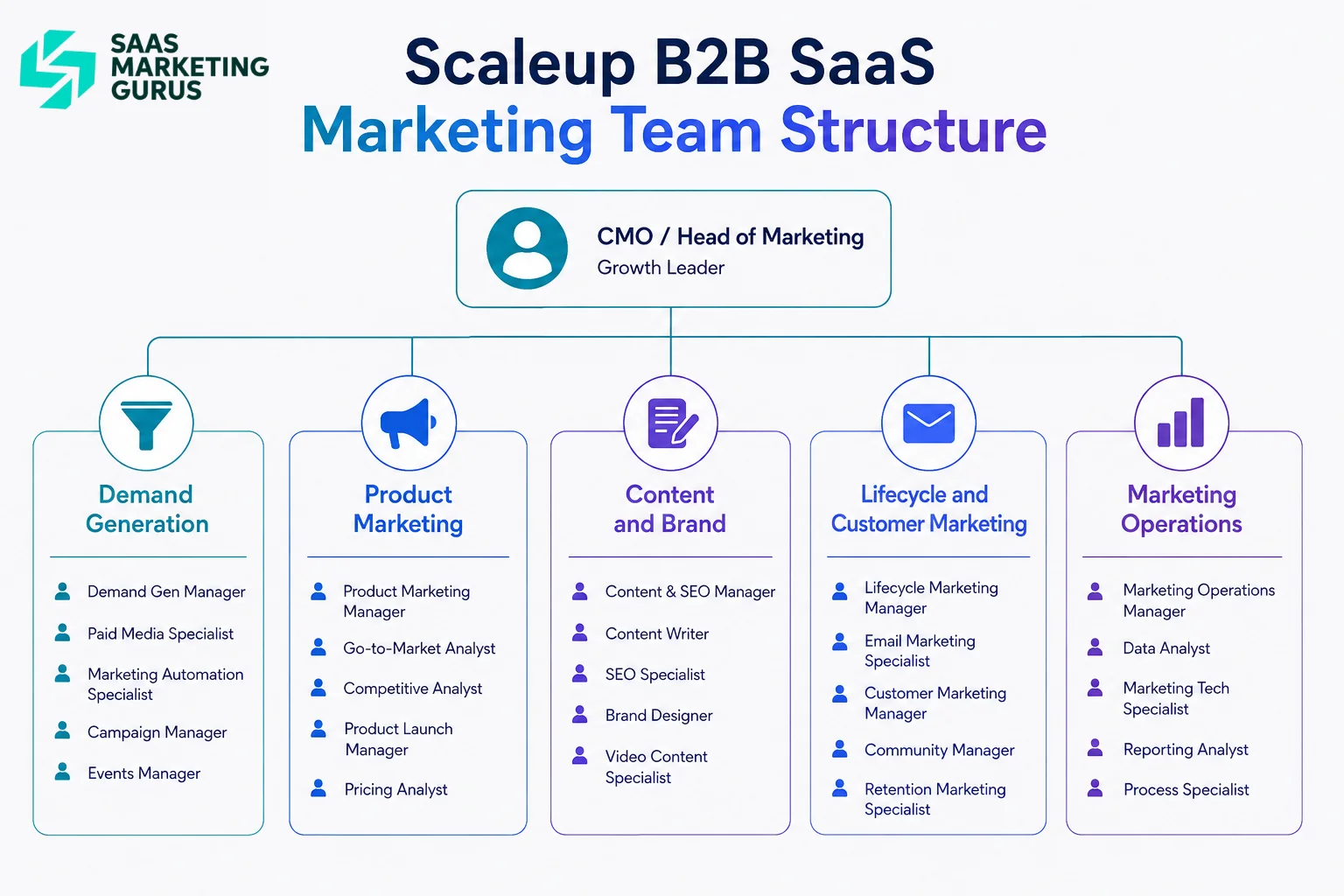
| Required outcome | Scale working channels while improving activation, retention, and measurement |
| Planning range | About 6 to 15 internal marketers |
| Recommended roles | VP of Marketing plus leads for Demand, Product Marketing, Content and Brand, Lifecycle or Customer Marketing, and Operations |
| Reporting line | Functional leads report to the VP, channel specialists report to their functional lead |
| What can be combined | Brand with content, or lifecycle with customer marketing while workloads remain manageable |
| What can be outsourced | Technical SEO, paid management, research, design, video, community, and regional production |
| Hiring trigger | Campaign volume, management needs, or data complexity repeatedly delays useful work |
| KPIs | Pipeline, acquisition cost, payback, activation, expansion pipeline, retention support, and data confidence |
| Common mistake | Adding specialists without defining handoffs between functions |
Stage 4: Enterprise or Multiple Product Marketing Team
| Decision | Recommendation |
|---|---|
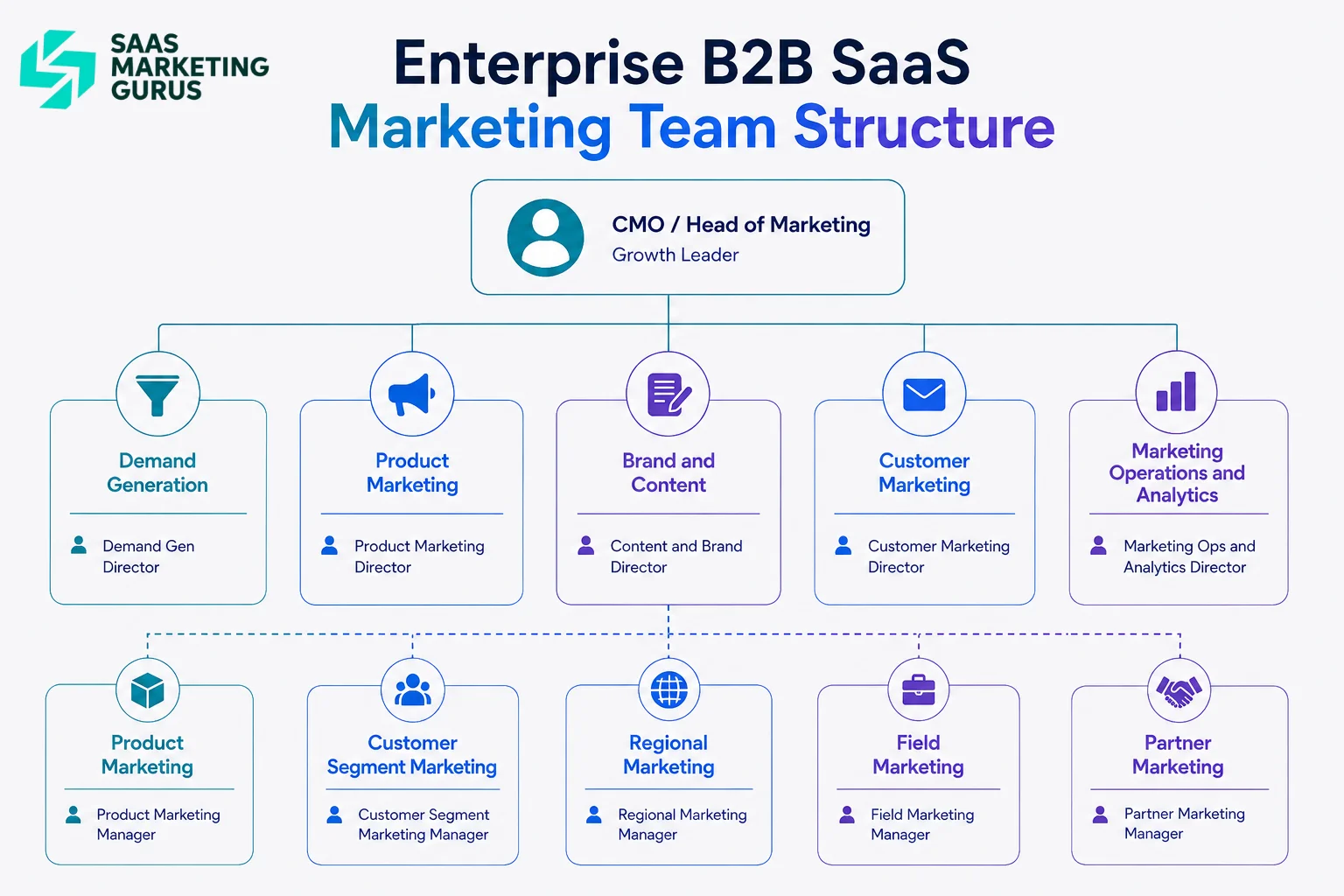
| Required outcome | Support different products and markets without losing consistency |
| Planning range | Often 15 or more internal marketers, based on product and market complexity |
| Recommended roles | CMO, central functional leaders, and product, segment, field, partner, or regional marketers |
| Reporting line | Functional leaders report to the CMO; market teams may use direct and dotted lines |
| What can be combined | Shared brand governance, positioning systems, analytics, and marketing technology |
| What can be outsourced | Localization, regional production, research, events, and specialist campaigns |
| Hiring trigger | A central team can no longer support distinct buyer journeys effectively |
| KPIs | Revenue contribution by segment, pipeline coverage, retention, expansion, brand demand, and operating efficiency |
| Common mistake | Adding reporting layers that slow decisions and campaign launches |
Team Structure by Go to Market Motion
| GTM motion | Functions to emphasize | Primary measures |
|---|---|---|
| Sales led | Demand Generation, Product Marketing, account based marketing, sales enablement, field marketing, and operations | Qualified pipeline, opportunity conversion, sales velocity, win rate, and acquisition cost |
| Product led | Growth, lifecycle, Product Marketing, content, customer education, and product analytics | Activation, product qualified leads, trial conversion, adoption, retention, and expansion |
| Partner led | Partner Marketing, channel enablement, Product Marketing, joint campaigns, and partner operations | Partner sourced pipeline, active partners, conversion, and revenue per partner |
| Hybrid | Separate owners for product activation and sales pipeline, supported by shared Product Marketing, Brand, and Operations | Measures for each motion plus clear rules for account ownership |
Who Should Report to Whom?
Choose reporting lines according to the decisions and resources a role needs. The options below are starting points, not measured industry rules.
A Chief Marketing Officer, or CMO, leads the marketing function. Revenue operations, or RevOps, coordinates systems, data and processes across revenue teams. Sales development representatives, or SDRs, typically handle prospecting and qualification responsibilities.
| Function | Starting reporting option | When another arrangement may fit |
|---|---|---|
| Product Marketing | CMO or VP of Marketing | Product leadership may fit when discovery, adoption or technical coordination dominates |
| Demand Generation | Head or VP of Marketing | A revenue leader may oversee the function if brand, research and longer-term demand work still have clear ownership |
| Marketing Operations | Marketing or RevOps leader | Central RevOps may fit when systems and data serve the full revenue organization |
| SDR team | Sales leader | Marketing ownership may fit a team focused primarily on inbound qualification |
| Customer Marketing | Marketing leader | Customer Success may be appropriate when the work centers on customer adoption and engagement |
| Growth Marketing | Marketing or Product leader | Product leadership may fit work requiring frequent changes inside the product |
Product Marketing Alliance’s 2026 report summary describes increased executive-level reporting and a stronger emphasis on commercial outcomes. It does not establish one reporting line that every company should adopt.
Document the handoff as well as the manager. For example, Marketing can define when an inquiry is ready for Sales, Sales can record acceptance or rejection, and RevOps can maintain the shared report. Agree response expectations and an escalation owner before the process goes live.
Which Marketing Role Should You Hire Next?
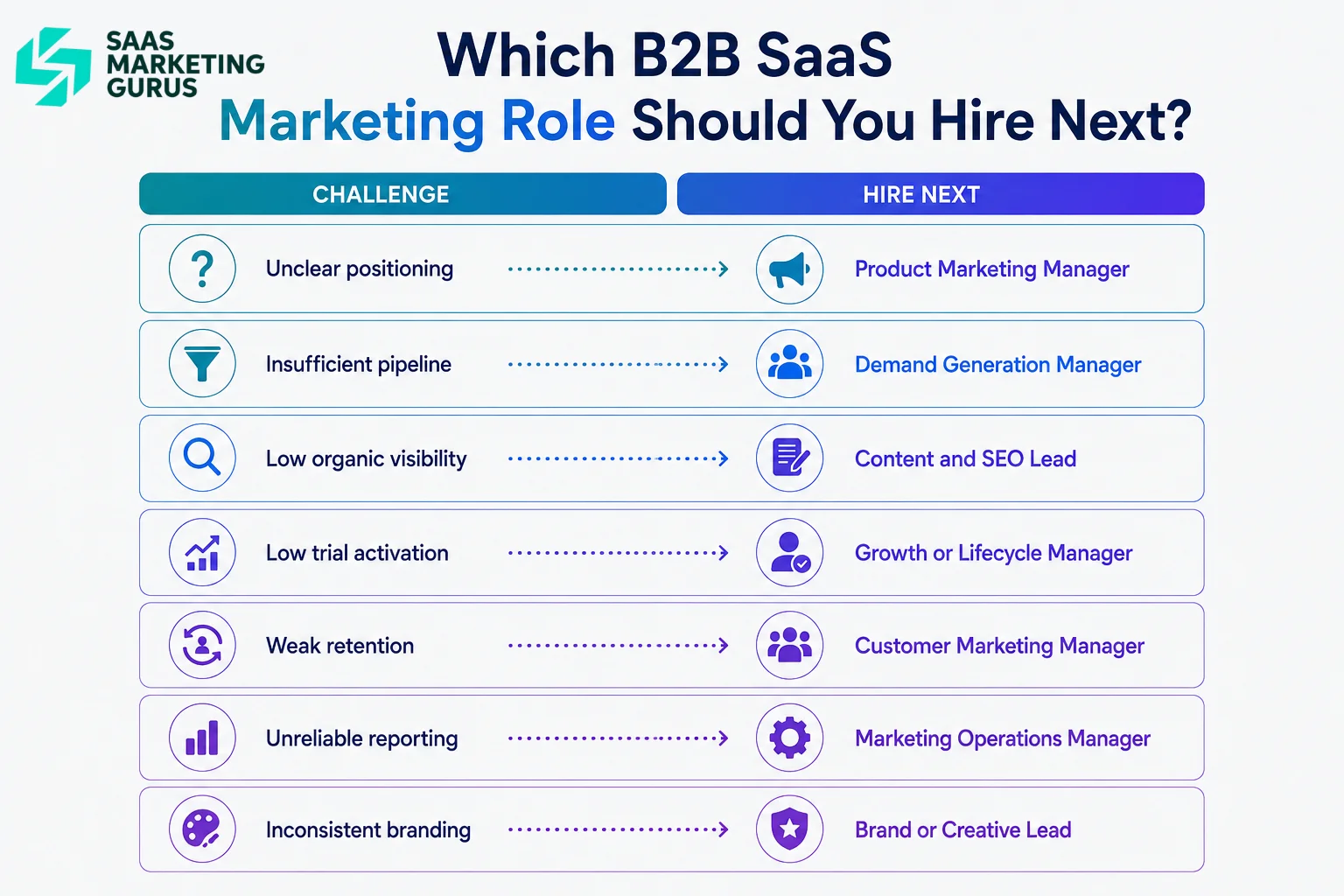
Use the table to identify a capability to investigate. Confirm the cause, recurring workload and available budget before approving a hire.
| Current constraint | Diagnose first | Capability to consider |
|---|---|---|
| Unclear positioning | Do buyers understand the product and its relevant differences? | Product Marketing |
| Insufficient qualified pipeline | Is the problem reach, audience fit, messaging, conversion or sales follow-up? | Demand Generation when acquisition capacity is the constraint |
| Low organic visibility | Is useful content missing, or are implementation and technical problems blocking it? | Content and SEO, technical support or a focused project |
| Low trial activation | Are users confused, encountering product friction or entering with unsuitable expectations? | Lifecycle Marketing with Product support |
| Weak retention or expansion | Is the cause product value, service delivery, customer fit or missing engagement? | Customer Marketing where communication, advocacy or expansion campaigns are the gap |
| Unreliable reporting | Are definitions, tracking, integrations or data ownership unclear? | Marketing Operations or RevOps |
| Inconsistent brand | Are standards missing, or does the team lack capacity to apply them? | Brand or Creative support |
A role becomes a stronger hiring case when the work is important, recurring and too large for the current owner after process problems have been addressed.
In House, Agency, Freelancer, or Hybrid?
Keep an accountable internal owner for marketing priorities, customer knowledge, positioning and business results.
An agency can contribute specialist expertise, strategic advice and channel execution. A freelancer may suit a defined assignment. A hybrid arrangement works when responsibilities, access, deliverables and review criteria are clear.
For example, an internal marketing leader can own the audience, priorities and pipeline target while an outside SEO team handles an agreed content and implementation scope. Review SaaS Marketing Gurus’ marketing services against the capability you need before deciding what to outsource.
Composite Example: A Five Person SaaS Marketing Team
This is an illustrative planning scenario, not a reported client engagement.
A sales-led SaaS company has a Head of Marketing, Product Marketer, Demand Generation Manager, Content Manager and Marketing Operations Manager. Pipeline has stopped growing, and the team is considering another acquisition hire.
Before hiring, the team reviews landing-page activity, qualified inquiries and sales-call notes. For this example, assume that relevant buyers use search during evaluation, commercial pages are missing, and the existing Content Manager has a sustained production backlog.
The Head of Marketing owns the decision. Product Marketing defines the buyer questions and positioning. An outside SEO specialist maps those questions to pages and identifies technical requirements. Marketing Operations establishes reporting, while the product or development owner schedules implementation.
The team reviews progress after two quarters, an illustrative review period. It examines completed work, qualified inquiries, opportunity quality, internal coordination costs and the remaining workload.
A permanent hire becomes a stronger option if valuable work continues to exceed available capacity. If the evidence instead shows weak positioning or poor sales follow-up, the next investment changes.
KPI Ownership and Handoffs
Separate ownership of a deliverable from responsibility for a shared business result. Product Marketing can influence win rate without controlling pricing, sales execution or product quality.
| Function | Work it directly owns | Shared measures it influences | Main handoff |
|---|---|---|---|
| Marketing Leadership | Priorities, budget allocation and marketing decisions | Revenue contribution and acquisition efficiency | Executive team, Sales and Product |
| Product Marketing | Research, positioning, launch plans and enablement materials | Win rate, adoption and launch performance | Product, Sales and Demand Generation |
| Demand Generation | Campaign delivery and qualification processes within its scope | Qualified pipeline, opportunities and acquisition cost | Sales and RevOps |
| Content and SEO | Content quality, publishing priorities and search work within scope | Organic conversions and assisted pipeline | Product Marketing, Demand Generation and development |
| Growth and Lifecycle | Lifecycle communication and agreed experiments | Activation and trial conversion | Product and Customer Success |
| Customer Marketing | Advocacy, customer communication and expansion campaigns | Retention, expansion pipeline and referrals | Customer Success and Sales |
| Marketing Operations | Tracking, system configuration and report maintenance | Data quality and reporting reliability | All revenue functions |
| Brand | Brand standards and agreed brand programs | Recognition, branded demand and share of voice | Content, Product Marketing and Creative |
For every metric, document its definition, source, reporting owner, review frequency and decision owner. Several functions can share a target while using one agreed definition.
Net revenue retention, or NRR, measures recurring revenue retained from an existing customer group after expansion, contraction and churn. It excludes new-customer revenue.
High Alpha’s January 2025 analysis reports that high-NRR companies grew 2.5 times faster than low-NRR companies in its 2024 data. This is an observed association, not proof that assigning a customer-marketing role causes faster growth.
Common Marketing Team Structure Mistakes for B2B SaaS
Hiring a CMO Too Early
A senior executive is useful when working functions and managers need strategic leadership. Before that point, an experienced generalist or fractional leader may contribute more directly.
Hiring Specialists Before Proving the Work
A specialist needs enough important, repeatable work to justify a permanent role. Test the capability, identify its business value, and establish internal ownership first.
Skipping Product Marketing
Weak positioning affects campaigns, content, sales conversations, pricing, and launches. Someone must own the market message, even before a dedicated Product Marketing Manager is hired.
Sharing KPIs Without Clear Decision Rights
Several teams can share pipeline, activation or retention goals. Problems arise when they use different definitions, count the same outcome inconsistently or assume another team will act.
Agree on the report owner, the people responsible for each contributing activity and the leader who resolves conflicting priorities. Shared targets need explicit responsibilities.
Adding Headcount Before Fixing Handoffs
More people will not solve unclear ownership. Document responsibilities, decision rights, and handoffs before approving another role.
How to Reorganize Without Slowing Growth
Start with a small set of responsibility changes that address the identified constraint. The following 90-day sequence is an illustrative planning approach.
- Days 1–15: Establish the baseline. List critical work, current owners, delays, campaign commitments and the measures you will use to assess the change.
- Days 16–30: Agree responsibilities. Confirm direct managers, decision rights, handoffs and any work that will stop.
- Days 31–60: Transfer work in stages. Document access, recurring tasks and open decisions. Keep a named owner for each active campaign during the transfer.
- Days 61–90: Review delivery. Check missed deadlines, duplicated work, handoff delays and whether the original constraint has improved.
Explain the changes to the people affected before switching responsibilities. Review the structure after major product or sales-motion changes, as well as during regular planning.
Frequently Asked Questions
What roles should a B2B SaaS marketing team have?
A B2B SaaS marketing team should cover leadership, Product Marketing, Demand Generation, Content and SEO, Growth or Lifecycle, Customer Marketing, and Marketing Operations. Small teams can combine these functions under experienced generalists. Growing companies should create dedicated roles when the work becomes important, repeatable, and too large for the current owner.
How many marketers should a B2B SaaS company have at each stage?
The examples in this guide use 0 to 2 internal marketers for founder-led marketing, 3 to 5 for early growth, 6 to 15 for scaleup, and 15 or more for a complex enterprise team. These are illustrative planning ranges. Workload, product complexity, available budget and sales motion should determine the actual team size.
What should the first marketing hire be at a SaaS startup?
The first hire is usually an experienced generalist who can turn customer insight into positioning, content, early demand tests, and basic measurement. If the founder already covers strategy but lacks one proven execution skill, a specialist or outside partner may be more useful. Hire against the clearest missing capability.
What are the first three marketing hires for a B2B SaaS company?
An illustrative starting team combines a senior generalist, a demand or growth marketer, and a product or content marketer. The order depends on the evidence. Diagnose whether growth is limited by positioning, reach, activation or execution capacity before choosing the next role.
When should a SaaS company hire a Product Marketing Manager?
Hire a Product Marketing Manager when messaging becomes inconsistent, launches require more coordination, Sales lacks useful materials, or different buyer groups need distinct narratives. Complex products and crowded categories may need this role earlier because positioning and sales education directly affect conversion.
Should Product Marketing report to Marketing or Product?
Product Marketing can report to Marketing when positioning, launches and sales enablement dominate the role. Product leadership may fit work centered on discovery, adoption and technical coordination. Choose the arrangement that provides access and decision authority, then document responsibilities across Marketing, Product and Sales.
When should a SaaS company hire Marketing Operations?
Hire a Marketing Operations Manager when reports become unreliable, attribution fails, several tools need an owner, or marketers spend too much time repairing data and processes. The role should improve system ownership, automation, tracking, and reporting speed so campaign teams can focus on growth.
Should SDRs report to Sales or Marketing?
Sales ownership can fit SDR teams focused on outbound prospecting and qualification. Marketing ownership can fit teams primarily handling inbound demand. Either arrangement needs shared qualification criteria, response expectations, account ownership rules and an agreed reporting process.
Should a SaaS company hire in house or use an agency?
Keep an accountable internal owner for priorities and business results. Agencies can add specialist advice and execution, while freelancers can handle defined assignments. Compare ongoing workload, management time, required product knowledge and total cost before choosing an employee, external provider or hybrid arrangement.
Build the Team Around the Next Growth Constraint
A useful B2B SaaS marketing team structure gives each important responsibility a clear owner and provides enough capacity to deliver the work.
Use the four factors in this guide: company stage, GTM motion, current constraint and proven capability. Confirm the cause of the problem, identify the work required and decide whether the next step is a process change, product improvement, employee or external specialist.
Review the decision against actual delivery and business results as the company changes.
Need specialist support for a marketing priority your team cannot currently cover? Get a free consultation with SaaS Marketing Gurus to discuss your growth goals, current marketing challenges and potential scope of support.