A SaaS content strategy is a structured plan for creating, publishing, distributing, and improving content that attracts the right buyers, builds trust, and generates business results.
For SaaS companies, content should do more than increase website traffic. It should help potential customers understand their problems, discover possible solutions, evaluate products, and take actions such as requesting a demo, starting a trial, or contacting sales.
A successful SaaS content strategy connects five areas:
- Customer problems
- Search demand
- Content topics
- Product value
- Revenue goals
Many SaaS companies publish content consistently but struggle to generate qualified leads because their content is not connected to customer intent or business outcomes.
At SaaS Marketing Gurus (SMG), we use a demand-focused approach that combines SaaS SEO, Generative Engine Optimization (GEO), content marketing, community insights, and conversion strategy to create content systems that support growth.
This guide explains how to build a SaaS content strategy that creates demand, captures search opportunities, improves AI visibility, and turns content into measurable pipeline.
What Is a SaaS Content Strategy?
A SaaS content strategy is a system for planning, creating, distributing, and optimizing content that attracts SaaS buyers, supports the customer journey, and generates business growth.
A complete strategy answers these questions:
- Who are we trying to reach?
- What problems do they need to solve?
- What information do they need at each buying stage?
- What are they searching for?
- Which content formats and channels should we use?
- How does each topic connect to our product?
- What should the reader do next?
- How will we measure results?
In simple terms, a SaaS content strategy connects customer problems with useful content, product value, and business goals. A broader SaaS content marketing strategy then turns that plan into a repeatable publishing and distribution system.
SaaS Content Strategy Framework: The SMG Growth Model
A successful SaaS content strategy needs more than a list of keywords. It needs a repeatable system that connects customer needs with business goals.
SMG uses a six-step SaaS Content Growth Model:
| Stage | Purpose | Key Actions |
|---|---|---|
| Customer Intelligence | Understand buyers | Research ICP, pain points, objections, and buying triggers |
| Search Opportunity Mapping | Find valuable topics | Analyze keywords, competitors, SERP intent, and content gaps |
| Content Planning | Build the roadmap | Create topic clusters, funnels, and content calendars |
| Content Creation | Produce valuable assets | Write guides, comparisons, use cases, and product-focused content |
| AI Visibility Optimization | Improve discoverability | Add definitions, entities, citations, examples, and structured answers |
| Revenue Measurement | Track impact | Measure leads, pipeline influence, conversions, and revenue |
This approach prevents SaaS companies from creating content only because a keyword has search volume. Every topic should have a clear audience, purpose, and business connection.
What Goals Should a SaaS Content Strategy Achieve?
A SaaS content strategy should support every stage of the customer journey, from discovering a problem to choosing a solution.
The main goals are:
| Goal | What It Helps Achieve | Recommended Content |
|---|---|---|
| Build Awareness | Help buyers understand a problem | Educational guides, research, industry insights |
| Create Demand | Influence buyers before they search | Expert content, videos, newsletters, founder insights |
| Capture Demand | Reach active buyers | Comparison pages, alternatives, solution pages |
| Generate Pipeline | Turn visitors into opportunities | Case studies, demos, landing pages |
| Improve Retention | Help customers succeed | Tutorials, knowledge bases, product education |
The goal is not publishing more content. The goal is creating content that moves the right audience closer to a business decision.
Start With Your Ideal Customer, Not a Keyword List
Keyword research matters, but it should not be the first step. A keyword tells you what someone searched. It does not always reveal who searched, why the problem matters, or whether that person could become a customer.
Start by defining your ideal customer profile, or ICP. Document:
- Company size and industry
- Relevant job roles
- Buying authority and other decision makers
- Daily problems and business risks
- Desired outcomes
- Common objections
- Problems your product can solve well
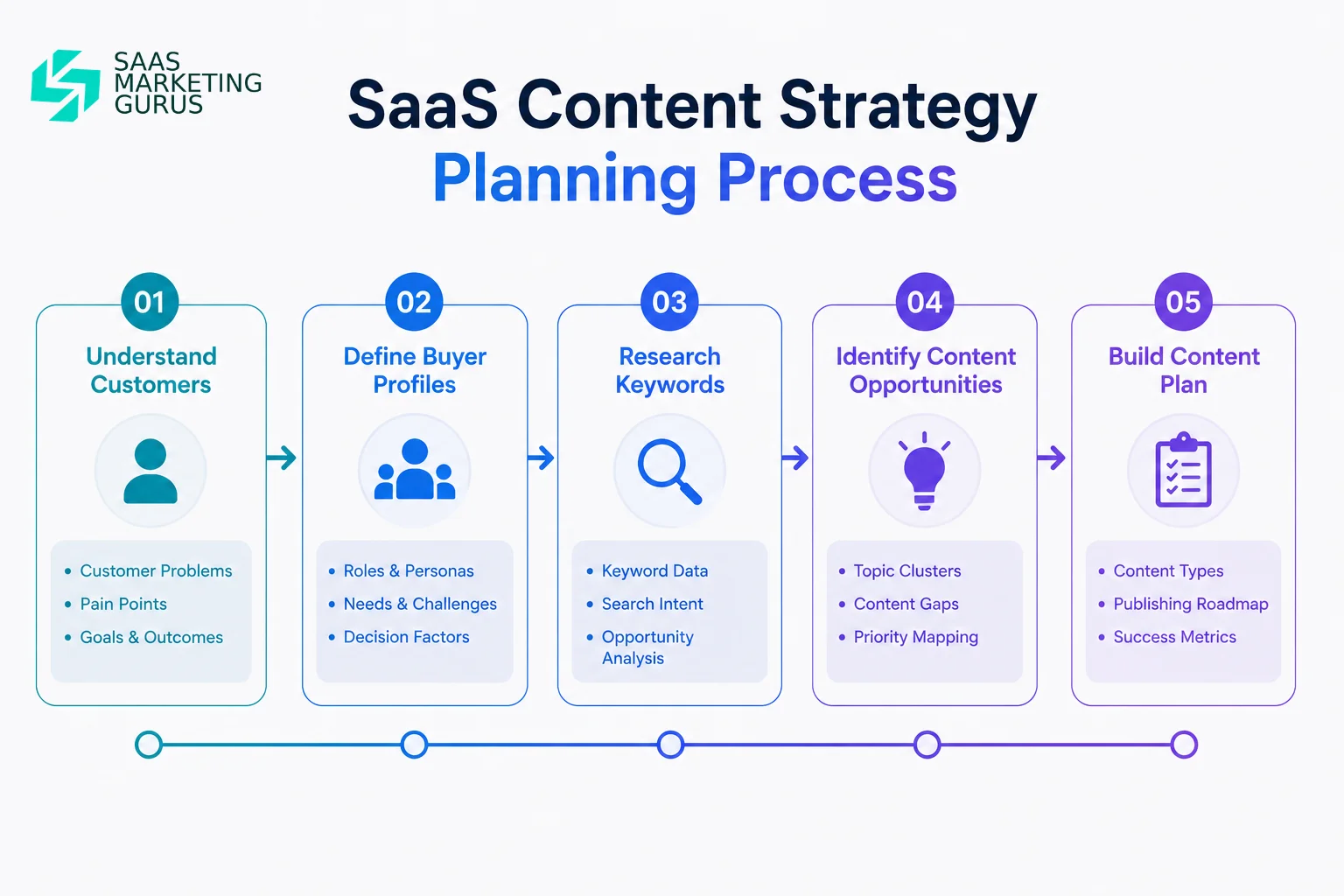
Use customer interviews, sales calls, support tickets, product reviews, lost deal notes, and industry communities to find real questions. Then use SaaS keyword research to validate demand, identify search language, and map each topic to business value.
Use Customer Jobs to Find Better Topics
Imagine that you sell route planning software. A basic keyword plan may target “route planning software.” However, your buyer may be trying to reduce fuel costs, plan routes for many stops, avoid late deliveries, or complete more jobs each day.
Those needs create useful topics such as “How to Plan the Shortest Route for Multiple Stops” or “How to Reduce Fuel Costs Across a Delivery Fleet.” The reader may not be looking for software yet, but the problem creates a natural connection to the product.
Use this sequence when choosing topics:
ICP → Customer problem → Search or discovery behaviour → Content topic → Product connection → Conversion goal
Before approving a topic, ask two questions:
- Does this problem matter to our ideal customer?
- Can our product or expertise help solve it?
If the answer to either question is no, the topic is unlikely to support meaningful growth.
Create Demand and Capture Existing Demand
A modern SaaS content strategy has two important jobs.
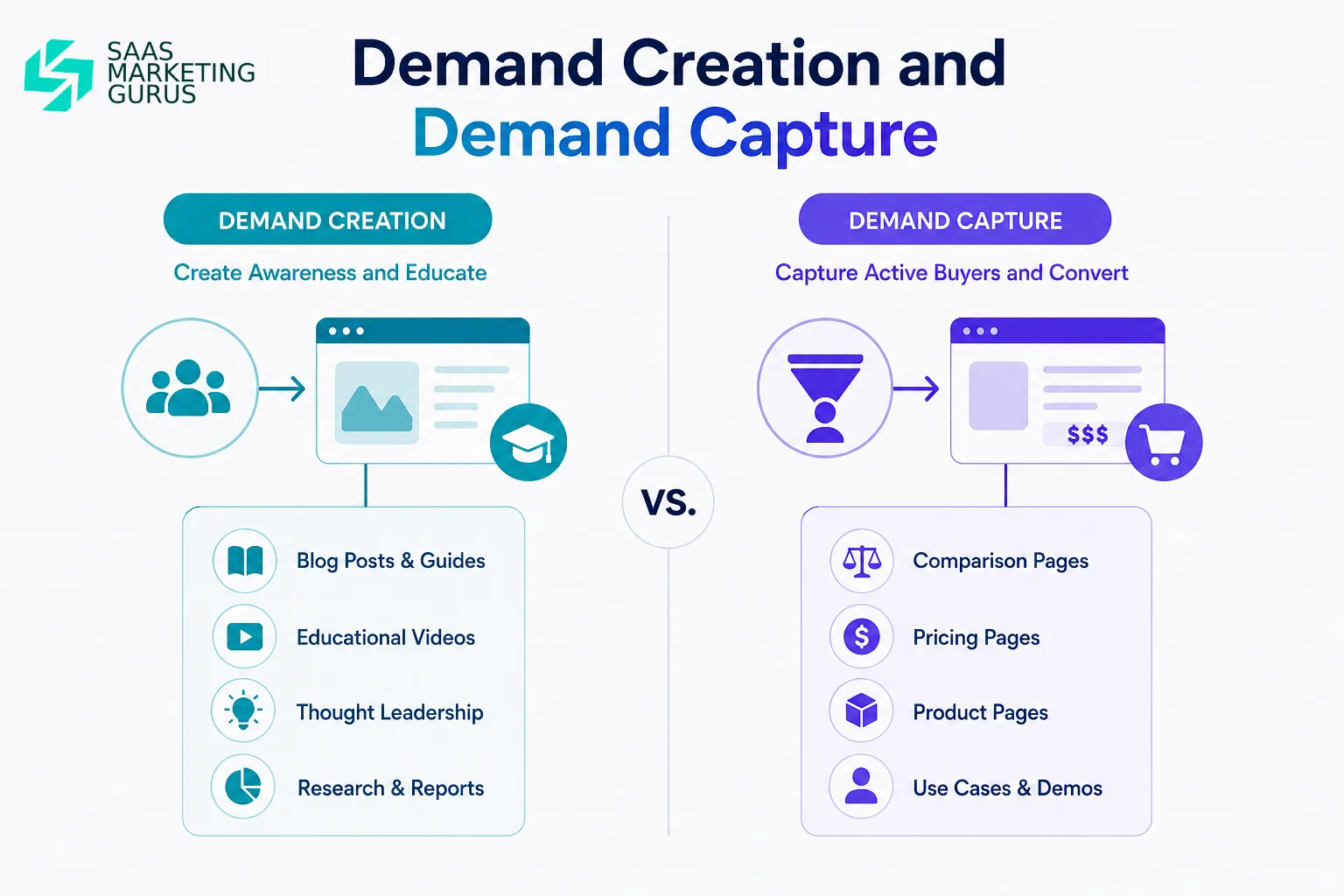
Create Demand
Demand creation reaches potential buyers before they are actively searching for a product. It helps them recognize a problem, understand its cost, and see that a better way is possible.
Useful formats include founder content, original research, educational articles, videos, webinars, LinkedIn posts, newsletters, and industry analysis.
The goal is not simply likes or impressions. Good demand creation gives the buyer a new and useful way to understand a problem.
Capture Demand
Demand capture reaches people who are already exploring a problem or comparing products. Their searches may include terms such as “best CRM for SaaS,” “CRM alternatives,” “CRM pricing,” or “CRM for small businesses.”
Useful content includes:
- Product and solution pages
- Use case pages
- Comparison and alternative pages
- Pricing pages
- Integration pages
- Case studies
- High intent guides
Both jobs matter. Demand creation builds familiarity and trust. Demand capture helps buyers find and evaluate your solution when they are ready.
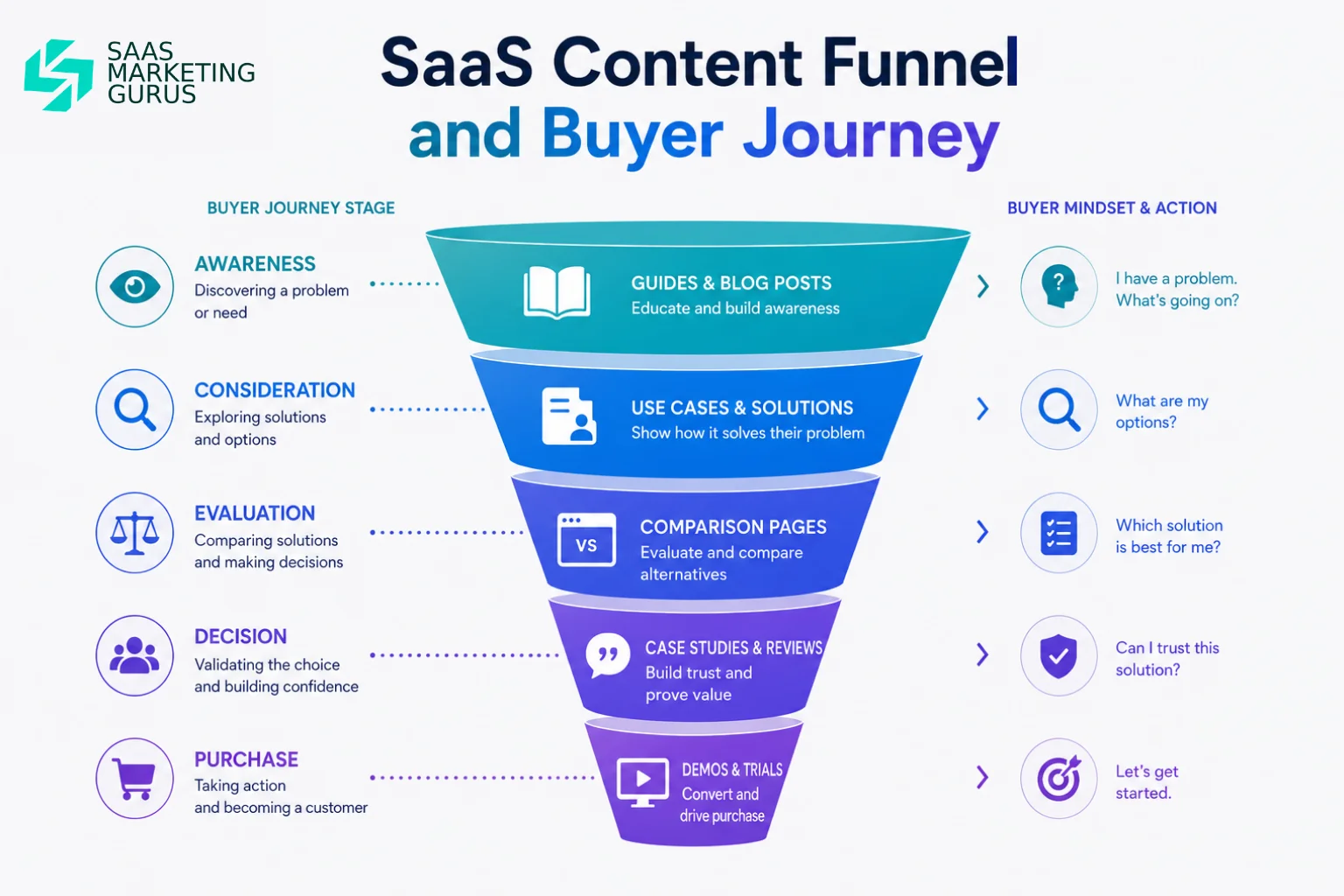
Map Content to Search Intent and the Buyer Journey
Not every keyword has the same value. A broad keyword with 20,000 monthly searches may generate less pipeline than a focused keyword with 200 searches if the smaller audience has a clear need and stronger buying intent.
| Buying stage | Buyer need | Best content |
|---|---|---|
| Awareness | Understand a problem | Guides, research, trends, and educational content |
| Consideration | Explore possible solutions | Workflows, templates, use cases, and practical guides |
| Decision | Compare and select a product | Comparisons, alternatives, pricing, case studies, and product pages |
| Adoption | Get value after purchase | Onboarding, tutorials, feature guides, and customer education |
Prioritize topics the way SMG’s own CLARITY framework does: Customer Problem, Level of Intent, Alignment With SERP, Revenue Potential, Independent Page Value, Topic Connection, and Yield Measurement. Our guide to AI keyword clustering walks through how to apply it. This keeps your plan focused on qualified demand instead of raw traffic.
Build a Clear SaaS Content Architecture
A SaaS blog should not be a collection of unrelated posts. Organize content into connected topic groups that help readers and search engines understand your expertise.
A simple structure is:
Core topic → Supporting guides → Use cases and comparisons → Product or service page
For example, a core page about SaaS demand generation could link to supporting content about demand generation metrics, demand creation versus demand capture, examples, tools, and relevant product use cases.
Map each search intent to the right page type:
| Search intent | Best page type |
|---|---|
| Informational | Guide, definition, tutorial, or research article |
| Commercial | Comparison, alternative, use case, or software list |
| Transactional | Product, pricing, demo, or trial page |
Add internal links where they help the reader continue the journey. Use clear anchor text that describes the destination. You can apply this structure across your wider B2B search engine optimisation strategy.
Make long pages easy to scan with clear headings, short sections, lists, and useful tables. This matches Nielsen Norman Group’s eye-tracking research on the F-shaped reading pattern, which shows that readers scan pages in patterns rather than reading every word in order.
Review existing pages before creating another article. Updating a page may be the better choice when it has declining rankings, high impressions but few clicks, outdated information, or strong traffic with weak conversion.
How Do You Optimize SaaS Content for SEO and AI Search?
SaaS buyers now use multiple discovery channels, including Google Search, AI assistants, communities, review platforms, and social networks.
Optimizing for modern search requires creating content that is easy for both humans and AI systems to understand.
A strong SaaS content page should include:
| Optimization Area | What To Add |
|---|---|
| SEO | Search intent, keyword coverage, internal links, technical optimization |
| AI Search | Clear definitions, structured answers, entities, evidence, examples |
| User Experience | Easy navigation, short sections, useful visuals |
| Trust | Expert input, references, customer proof, transparent claims |
For AI visibility, content should answer questions directly and provide information that is difficult to replace with generic summaries.
AI systems are more likely to reference content that includes:
- Original research
- Expert opinions
- Specific examples
- Clear definitions
- Supporting evidence
- Unique frameworks
Get Your Content Strategy Audited
Find out which pages create demand and which ones just fill a calendar.
How SaaS Companies Can Improve AI Search Visibility
Generative Engine Optimization (GEO) focuses on making content easier for AI platforms such as ChatGPT, Google AI Overviews, and Perplexity to understand and reference.
A SaaS content page can improve AI visibility by:
1. Answering Questions Clearly
Instead of:
“Content strategy is important for SaaS growth.”
Use:
“A SaaS content strategy helps companies attract buyers by connecting customer problems, search demand, and product solutions through useful content.”
2. Building Strong Topic Relationships
AI systems need context.
Connect related topics:
SaaS Content Strategy
→ SaaS SEO
→ SaaS Keyword Research
→ Content Clusters
→ Demand Generation
→ Conversion Optimization
3. Adding First-Hand Insights
Generic advice is easy to replace.
Original insights improve trust:
- Internal frameworks
- Campaign learnings
- Customer examples
- Industry observations
Connect Every Important Topic to Your Product
Helpful content can mention a product without becoming a sales pitch. The product should appear when it genuinely helps solve the problem being discussed.
Use this path:
Problem → Education → Possible solution → Product relevance → Next action
For example, an article can explain why lead management becomes inefficient, show a better workflow, and then demonstrate how the product supports that workflow. Screenshots, templates, integrations, feature examples, and customer outcomes can make the connection clear.
The closer a topic is to a buying decision, the stronger and more direct the product connection should be.
Turn Content Into a Conversion Journey
Do not leave readers wondering what to do next. Match the call to action to their intent.
| Reader intent | Suitable next action |
|---|---|
| Learning | Read a related guide or download a template |
| Exploring | View a use case or product overview |
| Comparing | Review a comparison, case study, or pricing page |
| Ready to act | Start a trial or book a demo |
A simple journey may look like this:
Educational content → Useful resource → Relevant call to action → Trial or demo → Follow up → Sales conversation
Not every visitor will convert during the first session. Email follow up, retargeting, product education, and case studies can keep suitable prospects moving toward a decision.
Build Distribution Into the Plan
Publishing is not the same as distribution. Decide how you will promote a topic before you create it.
For many B2B SaaS companies, a practical mix includes organic search, LinkedIn, founder content, email, video, communities, and selective paid promotion. One strong idea can become an article, short video, email, webinar section, social post, or presentation.
Adapt the idea to the channel. Do not copy the same text everywhere. Each version should fit the audience, format, and reason people use that channel.
Use Customer Proof to Build Trust
Buyers need proof when they move from learning to evaluation. Show what changed for a customer instead of only claiming that the product works.
Useful proof includes:
- Case studies with a clear problem, solution, and result
- Product screenshots and demonstrations
- Customer quotes with enough context
- Real workflows and use cases
- Original research or product data
- Specific outcomes and limits
Proof also makes content more distinctive. It demonstrates expertise through evidence rather than broad claims.
Measure Results Across the Full Journey
Traffic is useful, but it is not the final business result. Measure performance at four levels.
| Level | Useful metrics |
|---|---|
| Visibility | Rankings, impressions, organic visits, mentions, and click rate |
| Engagement | Returning visitors, useful page actions, content depth, and call to action clicks |
| Conversion | Trial starts, signups, demo requests, and qualified leads |
| Business impact | Opportunities, influenced pipeline, customers, retention, and revenue |
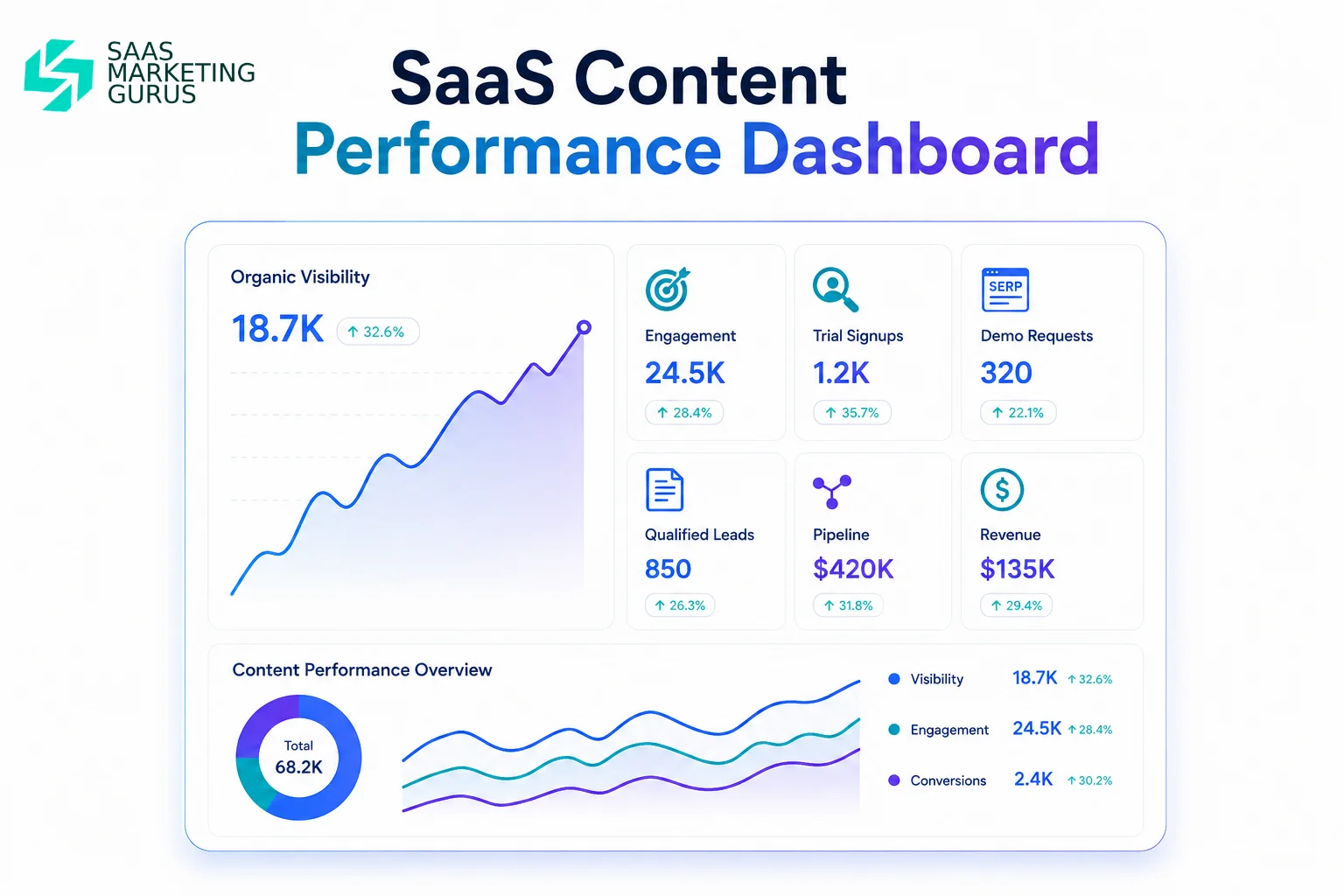
Content may influence several touchpoints before a conversion. A buyer might see a founder post, read a guide, compare products, open an email, review a case study, and then book a demo. Use analytics and customer relationship data together where possible.
The key question is not “How much traffic did this page receive?” It is “Did this content help a suitable buyer move closer to a useful business outcome?”
Improve Your SaaS Content Strategy Over Time
Treat the strategy as a working system. Review it as customer needs, search behavior, competition, and product priorities change.
| Signal | Likely issue | Recommended action |
|---|---|---|
| High traffic with few conversions | Weak offer or next step | Improve the call to action and product connection |
| High impressions with few clicks | Weak title or search fit | Test the title and meta description |
| Falling rankings | Outdated or incomplete page | Refresh facts, examples, and topic coverage |
| Good engagement with no product action | Product value is unclear | Add a relevant use case, proof, or product link |
| Repeated customer questions | Missing content | Create or expand a focused page |
| Recurring sales objections | Buyer uncertainty | Add comparison, proof, or risk reduction content |
Review performance every quarter, but do not wait for a formal review to fix clear problems. Sales, support, and customer success teams can reveal gaps that analytics alone will miss.
Build a SaaS Content System That Supports Growth
A SaaS content strategy should do more than keep your blog active. It should help the right people discover a problem, understand possible solutions, trust your expertise, evaluate your product, and take action.
Start with your ideal customer. Map real problems to search and buying intent. Build connected content around important topics, show the product where it is relevant, distribute each idea properly, and measure the effect on pipeline and revenue.
If your current content attracts traffic but does not create qualified opportunities, book a free SaaS growth consultation. SaaS Marketing Gurus can help you turn disconnected pages into a focused content system built around visibility, demand, and conversion.
FAQs
What is a SaaS content strategy?
A SaaS content strategy is a plan for creating, distributing, and improving content that attracts SaaS buyers, answers their questions, supports the buying journey, and generates business results such as leads, demos, trials, and revenue.
How do SaaS companies create a content strategy?
SaaS companies create a content strategy by defining their ideal customers, researching customer problems, analyzing search intent, building topic clusters, creating useful content, connecting content with product value, and measuring business impact.
What type of content works best for SaaS companies?
The best SaaS content depends on the buyer stage. Educational guides help create awareness, comparison pages help buyers evaluate solutions, case studies build trust, and product pages support conversions.
How much content should a SaaS company publish?
There is no fixed number of articles that guarantees success. SaaS companies should focus on creating high-quality content around customer problems, search demand, and business goals rather than publishing a high volume of unrelated posts.
What is the difference between SaaS content strategy and SaaS content marketing?
A SaaS content strategy defines the plan, audience, topics, goals, and measurement process. SaaS content marketing is the execution of that plan through content creation, publishing, distribution, and optimization.
How can SaaS companies optimize content for AI search?
SaaS companies can improve AI search visibility by adding direct answers, clear definitions, original insights, expert information, structured content, relevant entities, and trustworthy references.
Should SaaS companies focus on SEO or thought leadership?
Both approaches are valuable. SEO helps capture existing demand from people searching for solutions, while thought leadership helps create demand by changing how buyers understand a problem.
When should a SaaS company hire a content strategy agency?
A SaaS company may benefit from a content strategy agency when it struggles to generate qualified traffic, identify valuable topics, create scalable content systems, improve AI visibility, or connect content performance with revenue.