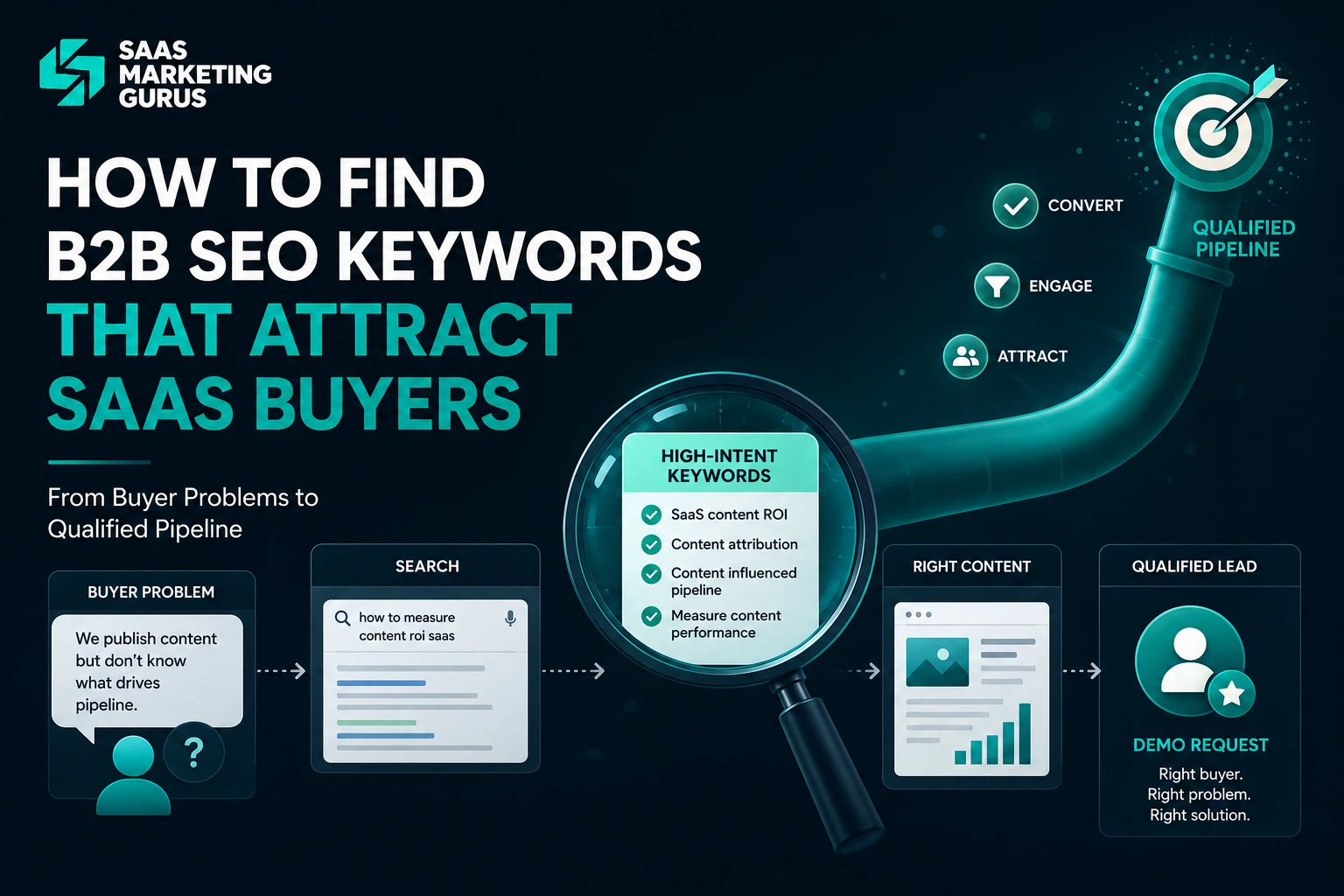
Your SaaS website might be getting organic traffic without attracting the people who are ready to buy.
You publish consistently. Rankings improve. Search impressions increase. Yet demo requests stay flat, or the leads coming from organic search do not match your ideal customer profile.
This usually starts with the keyword strategy.
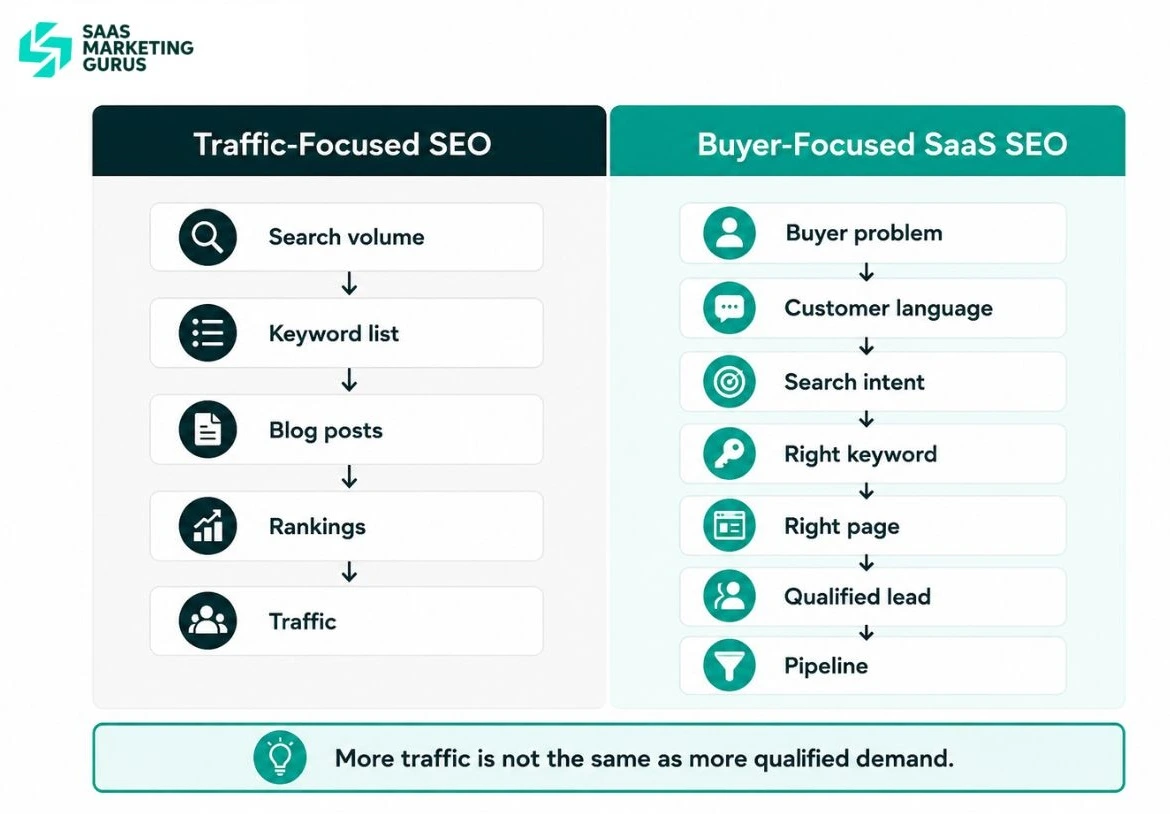
If your research focuses mainly on search volume and keyword difficulty, you might build a large list of keywords without knowing which ones matter to your buyers. A better SaaS content strategy starts with the problems your customers face, then works backward to the searches they use when looking for answers and solutions.
At SaaS Marketing Gurus, we connect customer problems, search intent, product value, content, and business goals rather than treating keyword research as a standalone SEO task.
Here is how we approach B2B SEO keyword research, from the first customer problem to the content you should create and the results you should measure.
What Are B2B SEO Keywords?
B2B SEO keywords are search terms used by business buyers when researching problems, solutions, vendors, and products before making a purchase decision.
For SaaS companies, valuable B2B SEO keywords are not always the keywords with the highest search volume. The best keywords are the ones that match:
- Your ideal customer profile (ICP)
- A real customer problem
- Search intent
- Your product solution
- Business outcomes
A strong B2B SaaS keyword strategy connects:
Buyer Problem → Search Query → Keyword Cluster → Content Type → Conversion Goal
This approach helps SaaS companies attract visitors who are more likely to become qualified leads instead of generating traffic without business impact.
What Types of B2B SEO Keywords Should SaaS Companies Target?
Not every keyword has the same business value. SaaS companies should build keyword clusters around different stages of the buyer journey.
| Keyword Type | Example | Search Intent | Recommended Page |
|---|---|---|---|
| Problem Keywords | How to improve SaaS customer retention | Research | Blog guide |
| Solution Keywords | Customer retention software | Commercial | Solution page |
| Comparison Keywords | HubSpot vs Salesforce alternatives | Evaluation | Comparison page |
| Alternative Keywords | Salesforce alternatives for startups | Switching intent | Alternative page |
| Integration Keywords | Salesforce marketing automation integration | Use case | Integration page |
| Industry Keywords | CRM software for fintech companies | Industry intent | Industry page |
| Feature Keywords | AI email automation software | Product research | Feature page |
What Goes Wrong When You Choose SaaS Keywords by Search Volume?
Search volume gives you useful information. It does not tell you whether a keyword is valuable to your SaaS business.
Consider a broad keyword such as “CRM software.”
It might have substantial search demand, but the searchers behind it have different needs. Some are students researching CRM. Some are small businesses. Some are looking for a free tool. Others are comparing enterprise platforms.
Now compare it with a search such as “compliance CRM for fintech.”
The second query tells you more about the searcher’s situation. The audience is narrower, but the business context is clearer.
For B2B SaaS, this distinction matters.
A keyword strategy built around volume alone often creates three problems:
You attract the wrong visitors
Broad keywords often bring visitors outside your ICP. Your analytics report looks better, while your sales team sees little change in qualified opportunities.
You publish content without a clear path to conversion
A visitor might read an educational article, leave, and never have a reason to explore your product. The article answered a question, but it did not support a buying decision.
You overlook specific searches from serious buyers
B2B buyers often search for a particular problem, use case, integration, comparison, or alternative. Those searches often have less reported volume than broad category terms.
That does not mean every low-volume keyword deserves attention. It means volume needs context.
A recent B2B SaaS discussion on Reddit shows the problem clearly. One founder reported that logical keywords for a validated SaaS category showed roughly 0 to 10 searches per month in Google Keyword Planner, even though established competitors already had customers.
The better question is not:
“How many people search this keyword?”
It is:
“Does this search represent a problem our target buyer has, and does our product offer a credible solution?”
Start With the Buyer Problem, Not the Keyword Tool
The usual keyword research process starts with a product category.
You enter your category into an SEO tool, export keywords, sort by volume, filter by difficulty, and start planning content.
For a B2B SaaS company, we prefer to start one step earlier.
Start with the buyer.
Ask:
- Who is involved in the purchase?
- What problem triggers the search?
- What outcome does the buyer want?
- What are they using today?
- What makes them look for another solution?
- Which questions come up during evaluation?
- Which competitors or alternatives do they consider?
This matters because a SaaS buying committee does not search with one voice. A marketing leader, finance stakeholder, technical evaluator, and end user might search for different information around the same purchase. SMG’s B2B SEO guidance follows this buyer-focused approach rather than treating the audience as one generic persona.
For example, suppose a SaaS company helps marketing teams understand which content contributes to pipeline.
A weak starting point would be:
“content marketing”
A stronger starting point would be:
“How do SaaS companies measure which content contributes to pipeline?”
Now you have a real buyer problem.
From there, keyword research might reveal searches such as:
- SaaS content ROI
- content attribution for SaaS
- how to measure content marketing ROI
- content influenced pipeline
- SaaS content attribution
- how to measure SaaS content performance
The keyword list becomes a result of customer research instead of the starting point.
How We Find B2B SaaS Keywords From Real Buyer Language
The next step is to collect the words buyers use when they describe their problems.
This is where B2B keywords research becomes more useful.
A keyword tool tells you how a search is estimated to perform. Customer conversations tell you why someone searches in the first place.
When researching a SaaS topic, look at sources such as:
- Sales call notes
- CRM opportunity notes
- Customer interviews
- Support questions
- Product reviews
- Competitor reviews
- Reddit discussions
- Industry communities
- Existing Google Search Console queries
The goal is not to copy customer sentences into a keyword tool.
The goal is to find repeated problems and phrases.
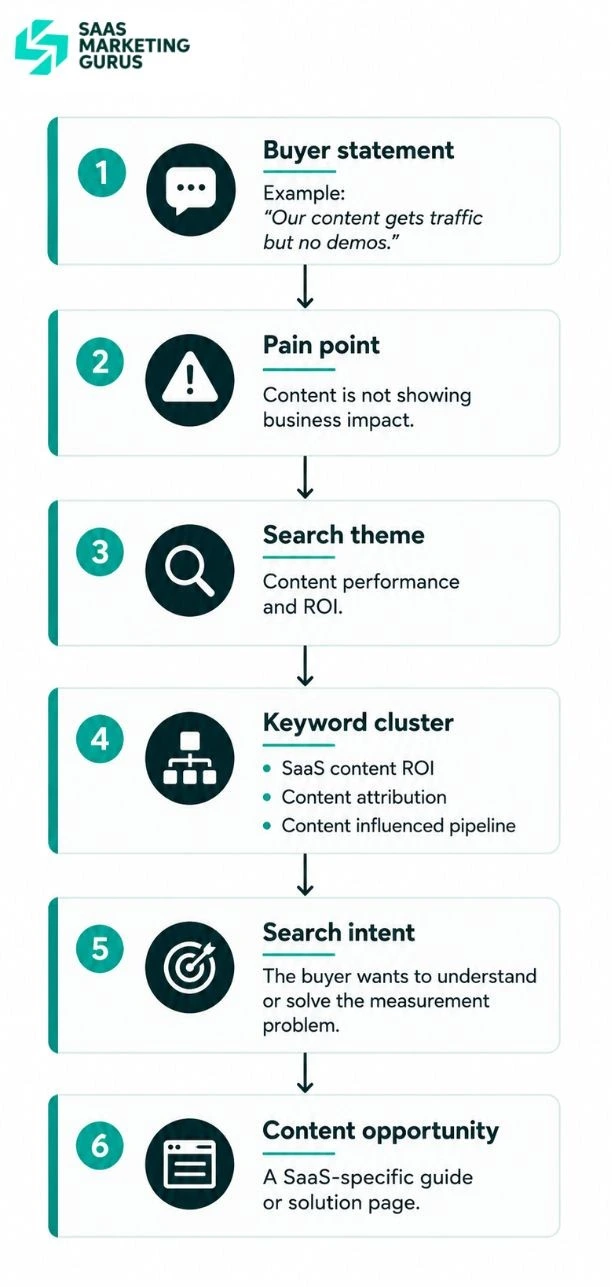
For example, a customer might say:
“We are getting traffic, but we don’t know which articles help sales.”
That statement contains several research directions:
- Content performance
- Content ROI
- Content attribution
- Pipeline influence
- Content measurement
You then turn those themes into keyword candidates.
This is one reason community research matters for SaaS content marketing strategy, because customer conversations often reveal the exact problems buyers are trying to solve.
The same research principle applies to SEO.
Find the conversation first. Then find the search opportunity.
The SMG B2B SaaS Keyword Qualification Framework
Before creating content around any keyword, evaluate it using six factors:
| Factor | Question |
|---|---|
| ICP Fit | Does this search match your ideal customer? |
| Problem Fit | Does it represent a real customer challenge? |
| Intent | Is the searcher researching, comparing, or buying? |
| Product Fit | Can your SaaS product solve this problem? |
| SERP Opportunity | Can you realistically compete? |
| Business Value | Can this keyword influence pipeline or revenue? |
A keyword with lower search volume but strong business alignment can often create more qualified opportunities than a high volume keyword with weak intent.
Turn Buyer Problems Into Search Themes and Keyword Clusters
Once you have customer language, group similar problems together.
For example:
| Buyer statement | Problem | Search theme | Keyword direction |
|---|---|---|---|
| “Our content gets traffic but no demos.” | Poor content conversion | Content performance | SaaS content ROI |
| “We don’t know which content influences deals.” | Attribution | Content attribution | SaaS content attribution |
| “What should we publish next?” | Content planning | Content strategy | SaaS content plan |
| “Which competitor is better for us?” | Vendor evaluation | Comparison | SaaS product comparison |
This step matters because one customer question often represents an entire group of searches.
You do not want four separate articles because four customers used slightly different wording.
You want to understand the shared problem, identify the search terms around it, then decide which page should answer the need.
This is where a SaaS content plan starts to take shape. The process becomes:
What Types of B2B SEO Keywords Should SaaS Companies Target?
SaaS buyers search differently depending on where they are in the buying journey. A strong keyword strategy should include multiple keyword types, not only informational searches.
| Keyword Type | Example | Search Intent | Best Page Type |
|---|---|---|---|
| Problem Keywords | How to reduce SaaS churn | Understanding a challenge | Blog guide |
| Solution Keywords | Customer retention software | Looking for solutions | Solution page |
| Comparison Keywords | HubSpot vs Salesforce | Evaluating options | Comparison page |
| Alternative Keywords | Salesforce alternatives | Switching vendors | Alternative page |
| Integration Keywords | Salesforce marketing automation integration | Finding workflows | Integration page |
| Industry Keywords | CRM software for fintech companies | Industry-specific research | Industry page |
| Feature Keywords | AI email automation software | Product research | Feature page |
The goal is not to rank for every keyword type. The goal is to create the right page for the right search intent.
How Should SaaS Companies Find Keywords for AI Search?
AI search engines such as ChatGPT, Google AI Overviews, and Perplexity do not only match exact keywords. They understand topics, entities, relationships, and user intent.
To improve visibility in AI search results:
- Create clear definitions for important concepts.
- Answer specific buyer questions.
- Include original examples and frameworks.
- Use structured content formats such as tables and checklists.
- Build topical authority around your SaaS category.
- Support claims with trusted sources.
For example:
Instead of only targeting:
“content attribution software”
Create supporting content around:
- How does content attribution work?
- How do SaaS companies measure content ROI?
- Best content attribution tools for B2B teams
- Content attribution vs marketing attribution
This creates stronger topic coverage for both Google and AI search systems.
Use SEO Tools to Validate Demand, Not Define the Strategy
Once you have candidate topics, bring in SEO data.
This is where tools become useful.
We want to know:
- Is there measurable search demand?
- Which related terms appear?
- What pages already rank?
- Which competitors receive visibility?
- How difficult is the SERP?
- Are there commercial variations?
- Does the topic show consistent interest?
- Does our existing website already receive impressions for related searches?
For a deeper approach to improving organic visibility, SaaS companies can also use a structured B2B SEO audit to identify keyword gaps, technical issues, content opportunities, and competitor weaknesses.
Each source answers a different question.
| Research source | What it tells you |
|---|---|
| Customer conversations | What buyers say |
| Reddit and communities | How buyers describe problems |
| Google Search Console | What your site already appears for |
| Keyword tools | Estimated search demand and related terms |
| Google results | What search intent looks like |
| Competitor research | Which topics and pages already attract visibility |
| Google Trends | Whether interest is growing, declining, or seasonal |
SMG’s current B2B SEO strategy also recommends using different tools for different research jobs. Google Search Console provides first-party search performance data, while Ahrefs is useful for competitor and backlink research, and Semrush provides broader SEO and AI visibility capabilities.
The important point is how you use the data.
Do not let a keyword tool decide your content strategy.
Use the data to test the opportunity you found through buyer research.
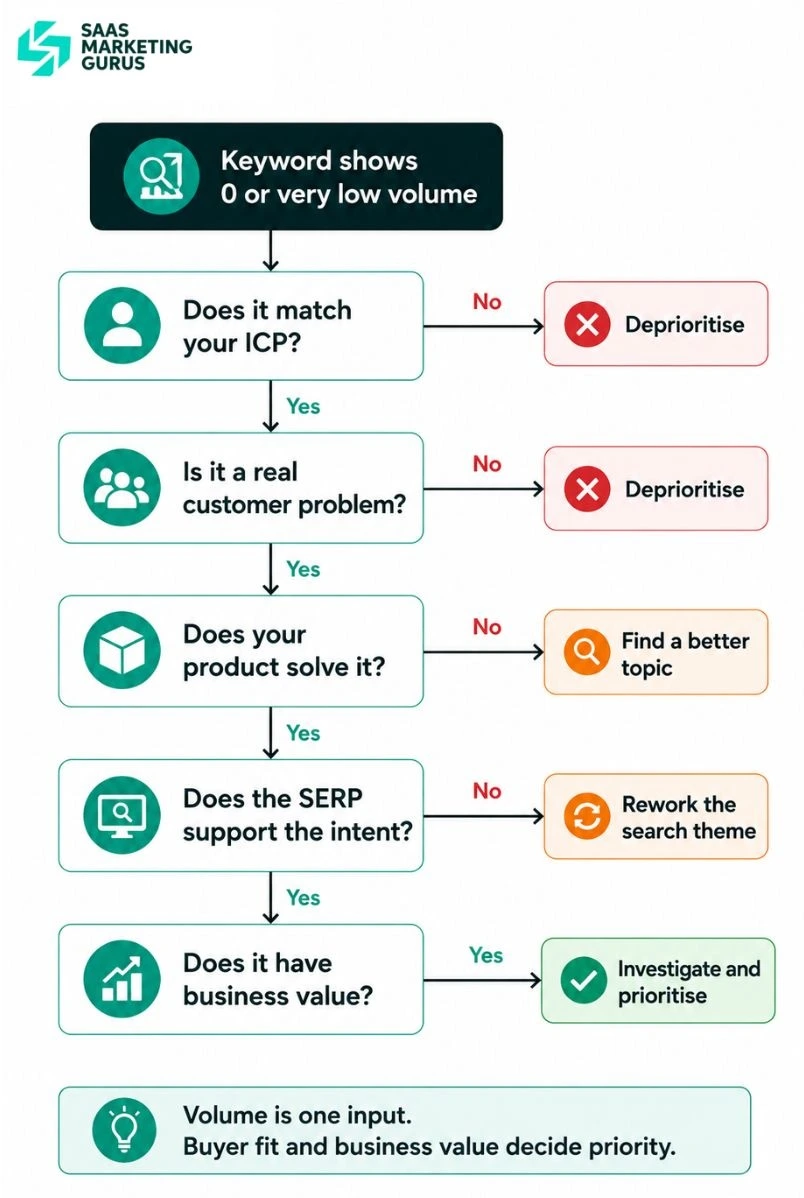
What Should You Do With a Keyword That Has 0 Search Volume?
A zero-volume estimate does not automatically mean zero demand.
It means the available tool does not report meaningful measurable volume for that exact query.
Before rejecting the topic, check the surrounding evidence.
Investigate further when:
- The keyword matches your ICP.
- The problem appears in customer conversations.
- Similar keyword variations show demand.
- Competitors rank for related searches.
- Google returns relevant results.
- The topic connects directly to your product.
- The search shows clear solution or evaluation intent.
- The topic supports an important business goal.
Deprioritise when:
- The audience does not match your ICP.
- The problem has little connection to your product.
- The SERP shows a completely different intent.
- You have stronger opportunities competing for the same resources.
- There is no clear business purpose for creating the page.
This distinction matters for B2B SaaS because buyers often describe the problem differently from the product category.
A company might sell an automated solution for a problem buyers do not know software can solve. In this situation, searching only for the product category produces a tiny keyword list. The Reddit example above shows this exact challenge.
Your research needs to expand from the product name to the problem, outcome, workflow, and alternatives.
Check the SERP Before You Commit to a Keyword
Keyword tools give you metrics.
The search results show you what Google thinks the searcher wants.
Before adding a keyword to your SaaS content plan, search it manually.
Look at:
- Which websites rank?
- What type of pages rank?
- Are they blog posts, product pages, comparison pages, or category pages?
- Are competitors dominating the results?
- Are Reddit discussions appearing?
- Are outdated pages ranking?
- Are the results focused on a different audience?
- Does Google show commercial results?
- Does the current content answer the query well?
This step often changes the content decision.
Suppose you find:
“SaaS content marketing strategy”
The keyword might look like a blog topic.
But after checking the SERP, you might find that most results are broad marketing guides. If your goal is to reach SaaS founders and marketing leaders, a more specific angle such as “SaaS content marketing strategy” with SaaS examples, content types, measurement, and buying-stage mapping might offer a stronger fit.
The SERP also helps you decide whether a keyword deserves a blog post at all.
A commercial query might need a solution page.
A comparison query might need a comparison page.
An alternative query might need an alternative page.
The keyword alone does not make that decision.
How We Prioritize Keywords by Buyer Value
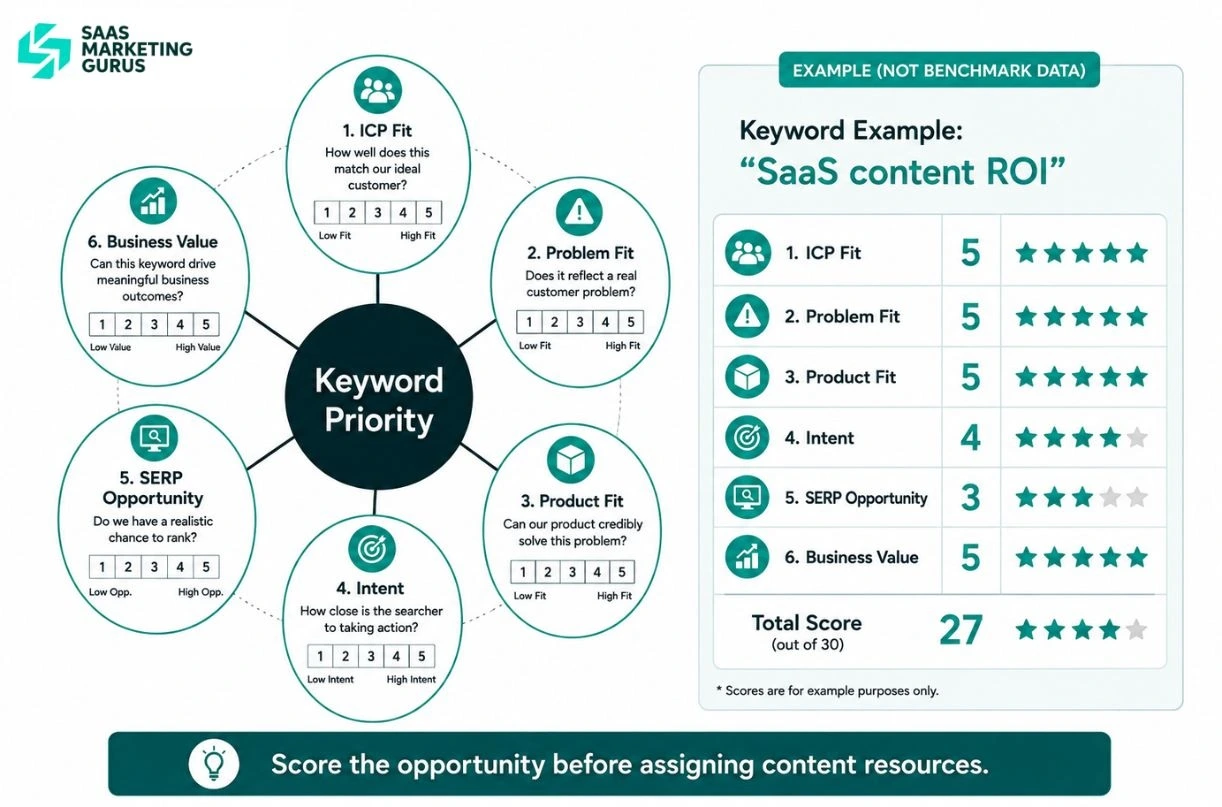
After validating the search opportunity, score each keyword against the factors that matter to the SaaS business.
A practical scoring model looks at six areas:
| Factor | Question |
|---|---|
| ICP fit | Is this our target buyer? |
| Problem fit | Does the search reflect a real customer problem? |
| Product fit | Does our SaaS solve the problem? |
| Intent | Is the searcher learning, researching solutions, comparing options, or choosing a vendor? |
| SERP opportunity | Is there a realistic opportunity to compete? |
| Business value | Could the topic influence a qualified action? |
Score each factor from 1 to 5.
Now compare two examples.
Keyword A: “content marketing”
It might have broader demand, but the audience is difficult to qualify. The search intent is broad, and the connection to a specific SaaS product is weak.
Keyword B: “how to measure content marketing ROI for SaaS”
The estimated volume might be lower, but the audience is more specific. The problem is clearer. The SaaS connection is stronger.
This does not mean Keyword B will automatically rank faster or generate more leads.
It means you have more evidence for prioritising it.
A strong B2B content strategy needs this layer of judgment. Otherwise, your content team ends up publishing the keywords with the biggest numbers rather than the topics with the strongest business fit.
One Keyword Does Not Always Mean One Blog Post
This is where keyword research needs to connect with your content plan.
The goal is not to turn every keyword into another blog post.
Instead, decide what page best satisfies the search.
| Search intent | Recommended page |
|---|---|
| Problem | Educational guide |
| Solution | Solution page |
| Comparison | Comparison page |
| Alternative | Alternative page |
| Integration | Integration page |
| Use case | Use-case page |
| Industry | Industry page |
| Transactional | Product or service page |
For example:
“how to reduce SaaS churn” might work as an educational guide.
“customer retention software” has stronger solution intent and might deserve a product or solution page.
“[Competitor] alternatives” needs an alternative page.
“[Tool A] vs [Tool B]” needs a comparison.
This prevents one of the most common content problems in SaaS marketing: using blog posts to target searches better served by commercial pages.
SMG’s B2B SEO approach also separates blog content from product, comparison, pricing, integration, use-case, and other page types because each page serves a different search intent and business goal.
Which Keyword Modifiers Show SaaS Buyer Intent?
Certain words indicate that a searcher is closer to evaluating or purchasing a solution.
| Modifier | Buyer Intent |
|---|---|
| Best | Comparing available options |
| Software | Looking for a solution |
| Tool | Evaluating products |
| Alternative | Considering a replacement |
| Pricing | Exploring purchase decisions |
| Vs | Comparing vendors |
| Integration | Looking for implementation options |
| For SaaS companies | Searching for a specific use case |
These modifiers help SaaS companies identify keywords that are more likely to attract buyers instead of general audiences.
What This Looks Like in a Real SaaS Content Strategy
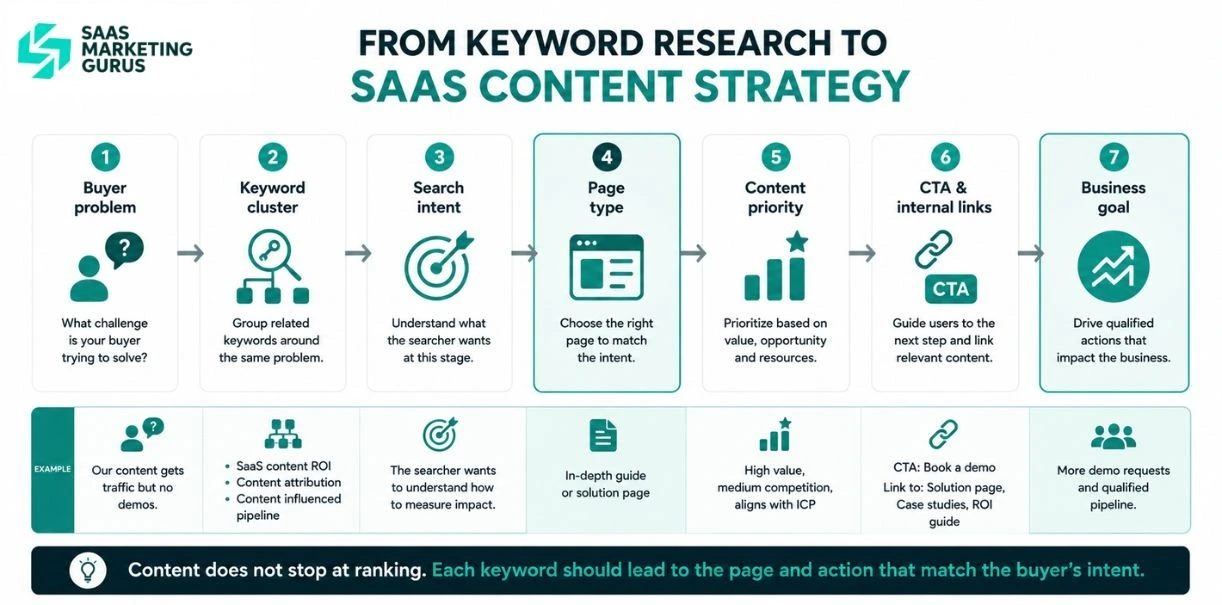
Once keywords have been researched and prioritised, they become part of a larger system.
The workflow looks like this:
Buyer problem → Keyword cluster → Intent → Page type → CTA → Internal links → Business goal
For example, imagine a SaaS company selling content attribution software.
A small cluster might look like this:
| Keyword | Intent | Page | Business goal |
|---|---|---|---|
| how to measure content marketing ROI | Problem | Guide | Educate |
| SaaS content ROI | Problem/Solution | Guide | Capture relevant searchers |
| content attribution software | Solution | Solution page | Generate demos |
| best content attribution software | Evaluation | Comparison | Capture active buyers |
| [Competitor] alternatives | Decision | Alternative page | Capture switchers |
Now the keyword research has become a SaaS content strategy.
The content team knows what to create.
The SEO team knows why each page exists.
The product marketing team knows where product value belongs.
The sales team has a clearer path from organic content to a commercial conversation.
A Real SaaS SEO Example From SaaS Marketing Gurus
The end goal of this process is not a larger keyword report.
It is better search visibility for the right buyers and more qualified opportunities.
SMG’s public case studies give a useful example. Its BRAVO SEO case study reports increased visibility and more than 20 demos per week through targeted SEO work.
SMG’s current SaaS SEO service page also reports 430+ buyer-intent keywords ranked, 40+ demos per month for B2B SaaS clients, and 3x organic conversion lifts through intent-driven content and product-led SEO systems.
The useful lesson is not the numbers alone.
The B2B SEO strategy has to connect search visibility with what happens after the click.
A ranking is useful when it reaches the right audience.
Traffic is useful when it creates meaningful engagement.
A lead is useful when it fits the target customer.
The strongest result is a qualified opportunity that enters the sales pipeline.
Example: Turning Keyword Research Into SaaS Pipeline
A SaaS company should not measure keyword success only by rankings.
A stronger measurement model is:
Keyword → Page → Visitor Intent → Conversion → Pipeline Impact
For example:
| Keyword | Page Type | Goal |
|---|---|---|
| How to measure SaaS marketing ROI | Educational guide | Capture problem-aware users |
| SaaS attribution software | Solution page | Generate demos |
| Best attribution software | Comparison page | Capture buyers evaluating options |
| Competitor alternatives | Alternative page | Capture switching users |
The goal is not to rank for more keywords. The goal is to rank for searches from the right buyers.
What Should You Measure After Publishing?
Your keyword strategy needs measurement after the content goes live.
Start with SEO signals:
- Impressions
- Rankings
- Organic clicks
- Click-through rate
- Non-brand organic traffic
Then measure buyer quality:
- ICP-fit visitors
- Engaged visits
- Demo requests
- Trial starts
- Marketing qualified leads
- Sales qualified leads
Then measure business impact:
- Sales opportunities
- Pipeline influenced
- Customers influenced
- Revenue influenced
SMG’s published content strategy and SEO guidance follow the same progression from organic visibility to qualified leads, pipeline contribution, and revenue impact.
The numbers also help you diagnose problems.
Traffic increases, but leads stay flat
Your keyword mix might attract too many informational visitors.
Traffic increases, but the audience is wrong
Your keyword strategy needs stronger ICP filters.
Rankings improve, but clicks stay low
Review the SERP, search intent, title, and page positioning.
Commercial traffic increases, but conversions stay low
Review the page experience, product relevance, CTA, and next step.
Organic leads increase, but pipeline does not
Look at lead quality and the types of keywords producing those leads.
Measurement should help you decide what to change next.
How Does AI Search Change SaaS Keyword Research?
AI search platforms such as ChatGPT, Google AI Overviews, and Perplexity do not only match exact keywords. They analyze topics, entities, relationships, and context to understand which sources provide useful answers.
For SaaS companies, improving visibility in AI search requires:
- Creating clear definitions for important topics
- Answering specific buyer questions
- Covering related concepts around the main keyword
- Using structured formats such as tables and frameworks
- Including original insights and examples
- Supporting claims with trusted references
For example, instead of only targeting:
“content attribution software”
A stronger topic cluster covers:
- What is content attribution?
- How do SaaS companies measure content ROI?
- Content attribution software comparison
- Best content attribution tools for B2B teams
- Content attribution vs marketing attribution
This helps search engines and AI systems understand your expertise around the complete topic.
When Should You Change Your SaaS Keyword Strategy?
Keyword research is not a one-time spreadsheet exercise.
Your SaaS product changes.
Your market changes.
Competitors publish new content.
Search results change.
Customers use new language.
AI search also changes how people find and evaluate information.
Review your keyword strategy when:
- Your product enters a new market.
- Your ICP changes.
- You launch a new product or feature.
- A new competitor changes the category.
- Search behaviour changes.
- Your traffic grows without qualified leads.
- Commercial pages lose visibility.
- A content cluster attracts traffic but fails to create business results.
- Search results change enough to affect your existing pages.
SMG’s current B2B SEO audit approach treats SEO as an ongoing growth diagnostic. It reviews keyword targeting, content gaps, internal links, competitor visibility, conversion paths, and AI search visibility rather than treating SEO as a one-time technical project.
How SMG Approaches B2B SaaS Keyword Research
At SaaS Marketing Gurus, keyword research is treated as a revenue-focused process rather than a simple ranking exercise.
Our approach combines:
- Buyer research
- Customer language analysis
- Search intent mapping
- Competitor research
- Keyword clustering
- Content planning
- Conversion tracking
This helps SaaS companies identify keywords that connect search visibility with qualified business opportunities.
B2B Keywords Research Checklist
Use this before you add another keyword to your content calendar.
- Define the ICP and buying roles.
- Identify the buyer’s problem.
- Collect language from sales and customer conversations.
- Review relevant Reddit and industry discussions.
- Group problems into search themes.
- Expand themes into keyword clusters.
- Validate search demand.
- Check Google Search Console where relevant.
- Review competitor visibility.
- Inspect the SERP manually.
- Check product fit.
- Score buyer and business value.
- Choose the right page type.
- Map keywords to your SaaS content plan.
- Add internal links between related pages.
- Define the conversion goal
- Measure qualified traffic, leads, pipeline, and revenue.
FAQs
What are B2B SEO keywords?
B2B SEO keywords are search terms used by business buyers when researching problems, solutions, services, or products. For SaaS companies, valuable B2B keywords match the buyer’s problem, search intent, and purchasing journey.
How do SaaS companies find B2B SEO keywords?
SaaS companies find B2B SEO keywords by combining customer research, sales conversations, competitor analysis, SEO tools, Google Search Console data, SERP analysis, and industry discussions. The best keywords usually come from understanding customer problems first.
Should SaaS companies target low volume keywords?
Yes. Low volume keywords can generate strong results when they represent a specific buyer problem or high purchase intent. A keyword with 20 monthly searches from the right audience can be more valuable than a broad keyword with thousands of irrelevant searches.
What keywords should SaaS companies prioritize?
SaaS companies should prioritize keywords based on buyer intent, including problem keywords, solution keywords, comparison keywords, alternative keywords, integration keywords, and industry-specific keywords.
Should every SaaS keyword become a blog post?
No. Each keyword should be mapped to the page type that best satisfies search intent. Some keywords need blog articles, while others require service pages, comparison pages, integration pages, or product pages.
How do I know if a B2B keyword is valuable?
Evaluate the keyword based on ICP relevance, customer problem, search intent, product alignment, SERP competition, and business impact. A valuable keyword should have a clear connection to qualified traffic and potential conversions.
How does AI search change SaaS keyword research?
AI search focuses more on topic understanding, entities, and complete answers instead of exact keyword matching. SaaS companies should create content that answers buyer questions, demonstrates expertise, and covers related topics around their main keywords.
Turn SaaS SEO Into Qualified Pipeline
Finding the right B2B SEO keywords is only the first step. SaaS Marketing Gurus helps B2B SaaS companies turn buyer-focused keyword research into content, rankings, qualified leads, and pipeline.
Our SaaS SEO services combine keyword research, search intent, content strategy, technical SEO, and AI search optimization to target the searches your potential customers use when evaluating solutions.
If your current content attracts traffic but fails to bring qualified opportunities, it is time to rethink what you are targeting and why. Explore our SaaS SEO services to build a keyword strategy focused on qualified traffic, conversions, and pipeline growth.