Inbound marketing for SaaS helps attract potential customers using search, content, social media, product education, and other useful experiences. It guides them to try your product, request a demo, make a purchase, and build a lasting relationship.
SaaS buyers now do more research on their own before talking to sales. In 2026, Gartner found that 67% of B2B buyers prefer not to work with a sales rep, and 45% used generative AI in a recent purchase. This means your website and content are a key part of the buying experience, not just a way to get traffic.
What Is Inbound Marketing for SaaS?
Inbound marketing for SaaS is a customer acquisition strategy that attracts, educates, and converts software buyers through search, content, product education, communities, and self-service experiences.
For B2B SaaS companies, inbound marketing focuses on attracting business buyers through useful content, search, product education, and other self-service experiences. The strategy should match the buyer’s problem, role, buying stage, and level of product knowledge.
A useful model is the SaaS Inbound Revenue Loop:
Discover → Diagnose → Evaluate → Convert → Activate → Expand
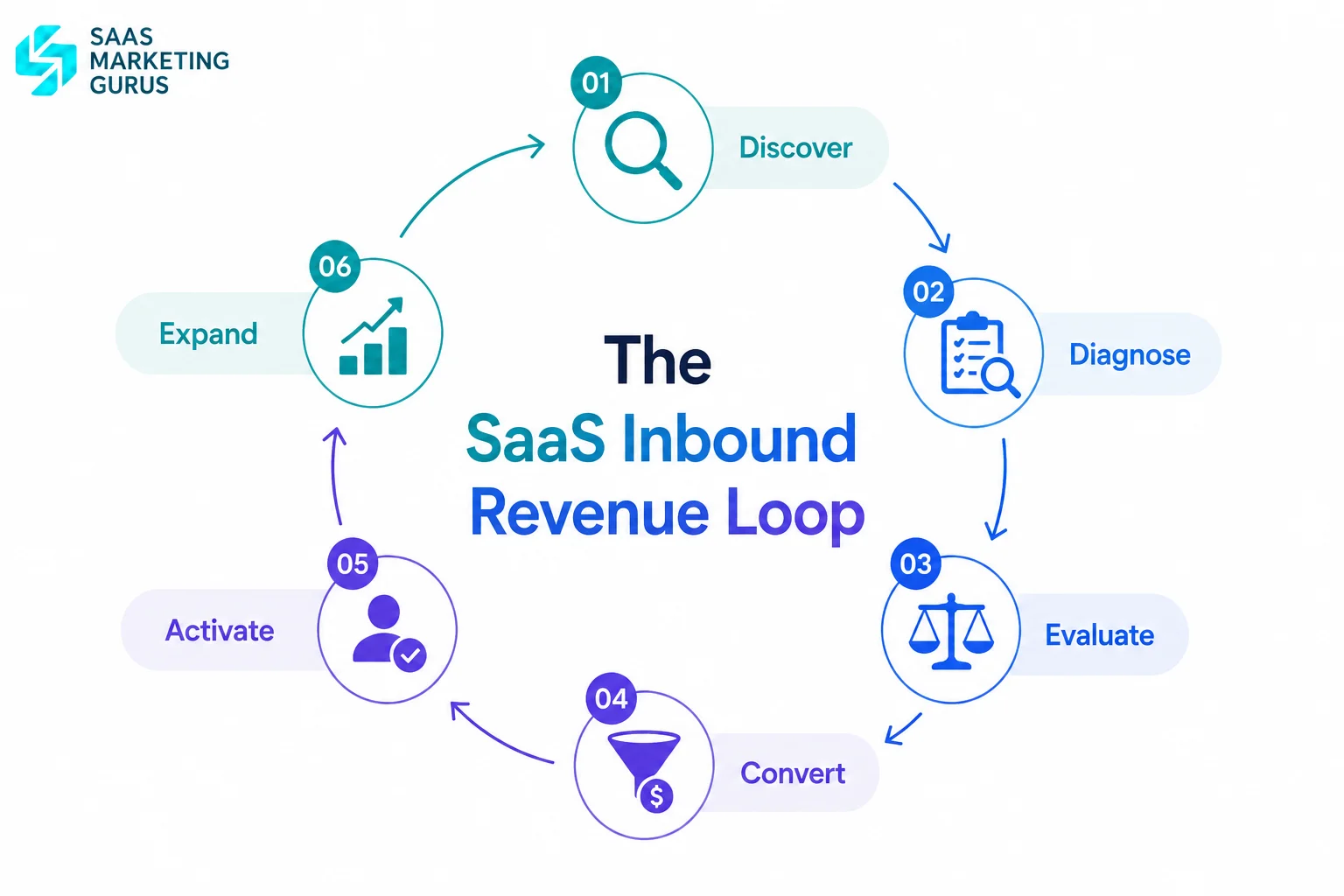
For example, a sales automation SaaS could attract a sales manager searching for ways to reduce manual prospecting. An educational guide addresses the problem, a use-case page explains the solution, a comparison page supports vendor evaluation, and a free trial creates a conversion opportunity.
The goal is not maximum traffic. The goal is qualified pipeline and revenue from the right customers.
How SaaS Inbound Marketing Works: The Revenue Framework
SaaS inbound marketing works by connecting buyer problems, helpful content, product education, and conversion opportunities into one revenue system.
A successful SaaS inbound strategy does not focus only on getting visitors. It helps potential customers move from discovering a problem to evaluating solutions and becoming long term users.
The process usually follows five stages:
| Stage | Buyer Goal | SaaS Content Examples |
|---|---|---|
| Discover | Understand a problem | Educational blogs, research reports, guides |
| Diagnose | Find possible solutions | Frameworks, checklists, webinars |
| Evaluate | Compare options | Comparison pages, alternatives, case studies |
| Convert | Take action | Demo pages, free trials, consultation pages |
| Expand | Increase product value | Tutorials, customer education, feature guides |
For example, a sales automation SaaS company may attract visitors through content about improving sales productivity. Once users understand the problem, they can move toward workflow guides, product comparisons, and eventually a free trial.
The goal is to create a connected experience where every content asset supports the next buying decision.
Why Inbound Marketing Works Differently for SaaS
SaaS inbound marketing is different from traditional B2B marketing. SaaS companies not only need to attract potential buyers and get them to sign up for a free trial or demo, but also help them become active users, keep them engaged, and encourage upgrades or renewals. Every step of the journey matters.
A SaaS buyer may research a problem, compare several tools, read reviews, ask an AI system for recommendations, evaluate pricing, and involve other stakeholders before making a purchase.
That means SaaS content needs to support the entire buying journey. Blog posts are only one part of the system.
SaaS Inbound by Business Model
| SaaS model | Primary inbound focus |
|---|---|
| Product-led | SEO, product education, free tools, templates, trial conversion |
| Sales-led | BOFU content, case studies, comparisons, demos |
| Hybrid | Self-serve education combined with sales enablement |
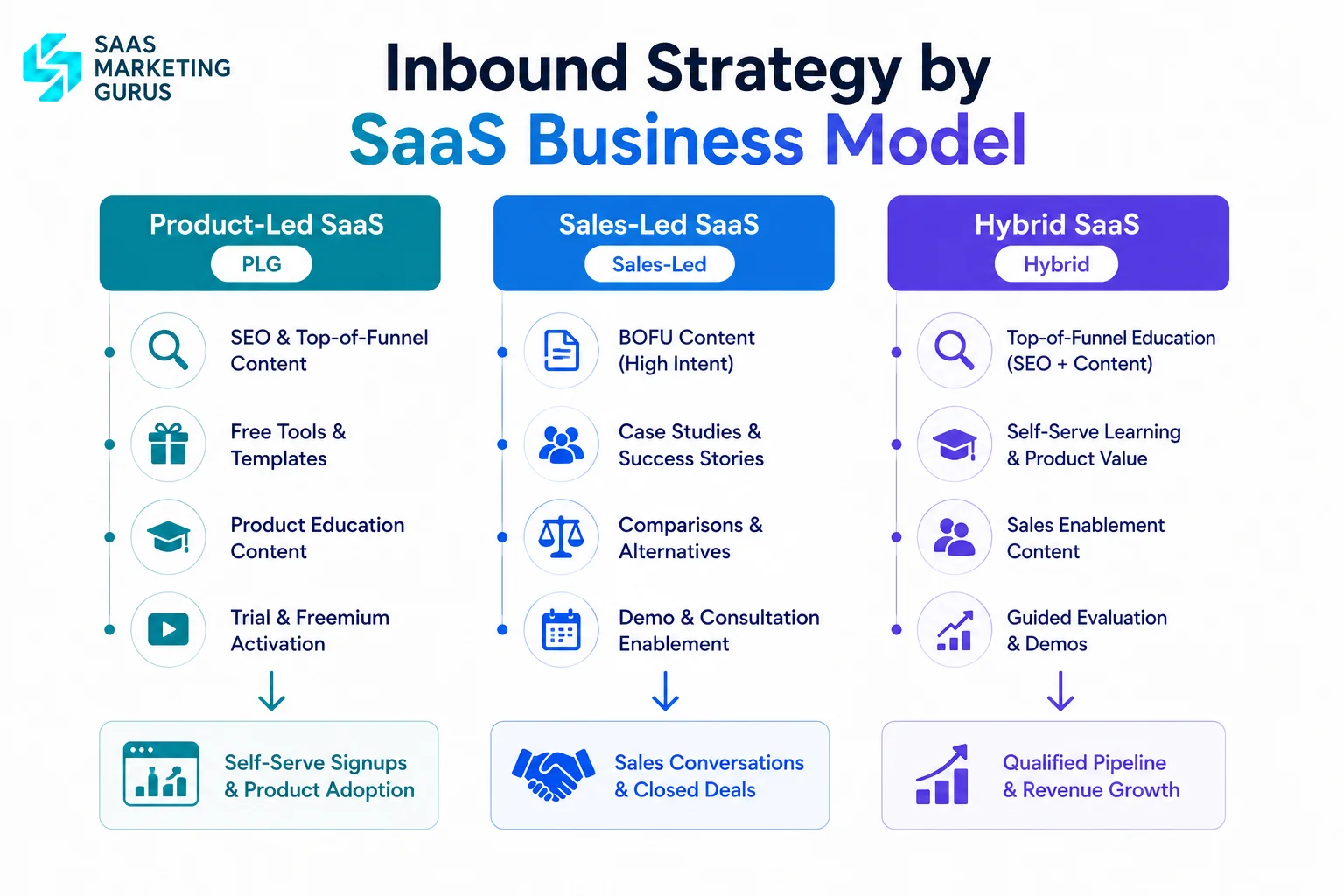
A product-led SaaS may optimize for trial signups and activation. A sales-led enterprise SaaS may prioritize qualified demo requests and buyer enablement.
SaaS Inbound Marketing vs. Outbound Marketing
Inbound attracts people who are researching a problem or solution. Outbound proactively reaches selected prospects through channels such as cold email, sales outreach, or paid campaigns.
| Inbound | Outbound |
|---|---|
| Captures existing interest | Creates targeted reach |
| Builds long-term content assets | Can create faster initial conversations |
| Uses SEO, content, communities, email, and education | Uses sales outreach, advertising, and prospecting |
| Buyer often controls research | Company initiates contact |
The two approaches can work together. Outbound can create targeted conversations, while inbound content addresses objections, demonstrates expertise, and helps prospects validate their decision.
7 Inbound Marketing Strategies for SaaS That Generate Pipeline
1. Build ICP-led content
Start with your ideal customer profile rather than a list of high-volume keywords.
Prioritize content around specific customer problems, use cases, buying triggers, objections, and desired outcomes.
For example, a CRM SaaS could create separate content for startups, agencies, and enterprise sales teams instead of publishing broad articles about “CRM software.”
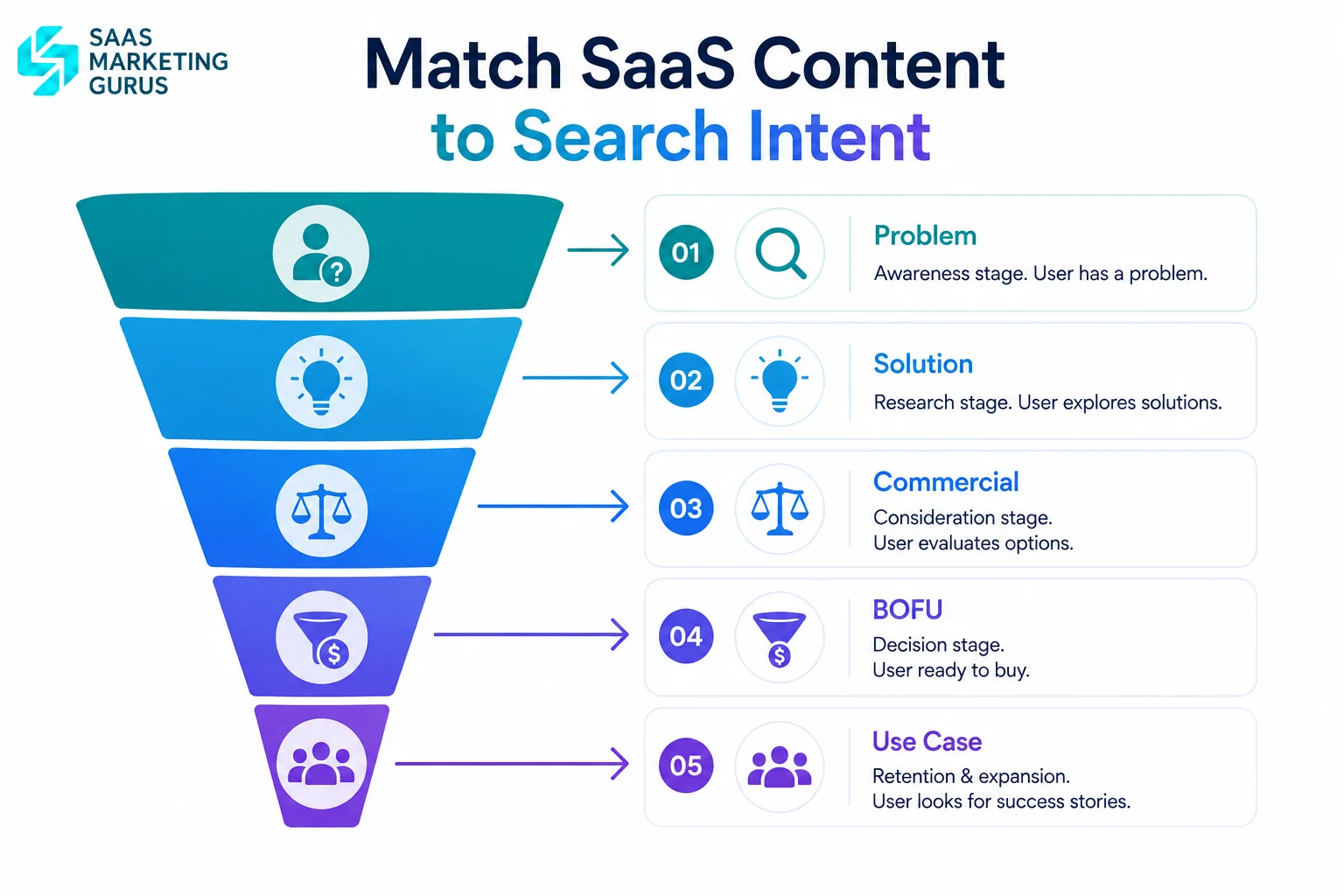
2. Target search intent, not just search volume
A strong SaaS inbound content strategy covers different stages of the buying journey.
| Intent | Example | Best content |
|---|---|---|
| Problem | how to automate sales follow-ups | Educational guide |
| Solution | sales automation software | Solution page |
| Commercial | best sales automation software | Comparison |
| BOFU | Salesforce alternatives | Alternative page |
| Use case | sales automation for SaaS | Use-case page |
This is why SaaS keyword research should map keywords to business value and conversion intent, not just search volume.
3. Create product-led content
Product-led content connects an educational topic with a practical product use case.
Instead of “What is email automation?”, a cold-email SaaS could publish “How to automate cold email follow-ups without damaging sender reputation.”
The second topic educates the buyer while naturally demonstrating the product’s relevance.
4. Build BOFU and comparison content
High-intent buyers often need help choosing between solutions.
Create:
- Competitor comparison pages
- Alternative pages
- Feature and pricing comparisons
- Implementation guides
- Industry-specific pages
- Case studies
- ROI resources
For SaaS, this content can be closer to revenue than broad awareness content because it supports evaluation and decision-making.
5. Publish original expertise
Generic advice is easy to produce and difficult to differentiate.
Prioritize ICP-specific use cases, comparison pages, alternatives, implementation guides, customer evidence, original research, and first-hand observations before scaling broad informational content.
Google’s people-first guidance recommends original information, substantial analysis, clear authorship, and demonstrable expertise rather than simply rewriting existing sources. Google’s helpful content guidance
For example, instead of publishing another generic “What Is Sales Automation?” article, analyze common sales workflows and explain which tasks SaaS teams can automate, what should remain human-led, and where automation can fail.
6. Optimize conversion paths
Inbound traffic becomes valuable when visitors have a logical next step.
A typical path might be:
Educational article → Use-case page → Product page → Trial/demo
Do not use the same CTA everywhere. An early-stage visitor may need a guide or template, while someone reading a competitor comparison may be ready for a demo.
7. Optimize for AI search and GEO
Generative Engine Optimization (GEO) is the practice of improving how a brand and its content are understood and represented in AI-generated answers and generative search experiences.
GEO is not a replacement for SEO. Google says its AI Overviews and AI Mode rely on existing Search systems and foundational SEO practices; there is no special GEO markup required. Google’s AI search guidance
Make content easier to retrieve and understand by:
- Answering questions directly
- Using descriptive headings
- Defining important concepts
- Adding original evidence
- Demonstrating first-hand expertise
- Keeping product and brand information consistent
- Supporting claims with credible sources
- Using tables where comparisons benefit from structure
SaaS Inbound Content Prioritization Framework
Not every content opportunity creates the same business impact. SaaS companies should prioritize topics based on three factors:
Impact × Intent × Effort
| Factor | Question |
|---|---|
| Impact | Can this topic influence revenue or pipeline? |
| Intent | Does the search indicate a real buying need? |
| Effort | How much research and production does it require? |
For example:
A keyword like “what is CRM software” may bring traffic but have low buying intent.
A keyword like “HubSpot alternatives for startups” usually shows stronger commercial intent because the buyer is already evaluating solutions.
SaaS teams should prioritize content that attracts the right audience and creates movement toward a product decision.
How Inbound Marketing Supports SaaS Lead Generation
Inbound supports SaaS lead generation by matching useful content to buyer intent and creating a clear path from discovery to conversion.
A simple system is:
Search/content → Qualified visitor → CTA → Lead or PQL → Nurture → Sales opportunity → Customer
For product-led SaaS, the conversion may be a trial or product signup. For sales-led SaaS, it may be a demo. For complex enterprise software, the first conversion could be an assessment, technical guide, or consultation.
The key is to match the conversion action to the buyer’s intent instead of forcing every visitor into a sales call.
Not every lead is ready to buy after the first conversion. Use relevant follow-up content, product education, case studies, comparison pages, or email nurture to help prospects move toward a buying decision.
For product-led SaaS, this can mean moving a trial user toward activation. For sales-led SaaS, it can mean helping a qualified lead build enough product and business understanding before speaking with sales.
For broader demand generation, see SaaS Marketing Services.
How SaaS Companies Should Prepare Content for AI Search
AI search systems look for content that clearly answers questions, explains concepts, and provides trustworthy information.
SaaS companies can improve AI visibility by:
- Writing clear definitions
- Answering common buyer questions directly
- Using structured headings
- Adding comparison tables
- Including original examples
- Supporting claims with reliable sources
- Showing practical experience
For example, a SaaS lead generation page should not only define lead generation. It should explain:
- Which channels work for different SaaS models
- How leads move through the funnel
- Which metrics measure success
- Common mistakes companies should avoid
Content that provides complete answers is easier for both users and AI systems to understand.
How AI Search Is Changing SaaS Marketing Strategy
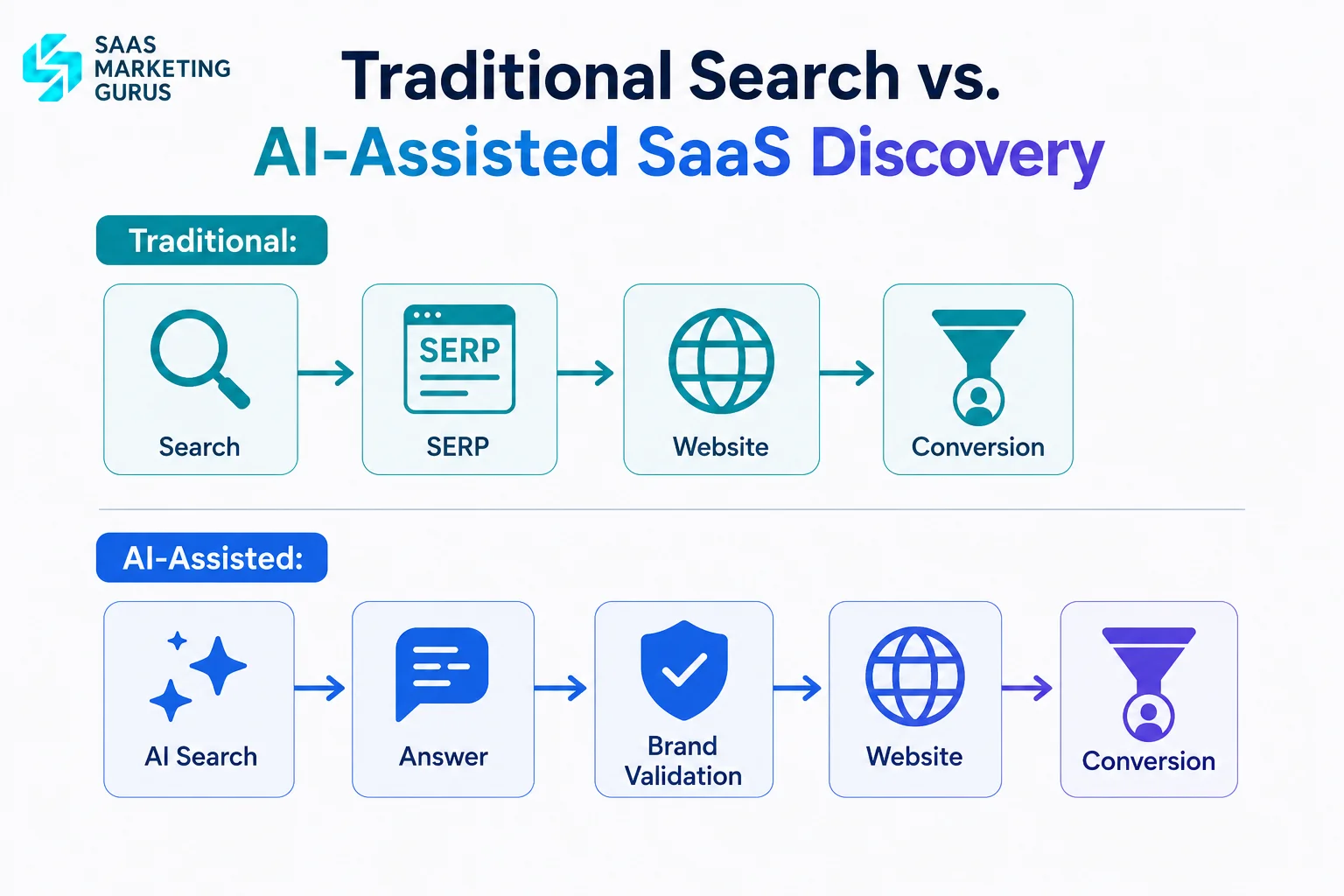
AI search changes SaaS marketing strategy by moving part of discovery from traditional search results to synthesized answers.
The traditional path is:
Google → Search result → Website → Conversion
An AI-assisted path can look like:
AI search → Synthesized answer → Brand validation → Website → Conversion
Gartner reported in May 2026 that 45% of surveyed B2B buyers had used GenAI during a recent purchase, primarily to gather information on vendors and products. Gartner’s 2026 B2B buyer research The same research found that 69% prefer to validate AI-generated insights with sales reps.
This makes clear, evidence-backed content more important. Your SaaS content should answer the question directly, explain important terms, show how the advice applies in practice, and support factual claims with reliable sources.
For example, a page about SaaS lead generation should not stop at defining the term. It should explain which channels fit different SaaS models, show how those channels connect to conversion, and give readers a practical way to measure whether the activity produces qualified pipeline.
For a deeper look at AI retrieval and generative search, see How Generative Search Ranking Works for SaaS.
SaaS Inbound Marketing Tools
SaaS teams usually combine multiple tools to research, publish, measure, and improve inbound performance.
| Category | Tools |
|---|---|
| SEO Research | Ahrefs, Semrush, Google Search Console |
| Analytics | Google Analytics 4, HubSpot Analytics |
| CRM | HubSpot CRM, Salesforce |
| Content Planning | Notion, Asana, Trello |
| Conversion Optimization | Hotjar, Microsoft Clarity |
The right tools depend on your growth stage. Early stage SaaS companies usually need visibility and conversion tracking, while larger companies need deeper attribution and revenue reporting.
How to Measure Inbound Marketing Against Revenue
The best way to measure SaaS inbound strategy is to connect acquisition to qualified leads, opportunities, pipeline, and revenue—not traffic alone.
Track the journey:
Organic visibility → Engaged traffic → Leads/PQLs → MQLs → SQLs → Opportunities → Pipeline → Revenue
| Metric | What it tells you |
|---|---|
| Organic traffic | Search visibility |
| Engagement | Content relevance |
| PQLs | Product interest |
| SQLs | Sales readiness |
| Opportunities | Commercial intent |
| Pipeline | Revenue potential |
| Revenue | Business impact |
HubSpot’s Shore case study reports a 12X increase in leads, 216% growth in organic traffic, and a 35% reduction in acquisition costs after Shore adapted its inbound methodology.
The figures are a case study, not a universal benchmark. The important lesson is to connect marketing activity with business outcomes.
A 90-Day SaaS inbound Strategy
Days 1–30: Research and foundation
Goal: Identify the highest-value inbound opportunities.
Actions: Define the ICP, map search intent, audit existing content, analyze competitors, and review conversion paths.
Deliverables: Keyword map, content gap list, funnel map, and priority-page list.
Days 31–60: Build and publish
Goal: Create assets that capture commercial and problem-aware demand.
Actions: Publish BOFU, use-case, comparison, product-led, and problem-aware content.
Deliverables: Priority landing pages, content cluster, internal links, and relevant CTAs.
Days 61–90: Optimize and distribute
Goal: Improve the content and channels that show business potential.
Actions: Review rankings, conversions, qualified leads, and pipeline. Update weak pages and distribute strong content through email, LinkedIn, communities, and sales enablement.
Deliverables: Updated content, distribution plan, performance report, and next-quarter priorities.
How to Prioritise Inbound Opportunities
Once you have your keyword map and content gap list, rank each opportunity using five factors:
| Factor | Question |
|---|---|
| ICP fit | Does this topic attract your target customer? |
| Search intent | Does the query show a clear problem or buying need? |
| Commercial value | Does the topic connect to your product or a buying decision? |
| Conversion potential | Is there a relevant next step for the visitor? |
| Effort | How much research, content, design, or development does it require? |
Start with opportunities where ICP fit, commercial value, and conversion potential are high. This helps your inbound programme focus on business opportunities instead of becoming a publishing schedule based only on keyword volume.
SaaS Inbound Marketing Checklist
Before scaling your inbound programme, check whether you have:
- Defined your ICP and priority buyer roles
- Mapped keywords to search intent
- Created problem, solution, commercial, and BOFU content
- Built relevant use-case and comparison pages
- Connected related content with internal links
- Added a relevant CTA to each major content type
- Created lead or trial nurture paths
- Connected marketing activity to CRM data
- Defined PQL, MQL, SQL, opportunity, and revenue reporting
- Set a process for reviewing and updating content
Common SaaS Inbound Marketing Mistakes
Publishing without an ICP: High traffic from the wrong audience rarely becomes revenue.
Chasing search volume: A small number of high-intent visitors can be more valuable than thousands of irrelevant visits.
Only creating informational content: SaaS websites also need comparison, alternative, use-case, product, and customer-proof content.
Ignoring conversion paths: A useful article without a relevant next step leaves buying intent unused.
Measuring traffic instead of pipeline: Rankings and traffic are useful indicators, but qualified opportunities and revenue are stronger business outcomes.
Treating AI search as a replacement for SEO: Google’s guidance confirms that existing SEO fundamentals remain important for AI search experiences.
How SaaS Marketing Gurus Approaches SaaS Inbound Marketing
At SaaS Marketing Gurus, the focus is not simply publishing more content. The goal is building a system that connects search visibility with qualified pipeline.
Our SaaS inbound marketing approach follows six steps:
1. Audience and ICP Research
We identify:
- Target customers
- Buyer roles
- Pain points
- Buying triggers
- Search behavior
2. Search and Content Mapping
We map topics based on:
- Buyer intent
- Revenue potential
- Competition
- Funnel stage
3. Content Development
We create assets including:
- SEO articles
- Product pages
- Comparison pages
- Use case pages
- Case studies
4. Conversion Optimization
Each asset receives a relevant next step based on visitor intent.
Examples:
Early stage:
Download guide
Middle stage:
View comparison
Bottom stage:
Request demo
5. AI Search Optimization
Content is structured to improve visibility across:
- Google AI Overviews
- ChatGPT search experiences
- Perplexity
- Other answer engines
6. Revenue Measurement
Performance is measured through:
- Qualified leads
- Pipeline contribution
- Opportunities
- Revenue impact
Turn SaaS Inbound Into a Revenue Engine
Inbound marketing for SaaS works best when SEO, content, AI search, conversion, nurturing, and sales work toward the same pipeline goals.
The goal isn’t to publish more articles. It is to create a system that helps the right buyers find your brand, evaluate your solution, and take the next step.
If your SaaS needs a strategy built around qualified pipeline rather than traffic, explore our SaaS SEO services or learn more about choosing a SaaS SEO agency.
FAQs
What is inbound marketing for SaaS?
Inbound marketing for SaaS is a strategy that attracts, educates, and converts software buyers through search, content, product education, and self-service experiences. It helps SaaS companies generate qualified pipeline by matching content with buyer needs.
How does inbound marketing help SaaS companies generate leads?
SaaS companies generate leads through SEO content, comparison pages, product education, free resources, templates, communities, and conversion-focused landing pages. The best results come when content connects with a clear buyer journey.
What content works best for SaaS inbound marketing?
The best SaaS inbound content depends on buyer intent. Educational guides attract problem-aware users, while comparison pages, alternatives, case studies, and ROI resources help buyers evaluate solutions.
How long does SaaS inbound marketing take to work?
Results depend on domain authority, competition, content quality, and conversion setup. Some high-intent pages can generate early opportunities, while SEO-driven inbound programs usually require several months of consistent optimization.
Should SaaS companies use inbound and outbound marketing together?
Yes. Inbound marketing builds awareness and buyer trust, while outbound marketing creates targeted conversations. Many SaaS companies use both strategies together to improve pipeline generation.
How should SaaS companies measure inbound marketing success?
SaaS companies should measure more than traffic. Important metrics include qualified leads, product qualified leads, sales opportunities, pipeline contribution, customer acquisition cost, and revenue generated from inbound channels.
How can SaaS companies improve visibility in AI search?
SaaS companies can improve AI search visibility by creating clear, authoritative content with direct answers, structured information, original insights, expert input, reliable citations, and consistent brand information.