Launching a SaaS product is easy. Getting the right people to discover it is much harder.
That’s where Product Hunt comes in. It gives SaaS startups a chance to reach early adopters, collect feedback, build credibility, and generate their first users. But simply launching isn’t enough. The products that succeed are backed by strong preparation, clear messaging, and a well-executed Product Hunt marketing strategy.
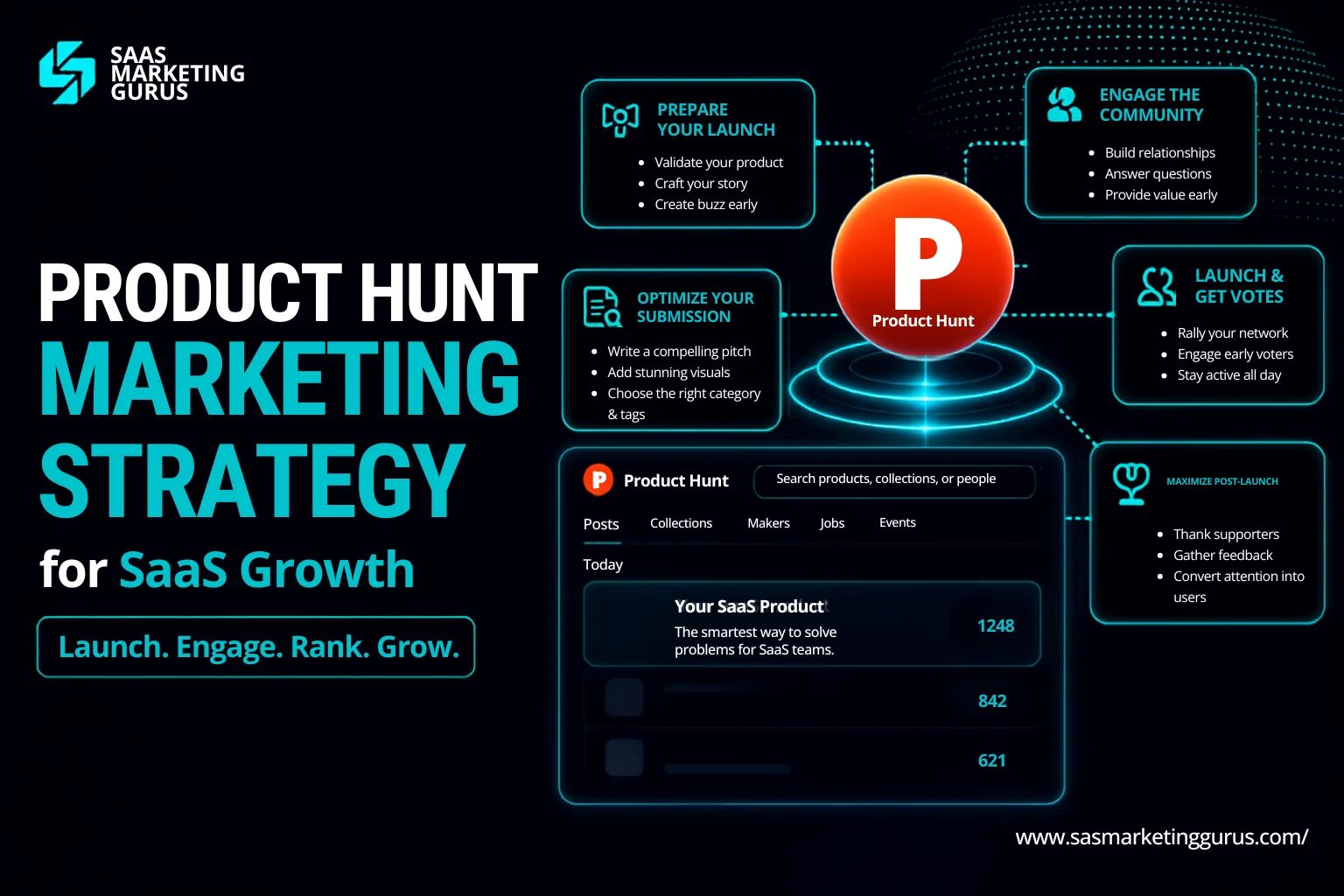
A Product Hunt marketing strategy is a structured approach to preparing, launching, promoting, and optimizing your product on Product Hunt to generate awareness, attract qualified users, collect valuable feedback, and drive long-term SaaS growth. The most successful launches begin weeks before launch day with audience building, optimized messaging, and a seamless onboarding experience—not just a Product Hunt listing.
In this guide, you’ll learn how to build a Product Hunt marketing strategy that helps your SaaS launch successfully. We’ll cover pre-launch planning, launch day best practices, Product Hunt ranking factors, KPI tracking, post-launch growth tactics, real SaaS examples, and common mistakes to avoid so you can turn your launch into lasting business growth.
What Is Product Hunt and Why Does It Matter for SaaS?
Product Hunt is an online community where people discover, discuss, and review new technology products. Every day, founders launch products across categories such as SaaS, AI, productivity, developer tools, and mobile applications.
Users can:
- Discover new products
- Upvote products they like
- Leave feedback
- Ask founders questions
- Share products with others
Unlike paid advertising, Product Hunt connects you with people who actively enjoy trying new products. Many are founders, developers, marketers, investors, journalists, and early adopters who influence buying decisions within their companies.
For SaaS businesses, this makes Product Hunt an excellent platform for validating ideas, acquiring early users, and collecting valuable product feedback before scaling paid marketing efforts.
For a closer look at how products are launched and discovered on the platform, you can explore our live Product Hunt launch tracker featuring real examples and launch activity.
After supporting multiple SaaS Product Hunt launches across different growth stages, we’ve consistently seen three factors separate successful launches from those that struggle: clear positioning, early audience building, and active founder engagement throughout launch day.
Why Product Hunt for SaaS Startups Works
A successful Product Hunt marketing approach focuses on customer acquisition, feedback collection, and long term brand visibility.
While Product Hunt doesn’t publicly disclose its full ranking algorithm, successful launches consistently share similar engagement patterns: early authentic interactions, meaningful discussions, high-quality community participation, and strong product presentation. Rather than optimizing for votes alone, optimize for engagement quality and user experience.
A successful Product Hunt strategy should support several business objectives, from acquiring users to validating your messaging.
| Goal | Business Benefit |
|---|---|
| Generate signups | Acquire early users quickly |
| Collect feedback | Improve product based on real users |
| Build credibility | Increase trust through community validation |
| Improve SEO | Earn backlinks from a high authority website |
| Create awareness | Reach founders, marketers, and investors |
| Validate messaging | Learn whether users understand your value proposition |
Many startups also use Product Hunt as a testing ground before investing heavily in paid acquisition.
For example, if visitors quickly understand your product and begin signing up, it’s a strong signal that your positioning is working. If they don’t, the feedback you receive can help improve your messaging before spending money on advertising.
Key Takeaway
Product Hunt works best when you treat it as a customer validation platform, not just a traffic source.
When Product Hunt Works Best for SaaS
| Situation | Recommendation |
|---|---|
| New SaaS launch | Strong fit for gaining early visibility, feedback, and first users |
| No existing audience | Build a community first before launching |
| Enterprise SaaS | Use Product Hunt mainly for awareness and credibility |
| Existing customers | Use it to validate updates and collect feedback |
Product Hunt Growth Tactics That Drive Long-Term Results
- Build an audience before launch: Start weeks before launch by engaging beta users, customers, email subscribers, and social followers to create early momentum.
- Engage founders and communities: Reply to comments, answer questions, and participate in relevant communities to build trust and increase visibility.
- Improve onboarding: Optimize signup flows, tutorials, and user guidance so Product Hunt visitors quickly understand your product value.
- Retarget visitors: Use email campaigns, Google Ads, or LinkedIn Ads to bring back interested visitors who did not convert during launch.
- Convert feedback into product updates: Analyze user comments and suggestions, then use insights to improve your product and share updates with the community.
How Does Product Hunt Ranking Work?
One of the biggest myths is that Product Hunt rankings depend only on the total number of upvotes.
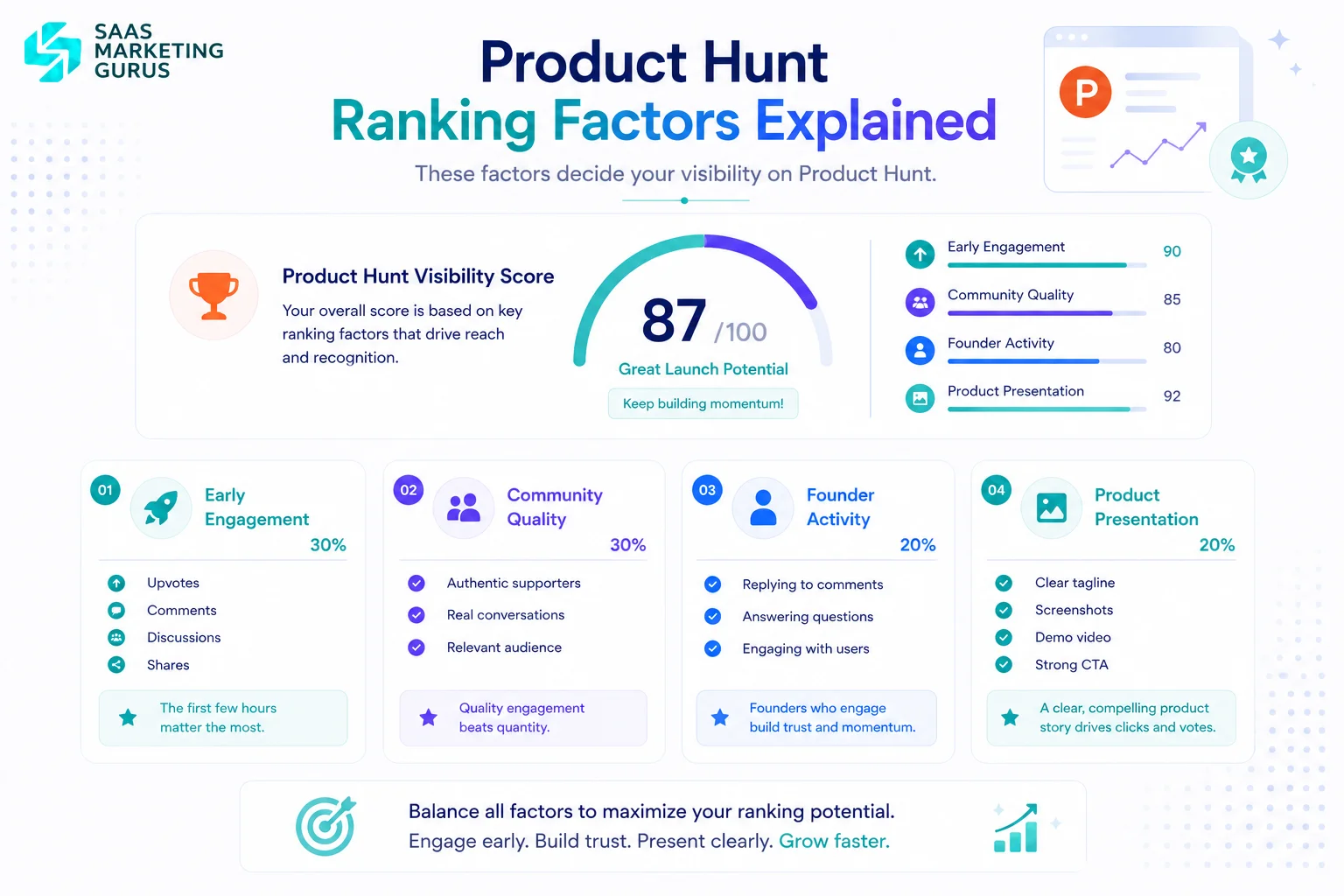
In reality, the platform considers several engagement signals.
1. Early Engagement
The first few hours after launch are critical.
Products that receive authentic engagement early are more likely to gain visibility throughout the day.
This includes:
- Upvotes
- Comments
- Discussions
- Shares
- Product page visits
2. Community Quality
A smaller number of genuine supporters is more valuable than a large number of suspicious or low quality votes.
Artificial engagement may reduce trust and can negatively affect your launch.
3. Founder Participation
Successful founders actively answer questions, thank users, and participate in discussions.
Every reply builds trust and encourages more interaction.
4. Product Presentation
Visitors decide within seconds whether they understand your product.
Your Product Hunt page should include:
- A clear product name
- A benefit focused tagline
- Screenshots
- GIFs
- Short demo video
- Helpful maker comment
- Strong call to action
According to conversion research from CXL, users are much more likely to convert when they immediately understand the value of a product.
Loom’s launch demonstrated the importance of founder engagement. The team actively answered questions throughout launch day, creating discussions that kept visitors engaged and encouraged additional participation from the community.
Key Takeaway
Product Hunt rewards authentic engagement and preparation, not shortcuts.
Product Hunt Launch Strategy: Pre Launch Planning
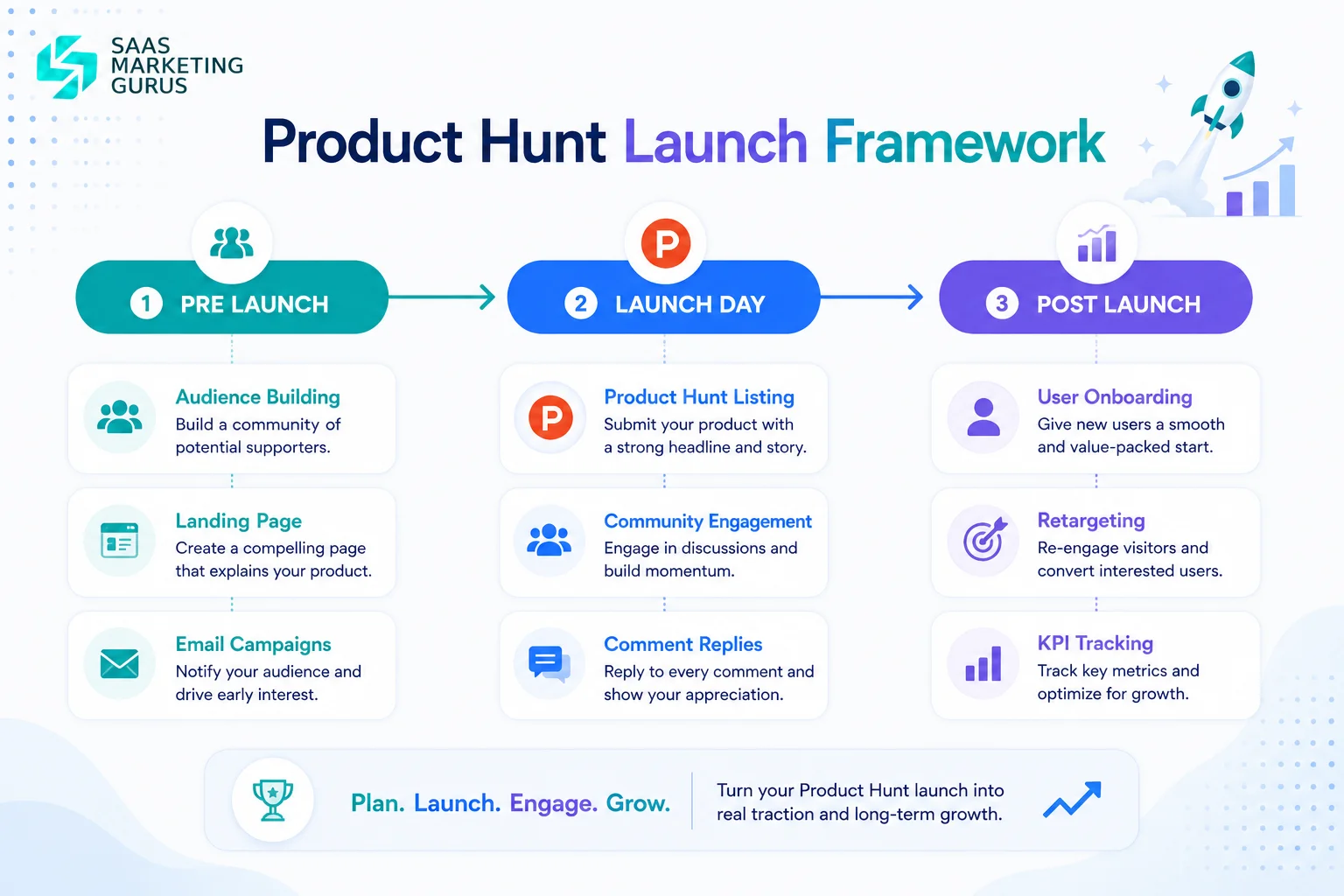
Most successful launches begin weeks before launch day.
Think of Product Hunt as the final stage of your launch campaign rather than the beginning.
Build an Audience First
Start with people who already know your product.
This may include:
- Beta users
- Existing customers
- Newsletter subscribers
- LinkedIn followers
- X followers
- Slack communities
- Discord communities
- Startup groups
Even a few hundred engaged supporters can create valuable early momentum.
Use Email Marketing
HubSpot consistently reports email marketing as one of the highest ROI acquisition channels.
Instead of sending one launch email, create a short sequence.
| Timeline | Purpose |
|---|---|
| 2 weeks before | Product updates |
| 1 week before | Announce launch date |
| 1 day before | Build excitement |
| Launch day | Invite support |
| 2 days after | Thank users and collect feedback |
Prepare Your Landing Page
A great Product Hunt page won’t help if your landing page doesn’t convert.
Make sure visitors can quickly answer:
- What is this product?
- Who is it for?
- Why should I care?
- What should I do next?
Keep your CTA simple.
Examples:
- Start Free
- Join the Waitlist
- Book a Demo
30 Day Launch Framework
| Timeline | Action |
|---|---|
| Day 30 | Finalize messaging |
| Day 20 | Collect beta feedback |
| Day 15 | Grow your audience |
| Day 10 | Create launch assets |
| Day 7 | Engage with communities |
| Day 3 | Test analytics and onboarding |
| Day 1 | Final quality check |
| Launch Day | Publish and engage |
Launch Checklist
Before launch, confirm that you have:
- Product Hunt page
- Landing page
- Product demo
- Screenshots
- Analytics
- Email campaign
- Social posts
- UTM tracking
- Customer support
Key Takeaway
Preparation creates momentum. Most successful launches are built over several weeks, not several hours.
What Should You Do on Product Hunt Launch Day?
Launch day is where all your preparation comes together. While it’s exciting to see your product go live, the first 24 hours are also the most important. Product Hunt rewards products that receive authentic engagement early, so your goal should be to keep the momentum going throughout the day.
Instead of focusing only on collecting upvotes, focus on creating conversations, answering questions, and guiding visitors toward your website.
Start Strong
Many founders launch their product as soon as the new Product Hunt day begins. Once your product is live, verify that everything is working correctly before sharing the link.
Your first actions should include:
- Notify your email subscribers
- Share the launch on LinkedIn and X
- Let your beta users know you’re live
- Thank early supporters
- Monitor comments and reply quickly
Avoid asking people to “just upvote.” Instead, encourage them to try your product, leave honest feedback, and join the discussion.
Stay Active Throughout the Day
One common mistake is promoting the launch once and then disappearing.
The most successful founders remain active throughout the day by:
- Answering every comment
- Responding to product questions
- Sharing updates on social media
- Thanking new supporters
- Fixing issues quickly if users report them
This builds trust and encourages more people to interact with your launch.
Which Product Hunt KPIs Should You Track?
Upvotes are exciting, but they don’t tell you whether your launch was successful.
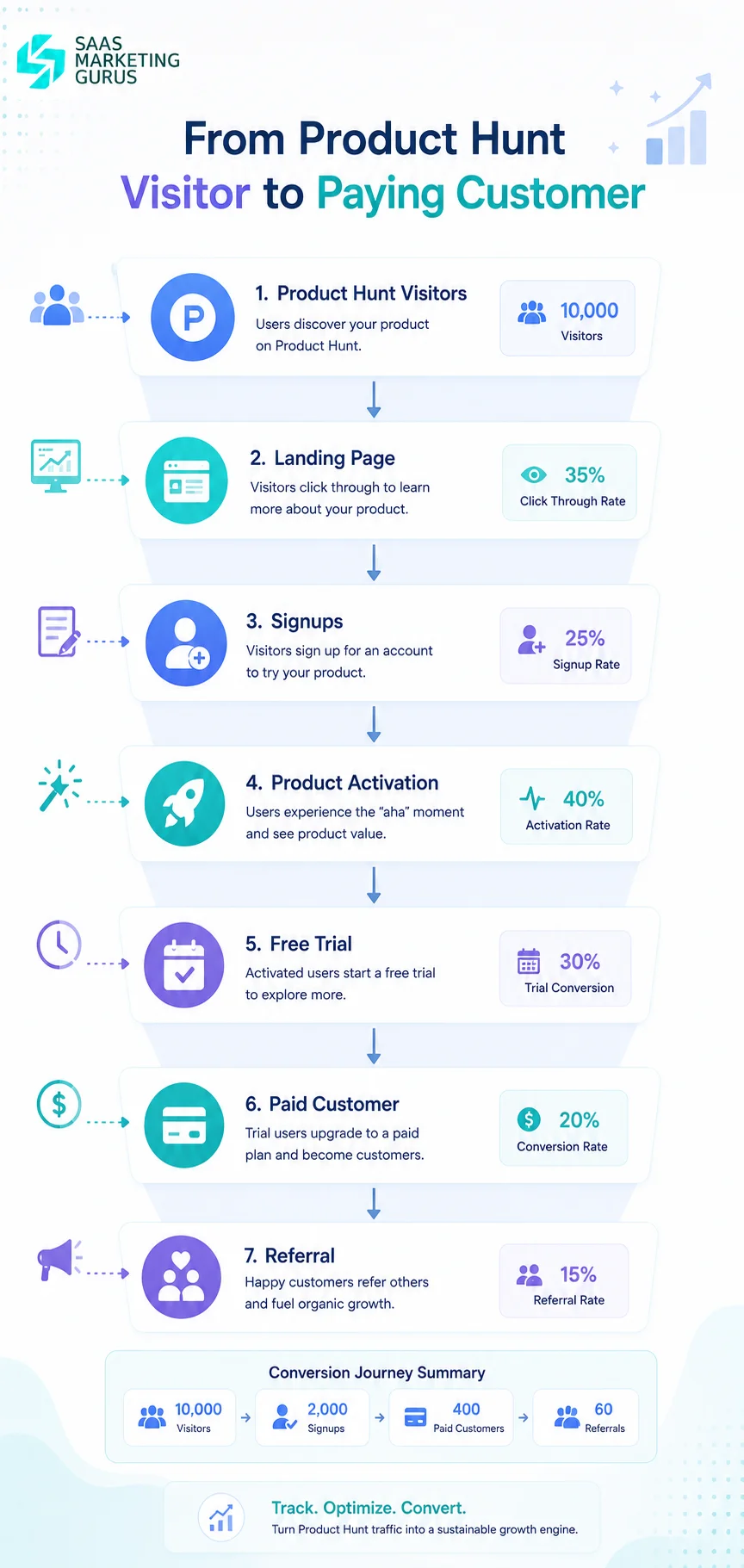
Instead, measure the business results your launch generates.
| KPI | Why It Matters |
|---|---|
| Website Visitors | Measures launch reach |
| Signup Rate | Shows how well your landing page converts |
| Free Trial Starts | Indicates buying interest |
| Demo Requests | Measures sales opportunities |
| Activation Rate | Tracks how many users experience value |
| Paid Conversions | Shows revenue impact |
| Customer Retention | Measures long term success |
| Referral Traffic | Helps evaluate ongoing visibility |
Benchmark Tip: Compare Product Hunt traffic with activation rate instead of focusing only on visits. A launch generating fewer visitors but higher activation and paid conversions usually delivers stronger long-term ROI than one driven by vanity metrics.
For example, if 3,000 people visit your website but only 30 create an account, the problem isn’t Product Hunt. It’s likely your landing page or onboarding experience.
Google Analytics can help track visitor behavior, while product analytics tools such as Mixpanel or PostHog can measure activation and retention.
Key Takeaway
Don’t judge your launch by where you ranked. Judge it by how many qualified users became active customers.
Turn Traffic Into Customers with a Simple Funnel
A Product Hunt launch should feed a complete customer journey rather than end with a website visit.
A simple SaaS funnel looks like this:
| Stage | Goal |
|---|---|
| Product Hunt | Generate awareness |
| Landing Page | Explain your value |
| Signup | Capture the lead |
| Onboarding | Help users experience value quickly |
| Free Trial | Encourage product adoption |
| Paid Plan | Convert users into customers |
| Email Marketing | Retain and re-engage users |
| Referrals | Turn happy customers into advocates |
Every step should make it easier for users to continue their journey.
If people leave after visiting your landing page, improving your conversion rate will often have a greater impact than getting more Product Hunt traffic.
How Do You Keep Growing After Your Product Hunt Launch?
Many founders believe their launch ends after 24 hours.
In reality, that’s when long term growth begins.
The visitors you attract during launch have already shown interest in your product. Your job now is to continue building relationships with them.
Follow Up Quickly
Send a welcome email within the first day.
Thank users for their support and show them how to get started.
A simple onboarding email sequence can improve activation rates and reduce early drop offs.
Collect Feedback
Ask new users:
- What problem were you trying to solve?
- What almost stopped you from signing up?
- What feature would make the product more valuable?
This feedback often shapes the next version of your product.
Repurpose Your Launch
Don’t let your launch disappear after one day.
Turn it into:
- A blog post
- A LinkedIn article
- A customer case study
- Social media content
- Website testimonials
This extends the value of your Product Hunt launch well beyond launch day.
Retarget Interested Visitors
Not everyone will sign up during their first visit.
Running retargeting campaigns through Google Ads or LinkedIn Ads can help bring interested visitors back after they’ve had time to consider your product.
Key Takeaway
The companies that gain the most from Product Hunt continue marketing after launch instead of stopping when the leaderboard closes.
Post-Launch Priority Checklist
- Review launch analytics within 24 hours.
- Respond to every Product Hunt comment.
- Send onboarding emails to new users.
- Analyze user feedback for recurring issues.
- Launch remarketing campaigns.
- Repurpose launch content across SEO and social channels.
- Publish product improvements to maintain momentum.
Product Hunt vs BetaList vs Indie Hackers
Many startups wonder whether Product Hunt should be their only launch platform.
The answer is no.
Each platform serves a different purpose.
| Feature | Product Hunt | BetaList | Indie Hackers |
|---|---|---|---|
| Primary Goal | Product launch | Early startup discovery | Community building |
| Traffic | High during launch | Steady over time | Consistent discussions |
| Audience | Early adopters | Startup enthusiasts | Founders and builders |
| Best For | Launch day visibility | Early validation | Building relationships |
Rather than choosing one platform, many successful SaaS companies combine all three.
For example:
- Launch publicly on Product Hunt.
- List the product on BetaList for ongoing discovery.
- Share your journey and collect feedback on Indie Hackers.
Together, these channels provide immediate visibility and long term community engagement.
What Product Hunt Mistakes Should You Avoid?
Many Product Hunt launches underperform because founders repeat the same mistakes.
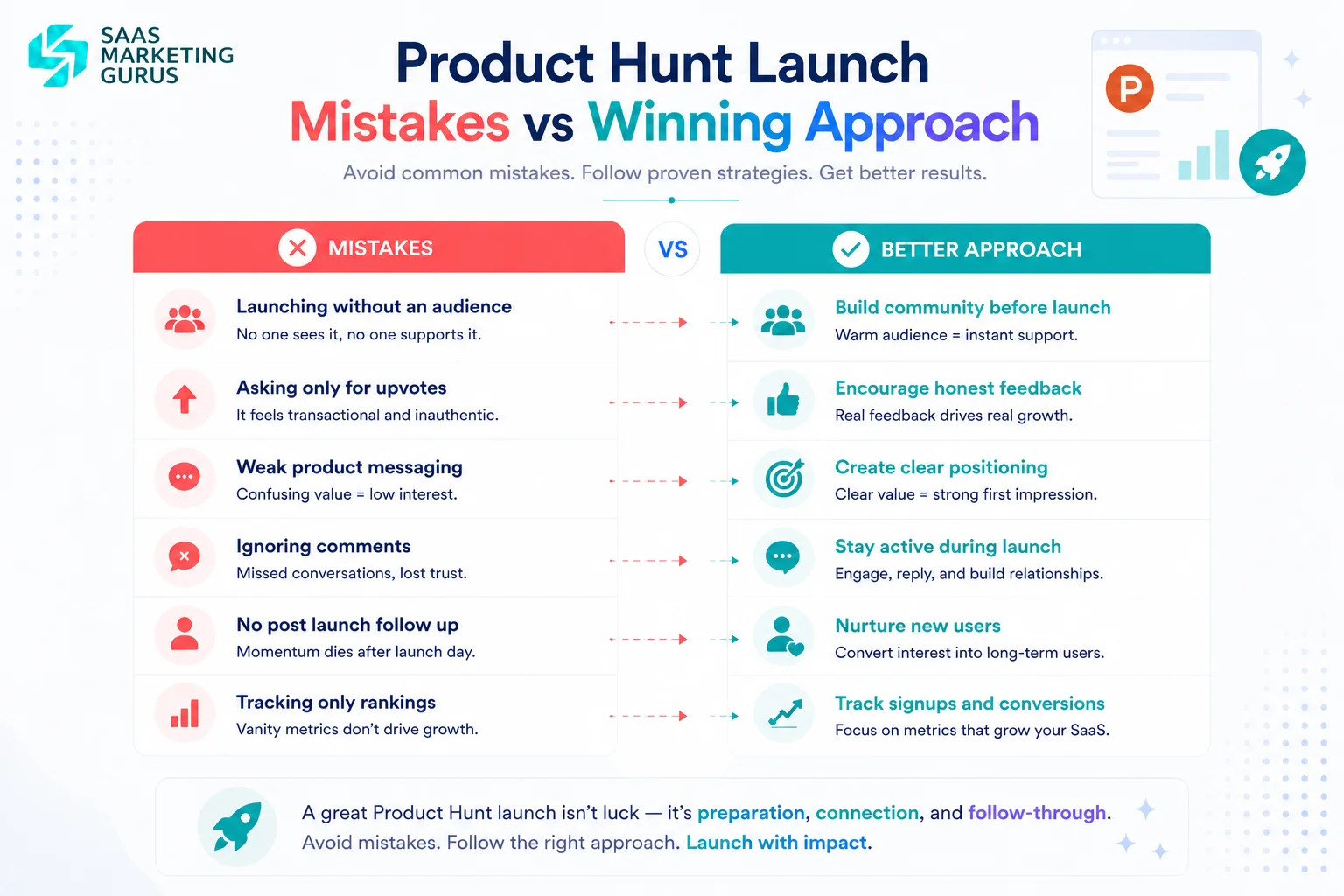
Here are some of the most common ones:
| Mistake | Better Approach |
|---|---|
| Launching without an audience | Build demand before launch |
| Asking only for upvotes | Encourage honest feedback and discussion |
| Weak landing page | Focus on clear messaging and conversion |
| Ignoring comments | Stay active throughout launch day |
| No follow up | Continue nurturing users after launch |
| Measuring only upvotes | Track business KPIs instead |
Remember, Product Hunt is only one part of your growth strategy.
The goal isn’t to finish first on the leaderboard. The goal is to acquire customers who continue using your product long after launch day.
In the final section, we’ll cover frequently asked questions, summarize the key lessons from this guide, and finish with practical next steps for planning your own Product Hunt launch.
FAQs
Is Product Hunt still worth it for SaaS startups?
Yes. Product Hunt remains one of the best platforms for launching SaaS products, reaching early adopters, collecting product feedback, and building credibility. It works best when combined with SEO, content marketing, email marketing, and community engagement.
How can I improve my chances of ranking higher on Product Hunt?
Focus on building an audience before launch, creating a compelling Product Hunt page, engaging with the community, responding to every comment, and driving authentic discussions. Consistent engagement is more valuable than simply collecting upvotes.
Does Product Hunt help SEO?
Yes. While Product Hunt isn’t a direct Google ranking factor, it can generate high-authority backlinks, branded searches, referral traffic, social mentions, and increased brand visibility that support your overall SEO strategy.
What KPIs should I track after a Product Hunt launch?
Measure business outcomes rather than vanity metrics. Track website visitors, signup rate, free trial starts, activation rate, paid conversions, customer retention, and referral traffic to understand the real impact of your launch.
Can I relaunch my product on Product Hunt?
Yes. You can launch again if you’ve introduced significant new features, a major redesign, or a substantial product update that provides new value for the Product Hunt community.
When is the best time to launch on Product Hunt?
Most founders publish their products at the beginning of a new Product Hunt day to maximize visibility. However, preparation, audience building, and active engagement throughout launch day have a much greater impact on success than launch timing alone.
Is Product Hunt enough to grow a SaaS business?
No. Product Hunt should be one part of your go-to-market strategy. The best results come when you combine it with SEO, content marketing, email marketing, social media, paid acquisition, and continuous product improvement.
Beyond Upvotes: Build a Product Hunt Launch Strategy That Drives Real SaaS Growth
A successful Product Hunt marketing strategy is about more than earning upvotes or chasing leaderboard rankings. It’s about launching with a clear plan, attracting the right audience, collecting actionable feedback, and turning early interest into long-term customer growth.
The most successful SaaS companies start preparing weeks before launch, engage actively with the Product Hunt community, optimize their landing pages and onboarding, and continue nurturing users long after launch day. When combined with SEO, content marketing, email marketing, and product-led growth, Product Hunt can become a powerful acquisition channel rather than a one-day event.
If you’re new to the platform, start by learning what Product Hunt is and how launches work before building your campaign. You can also explore our guides on Featured vs. Non-Featured Product Hunt launches and SaaS Marketing Strategies to create a launch plan that supports long-term growth.
At SaaS Marketing Gurus, we help SaaS companies plan, launch, and optimize Product Hunt campaigns that generate qualified signups, valuable user feedback, and measurable business results. Book a free consultation and let’s build a Product Hunt launch strategy that drives sustainable SaaS growth.