Growth marketing vs demand generation comes down to scope. Demand generation creates qualified pipeline by building awareness and buyer interest before a sales conversation, while growth marketing improves the full customer lifecycle from acquisition to activation, retention, expansion and referral.
Fund demand generation first when too few qualified buyers know your product exists. Fund growth marketing first when buyers arrive but fail to activate, convert or renew. Most hybrid SaaS companies run both, with one clear priority each quarter.
This guide comes from SaaS Marketing Gurus (SMG), a B2B SaaS marketing agency specializing in Reddit marketing, Quora marketing, Generative Engine Optimization (GEO), SaaS SEO, and Product Hunt launches. Because SMG’s services sit mostly on the demand side, the guide also shows where demand generation ends and growth marketing has to take over.
What Is the Difference Between Growth Marketing and Demand Generation?
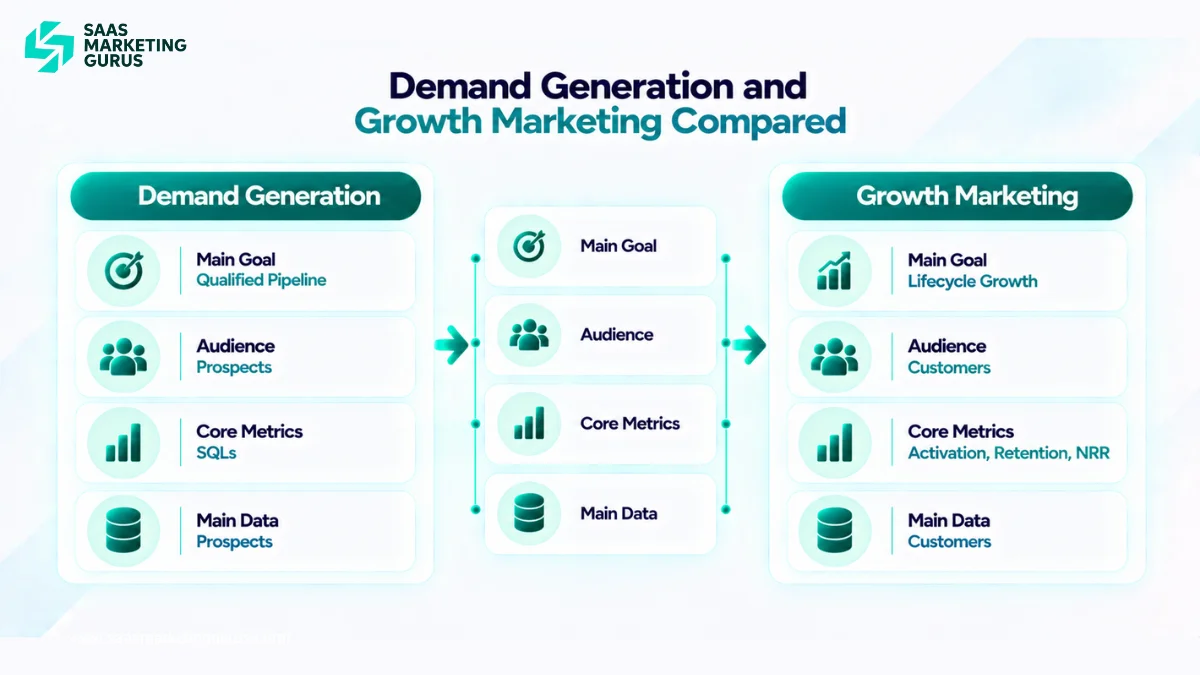
Demand generation owns the path from first awareness to a qualified sales opportunity. Growth marketing owns the path from first touch to a retained, expanding customer, so its scope is wider and it works closer to the product.
Demand generation: Salesforce describes demand generation as the full-funnel effort to build awareness, capture interest and convert buyers into qualified pipeline. In SaaS it usually includes SaaS SEO, content, community marketing, paid campaigns, webinars, account-based marketing and lead nurturing.
Growth marketing: an experiment-led discipline that uses product, billing and customer data to improve acquisition, activation, conversion, retention, expansion and referral.
| Area | Demand generation | Growth marketing |
|---|---|---|
| Main goal | Qualified pipeline and sales opportunities | Lifecycle revenue growth |
| Scope | Awareness to sales opportunity | Acquisition to referral |
| Audience | Prospects and buying committees | Prospects, users and customers |
| Usually reports to | Marketing leadership, aligned with sales | Marketing, product or a growth lead |
| Core metrics | Pipeline, SQLs, win rate, sales velocity | Activation rate, CAC, LTV, NRR |
| Main data | Campaign, CRM and intent data | Product usage, billing and cohort data |
| Typical tactics | SEO, content, communities, ABM, webinars, paid | Onboarding, pricing tests, lifecycle email, referrals |
| Speed of feedback | Tied to sales cycle length | Fast for activation tests, slower for retention |
SQL means sales-qualified lead, CAC is customer acquisition cost, LTV is customer lifetime value and NRR is net revenue retention.
How Are Growth Marketing and Demand Generation Similar?
Both functions serve the same ideal customer profile (ICP), depend on data and answer to revenue rather than activity. The real overlap sits at the handoff, where a qualified lead becomes a trial user or a closed deal becomes an onboarding.
That handoff is where unclear ownership tends to hurt. Demand generation counts the opportunity as a win, growth marketing inherits a user who was never a fit, and nobody owns the gap.
Fix it with one shared metric across both teams, such as qualified pipeline that reaches activation within 30 days. Both teams then win or lose on the same number.
What Does Each Function Do Day to Day?
Demand generation runs programs that reach buyers who are not yet in your funnel. Growth marketing runs experiments on people who are already in it, from new signups to long-standing accounts.
Demand Generation Tactics
Organic demand work builds visibility where buyers research: search, communities and AI answers. Paid demand work buys reach and speed.
- Search: SaaS SEO and comparison content for evaluation-stage queries
- Communities: Reddit and Quora threads where buyers ask for tools
- AI answers: GEO so AI assistants cite your product accurately
- Paid and ABM: LinkedIn, paid search and named-account campaigns
- Events and nurture: webinars, email nurture and sales enablement content
In SMG’s BRAVO SEO case study, search-led demand generation took the employee recognition platform to 20+ demos per week within three months.
Growth Marketing Tactics
Growth marketing works inside the product and the customer base. Its job is to turn signups and new customers into active, paying and expanding accounts.
- Onboarding experiments on the first-value moment
- Trial-to-paid and demo-to-close conversion tests
- Pricing, packaging and upgrade prompts
- Lifecycle email and in-app messages by usage stage
- Referral and expansion programs for healthy accounts
Strong SaaS product marketing gives both functions the positioning and value messages they test against.
How Has AI Search Changed Demand Generation in 2026?
AI search has moved much of demand generation’s work upstream, into answers buyers read before they visit any vendor site. Demand generation now has to earn a place on the shortlist inside ChatGPT, Perplexity and Google AI Overviews, not just the click.
According to G2’s April 2026 research, 51% of B2B software buyers now start research in an AI chatbot more often than in Google. The same survey of 1,076 buyers found 69% chose a different vendor than planned based on chatbot guidance.
This changes the scope of demand generation, not growth marketing. Visibility in AI answers, review sites and community threads is now pipeline work, because those sources shape the shortlist before a buyer fills in a form.
It also explains why last-touch attribution undercounts demand generation. A buyer who first saw your brand in a Perplexity answer or a Reddit thread may arrive later as direct or branded traffic. That is why Generative Engine Optimization and Reddit marketing for SaaS belong in the demand generation budget.
Find Your Real Growth Constraint
Get a second opinion on whether pipeline or activation is holding your SaaS revenue back.
Book a free strategy call with SMG
Which Should a SaaS Company Prioritize: Growth Marketing or Demand Generation?
Prioritize the function that fixes your weakest commercially important stage. Company stage, team size and what competitors hire are weaker signals than where qualified buyers currently drop out.
Use this constraint test against your last two quarters of data:
| What you see | Likely constraint | Fund first | First move |
|---|---|---|---|
| Sales has capacity but too few qualified opportunities | Reach and buyer interest | Demand generation | Build evaluation-stage content and AI-answer visibility |
| Pipeline volume is fine but win rates are low | Positioning or buyer fit | Demand generation with product marketing | Tighten the ICP and comparison messaging |
| Many signups, few reach first value | Activation | Growth marketing | Shorten onboarding to the first-value action |
| Customers churn or never expand | Retention and expansion | Growth marketing | Compare usage of retained and churned accounts |
| Strong retention, flat new customer count | Reach | Demand generation | Add channels buyers use for research |
| Pipeline and activation both weak | Product-market fit | Neither yet | Validate the ICP and core use case first |
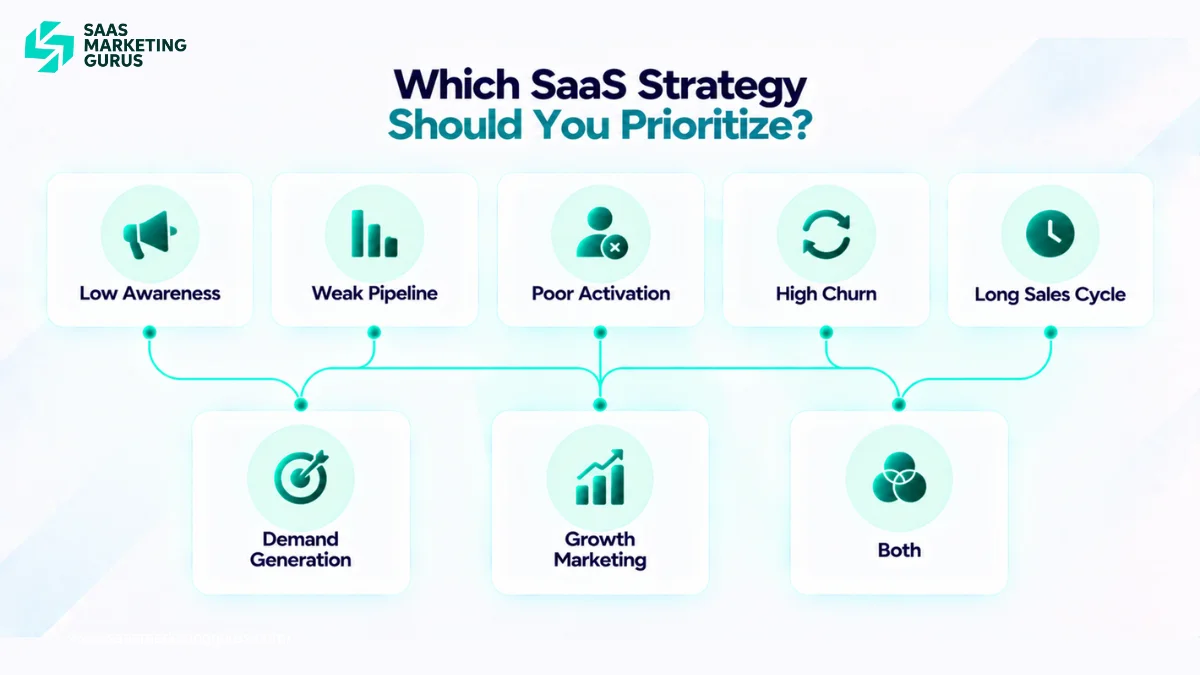
Illustrative example: a cybersecurity SaaS company with strong retention but thin enterprise pipeline should fund demand generation through buyer education, search visibility, webinars and account-based campaigns. A project management platform with plenty of free signups but few team invitations should fix onboarding before it buys more traffic.
Our B2B SaaS marketing strategy guide shows how to find that main growth constraint across the full funnel.
When Do You Need Both?
Hybrid SaaS companies with a self-serve plan and an enterprise tier usually need both at once. Self-serve revenue depends on activation, while enterprise revenue depends on demand creation across a buying committee.
Give each function one owner and one target, then decide each quarter which one gets the next budget dollar. The trade-off applies at company scale too.
Intercom CEO Eoghan McCabe wrote in March 2026 that the company put its marketing behind its Fin AI agent and chose brand and positioning work over incremental performance marketing. That was a slower bet on creating new demand rather than squeezing more from the existing funnel, and he reports the company has since reached $400M ARR.
How Should You Measure Growth Marketing and Demand Generation?
Measure demand generation on qualified pipeline and win rate, and growth marketing on activation, retention and NRR. Then connect the two by tracking how customers from each demand source behave after they sign.
That connection is where many teams struggle. Salesforce’s tenth State of Marketing report (2026) found that only one in four marketers are satisfied with how they use data to power personalized, two-way customer interactions.
Build a demand quality view in four steps:
- Tag every opportunity with its original demand source in the CRM.
- Pass that source into product analytics at signup or kickoff.
- Compare activation, 90-day retention and expansion by source.
- Move budget toward sources whose customers activate and stay.
A smaller channel can beat a larger one on revenue when its customers activate faster and stay longer. Run this review before you reallocate your SaaS marketing budget.
Who Should You Hire First: a Growth Marketer or a Demand Generation Manager?
Hire a demand generation manager first when sales has capacity and pipeline falls short. Hire a growth marketer first when self-serve signups or new customers stall before activation, paid conversion or renewal.
Demand generation roles usually sit in marketing with tight sales alignment. Growth roles often sit closer to product, because the work depends on product data and in-app changes.
In early-stage teams, one senior marketer often covers both until the constraint is clear. Our B2B SaaS marketing team structure guide shows how these roles split as the company grows.
What Mistakes Should SaaS Teams Avoid With Growth Marketing vs Demand Generation?
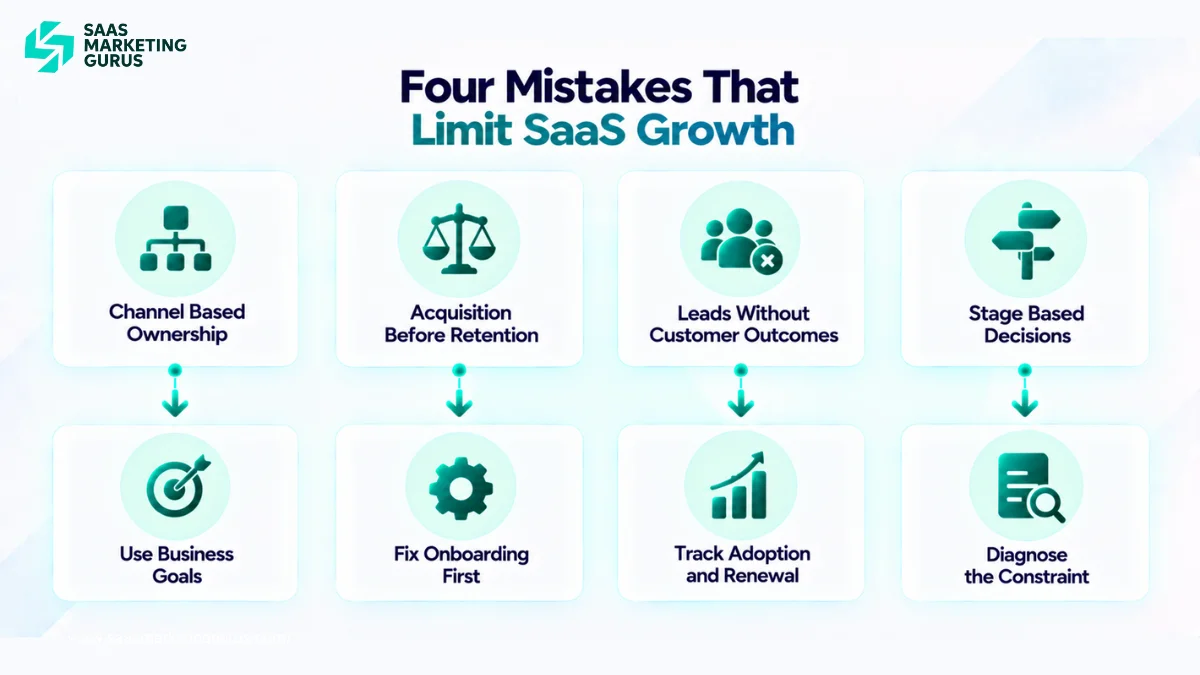
The costliest mistakes come from blurring the two functions or funding the wrong one for the current constraint.
- Defining each function by channels. SEO or email can serve either one, so define each by the revenue stage it owns.
- Scaling acquisition before fixing activation. More traffic into a leaky onboarding raises CAC without raising revenue.
- Treating MQLs as the finish line. Track what share of sourced customers activate, renew and expand.
- Choosing by company stage alone. Stage sets the context, but the current constraint sets the priority.
- Giving only last-touch credit. AI answers and community threads shape shortlists before any trackable click.
Growth Marketing vs Demand Generation: Which Should You Choose?
Choose demand generation first when you sell through a sales team, retention is healthy and sales has more capacity than qualified opportunities. Choose growth marketing first when signups or new customers already arrive but stall before value, payment or renewal. Run both when self-serve and enterprise revenue sit side by side, with one clear priority each quarter.
Your next step: pull the last two quarters of pipeline by source, activation rate and customer retention. Fund the function that matches the weakest of the three for one quarter, and judge it on that metric moving rather than on lead volume.
If you want a second set of eyes on that diagnosis, book a free strategy call with SMG and talk through what your pipeline and activation data point to before you commit budget.
Frequently Asked Questions
Is demand generation part of growth marketing?
Demand generation can sit inside a broader growth marketing strategy, because growth marketing covers the full lifecycle while demand generation covers the path to a sales opportunity. Many B2B SaaS companies still run them as separate teams, since demand generation aligns with sales and growth work depends on product data.
Is demand generation the same as lead generation?
No. Demand generation builds awareness and buying interest among people who may not be ready to talk to sales. Lead generation captures contact details from people already interested, usually through forms, gated content or demo requests. Demand generation creates the interest that lead generation later turns into named contacts for sales.
Is growth marketing only for product-led SaaS?
No. Product-led companies depend on it most, but sales-led SaaS companies use growth marketing to improve demo-to-close conversion, onboarding, adoption, renewals and expansion. Any SaaS business with recurring revenue benefits from someone owning activation and retention, because renewal and expansion revenue compound over the life of each account.
Which should an early-stage SaaS company invest in first?
Start with enough demand generation to confirm the right buyers want the product, then check whether those users activate and stay before you scale acquisition. Early-stage teams rarely need two specialists. One senior marketer can run a small demand program and basic activation tracking until the main constraint becomes clear.
What KPIs separate growth marketing from demand generation?
Demand generation KPIs focus on pipeline creation: qualified pipeline value, sales-qualified leads, win rate and sales velocity. Growth marketing KPIs focus on the lifecycle: activation rate, trial-to-paid conversion, customer acquisition cost, lifetime value and net revenue retention. Customer quality by demand source connects the two sets of numbers.
Does AI search change how SaaS teams should split budget between the two?
Yes, mostly on the demand generation side. G2’s April 2026 research found 51% of B2B software buyers start research in an AI chatbot more often than in Google, so visibility in AI answers, review sites and community threads now shapes shortlists. Growth marketing priorities stay largely the same once buyers reach your product.