Learn the difference between Answer Engine Optimization (AEO) and Generative Engine Optimization (GEO) in 2026. Understand how SaaS content gets retrieved, cited, and included in AI answers across ChatGPT, Perplexity, and Google AI Overviews.
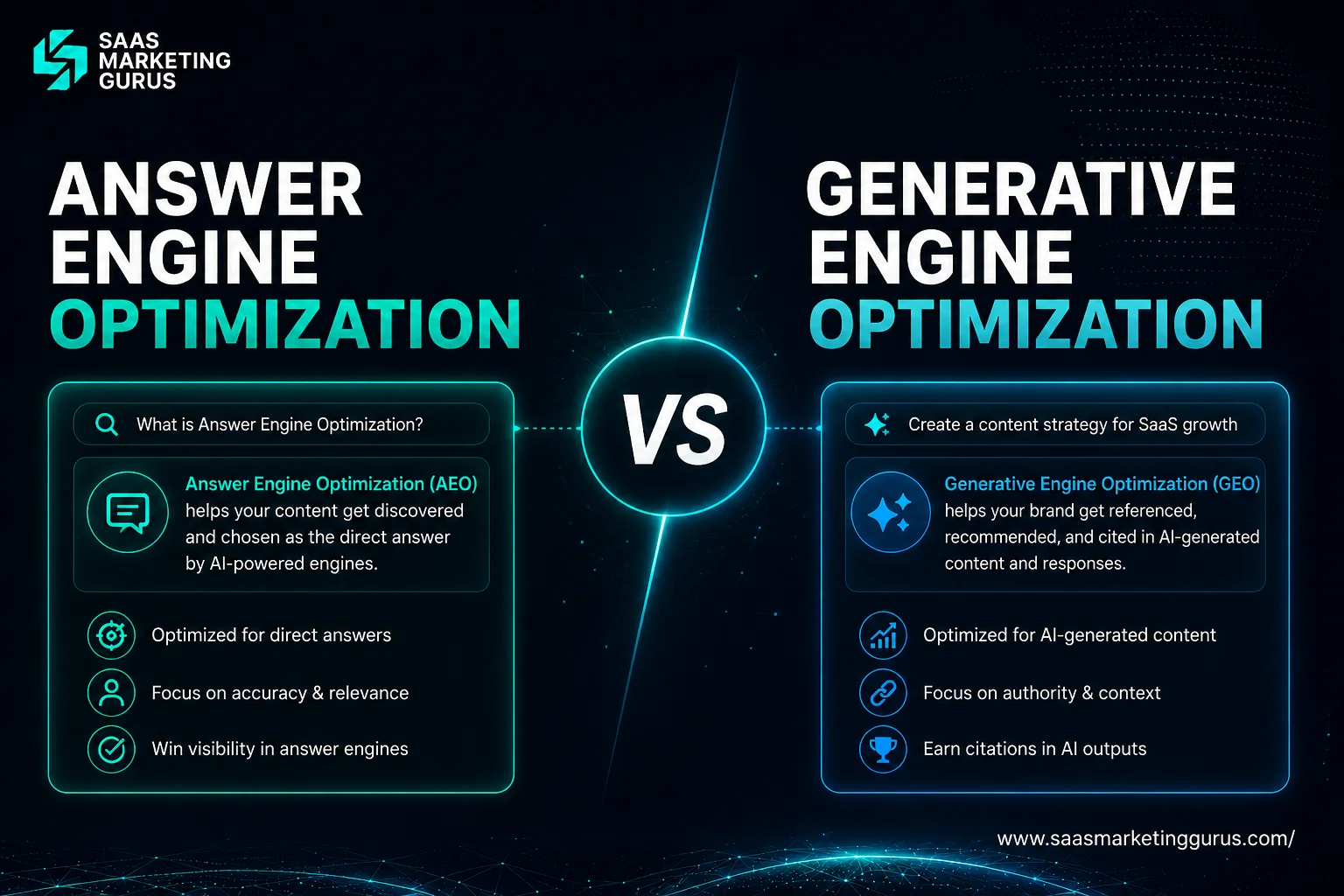
Answer Engine Optimization (AEO) focuses on helping people find clear answers. Generative Engine Optimization (GEO) focuses on how a brand or source appears within generated responses. The practices overlap, so most SaaS teams should improve them through one content program.
For a small team, the best starting point is usually an existing page that leaves an important buyer question unanswered. Fix technical access problems first, and gather missing product evidence before making stronger claims.
The discussion around answer engine optimization vs generative engine optimization often makes the work sound more separate than it is. Both require useful information, accurate explanations, and a way to measure whether visibility supports the business.
SaaS Marketing Gurus (SMG), a B2B SaaS marketing agency based in Magdeburg, Germany, offers SaaS SEO and generative engine optimization services. This guide explains the practical differences, where to start, and how to judge the results.
Are AEO and GEO the Same?
AEO and GEO describe overlapping efforts to improve visibility in answer based experiences. A useful working distinction is that AEO emphasizes answering a question clearly, while GEO emphasizes how information and brands appear within generated responses.
Answer Engine Optimization includes improving definitions, instructions, comparisons, and other answers that search engines or assistants may surface.
Generative Engine Optimization focuses on visibility and accurate representation within generated answers. That can include a citation linking to your website or a relevant mention of your product.
These are working definitions, not separate technical standards. Google treats optimization for its generative search features as part of SEO.
You may also encounter generative search optimization and LLM optimization. Generative search optimization commonly describes similar AI search work. LLM optimization refers to work intended to improve how large language model experiences interpret or present information.
When comparing services, ask what each label covers. The useful details are the pages being improved, the evidence being added, the platforms being observed, and the outcomes being measured.
How Do AEO, GEO, and SEO Compare?
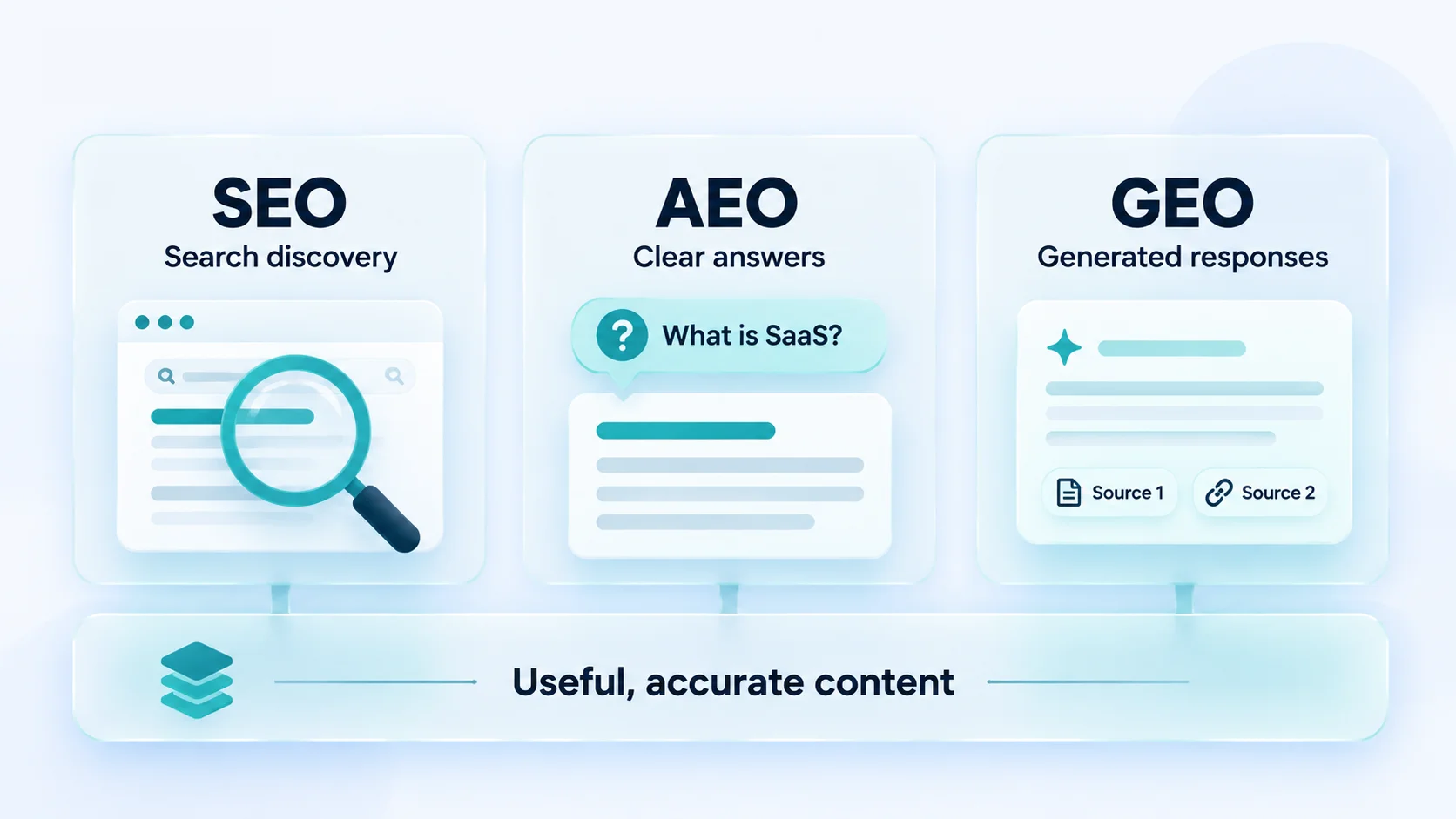
SEO, AEO, and GEO share many activities. Their most useful distinction is the result your team wants to improve, rather than an exclusive content format or ranking signal.
| Decision factor | SEO | AEO emphasis | GEO emphasis |
|---|---|---|---|
| Main objective | Help relevant users discover your pages through search | Provide clear answers in answer based results | Improve visibility and accurate representation in generated answers |
| Typical work | Access, indexing, relevance, internal links, and site quality | Direct explanations, useful steps, and clear comparisons | Product evidence, detailed comparisons, consistent facts, and citation monitoring |
| SaaS example | A discoverable subscription billing guide | An explanation of what happens after a payment fails | A supported comparison of payment recovery approaches |
| Practical strength | Supports discovery across a wider content program | Resolves a specific buyer question | Supports questions requiring context and evaluation |
| Main limitation | Visibility does not establish business value | The answer may satisfy someone without a visit | Mentions and citations do not establish endorsement |
| Effort drivers | Site condition and content gaps | Page quality and expert review | Evidence collection, product verification, and monitoring scope |
| Useful measures | Relevant visits and qualified conversions | Answer appearances, accuracy, and resulting visits | Citations, mentions, accuracy, and qualified referrals |
AEO vs SEO is not a choice between clear answers and discoverable pages. A useful search page needs both. Likewise, a detailed comparison can answer a short question while providing the evidence needed for a larger decision.
These activities concern organic visibility. Advertising is a separate purchase and should have separate performance reporting.
Should SaaS Companies Start with AEO or GEO?
A small SaaS team should usually begin with clear answers on existing pages that matter to buyers. Change that priority when technical access prevents discovery or when the page lacks the evidence needed to support its claims.
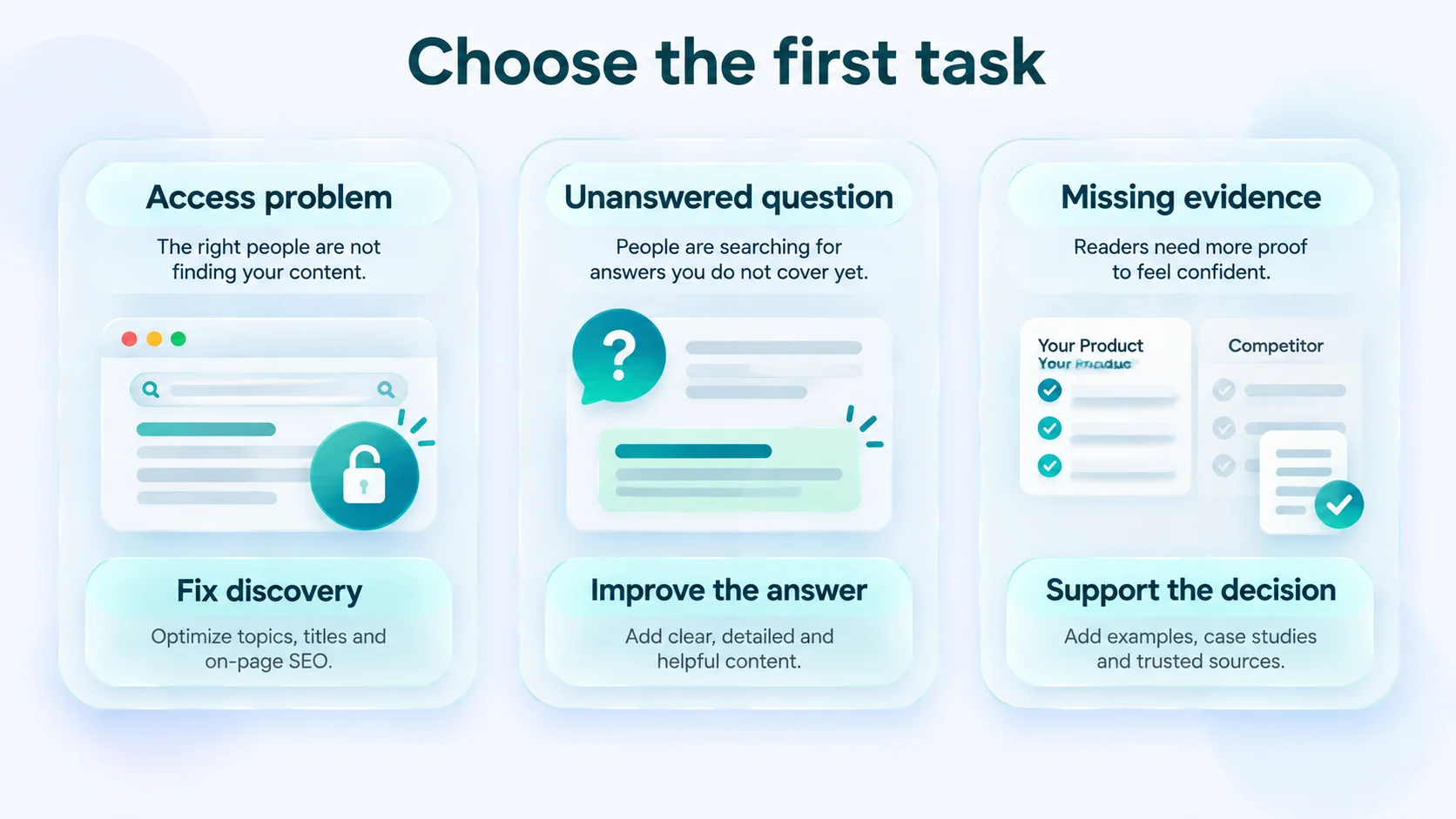
Choose the first task according to the problem:
- Important pages are inaccessible or absent from search. Investigate access, indexing, and internal links. Treat this as foundational SaaS SEO work.
- Pages attract relevant visitors but leave basic questions unanswered. Improve definitions, setup instructions, pricing explanations, and product limitations. This is a practical AEO starting point.
- Buyers cannot compare the product confidently. Add verified capabilities, implementation requirements, fair comparisons, and documented evidence. This supports the evaluation work commonly described as GEO.
Use both approaches when a buying decision requires an immediate answer followed by deeper investigation. A short answer about an integration can lead into setup instructions, supported workflows, and relevant limitations.
Budget for the tasks rather than the labels. Updating an accurate existing explanation may require an editor and product reviewer. Creating a reliable comparison may also require testing, research, and continuing maintenance.
Ask providers to separate those deliverables in their proposals. A price comparison between AEO and GEO is not meaningful unless the scope is comparable.
How Do AI Search Systems Find and Use Sources?
AI search can combine information retrieval with generated responses, but the process differs by platform and mode. A single model cannot explain how every answer was produced.
Google describes using its search ranking systems to retrieve relevant pages. It can also issue related searches, called query fan out, to investigate different parts of a question.
For a SaaS comparison, related questions might concern integrations, implementation, pricing, and limitations. Your content should explain the relevant facts and show what supports them.
Clear sections help readers find those facts. They do not create a universal eligibility rule: Google explicitly says content does not need to be broken into tiny chunks for its AI features.
Avoid treating fixed paragraph lengths, mandatory entity counts, or particular writing templates as guaranteed routes to a citation.
How Can SaaS Teams Apply AEO and GEO Together?
Apply AEO and GEO to the same buyer problem: answer the immediate question, then provide the evidence needed for the next decision. Keep both grounded in the same verified product facts.
The following subscription billing scenario is illustrative. It is not an SMG case study or a claim about a named product.
AEO example: explain what happens after a failed payment
For a buyer asking what happens after a subscription payment fails, explain the recovery process before discussing product benefits. Include the conditions that change the next action.
An opening answer could read:
Payment recovery starts by identifying why the charge failed. A temporary failure may justify another attempt, while an expired card usually requires updated payment details. The next action depends on the payment response and the provider’s rules.
Then explain the workflow: classify the failure, select the appropriate recovery action, notify the customer where needed, and record the outcome.
The writer needs current documentation and a product expert who can confirm the behavior. Explain when another attempt is inappropriate and link to the relevant setup instructions.
The immediate quality check is simple: can the reader identify the next action without contacting support? Search appearances and qualified visits are separate outcomes to monitor.
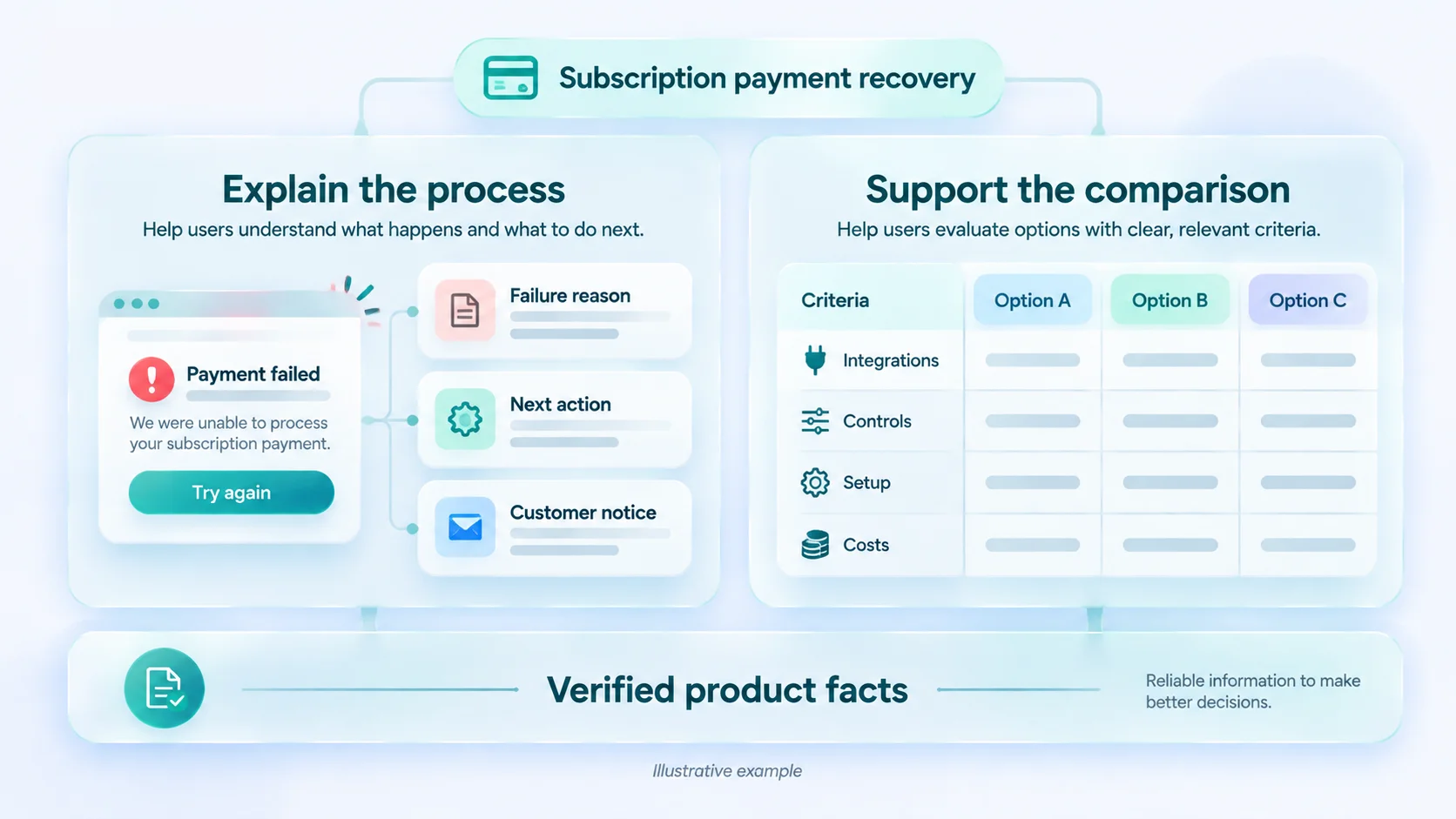
GEO example: compare payment recovery options
For a buyer comparing payment recovery software, evaluate every option against the same relevant criteria. A list of product names does not explain which one fits the buyer’s workflow.
| Buyer question | Evidence to collect |
|---|---|
| Which payment failures can the product handle? | Documented coverage and exclusions |
| What integrations are required? | Supported providers and setup requirements |
| Who controls retry and notification rules? | Configuration documentation and permissions |
| What will implementation involve? | Migration steps, testing needs, and ownership |
| How are costs calculated? | Current pricing terms and material conditions |
| How will performance be assessed? | Metric definitions, reporting capabilities, and limitations |
Mark unavailable information as unverified. Do not infer a capability from broad promotional wording.
Finish with a conditional recommendation. A team with limited engineering capacity may prioritize an existing documented integration. Another may need more control over recovery rules and accept additional implementation work.
The comparison now supports a decision, whether or not an AI system cites it.
Keep the answer and comparison consistent
Use one set of verified facts across the short answer, comparison, and product documentation. Assign someone to review changes in capabilities, pricing, and setup requirements.
Before publishing, check that each page answers its main question, explains relevant limitations, supports factual claims, and gives the reader a next step.
Google’s guidance emphasizes original, useful content rather than generic summaries.
For a broader overview of answer based content planning, see SMG’s AEO for SaaS guide.
What Should You Check When AI Answers Omit Your Brand?
A missing brand mention is a reason to investigate, not proof that your content failed a retrieval test. First establish whether the question is relevant to your product and whether a useful answer would reasonably mention it.
Check four areas:
- Access: Can the relevant page be reached and indexed? Google’s guidance includes accessible content, working pages, and appropriate preview controls.
- Question coverage: Does the page resolve the actual question? A billing glossary does not necessarily answer a buyer’s comparison of migration options.
- Evidence: Can readers verify the capabilities or results claimed? Replace vague benefits with documented features, conditions, limitations, and sourced findings.
- Observation quality: Have you checked several relevant questions under consistent conditions? One response cannot establish visibility across a platform.
Record the missing information before choosing a fix. If the product is unsuitable for the question, seeking inclusion would not help the reader.
SMG’s broader AI search optimization guide covers related planning topics. Keep each diagnosis tied to observable page issues rather than an assumed hidden score.
How Should You Measure AEO and GEO Results?
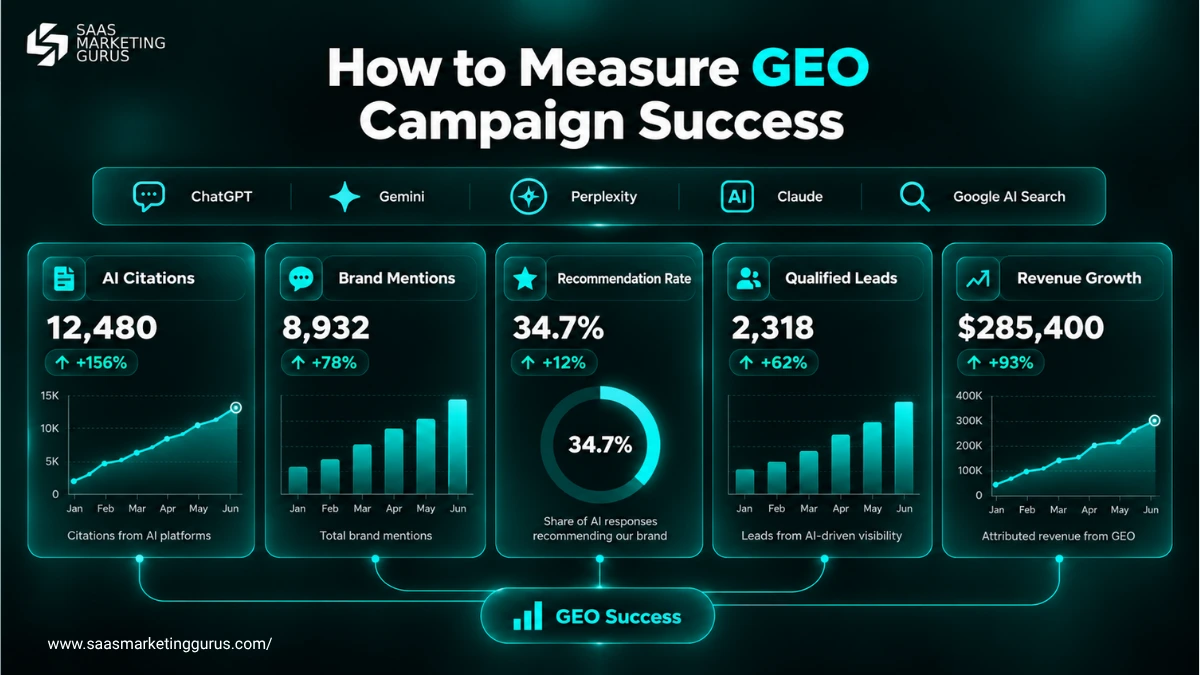
Measure AEO and GEO through separate records of visibility, accuracy, visits, and business outcomes. A citation shows that a page appeared as a source; it does not show that someone visited, trusted, or purchased from the company.
| Measure | What to record | Interpretation limit |
|---|---|---|
| Answer appearance | Question, platform, date, and result format | One observation does not establish stable visibility |
| Brand mention | Whether the brand appeared and what was said | A mention may lack a link or recommendation |
| Source citation | Exact cited URL and surrounding claim | A citation does not establish a visit |
| Representation accuracy | Incorrect or unsupported product statements | Accuracy requires checking current evidence |
| Referral activity | Attributable visits and meaningful actions | Some discovery paths will not be attributable |
| Qualified outcomes | Suitable demos, activated trials, or opportunities | Small samples can distort conversion rates |
Use available platform reporting alongside your analytics. Keep each report’s coverage separate rather than treating it as a view of all AI search activity.
For example, Microsoft’s AI Performance reporting provides citation and cited page information across supported experiences. Microsoft distinguishes those measures from ranking or placement within an answer.
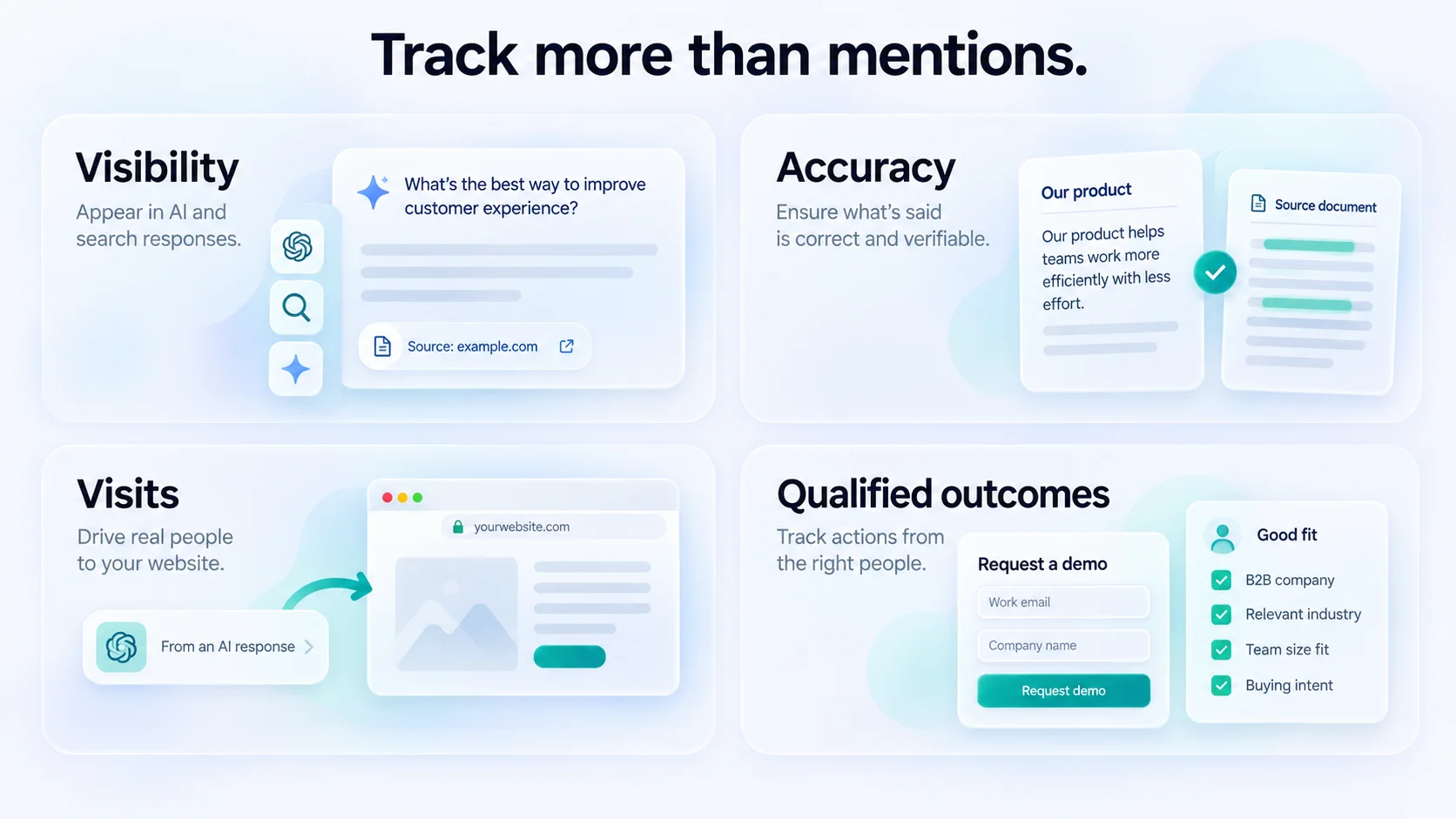
For manual checks, use a fixed set of buyer questions. Record the platform, available model or mode, language, date, and whether the session starts without previous conversation context.
Calculate sampled citation frequency as:
Responses citing your website ÷ eligible responses checked × 100
An illustrative result of four cited responses from 20 checks is 20%. Report the counts alongside the percentage and label it as a sample, rather than market share.
Keep branded and unbranded questions separate. Asking about your company by name tests a different situation from asking for suitable products in its category.
Finally, connect attributable visits to an agreed business outcome. For a sales driven SaaS company, that might be a qualified demo. For a product led company, it might be a trial that reaches a meaningful activation step.
Start with One Buyer Question and a Measurable Test
For a small SaaS team, the practical answer to answer engine optimization vs generative engine optimization is to run one content program with clear priorities. Improve answers on existing buyer pages, then add deeper evidence where buyers need help evaluating the product.
Change that order when technical access blocks discovery or a page lacks the facts needed to support its claims.
Start with one important page and a fixed set of buyer questions. Record a baseline, publish the corrections, and review the same measures after four weeks as an initial checkpoint.
Define success before publishing: accurate answers, more relevant observed citations or answer appearances, and qualified visits or inquiries. If exposure remains too small, extend observation instead of declaring success or failure.
If visibility grows without suitable inquiries, review audience fit and the page’s next action before expanding the program. Get a free consultation with SMG to discuss which page and outcome to prioritize.
Frequently Asked Questions
Is answer engine optimization the same as generative engine optimization?
AEO and GEO overlap, and their meaning varies between providers. AEO commonly emphasizes clear answers, while GEO emphasizes visibility in generated responses. Some providers use AEO to cover both. Compare the proposed work, target platforms, and reporting methods before treating them as separate services.
Does GEO replace traditional SEO?
GEO does not remove the need for discoverable, useful website content. Technical access, relevant information, and internal links still matter. Treat AI visibility work as part of the wider search and content program, with additional observations for citations, mentions, and representation accuracy.
Which content should a SaaS team improve first?
Start with an existing page that supports an important buyer question and has a clear information gap. Product setup, integrations, pricing explanations, and comparisons are useful candidates. Fix access problems first, and gather missing product evidence before adding stronger claims or recommendations.
Do AEO and GEO require separate budgets?
Separate budgets are unnecessary when the work overlaps. Estimate the tasks instead: technical checks, editing, expert review, evidence collection, and monitoring. A short factual update and a researched product comparison may require very different resources, regardless of whether the provider calls them AEO or GEO.
Can a page rank in Google without appearing in an AI answer?
Yes. A conventional search result and a sampled AI response are different observations. Absence from an answer does not establish an indexing problem or prove that the page needs restructuring. Check question relevance, page access, evidence, and repeated observations before choosing a fix.
Does a citation mean the AI recommends my product?
A citation identifies a source used in an answer. It may support a definition, limitation, or comparison without recommending the product. Record the surrounding wording and whether the statement is accurate. Assess referrals and qualified outcomes separately from the citation itself.