AI keyword clustering helps SaaS companies organize thousands of search queries into meaningful groups based on search intent, topic relevance, and business value. Instead of creating separate pages for every keyword, companies can identify which terms belong together and build content structures that better match what users are searching for.
A strong SaaS keyword clustering process combines artificial intelligence with human SEO judgment. AI can quickly identify patterns between keywords, while SEO experts validate those groups by analyzing Google search results, buyer intent, competition, and revenue potential.
For SaaS companies, the goal is not to create the largest number of keyword groups. The goal is to build a focused SaaS content architecture where every page has a clear purpose, supports the buyer journey, and improves visibility across traditional search and AI-powered search experiences.
At SaaS Marketing Gurus, we use AI-assisted analysis combined with SEO strategy to identify valuable keyword opportunities, prevent content cannibalization, and create topic clusters designed around qualified traffic and business growth.
What Is AI Keyword Clustering?
AI keyword clustering is the process of using artificial intelligence to group related search queries based on meaning, search intent, SERP similarity, and business relevance. It helps SEO teams decide which keywords should target the same page and which require separate content.
AI keyword clustering groups related search queries together. It can group them by meaning, search intent, audience, funnel stage, or page type.
Some tools use natural language processing to understand the keywords. They may also use vector embeddings to measure how closely the keywords are related. More advanced methods compare the search results for each query as well.
Semantic similarity means that two keywords discuss the same subject. SERP similarity means that Google treats them as the same search need. This difference is important when deciding whether keywords belong on the same page.
For example, “cold email software” and “cold email templates” are both related to cold email. However, they have different search intent. Someone searching for cold email software may be comparing products. Someone searching for cold email templates wants practical examples. Targeting both keywords on one page may make that page less relevant to each search.
If you’re still creating your initial keyword list, follow a structured SaaS keyword research process before grouping the keywords.
What Are the Benefits of AI Keyword Clustering for SaaS Companies?
AI keyword clustering helps SaaS companies move from random keyword targeting to a structured content strategy. Instead of creating pages based only on search volume, teams can understand what users need and create content that matches different stages of the buying journey.
The main benefits include:
1. Better Search Intent Matching
Keyword clustering helps separate informational, commercial, and transactional searches.
For example:
“what is CRM software”
→ Educational content
“best CRM software for startups”
→ Comparison content
“CRM software pricing”
→ Bottom funnel content
Each keyword group can receive the right page type.
2. Reduced Keyword Cannibalization
Without keyword clustering, SaaS websites often create multiple pages targeting similar keywords. This can make search engines unsure which page should rank.
Clustering helps assign one clear purpose to each URL.
3. Stronger Topic Authority
A connected group of pages covering different aspects of a topic helps search engines understand website expertise.
For example:
Main topic:
SaaS SEO
Supporting pages:
- SaaS SEO audit
- SaaS SEO strategy
- SaaS keyword research
- SaaS content marketing
Together, these pages create stronger topical coverage.
4. Better AI Search Visibility
AI systems need clear relationships between topics, entities, and answers. Well organized clusters make it easier for AI search systems to understand the context of your content.
However, keyword clusters alone do not guarantee AI citations. Content quality, authority, evidence, and usefulness still matter.
How Are Keyword Clusters Different From Topic Clusters?
The table below explains what each type of cluster organizes and how it supports your content strategy.
| Concept | Question it answers | Typical output |
|---|---|---|
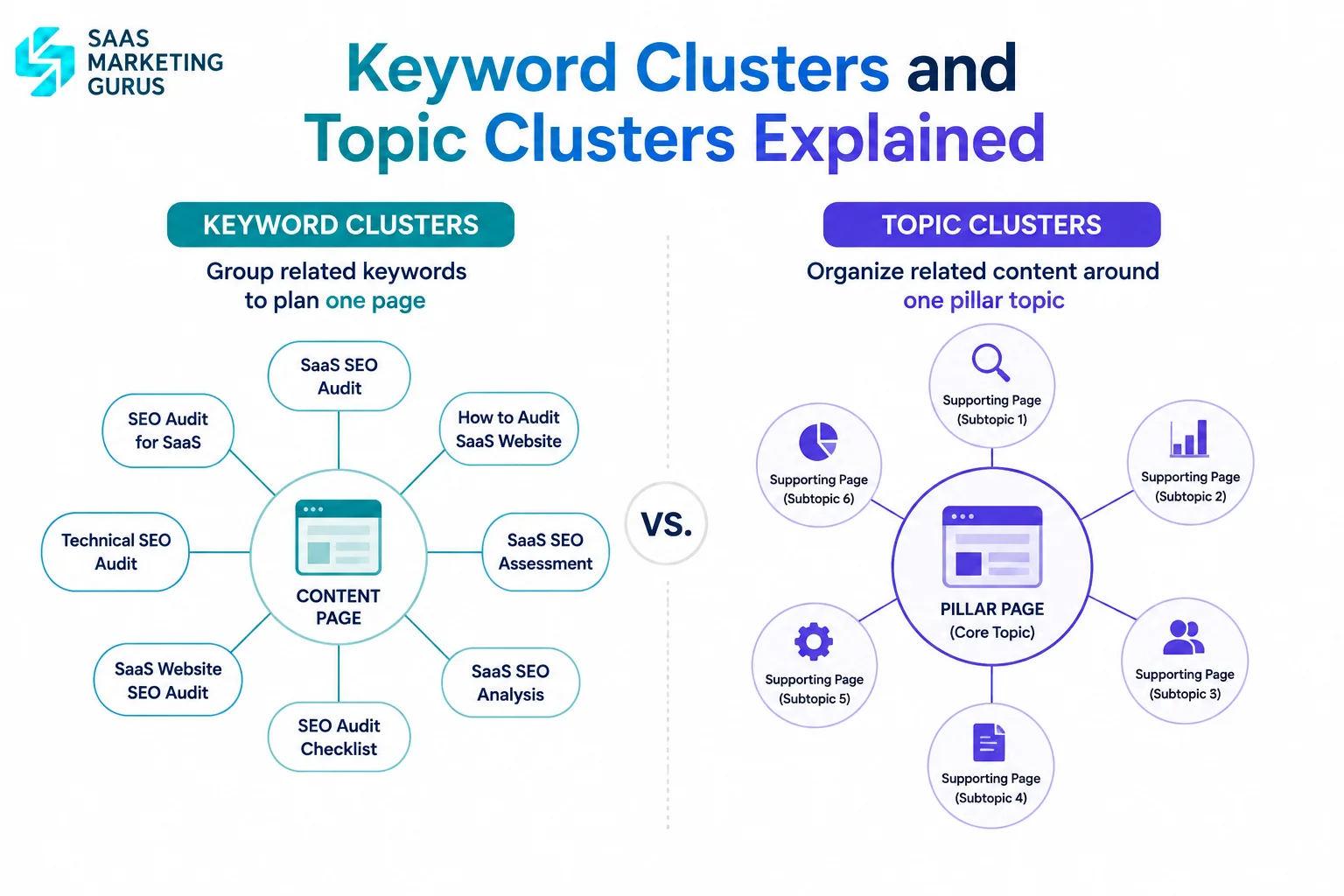
| Keyword cluster | Which queries should one page target? | One primary keyword with related terms |
| Topic cluster | Which pages should cover a broader subject? | A pillar page with supporting pages |
A keyword cluster helps you plan the keywords for one page. A topic cluster helps you organize several related pages across your website. Strong B2B SaaS SEO needs both.
How Do You Build AI Keyword Clusters for SaaS?
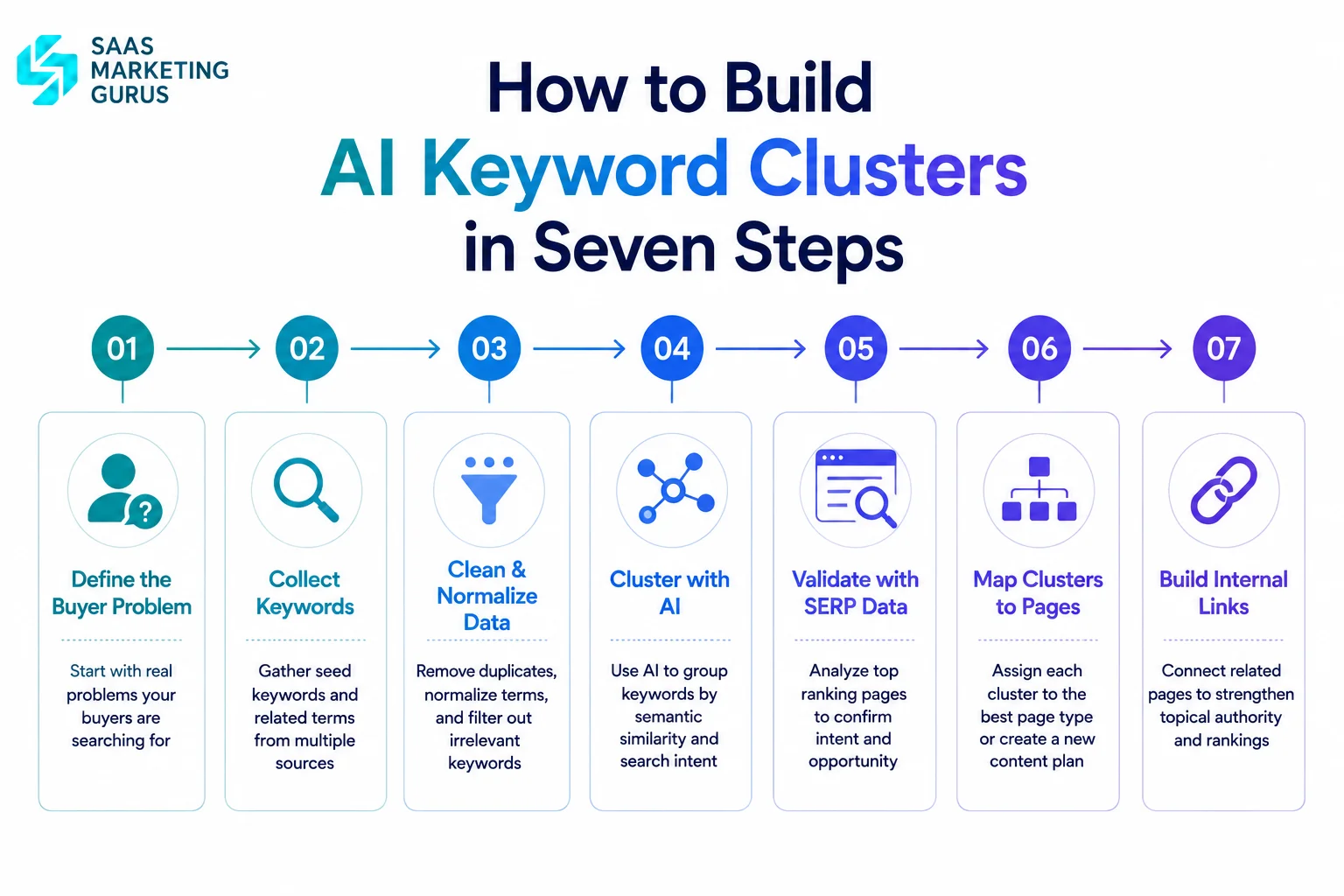
AI keyword clustering for SaaS involves collecting keywords, grouping them by intent, validating groups through SERP analysis, mapping clusters to pages, and measuring performance after publishing.
Use this seven-step process to move from raw queries to a measurable content structure.
1. Start With a Buyer Problem
Choose a problem your product solves, such as sales automation, customer onboarding, subscription billing, or email outreach. Avoid starting with thousands of unrelated keywords.
Prioritize topics connected to product value. A low-volume comparison or integration query may be more useful than a broad informational term because it is closer to a buying decision.
2. Build a Complete Keyword List
A keyword universe is a complete list of search terms related to your main topic. Building this list helps you understand what your audience searches for and which questions your content should answer.
Collect keywords from several sources, including:
- Keyword research tools
- Competitor pages
- Google autocomplete
- People Also Ask results
- Sales calls
- Support tickets
- Online community discussions
- Google Search Console
The Search Console Performance report shows the search queries that already bring impressions and clicks to your website. This data can help you find valuable keywords that other research tools may miss.
3. Clean and Label the Data
Remove duplicates, irrelevant terms, outdated phrases, and meaningless variations. Then label each query by:
- Search intent
- Buyer stage
- Product relevance
- Likely page type
- Existing ranking page
Clean inputs reduce misleading clusters and make human review faster.
4. Create Initial AI Clusters
Use an AI model or keyword clustering tool, such as ChatGPT, to group keywords by meaning, search intent, audience, and page type. Treat these groups as a first draft and review them before creating content.
Google notes that generative AI can help with research and content structure, but publishing many low value pages may violate its scaled content abuse policy. Review the official guidance on generative AI content before turning clusters into pages.
5. Validate Every Important Cluster Against the SERP
Use the same repeatable method for each commercial or high priority cluster:
- Search the primary keyword and each close variation in the same location and device setting.
- Record the top ten organic results for every query.
- Compare overlapping URLs, dominant intent, and ranking page type.
- Calculate overlap as shared top ten URLs divided by ten.
- Check whether the same pages satisfy the same buyer need.
Use overlap as evidence, not an automatic rule:
| SERP overlap | Recommended action |
|---|---|
| 60% or more | Usually test one page |
| 30% to 50% | Review intent and page types manually |
| Below 30% | Usually create separate pages |
These are working thresholds, not Google rules. Adjust them for the market, SERP volatility, and query specificity.
Key takeaway: The SERP shows what type of content Google considers most relevant for a keyword. Compare the results before deciding whether similar keywords should target the same page.If the same pages appear for two keywords, they may belong on one page.
Why SERP Overlap Matters More Than Keyword Similarity
Two keywords can look similar but require completely different pages.
For example:
“SEO tools for SaaS”
and
“SEO strategy for SaaS companies”
Both contain SaaS SEO terms, but the search intent is different.
The first query suggests users want software recommendations.
The second query suggests users want a strategy or process.
Google’s search results reveal whether these keywords represent the same information need. This is why SERP overlap analysis is one of the most important validation steps in AI keyword clustering.
6. Map Clusters to Pages
Assign each validated cluster to one action:
| Situation | Action |
|---|---|
| A relevant page already ranks | Update and expand it |
| Two pages target the same intent | Consolidate or reposition one page |
| No suitable page exists | Create a new page |
| The topic has little buyer value | Do not prioritize it |
Before publishing new URLs, use a B2B SEO audit to find existing pages that should be updated, merged, or redirected.
7. Build the Topic Cluster and Internal Links
Connect the mapped pages around a clear pillar. Supporting pages should link to the pillar when it helps the reader, while the pillar should link to every important supporting page. Add links between supporting pages when their topics form a natural next step.
Use concise, descriptive anchor text. Google recommends contextual internal links because they help people and search engines understand related pages. See its link best practices.
What Does a Complete SaaS Topic Cluster Look Like?
Imagine a SaaS company that sells B2B lead generation software. It starts with these keywords:
- B2B lead generation
- Lead generation software
- Lead generation tools
- LinkedIn lead generation
- Cold email templates
- Lead generation automation
- How to generate B2B leads
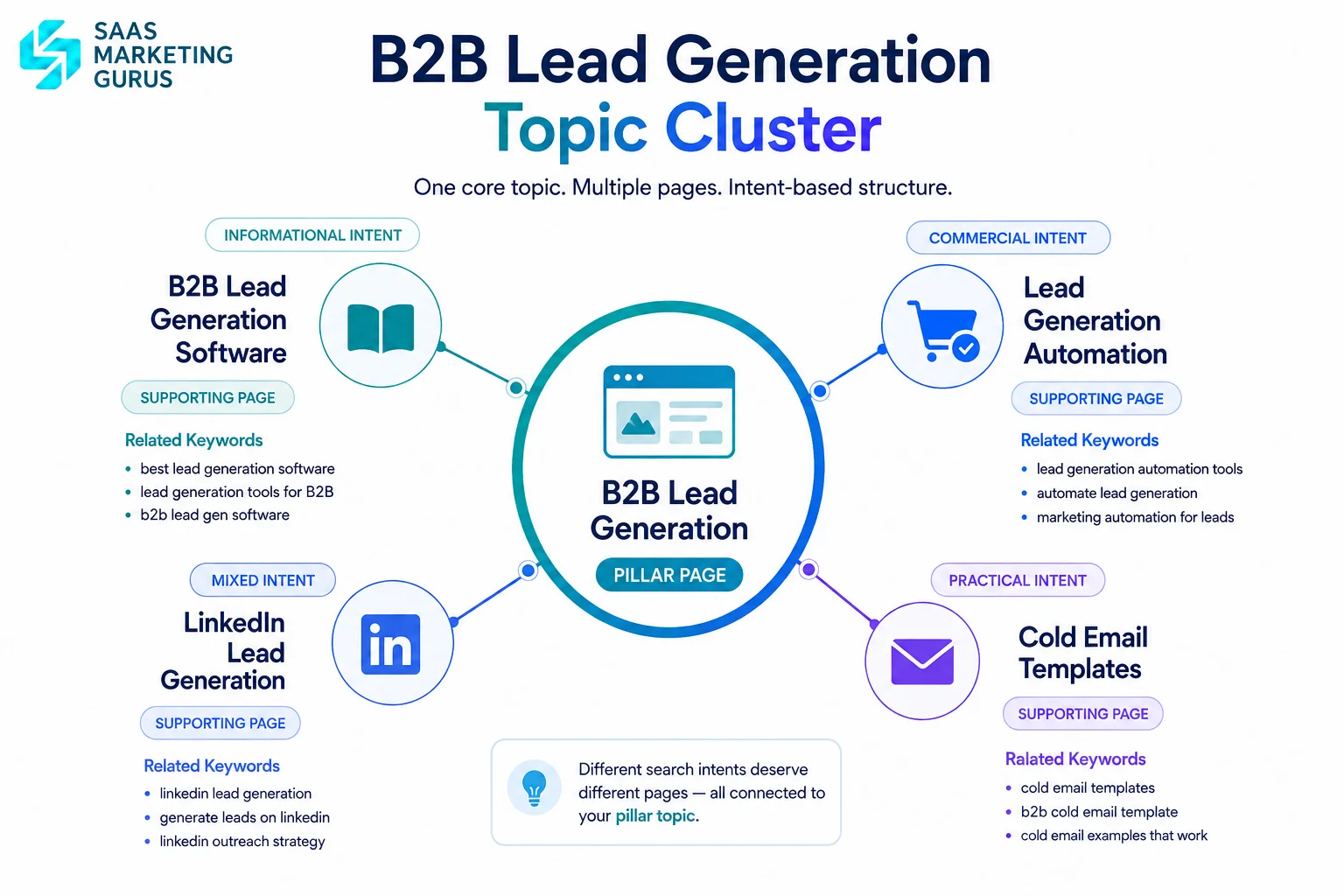
An AI tool may group all these keywords together because they cover the same general topic. However, people use these searches for different reasons. The keywords should therefore be divided into separate pages.
The table below shows how the keywords can be organized by search intent.
| Page | Search intent | Related keywords |
|---|---|---|
| B2B Lead Generation | Learning about the topic | methods, process, strategy |
| B2B Lead Generation Software | Comparing solutions | software, tools, platforms |
| Lead Generation Automation | Learning and comparing | automated lead generation |
| LinkedIn Lead Generation | Learning how to use LinkedIn | LinkedIn prospecting |
| Cold Email Templates | Finding practical examples | templates, examples |
The B2B lead generation page acts as the main page. It links to the four supporting pages. The software page can also link to the automation page because buyers may want to compare those options.
The cold email templates page should remain separate. Its visitors want ready to use examples, while visitors to the software page want to compare products.
Key takeaway: Keywords can cover the same general topic but still need separate pages when people search for them with different goals.
How we handles this: SaaS Marketing Gurus uses this process while building SaaS SEO strategies, content roadmaps, and topic clusters for B2B SaaS companies.
AI can find related keywords, but human review decides which keywords truly belong on the same page.
How Does the SaaS Marketing Gurus CLARITY Framework Evaluate Keyword Clusters?
AI can organize thousands of keywords within minutes, but automation alone cannot decide which topics deserve investment.
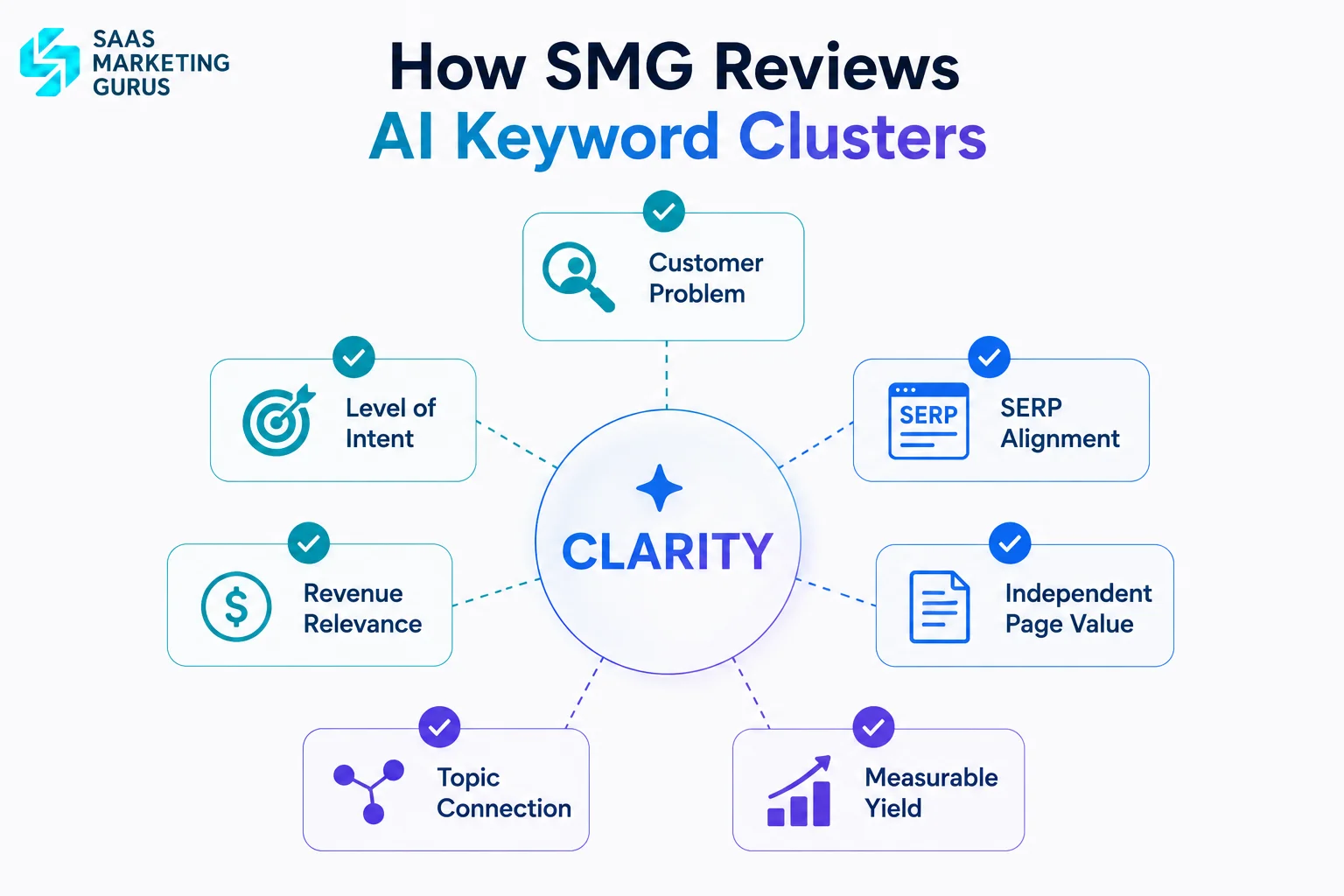
SMG uses the CLARITY framework to evaluate keyword clusters through seven important checks:
| Framework Element | Question |
|---|---|
| Customer Problem | Does this topic solve a real customer challenge? |
| Level of Intent | Is the user researching, comparing, or ready to buy? |
| Alignment With SERP | Does Google show similar results for these queries? |
| Revenue Potential | Can this topic influence pipeline or conversions? |
| Independent Page Value | Does this keyword group need its own page? |
| Topic Connection | Does it strengthen the overall SaaS topic cluster? |
| Yield Measurement | Can performance be tracked through rankings, traffic, and leads? |
The framework helps SaaS companies avoid creating content based only on keyword volume. Instead, it creates a content roadmap connected to buyer needs and business outcomes.
How SMG Would Cluster SaaS SEO Keywords
Imagine a SaaS SEO agency targeting these keywords:
- SaaS SEO agency
- SaaS SEO services
- SEO for SaaS companies
- SaaS SEO consultant
- SaaS keyword research
- SaaS content marketing
AI may initially group these together because they relate to SaaS SEO.
After SERP and intent analysis:
| Page | Target Keywords | Intent |
|---|---|---|
| SaaS SEO Agency | agency, consultant | Commercial |
| SaaS SEO Services | services, solutions | Commercial |
| SaaS Keyword Research | keyword research process | Informational |
| SaaS Content Marketing | content strategy | Informational |
This structure prevents one page from competing against itself and creates a clearer buyer journey.
Have thousands of keywords but no clear content roadmap? We can analyze your keyword data and create a prioritized SaaS SEO content plan.
What Tools Can You Use for AI Keyword Clustering?
Different tools support different parts of the keyword clustering process. Most SaaS SEO teams use multiple tools instead of relying on one platform.
| Tool | Best Use Case |
|---|---|
| Semrush | Keyword discovery, competitor research, and keyword data |
| Ahrefs | Competitor analysis, keyword research, and ranking analysis |
| Keyword Insights | Automated keyword grouping based on SERP data |
| ChatGPT | Initial keyword organization, classification, and content planning |
| Google Search Console | Finding existing search queries and content opportunities |
AI tools can speed up the first stage of clustering, but final decisions should always consider search intent, SERP results, and business goals.
How Can Topic Clusters Support AI Search Visibility?
Topic clusters can help AI search systems understand relationships between your content, topics, and entities. When pages clearly answer related questions and connect through meaningful internal links, they provide stronger context for search engines and AI systems.
For AI search optimization, each important page should:
- Answer the main question quickly
- Define important concepts clearly
- Include reliable sources
- Demonstrate expert experience
- Connect related topics through internal links
- Provide original examples and insights
Google has stated that its AI search features rely on the same core SEO principles used in traditional search. OpenAI also provides guidance for publishers who want their content to be accessible in ChatGPT search.
How Should You Measure Cluster Performance?
Record a baseline before publishing or restructuring the cluster. Review results monthly by page and by topic group.
Track:
- Indexed pages and crawl issues
- Rankings and query coverage
- Organic clicks and impressions
- Internal link engagement
- Conversions and qualified demo requests
- Assisted pipeline or revenue
- Brand mentions and citations in relevant AI answers
- Cannibalization between cluster pages
Compare performance at 30, 60, and 90 days. Update weak pages when intent has shifted, consolidate pages that compete for the same queries, and refresh evidence when sources become outdated.
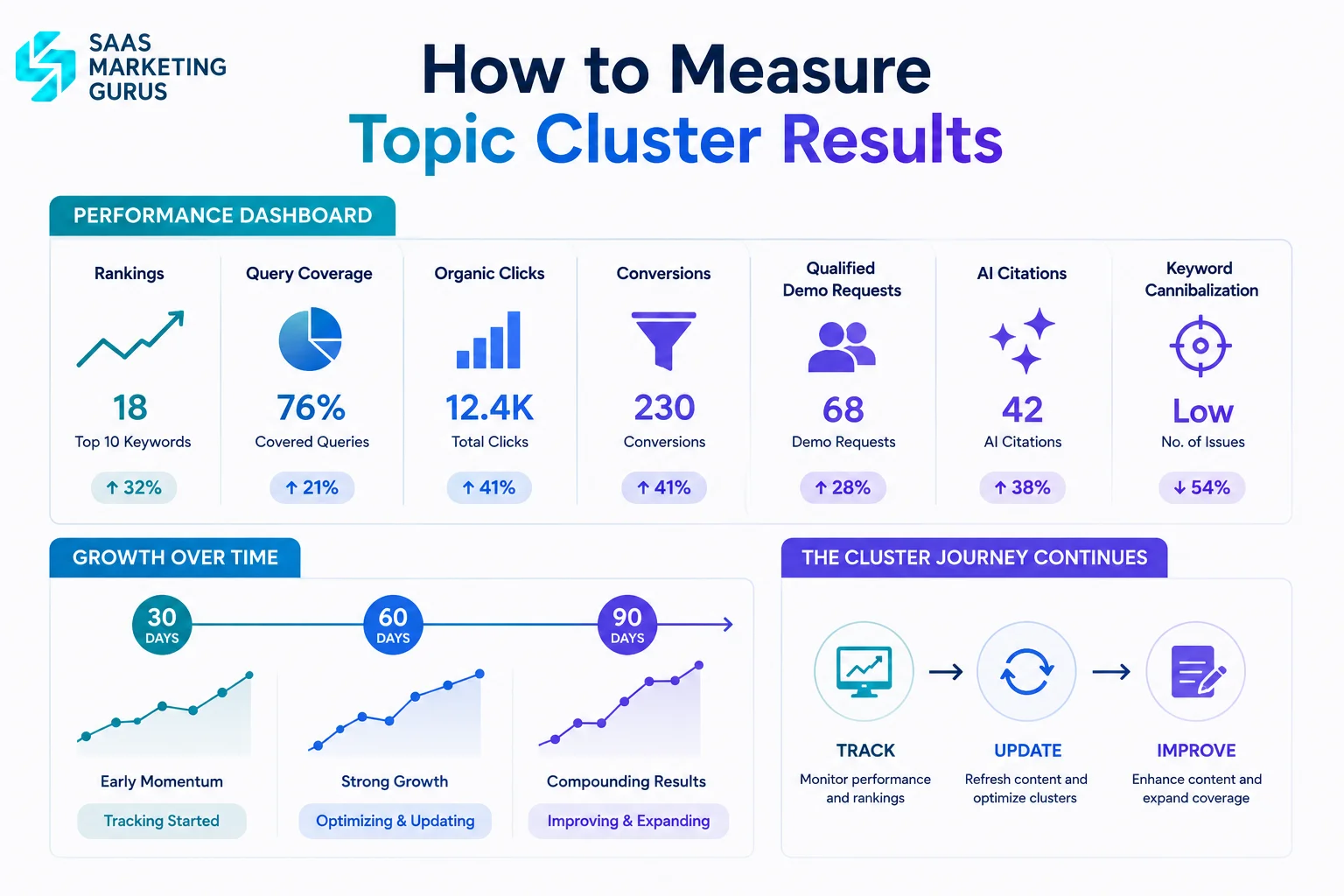
Cluster Performance Dashboard Example
| Metric | What It Shows |
|---|---|
| Keyword coverage | Whether the website ranks for more related queries |
| Average ranking position | Improvement in search visibility |
| Organic clicks | Traffic generated from the cluster |
| Conversion rate | Business value of the traffic |
| AI mentions | Visibility in AI-generated answers |
| Internal link engagement | User movement between related pages |
AI Keyword Clustering Checklist
Before approving a cluster, confirm that:
- The keywords share the same intent.
- The SERPs have meaningful overlap.
- The proposed page has a distinct purpose.
- The topic matters to the buyer and product.
- An existing page cannot satisfy the need.
- Internal links have clear destinations.
- The page has a measurable business outcome.
Common AI Keyword Clustering Mistakes SaaS Companies Should Avoid
1. Creating Clusters Based Only on Keyword Similarity
AI may group keywords because they contain similar words. However, similar wording does not always mean similar intent.
Always check the SERP before combining keywords.
2. Ignoring Business Value
High search volume does not always mean high value.
A lower volume keyword such as:
“enterprise SaaS SEO agency”
may attract more qualified leads than:
“what is SEO.”
3. Creating Too Many Pages
Large keyword lists can tempt companies to create hundreds of pages.
More pages do not automatically create more traffic. Each page should solve a unique user problem.
4. Forgetting Existing Content
Before creating new URLs, review current pages.
An existing page may already have ranking potential and only needs improvement.
Frequently Asked Questions
Can ChatGPT create keyword clusters?
Yes. ChatGPT can help group keywords by topic, search intent, funnel stage, and page type. However, the output should be reviewed against Google SERPs, competitor pages, and business goals before creating content.
How many keywords should be included in one keyword cluster?
There is no fixed number. A keyword cluster should include only keywords that represent the same search intent and can be answered effectively on one page.
A smaller, focused cluster is usually better than a large group of unrelated keywords.
What is the difference between keyword clustering and topic clustering?
Keyword clustering focuses on deciding which keywords should be targeted on one page.
Topic clustering focuses on organizing multiple pages around a broader subject.
For example:
Keyword cluster:
“SaaS SEO agency, SaaS SEO consultant, SaaS SEO services”
Topic cluster:
“SaaS SEO” with supporting pages about audits, strategy, keywords, and content.
Does AI keyword clustering improve SEO rankings?
AI keyword clustering does not directly improve rankings. It improves the content planning process by helping teams create pages that better match search intent, avoid keyword cannibalization, and build stronger topic coverage.
What are the best tools for AI keyword clustering?
Popular tools include Semrush, Ahrefs, Keyword Insights, ChatGPT, and Google Search Console. The best approach combines AI automation with human review of search intent and SERP results.
Can keyword clustering help with GEO and AEO?
Yes. Keyword clustering can support GEO and AEO by helping websites organize related questions, entities, and answers clearly. However, AI visibility also depends on content quality, authority, citations, and user value.
Should SaaS companies use AI keyword clustering or manual research?
The best approach combines both. AI helps process large keyword datasets quickly, while SEO experts validate intent, competition, and business value before deciding the final content structure.
Can SaaS companies outsource AI keyword clustering?
Yes. SaaS companies can work with SEO agencies that combine AI tools with human search intent analysis. An experienced team can help identify priority clusters, map pages, improve internal linking, and create a content roadmap aligned with business goals.
Stop Grouping Keywords. Start Mapping Buyer Intent.
AI keyword clustering is most useful when it improves decisions, not when it produces the largest number of pages. Start with buyer problems, use AI to organize the data, validate important clusters with SERP overlap, and let human judgment determine the final architecture.
SaaS Marketing Gurus combines keyword research, content strategy, SEO, and generative engine optimization services to build clusters around qualified visibility and buyer intent.
Want a practical page map from your keyword data? Book an SEO and GEO strategy call with SMG to identify which pages to create, improve, combine, or remove.