Content development services turn a SaaS content strategy into finished, accurate assets: research, briefs, subject matter expert (SME) input, drafting, technical and SEO review, editing, publishing and refreshes. For a SaaS company, the service is worth paying for only when it connects each asset to a buyer question and a next step, such as a demo request.
Most teams do not struggle to write. They struggle to produce accurate content about a technical product for several buyer roles while search results and AI answers keep changing. This guide from SaaS Marketing Gurus (SMG), a B2B SaaS marketing agency, specializing in Reddit marketing, Quora marketing, Generative Engine Optimization (GEO), SaaS SEO, and Product Hunt launches, shows what the work includes, who owns each stage, and how to judge whether it is producing pipeline.
Key Takeaways
- Content development is the production layer; strategy decides what should exist.
- Every asset type needs different evidence before anyone writes.
- SME access is a frequent bottleneck, so schedule it into the workflow.
- Structure each section to answer one question on its own.
- Measure assets against their job, then refresh before you replace.
What Are Content Development Services?
Content development services are the research, writing, review, publishing and maintenance work that turns planned topics into finished content. In SaaS, that covers blog posts, comparison pages, integration guides, use case pages, case studies and thought leadership, each built around the evidence its reader needs.
The difference from generic article writing is the evidence layer. A comparison page needs verified competitor facts and fair limitations. An integration guide needs product detail that only engineers or support staff can confirm.
Use this matrix to scope what a content development engagement should produce for each asset type:
| Asset type | Buyer job | Evidence it needs | Who must review |
|---|---|---|---|
| Problem or how-to article | Name the problem and a first fix | Customer language from sales calls and support tickets | Editor, SEO lead |
| Comparison or alternatives page | Weigh options fairly | Current feature, pricing and limitation facts for each option | Product marketer, SME |
| Integration or technical guide | Confirm technical fit | Accurate setup steps from the live product | Engineer or support lead |
| Use case page | Picture the product in their workflow | Real workflows, named roles, measurable outcomes | Customer success, SME |
| Case study | Justify the purchase internally | Baseline, work done, timeframe and result, approved by the client | Account owner, client |
| Thought leadership | Trust the team’s judgment | An original point of view or first-party data | Named expert author |
If a proposal quotes articles per month without naming the evidence each asset needs, it is quoting writing, not content development.
How Is Content Development Different From Content Strategy?
Content strategy decides what should exist, who it serves, why it matters and how success is measured. Content development turns those decisions into finished assets and keeps them accurate after publication.
A simple example shows the split. Strategy identifies “CRM alternatives” as a decision-stage opportunity for a sales operations audience. Development then defines the research, builds the comparison structure, gathers product evidence, writes the page, checks every claim, adds internal links and prepares it for publication.
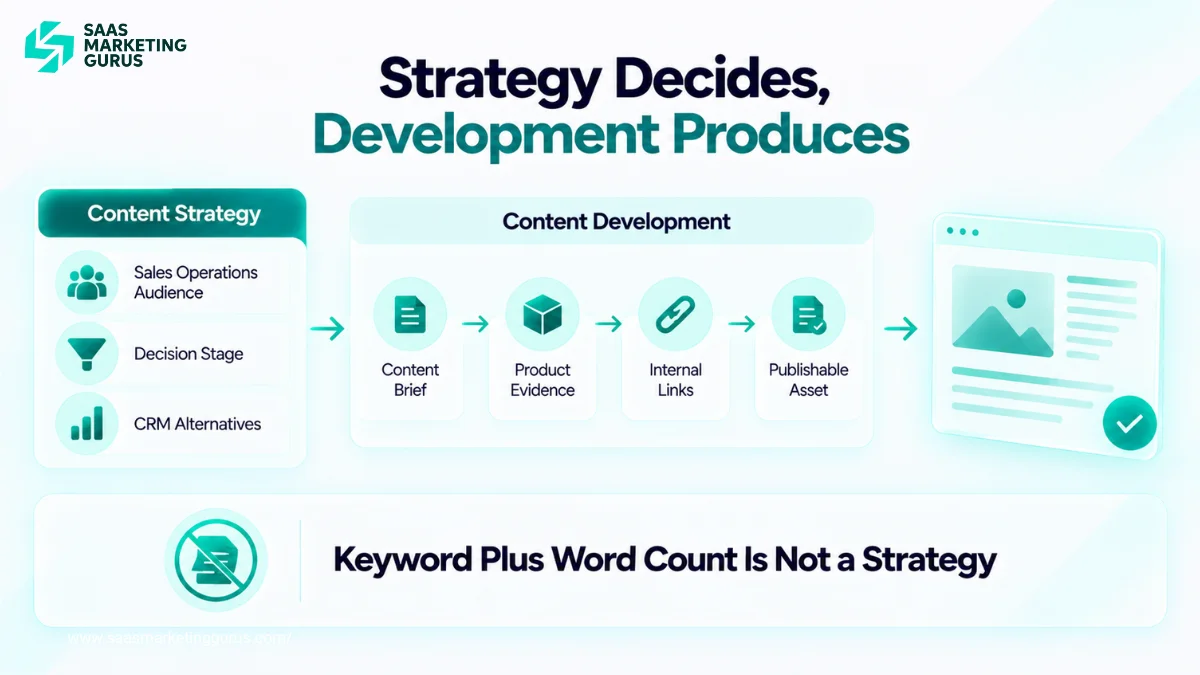
Separating the two prevents a common failure: a writer receives a keyword and a word count with no context, and the result is technically complete but strategically weak. At SMG, the handoff between the two is a brief scored against our CLARITY framework for keyword and cluster decisions, so the writer knows the customer problem, intent level and revenue potential before drafting. Our SaaS content marketing strategy guide covers the planning side in full.
What Does a SaaS Content Development Workflow Look Like?
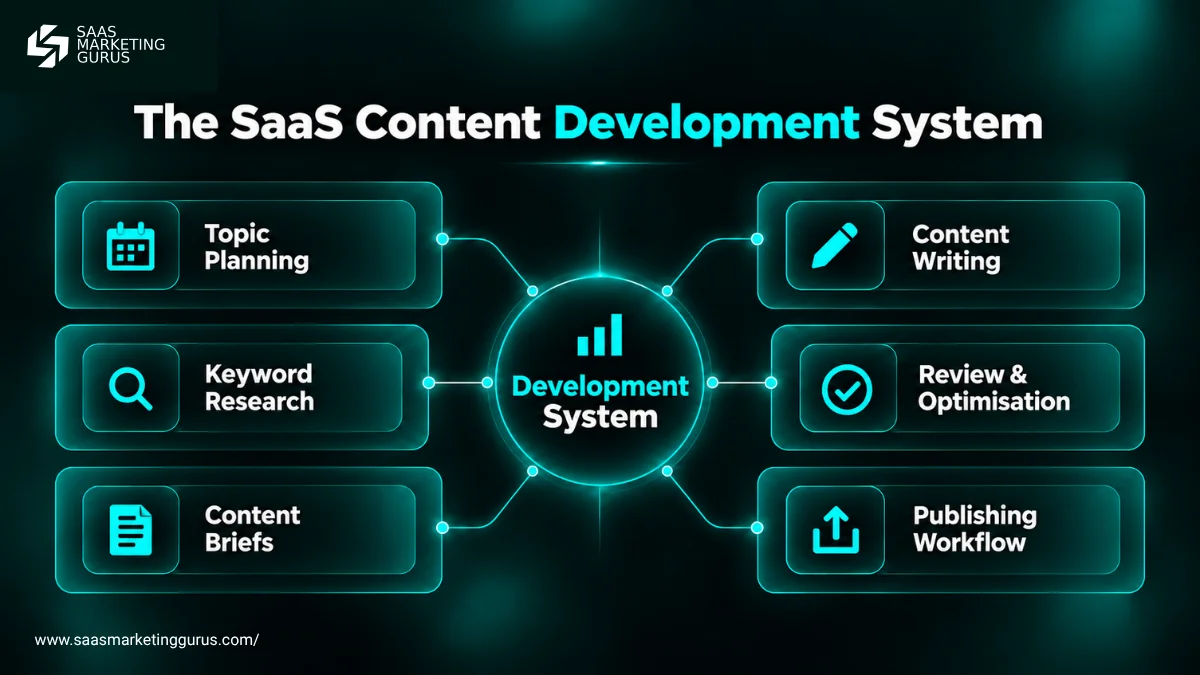
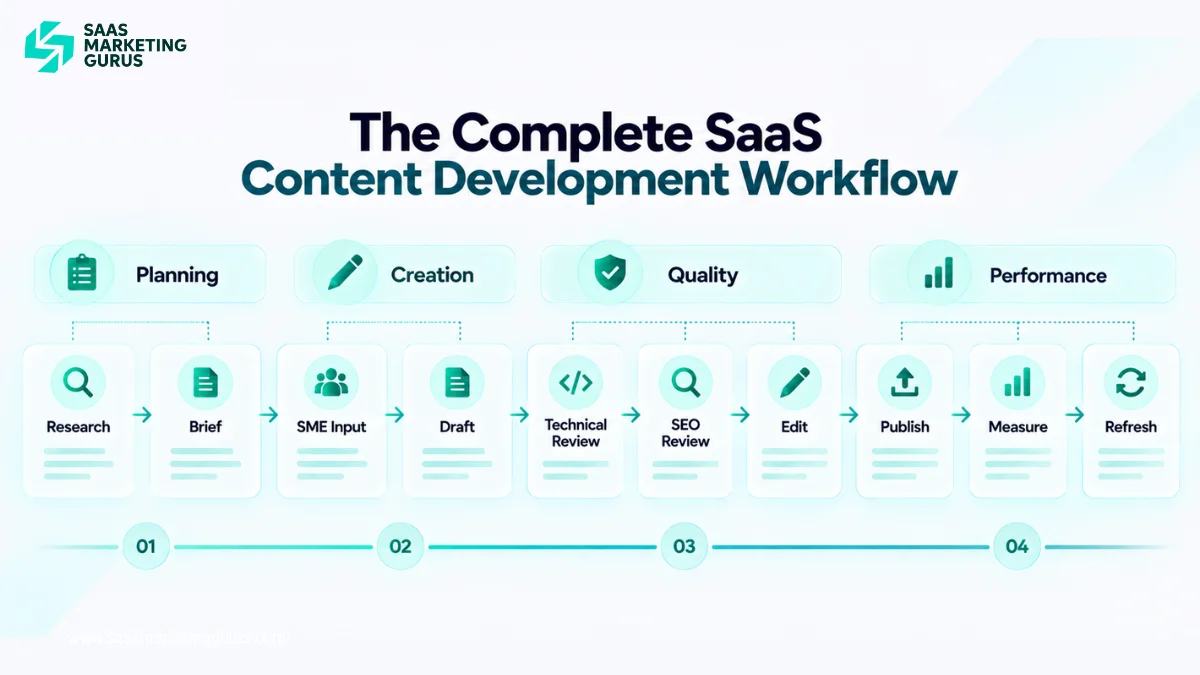
An effective SaaS content development workflow runs in a fixed sequence of seven stages, each with one owner and one output, so quality does not depend on anyone’s memory. In our experience, skipping the SME stage is the most common reason technical content ships with errors.
- Brief. Owner: strategist. Output: audience, intent, primary question, evidence list, internal links, CTA and format.
- Research. Owner: writer. Output: SERP notes plus customer language from sales calls, support tickets, reviews, community threads and lost-deal notes.
- SME input. Owner: writer and SME. Output: confirmed product facts, captured before drafting rather than after.
- Draft. Owner: writer. Output: a first version built around the agreed angle, with every claim linked to its source.
- Review. Owner: editor, SME and SEO lead. Output: technical accuracy, intent coverage, citations, internal links and conversion path checked.
- Publish. Owner: content manager. Output: live page, metadata, publish date and an owner recorded in the content inventory.
- Measure and refresh. Owner: content manager. Output: a review date and a refresh decision based on performance and product changes.
SME access deserves its own line in the plan. According to the Content Marketing Institute’s B2B Content and Marketing Trends: Insights for 2026 report (October 2025), 37% of B2B marketers say fewer than 5% of their employees with specialized expertise actively contribute to thought leadership. In our experience, a short, scheduled interview per asset gets more usable product detail than asking engineers to review finished drafts.
What Should a Content Brief Include?
A content brief should define the target reader, search intent, primary question, product connection, competing pages, required evidence, internal links, CTA and content format. It should also flag every claim that needs SME validation before drafting starts.
Ask any partner to show you a real brief, not only finished articles. The brief reveals whether the team understands your buyer and the business goal behind the page.
Where Does AI-Assisted Drafting Fit?
AI-assisted drafting fits inside the workflow, after the brief and SME input, never in place of them. It speeds up production, but the evidence and judgment still have to come from people who know the product.
The same Content Marketing Institute report found that 89% of B2B marketers using AI apply it to written content. Among those using AI for content creation, 58% say content quality improved, while 12% say it declined. A clear policy on where AI is allowed, and who verifies its output, is the practical safeguard.
Turn Content Into Demo Pipeline
See which of your pages SMG would refresh, merge or build first for search and AI answers.
How Should SaaS Content Be Structured for Search and AI Answers?
SaaS content should answer one question per section, directly, in a passage that still makes sense when quoted on its own. Clear entities, dated evidence and question-shaped headings make each passage easier for readers and search systems to use.
Google’s Search Central guidance on AI features (updated August 2025) says standard SEO best practices still apply to AI Overviews and AI Mode, with no additional technical requirements. It also explains that these features may run multiple related searches across subtopics to build a response. A page that answers those subtopics cleanly, one per section, gives the system more usable passages.
In practice, a content development service should enforce these rules at the review stage:
- Open each section with a one to three sentence direct answer.
- Name the product, category and audience instead of using “it” or “this”.
- Attach a source and year to every statistic.
- Define technical terms the first time they appear.
- Use a table when readers compare options.
Our guide to answer engine optimization (AEO) for SaaS explains passage structure in more detail, and SMG’s Generative Engine Optimization services apply it across a full content library. No structure guarantees inclusion in an AI answer, so treat it as a quality standard, not a promise.
Should You Use In-House, Freelance, Agency or Hybrid Content Development?
Choose in-house content development when product depth matters most and volume is steady. Choose freelancers for defined one-off assignments, and an agency when you need several specialist roles without hiring them. A common setup is a hybrid: an in-house owner who controls strategy and SME access, with external production.
| Dimension | In-house team | Freelancers | Agency | Hybrid |
|---|---|---|---|---|
| Product and SME access | Strongest | Weakest; depends on your coordination | Moderate; improves with onboarding | Strong through the in-house owner |
| Capacity to scale | Limited by headcount | Flexible per assignment | Flexible across roles | Flexible |
| Coordination load on you | Low | High across several writers | Low to moderate | Moderate |
| Specialist coverage | Only roles you hire | One skill per person | Several roles in one team | Split by design |
| Cost structure | Salaries and tools, fixed | Per piece or per hour | Retainer or project fee | Salary plus retainer |
| Best fit | Mature teams with steady volume | Defined gaps with an in-house editor | Teams without a full content function | Teams with a strong owner and variable volume |
Freelancers work well when an in-house editor owns briefs, standards and internal links. Without that owner, the coordination burden lands on whoever manages the content calendar.
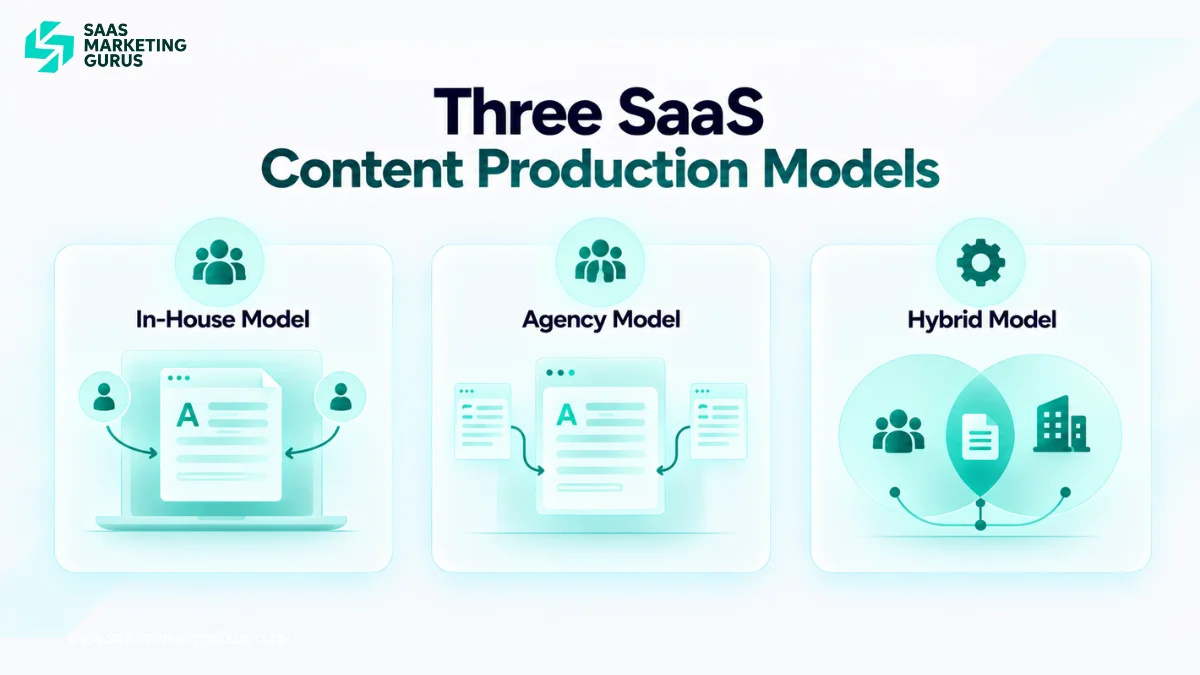
An agency is only useful if it covers the full production problem. If it delivers articles without briefs, SME interviews and refreshes, you still own the hardest parts. Our breakdown of agency vs in-house marketing covers the wider trade-offs, and the SaaS marketing budget guide shows how to size content spend against other channels.
How Do You Measure Content Development and Decide What to Refresh?
Measure each asset against its job. Judge problem articles on qualified traffic and assisted conversions, comparison and use case pages on demo requests, and technical guides on activation or support deflection. Output volume is not a success metric.
This is where most programs fall short. In the Content Marketing Institute’s 2026 research, 40% of B2B marketers named creating content that prompts a desired action, such as conversion, as a top challenge, and 33% named measuring content effectiveness. Both figures come from a self-reported survey of 1,015 B2B marketers, fielded June to August 2025.
Set a refresh trigger for every page instead of waiting for traffic to fall:
- Pricing, packaging or plan names change.
- An integration, feature or UI screen changes.
- A competitor in a comparison page changes positioning.
- The SERP or AI answer for the query shifts format.
- The page ranks but earns no conversions.
When a page underperforms, diagnose before you publish another one. The fix might be a better title, a stronger intent match, missing proof, weak internal links or a different page type. For reference, SMG reports +20 demos per week for a FinTech CRM after improving its visibility across search and comparison queries. That is a historical client result, not a forecast for another company.
What Should You Ask Before Buying Content Development Services?
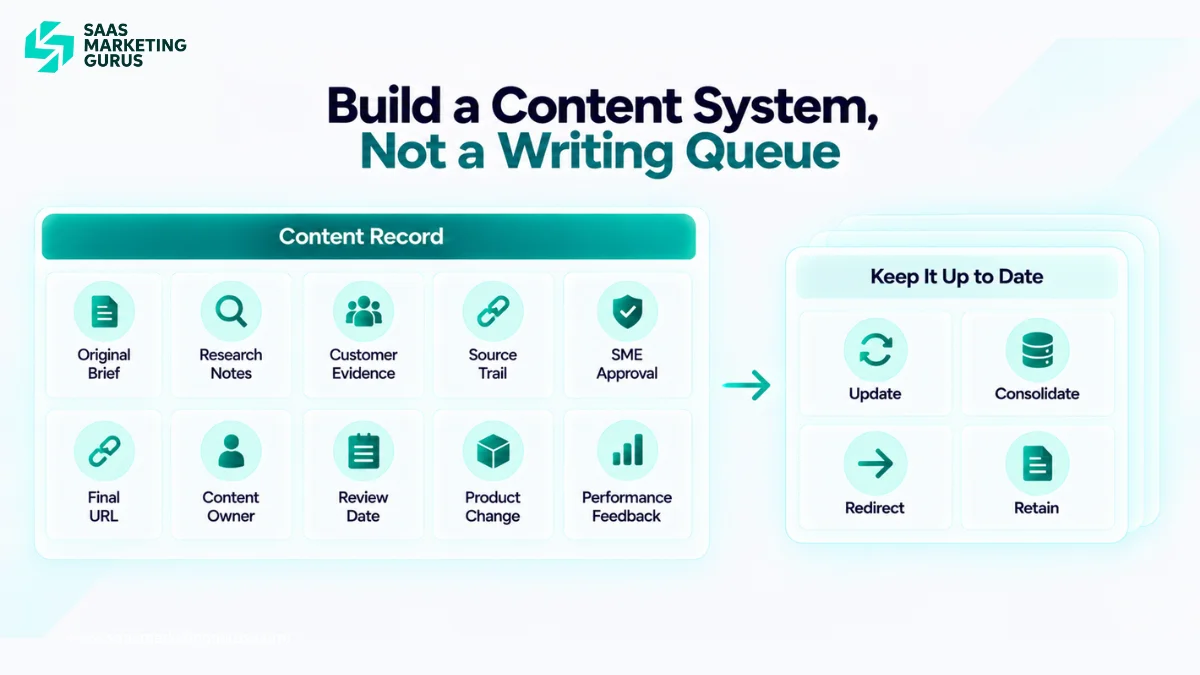
Ask how the provider handles research, SME access, fact-checking, revisions, publishing and refreshes, and ask to see a real brief. Those answers show whether you are buying a production system or a writing queue.
Use these production-focused questions:
- Who owns research and fact-checking, and where is the source trail stored?
- How do product experts review technical claims, and how much of their time do you need?
- What is your policy on AI-assisted drafting, and who verifies the output?
- How do you prioritize refreshes after publication?
- Who owns the briefs, research notes and drafts if the engagement ends?
- How do you connect content performance to qualified leads or demos?
If you are still choosing between strategy-led partners, our guide to choosing a content strategy agency for SaaS includes a weighted scorecard and proposal red flags.
Conclusion: Build a Production System, Not a Writing Queue
The best content development services for SaaS work as one system. Strategy sets the brief, SMEs supply the evidence, reviewers protect accuracy, and measurement decides what gets refreshed. The goal is a library that helps buyers answer questions, compare options and move toward a demo, not a higher article count.
For most B2B SaaS teams, the right starting point is a hybrid: keep one in-house owner for strategy and SME access, then add external production once briefs and review steps are documented. A fully in-house team makes more sense when volume is steady and product depth is the bottleneck.
Your next step: pick your five highest-intent pages, write a brief for each using the fields above, and record an owner and a refresh date. Review demo requests from those pages after one quarter.
If you want to put this system into practice, book a free strategy call with SMG and see how our SaaS SEO team would build your production workflow around demos, not word counts.
Frequently Asked Questions
What do content development services include for a SaaS company?
Content development services for a SaaS company include briefs, research, subject matter expert interviews, drafting, technical and SEO review, editing, publishing and scheduled refreshes. A complete service also records an owner and a review date for every page, so content stays accurate as pricing, features and integrations change.
What is the difference between content development and content creation?
Content creation usually means producing individual pieces such as articles, videos or graphics. Content development covers the full process around those pieces: briefing, research, expert input, fact-checking, optimization, publishing and maintenance. For SaaS companies, development matters more because technical accuracy and ongoing updates decide whether content keeps converting.
How long does it take to develop one SaaS blog post?
The timeline depends on SME availability, review rounds and topic complexity more than writing speed. A post that needs product confirmation or legal review takes longer than a general how-to. Agree on turnaround for each stage, especially SME review, before production starts, because unscheduled expert time is a common cause of delays.
Should SaaS companies use AI to write content?
SaaS companies can use AI to speed up drafting, but only after the brief and SME input are complete. AI cannot supply product facts, customer evidence or an original point of view. Set a written policy on where AI is allowed and assign a named person to verify every claim before publication.
How do I know if a content development company understands SaaS?
A content development company understands SaaS when it asks about your buyers, sales objections and product before discussing volume. Ask for a real brief, its SME interview process and an example of a refreshed page. Vague answers about process or reporting limited to traffic suggest a writing vendor, not a development partner.
How often should SaaS content be refreshed?
Refresh SaaS content when something it depends on changes: pricing, features, integrations, competitor positioning or the search results for its query. Review high-intent pages, such as comparison and use case pages, more often than general articles. Record a review date for each page so refreshes happen on schedule, not after traffic drops.