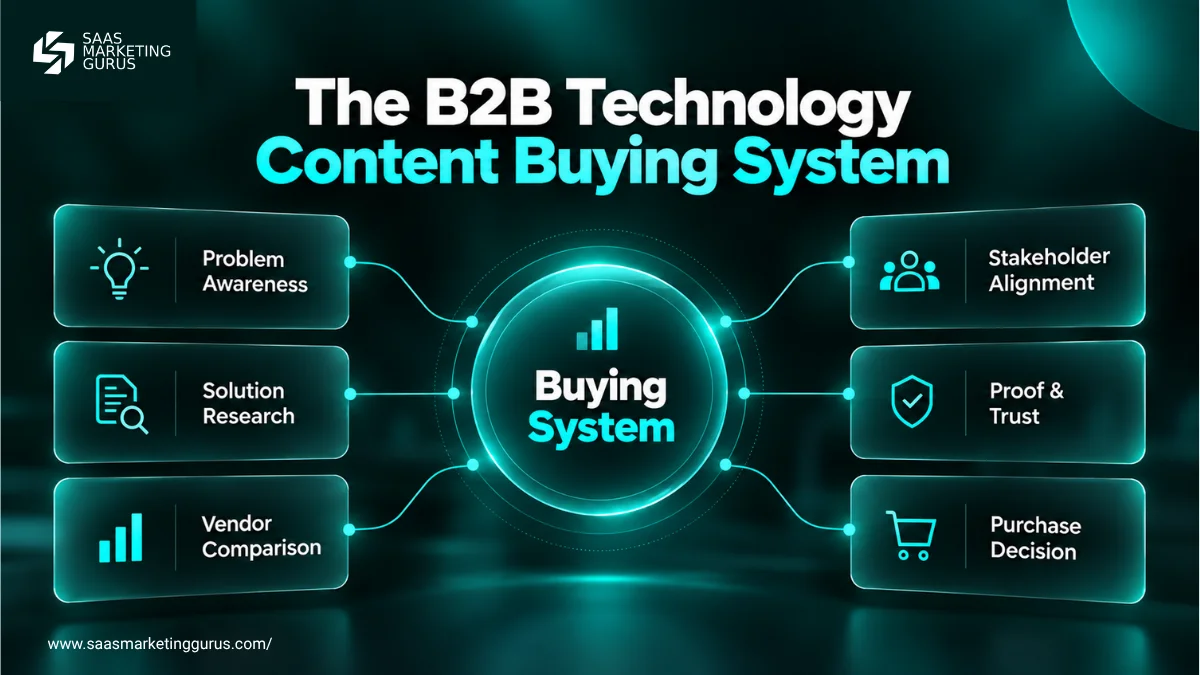
B2B technology content marketing works when each asset answers a specific question for a specific member of the buying committee, with enough technical proof to survive scrutiny. Your buyer usually understands the problem already. They need to know whether your product fits their architecture, workflow, security requirements, budget and business case.
That is where most SaaS content falls short. It ranks for broad terms, pulls traffic and never shows up in a real evaluation. SaaS Marketing Gurus (SMG), a B2B SaaS marketing agency specializing in Reddit marketing, Quora marketing, Generative Engine Optimization (GEO), SaaS SEO, and Product Hunt launches, builds content programs for the opposite outcome: demos and qualified pipeline.
This guide shows how to map content to technical buyers, keep it accurate, structure it for Google and AI search, and measure what it contributes to revenue.
What Is B2B Technology Content Marketing?
B2B technology content marketing is the practice of creating technically accurate content that helps every stakeholder in a software or technology purchase evaluate fit, risk and value. It covers integration guides, comparisons, case studies, security explainers and business cases, not just blog posts.
It differs from general B2B content in one way that changes everything: the reader can check your claims.
A developer can test your setup steps. A security lead can compare your data handling against their policy. A finance lead can rebuild your ROI math.
So the job is not to simplify the product until it sounds easy. The job is to remove uncertainty for the person making each part of the decision. If your SaaS content program has no strategy layer yet, start with our guide to SaaS content marketing strategy, then use this article to adapt it for technical buyers.
Why Does B2B Tech Content Need a Different Approach?
B2B tech content needs a different approach because buyers now research alone, across many sources and increasingly through AI tools, before they talk to sales. Your content is doing the first round of selling without a rep in the room.
According to a Gartner survey of 645 B2B buyers published in 2026, buyers used an average of seven information sources during a recent purchase. 45% used GenAI, mainly to gather information on vendors and products, and 67% said they prefer a rep-free buying experience.
Consistency matters too. Gartner research published in 2025 found 69% of B2B buyers saw inconsistencies between a supplier’s website and what its sellers told them.
Three things follow for SaaS teams:
- Several roles judge the purchase, each with different questions.
- AI answers summarize your pages, so vague claims get lost.
- Website content and sales messaging must say the same thing.
One generic article cannot serve all of that. A content system with a defined job for each asset can.
What Content Does Each Member of the Buying Committee Need?
Each member of a B2B tech buying committee needs content that answers their specific risk question with evidence they can verify. Map assets to roles before you plan topics, not after.
| Buyer | Question they need answered | Useful content | Proof it must contain |
|---|---|---|---|
| CTO or technical leader | Will this fit our architecture, scale and roadmap? | Architecture guides, integration pages, migration plans | Supported stacks, limits, dependencies |
| Developer or practitioner | What will implementation actually require? | Tutorials, workflow guides, code examples, troubleshooting | Working steps, prerequisites, edge cases |
| Security team | How are data, access and compliance handled? | Security pages, data flow explanations, compliance guides | Named controls, certifications, data residency |
| Finance or procurement | What will it cost, and what value will it create? | Pricing explainers, total cost comparisons, ROI models | Cost drivers, assumptions, payback logic |
| Executive decision maker | What outcome can we expect, and what are the risks? | Case studies, executive briefs, implementation plans | Baseline, timeframe, measured result |
| Internal champion | How do I build support for this internally? | Comparison pages, use cases, shareable summaries | Fair comparison criteria, customer proof |
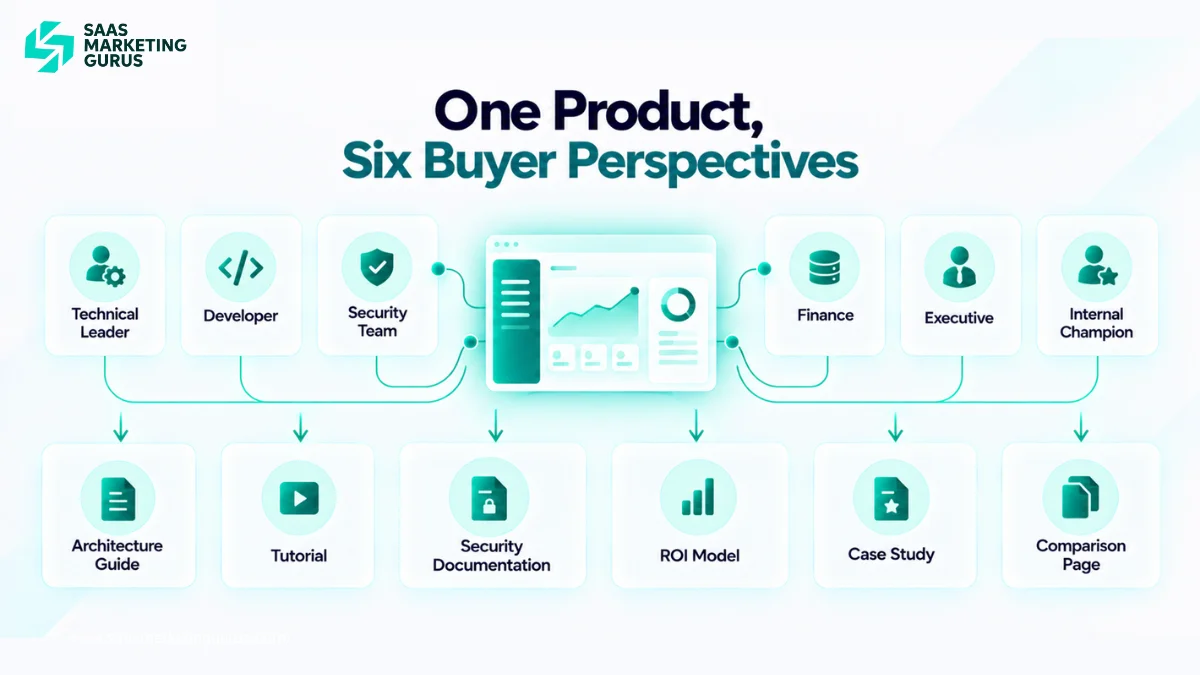
The last column is the part most teams skip. A security page without named controls, or a case study without a baseline, reads as marketing to a technical evaluator.
Use this table as a gap audit. List your existing assets under each role. Empty rows show where deals stall.
Which B2B Technology Content Formats Drive Pipeline?
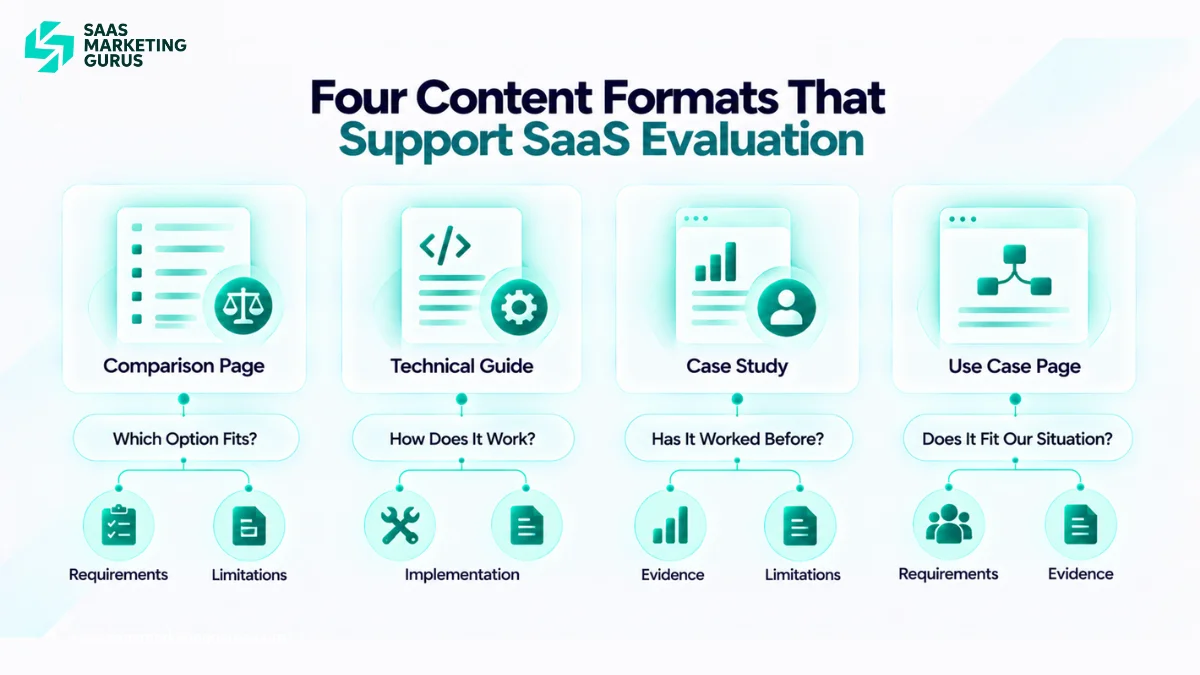
The formats that drive pipeline in B2B tech are the ones buyers use during active evaluation: comparisons, implementation guides, case studies, use case pages and integration pages. Awareness articles still matter, but they rarely move a shortlist on their own.
Comparison content supports buyers who are already choosing. Compare meaningful criteria, such as deployment model, integration depth and total cost, instead of repeating feature lists. State which type of team fits each option and where your product is the weaker choice.
Technical guides work when they solve a real implementation problem. A guide on data migration, API setup, deployment, observability or security should contain enough detail for the reader to understand the task and its prerequisites.
Case studies work when they show the starting situation, decision process, implementation and result. Buyers need to relate the example to their own situation, so include company type, team size, timeframe and the metric that changed.
Use case and integration pages connect a specific problem to the product. They give buyers and search engines a clear link between “we need X with Y” and your solution.
Prioritize by where deals stall. If prospects drop after the first call, build comparisons and business cases. If they stall in technical review, build integration and security content first.
How Do You Get Technical Accuracy Without Engineers Writing Every Post?
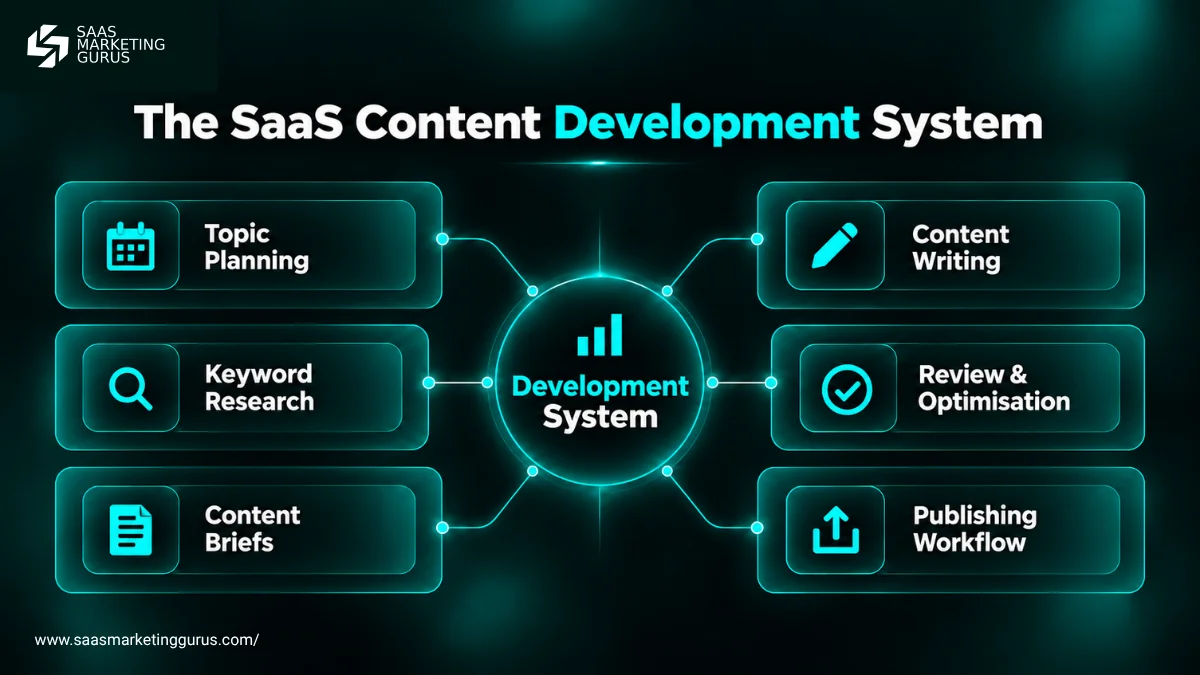
You get technical accuracy by pairing a skilled writer with a subject matter expert (SME) through a short, repeatable interview and review process. The writer owns structure and clarity. The SME supplies accuracy, product context, edge cases and real examples.
Most teams under-use their experts. The Content Marketing Institute’s B2B Content and Marketing Trends: Insights for 2026 (2025) found 37% of B2B marketers say fewer than 5% of their employees with specialized expertise actively contribute to thought leadership. The same survey found 12% of marketers using AI for content creation saw content quality decline.
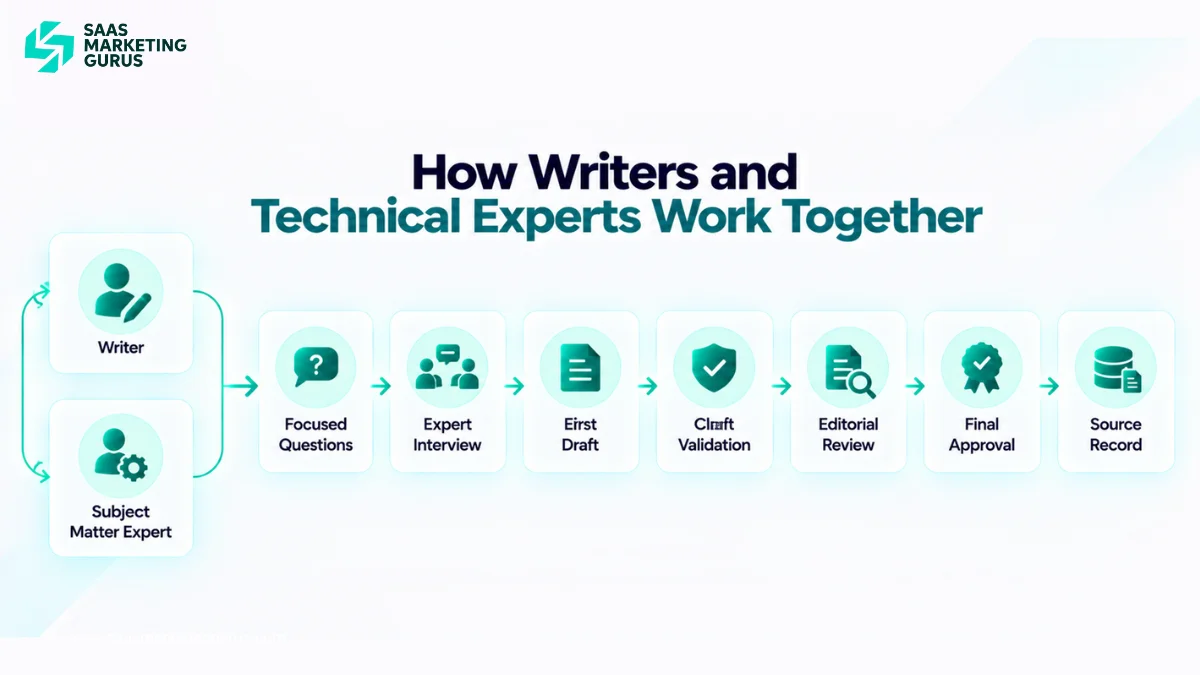
A simple SME process that respects engineering time:
- Send five to eight focused questions before the interview.
- Record a 20 to 30 minute call and transcribe it.
- Draft from the transcript, keeping the expert’s own examples.
- Return only the technical claims for approval, not the whole draft.
- Log approved claims so future articles can reuse them.
Research inputs should go beyond keyword tools. Product documentation, support tickets, sales call notes, implementation notes and community threads reveal the language and objections behind the query. Subreddits where your buyers talk shop are especially useful; our guide to subreddit targeting explains how to find the right ones.
If you lack the internal capacity to run this process, compare options in our overview of content development services for SaaS.
How Should B2B Tech Content Be Structured for Google and AI Search?
B2B tech content should open every section with a direct, self-contained answer, then support it with specifics, because both search results and AI answers pull short passages out of context. Google states that AI Overviews and AI Mode rely on the same SEO fundamentals as regular Search.
Google’s AI features documentation explains that both features may use “query fan-out,” running multiple related searches across subtopics to build a response. A page must be indexed and eligible for a snippet to appear as a supporting link. Google lists no additional technical requirements.
In practice, that means four structural habits:
- Put the answer in the first one to three sentences under each heading.
- Name the product, integration or standard explicitly instead of saying “it.”
- Use tables for comparisons and numbered steps for processes.
- State limits and prerequisites plainly; hedged claims rarely get quoted.
Query fan-out also rewards coverage. When a buyer asks an AI tool how two platforms compare on security, the answer draws on pages that address that sub-question directly. Our breakdown of how generative search engines rank content covers the signals in more detail.
Brand mentions outside your site matter too. Reddit threads and community discussions can surface in Google results and AI answers, which is why SMG’s Generative Engine Optimization services combine on-site structure with community and entity signals. None of this guarantees a citation; it makes your content easier to retrieve and quote accurately.
How Do You Connect Technical Content to the Product?
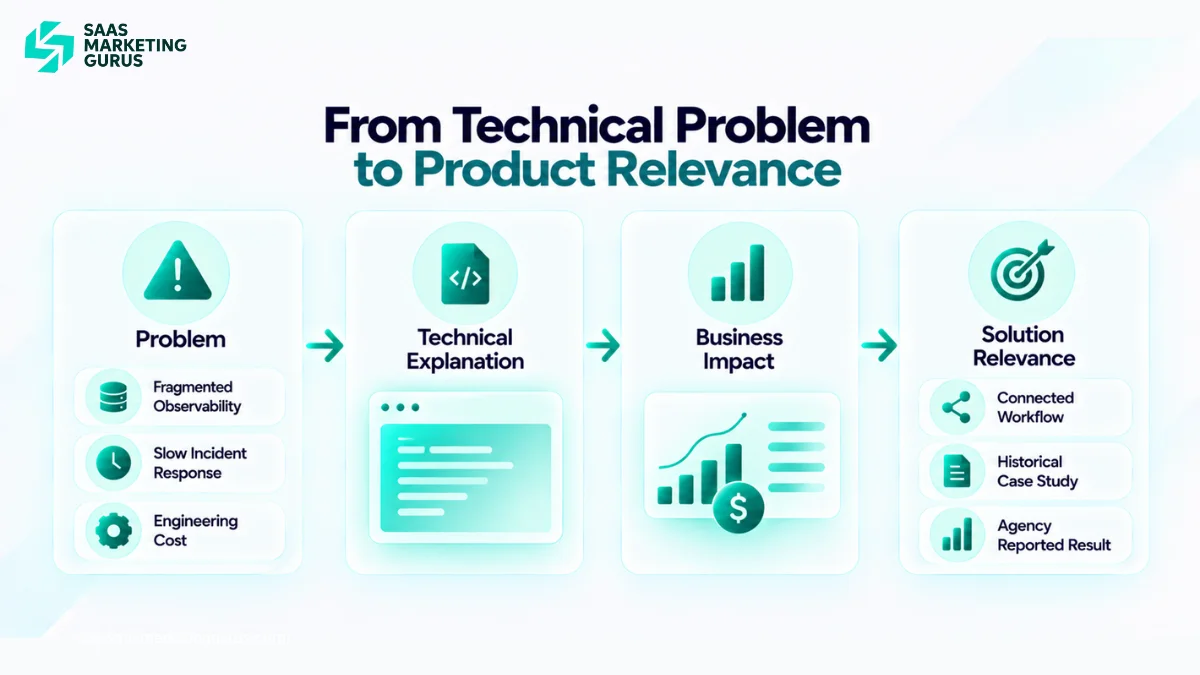
Connect technical content to the product with a four-part sequence: the problem in the buyer’s language, the technical cause, the business impact, and where your product fits. The article stays useful even if the reader never buys.
Here is how the sequence works:
- Problem: describe it the way the buyer describes it in tickets and threads.
- Technical cause: explain why it happens, with the mechanism named.
- Business impact: show the operational or financial consequence.
- Product fit: explain the available approaches and where yours fits, including when it does not.
Illustrative example: a DevOps platform might explain why fragmented observability slows incident response, show the technical causes, connect the delay to engineering cost, and then explain how its platform addresses that workflow.
SMG applies the same principle in its own SaaS SEO work, connecting high-intent searches to product-led pages. On its SaaS SEO services page, SMG reports 430+ buyer-intent keyword rankings and 40+ demos per month across B2B SaaS client work.
SMG also reports a 400% SEO ROI for a DevOps tooling company through structured content and community discussion. These are agency-reported figures, not universal benchmarks.
How Do You Measure B2B Technology Content Marketing?
Measure B2B technology content marketing by its influence on pipeline, not by traffic alone. Track which assets appear in the journeys of opportunities, which ones sales uses, and which ones drive demo requests.
Measurement is a common weak spot. CMI’s 2026 research found 33% of B2B marketers list measuring content effectiveness among their top three challenges, and 40% name creating content that prompts a desired action, such as conversion.
| Metric | What it tells you | Where to track it |
|---|---|---|
| Content-sourced demos | Which assets start conversations | Form source and first-touch data in your CRM |
| Content-influenced pipeline | Which assets appear in active deals | Opportunity contact touchpoints |
| Sales usage | Which assets reps send during evaluation | Sales enablement tool or shared link tracking |
| Buyer-intent rankings | Visibility for evaluation queries | Search Console, filtered to commercial terms |
| AI referral traffic | Visits from ChatGPT, Perplexity and similar tools | Analytics referral reports |
Review these quarterly by asset type. If comparison pages influence pipeline but tutorials only drive traffic, shift production toward comparisons. For the full path from visit to demo, see our guide to the SEO conversion funnel.
What Mistakes Hold B2B Tech Content Back?
The most damaging mistakes are writing for search volume instead of a defined buyer, and publishing surface-level explanations that technical readers dismiss. Each has a direct fix.
- Writing for volume. Fix: pick one buyer role and one decision question per asset.
- Shallow product explanations. Fix: include setup steps, limits and prerequisites.
- Unreviewed AI drafts. Fix: route every technical claim through SME approval.
- Only awareness content. Fix: build comparisons, integrations and use cases before more top-of-funnel posts.
- Hiding limitations. Fix: state what the product does not support; technical buyers trust it more.
- No measurement plan. Fix: tag every asset to a buyer role and track influenced pipeline.
Conclusion
B2B technology content marketing earns pipeline when it removes uncertainty for each person in the buying committee. The teams that win do not publish more. They publish assets with a defined job, verified technical detail and a clear path to the product.
Your next step: audit your existing content against the buyer table above. Pick the role with the emptiest row, usually security or finance, and ship two assets for it this quarter.
Measure success by whether those assets appear in active opportunities within 90 days. If they do not, review the topic choice with sales before producing more.
If you’re ready to turn technical expertise into content that shortlists your product, book a free strategy call with SMG and see how a dedicated SaaS marketing team can build it with you.
Frequently Asked Questions
What is the difference between B2B tech content marketing and B2B SaaS content marketing?
B2B tech content marketing covers any technology purchase, including hardware, infrastructure and developer tools, while SaaS content marketing focuses on subscription software. Both serve a buying committee. SaaS content leans more on trials, onboarding and expansion, while broader tech content often carries heavier security, integration and procurement detail.
Who should write technical content for a B2B SaaS company?
A skilled content writer should draft technical content, supported by a subject matter expert who reviews every technical claim. Engineers rarely have time to write full articles. A structured interview, a transcript-based draft and a claims-only review keep content accurate without pulling engineers away from product work.
What content converts best for technical B2B buyers?
Comparison pages, integration guides, security explainers and detailed case studies convert best for technical B2B buyers because they support active evaluation. Each works when it includes verifiable proof: supported stacks, prerequisites, named controls, or a baseline and measured result. Awareness articles support discovery but rarely move a shortlist alone.
How long does B2B technology content marketing take to show results?
Timing depends mainly on sales cycle length, since content influence shows up only when influenced deals reach the pipeline. Bottom-of-funnel assets, such as comparisons and integration pages, tend to show influence sooner than awareness content. Set a 90-day review, then track influenced pipeline quarterly rather than judging by traffic alone.
How do you get B2B tech content cited in ChatGPT and Google AI Overviews?
No tactic guarantees citations, but clear structure improves the odds. Open each section with a direct answer, name products and standards explicitly, and cover the sub-questions buyers ask. Google says AI Overviews use standard SEO fundamentals and require indexed pages eligible for snippets. Consistent brand mentions across communities also help.
Should a B2B tech company build content in-house or hire an agency?
Build in-house when you have writers with product access and SME time; hire an agency when you need specialized capacity, speed, or channel expertise such as SEO and GEO. Many SaaS teams combine both: internal experts supply accuracy while an agency runs strategy, production and distribution against pipeline goals.