
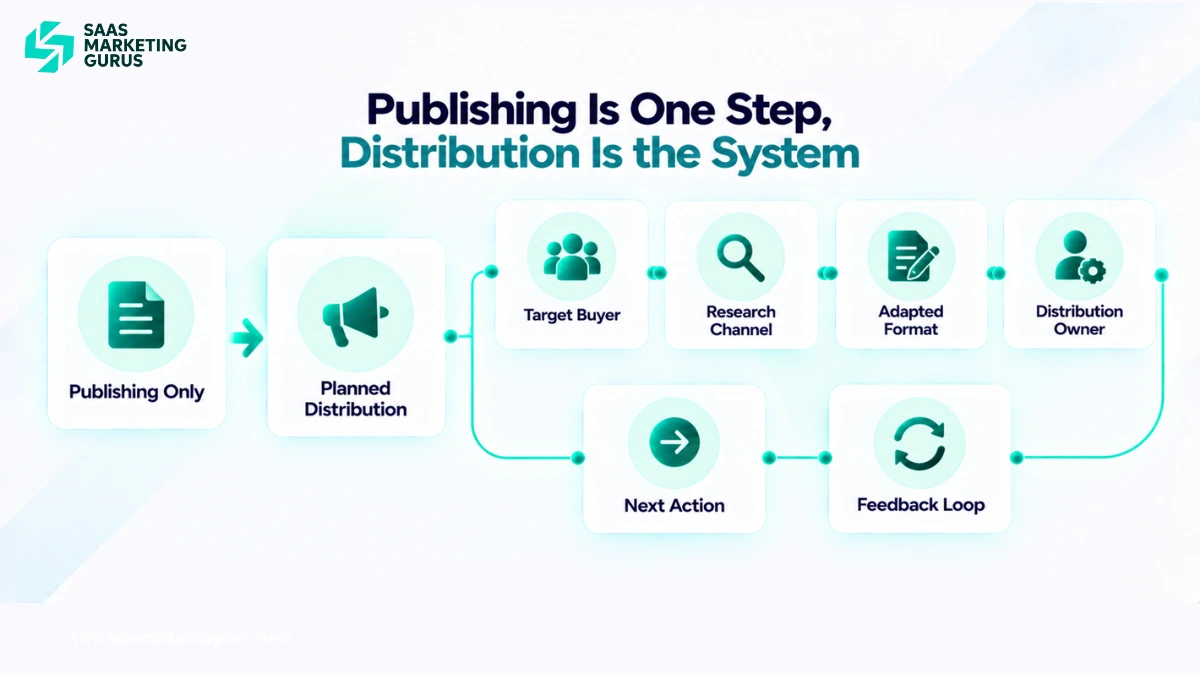
A content distribution strategy for SaaS decides, before an article is written, which channels it will reach, how it changes for each one, and which buyer action it should drive. Publishing puts the asset on your site. Distribution puts it where buyers already research.
That research now happens in several places at once. G2’s April 2026 survey of 1,076 B2B software buyers found that 51% start research in an AI chatbot more often than in Google, while 61% use AI search and Google together. A post that waits for rankings alone reaches only part of that journey.
This guide comes from SaaS Marketing Gurus (SMG), a B2B SaaS marketing agency specializing in Reddit marketing, Quora marketing, Generative Engine Optimization (GEO), SaaS SEO, and Product Hunt launches. It covers channel choice, asset adaptation, a 90-day distribution calendar, and how to measure distribution against pipeline.
What Is a Content Distribution Strategy for SaaS?
A content distribution strategy for SaaS is the documented plan for how each asset reaches its target buyers after publication: which channels, in which format, owned by whom, and measured against which business outcome. It turns a publishing calendar into a pipeline system.
The difference from publishing matters. An article can rank for months and still miss the buyers who compare vendors inside ChatGPT, a subreddit, or a review site. Distribution closes that gap by sending the same core idea to each place buyers look, in the format that place rewards.
A working content marketing distribution strategy uses three channel types, each with a different job:
| Channel type | Examples | What it does well | Limitation |
|---|---|---|---|
| Owned | Website, blog, email list | You control the message, links, and conversion path | Reach depends on your existing audience and rankings |
| Earned | Reddit threads, Quora answers, reviews, AI answers | Third-party trust from sources buyers and AI tools check | You cannot control what others say, and it needs steady participation |
| Paid | LinkedIn ads, retargeting, sponsored newsletters | Fast, precise targeting | Stops when spend stops and builds little trust alone |
Start from owned channels, earn trust in communities and review sites, and use paid only to speed up assets that already convert.
Where Do SaaS Buyers Research Before They Buy?
SaaS buyers research across AI chatbots, Google, review sites, and peer communities, usually in combination. Your distribution plan should follow that mixed path instead of betting on one traffic source.
G2’s 2026 research on AI search and software buying shows the pattern:
- 51% start software research in an AI chatbot more often than Google.
- That figure was 29% in G2’s 2025 Buyer Behavior Report.
- 71% rely on AI chatbots at some point in their research.
- 61% use AI search alongside Google, not instead of it.
- A review-site citation is the top signal that raises trust in an AI answer.
Two practical conclusions follow. First, Google still matters, and Google’s own guidance says standard SEO best practices apply to AI Overviews and AI Mode. Second, AI tools assemble answers from many third-party sources, so the threads, answers, and reviews that mention your product become part of your distribution footprint.

G2 also found that buyers read consistent descriptions across ChatGPT, Gemini, and Claude as a trust signal. Keeping your positioning identical on your site, review profiles, and community answers is therefore part of the distribution job.
Which Channels Should a SaaS Content Distribution Strategy Use?
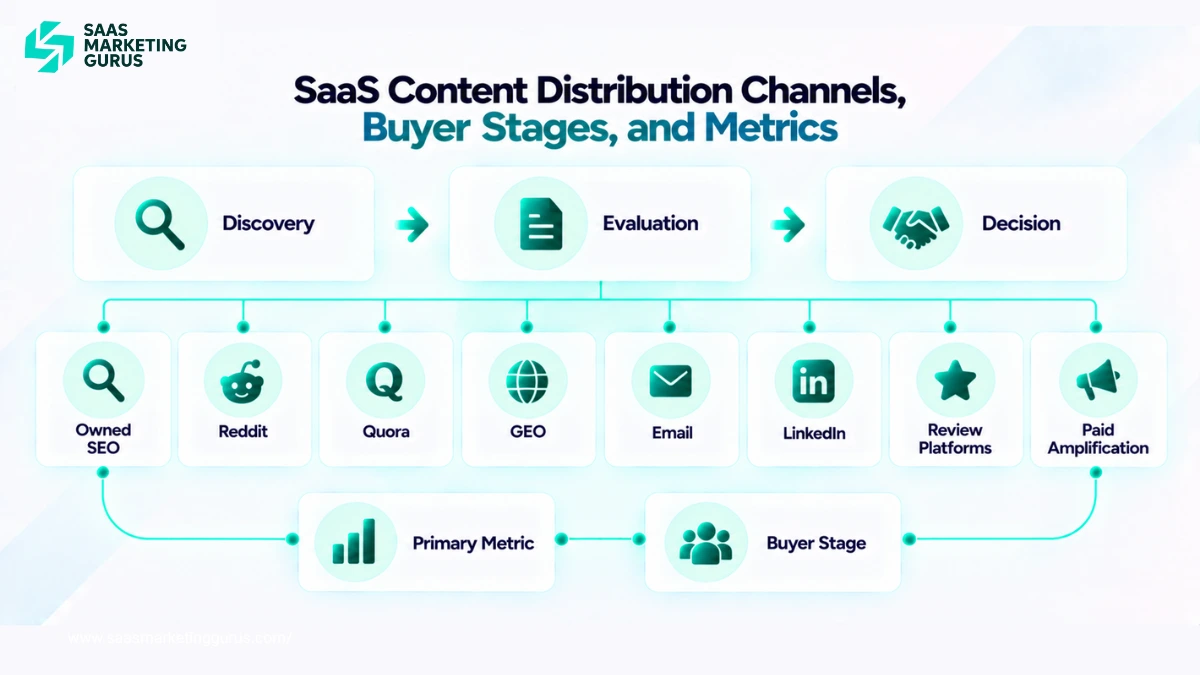
Choose the three or four channels where your target buyer already asks questions, then add more only after those channels show a link to demos. For most B2B SaaS teams, that core is owned SEO, email, one community such as Reddit or Quora, and content structured for AI answers.
How Does Your Own Site Anchor Distribution?
Your website is the distribution foundation because you control the page, internal links, conversion path, and update cycle. Every other channel should send buyers back to an owned page built to convert.
Prioritize organic investment by intent. Comparison, alternatives, use-case, integration, and solution pages usually deserve more promotion than broad awareness posts because the reader is closer to a shortlist. SaaS SEO sets which of these pages exist and how they link to each other.
How Do You Distribute Content on Reddit?
Reddit distribution works through participation, not link posting. Find threads where your buyer already asks a relevant question, answer it fully in the comment, and mention your product or article only when it directly answers the question and the subreddit rules allow it.
Treat each subreddit as its own audience. Read the rules, check what moderators remove, and build a comment history before you share anything you own.
Reddit threads also show you buyer objections that belong in your next article update. A Reddit marketing program works best when it runs every week, not only on launch day.
How Does Quora Fit a SaaS Distribution Plan?
Quora suits question-led research, where a buyer types a specific problem and reads several expert answers. Write each answer so it stands alone, explain the reasoning behind your recommendation, and add a link only as supporting reading.
Pick questions that match your commercial topics and still get views. Answer from real experience, with numbers you can support. Quora marketing done this way also adds to the public, third-party material AI tools can find.
How Do You Distribute Content Into AI Answers?
You cannot submit an article to ChatGPT or Google AI Overviews, but you can make it easy for them to find, trust, and quote. Generative Engine Optimization (GEO) is the practice of shaping how a brand is represented and retrieved in AI-generated answers.
In practice, that means clear definitions, a direct answer under each heading, original evidence, and the same product facts across your site, review profiles, and community answers. Google notes that AI Overviews and AI Mode can use query fan-out, running several related searches to build one response, so covering the sub-questions around a topic gives retrieval more to work with.
Our Generative Engine Optimization service and this guide to AEO and GEO for SaaS cover the structure in more depth.
Why Do Review Platforms Belong in Distribution?
Review platforms such as G2 and Capterra distribute proof rather than articles. They matter because buyers trust AI answers more when those answers cite review sites.
Ask recently successful customers for reviews that describe the problem your latest content addresses. Keep your category, positioning, and feature descriptions on each profile consistent with your website.
How Should Email and LinkedIn Carry an Asset?
Email and LinkedIn put an asset in front of people who already know you. In CMI’s 2026 B2B research, marketers rated LinkedIn (76%) and email newsletters (54%) as the most effective channels for thought leadership content.
Send subscribers one lesson and one link, not the whole article. On LinkedIn, publish the insight natively from a founder or subject-matter expert and add the link in context. Our comparison of Reddit vs LinkedIn marketing explains where each platform fits.
When Is Paid Distribution Worth It?
Paid distribution is worth it after an asset proves it converts organically. Use LinkedIn ads or retargeting to push a comparison guide or case study that already produces demos, not to rescue an article nobody engages with.
Set a budget cap and one success metric, such as cost per qualified demo, before the campaign starts.
How Do You Adapt One Asset for Each Channel?
Keep the core idea fixed and change only the format, length, and call to action for each channel. Pasting the same article everywhere reads as promotion, and communities ignore or remove it.
This map connects each channel to the buyer stage it serves and the metrics that show it is working:
| Channel | Adapted format | Buyer stage | Leading signal | Business metric |
|---|---|---|---|---|
| Organic search | Updated article or comparison page | Research to evaluation | Impressions and rankings for target queries | Demo requests from organic sessions |
| AI answers | Direct answers, definitions, consistent product facts | Discovery to shortlist | Brand mentions for tracked buyer prompts | Self-reported AI sources on demo forms |
| Full-answer comment or discussion post | Evaluation | Replies and upvotes | Referral sessions and branded search trend | |
| Quora | Standalone expert answer | Problem research | Answer views and upvotes | Referral sessions to commercial pages |
| Review sites | Fresh reviews tied to use cases | Validation | Review volume and recency | Reviews mentioned in sales calls |
| One lesson, one link | Nurture | Click rate | Replies and demos from subscribers | |
| Native post from a named expert | Awareness to consideration | Comments from target accounts | Inbound conversations | |
| Paid | Retargeting with a proven proof asset | Decision | Click cost from target accounts | Cost per qualified demo |
Here is how that looks for one asset (illustrative example). A security SaaS company publishes “SOC 2 automation vs manual audit prep.” The article targets comparison searches, and the launch email sends one cost insight to subscribers.
The founder posts the three biggest audit delays on LinkedIn. The team answers an existing Reddit thread about audit prep time without a link unless someone asks for one. On Quora, it answers a question about how long SOC 2 takes for a startup, with the article as supporting reading.
One idea, five formats, each matched to how that audience reads.
How Do You Build a Content Distribution Calendar?
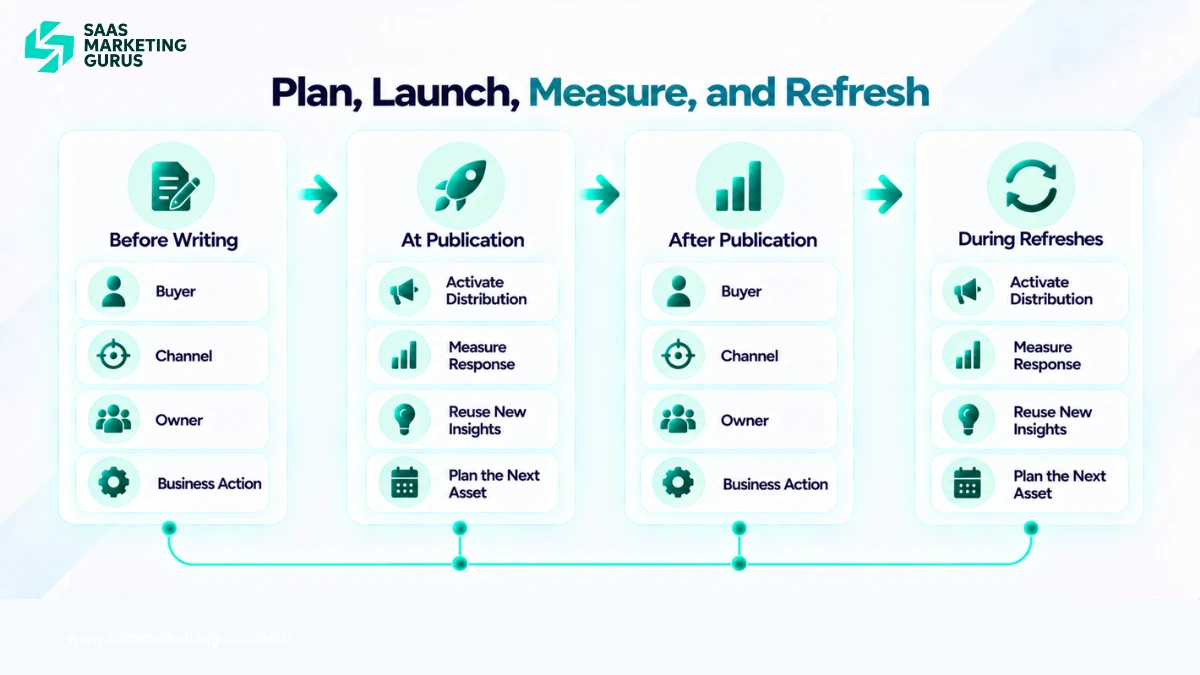
A distribution calendar schedules promotion in waves around each asset, starting in the brief and running about 90 days after launch. Because it follows the asset, it never turns into a separate social schedule disconnected from content goals.
- Before writing: add a distribution section to the brief with the target buyer, channels, format per channel, owner, and the business action the piece should drive. Build reusable parts into the draft, such as quotable findings, tables, and examples.
- Launch week: publish, add internal links from related pages, send the email, and post native LinkedIn content.
- Weeks 2 to 4: answer relevant Reddit and Quora questions, share one new insight per week, and give sales the asset for live deals.
- Days 30 to 90: review which channels drove engaged sessions and demos, refresh the article with new buyer questions, and push the update through the channels that worked.
Give every step a named owner. Distribution most often fails when the content team assumes social will promote an asset and the social team assumes content already did.
Topic choice decides how far an asset can travel. Original data, clear opinions, comparisons, and frameworks give each channel something worth discussing, which is why distribution planning belongs in your wider SaaS content marketing strategy, not after it.
How Do You Measure Content Distribution by Pipeline?
Measure distribution in two layers: leading signals for each channel, and one shared business outcome such as qualified demos or influenced pipeline. Leading signals show a channel is working. The business outcome shows it is worth continuing.
The second layer is where most teams struggle. In CMI’s 2026 B2B research of 1,015 marketers, the most common content challenge was creating content that prompts a desired action (40%), and 33% named measuring content effectiveness.
Three practices close that gap:
- Ask buyers directly. Add a required “How did you hear about us?” free-text field to demo forms. It captures Reddit threads, AI chatbots, and podcasts that analytics tags miss.
- Watch branded demand. Track branded search and direct traffic next to community activity, because a Reddit discussion or AI answer often shows up later as a branded search, not a referral click.
- Review monthly, cut quarterly. Check every channel against demos each month, and drop the weakest after 90 days of consistent effort.
Last-click attribution undercounts community and AI channels. Judge them with self-reported sources and trend lines instead.
What Mistakes Break a SaaS Content Distribution Strategy?
Most distribution failures come from treating it as an afterthought or a copy-paste job. Watch for these five:
- Planning distribution after publishing. Without channels and an owner in the brief, promotion shrinks to one LinkedIn post.
- Dropping links in communities. Reddit and Quora audiences remove or ignore promotional posts from accounts with no history.
- Spreading across too many channels. Four channels run every week beat eight channels run once.
- Inconsistent positioning. Different product descriptions across your site, reviews, and answers weaken trust with buyers and AI tools alike.
- Judging by last click only. Community and AI influence rarely appears as the final touch before a demo.
Build Your Content Distribution Strategy Around Buyers
A content distribution strategy for SaaS works when every asset has a destination list before it has a draft. The channels matter less than the fit: each one should match where your buyer already asks questions and carry a format that reads naturally there.
If your team is small, start with owned SEO, email, and the one community where your buyers are most active. Add LinkedIn when a named expert can post weekly, and add paid only for assets that already convert to demos.
Next step: pick one high-intent article, map it to four channels using the table above, run the 90-day wave, and compare demo requests and self-reported sources against the previous period.
If you’re ready to put a buyer-first distribution system into practice, book a free strategy call with SMG and see how a dedicated SaaS marketing team can run it across SEO, Reddit, Quora, and GEO for you.
Frequently Asked Questions
What is the best content distribution strategy for a B2B SaaS startup?
The best content distribution strategy for a B2B SaaS startup focuses on three or four channels: owned SEO, an email list, one buyer community such as Reddit or Quora, and consistent product facts for AI answers. Plan channels in the brief, adapt the format for each, and judge results by demos, not reach.
How many channels should a SaaS company use to distribute content?
Most SaaS teams should run three or four distribution channels consistently before adding more. Choose the channels where buyers already ask questions about your category, publish there every week, and drop the weakest after about 90 days if it shows no link to demos or qualified pipeline.
How do you promote SaaS content on Reddit without getting banned?
Promote SaaS content on Reddit by answering questions fully in the comment, following each subreddit’s rules, and building a history of helpful contributions first. Share a link only when it directly answers the question. Accounts that post links without participating are the ones moderators and users remove.
Does content distribution help a SaaS brand appear in ChatGPT and AI Overviews?
Content distribution can improve how AI tools find and describe a SaaS brand, but it guarantees nothing. AI answers draw on many third-party sources, so consistent product facts across your site, review profiles, Reddit, and Quora give those systems more accurate material to retrieve and repeat.
How long should you keep distributing a blog post after publishing?
Plan to distribute a strong blog post for about 90 days. Use launch week for owned channels, weeks two to four for communities and sales enablement, and days 30 to 90 for a refresh based on new buyer questions, then promote the updated version again.
How do you measure whether content distribution drives pipeline?
Measure content distribution by pairing channel signals with one shared outcome, such as qualified demos. Add a free-text “How did you hear about us?” field to demo forms, track branded search next to community activity, and review channels monthly, since last-click attribution undercounts Reddit, Quora, and AI influence.