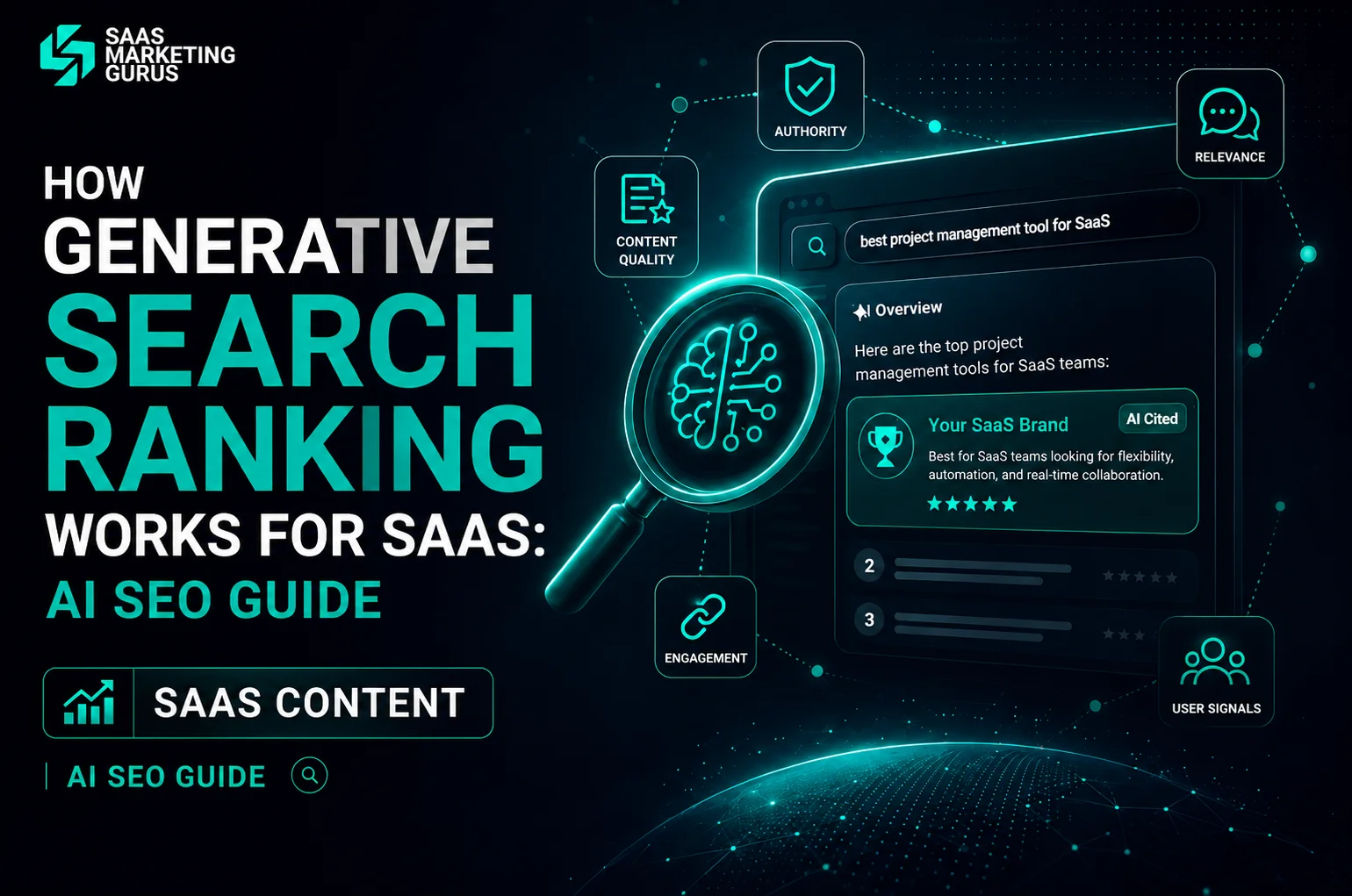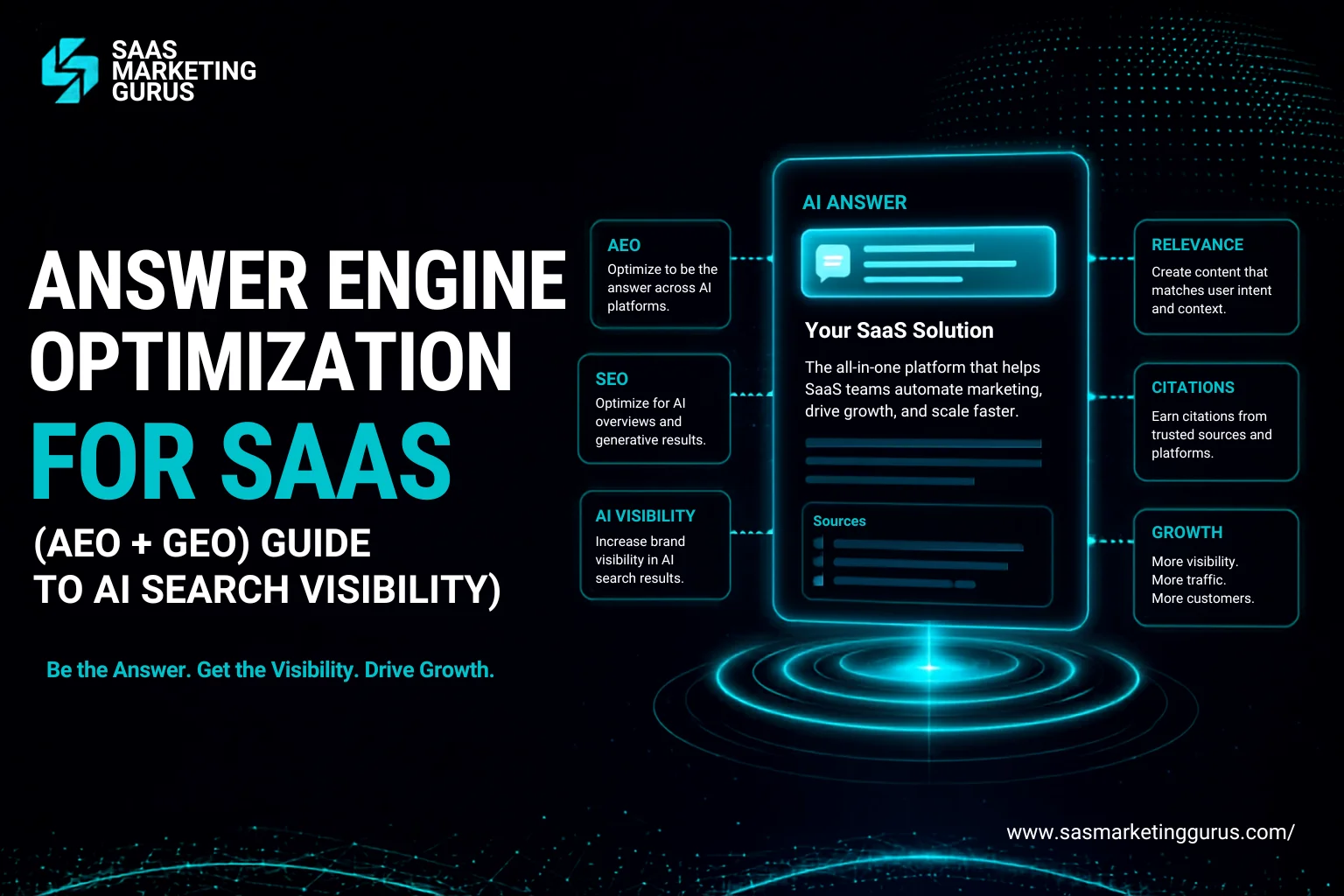
Learn how to optimize SaaS content for AI search engines like ChatGPT and improve visibility in AI-generated answers.
Ranking SaaS content today is not just about Google anymore. AI search engines like ChatGPT and other answer engines are changing how people find tools, compare options, and make decisions. If your content is not showing up in AI-generated answers, you are basically invisible to a growing share of your audience.
Many SaaS founders still rely on traditional SEO tactics that focus on keywords and backlinks, but AI search looks at context, clarity, and real usefulness. It pulls answers, not just links. This creates a gap where good products get ignored simply because their content is not structured for AI retrieval.
The fix is not complicated, but it does require a shift. You need to optimize your SaaS content for how AI understands, selects, and presents information, not just how search engines rank pages.
If you need help building an AI-first SaaS SEO strategy, SMG’s SaaS SEO services can help improve your visibility across Google and AI search engines.
What is AI Search and SaaS Content
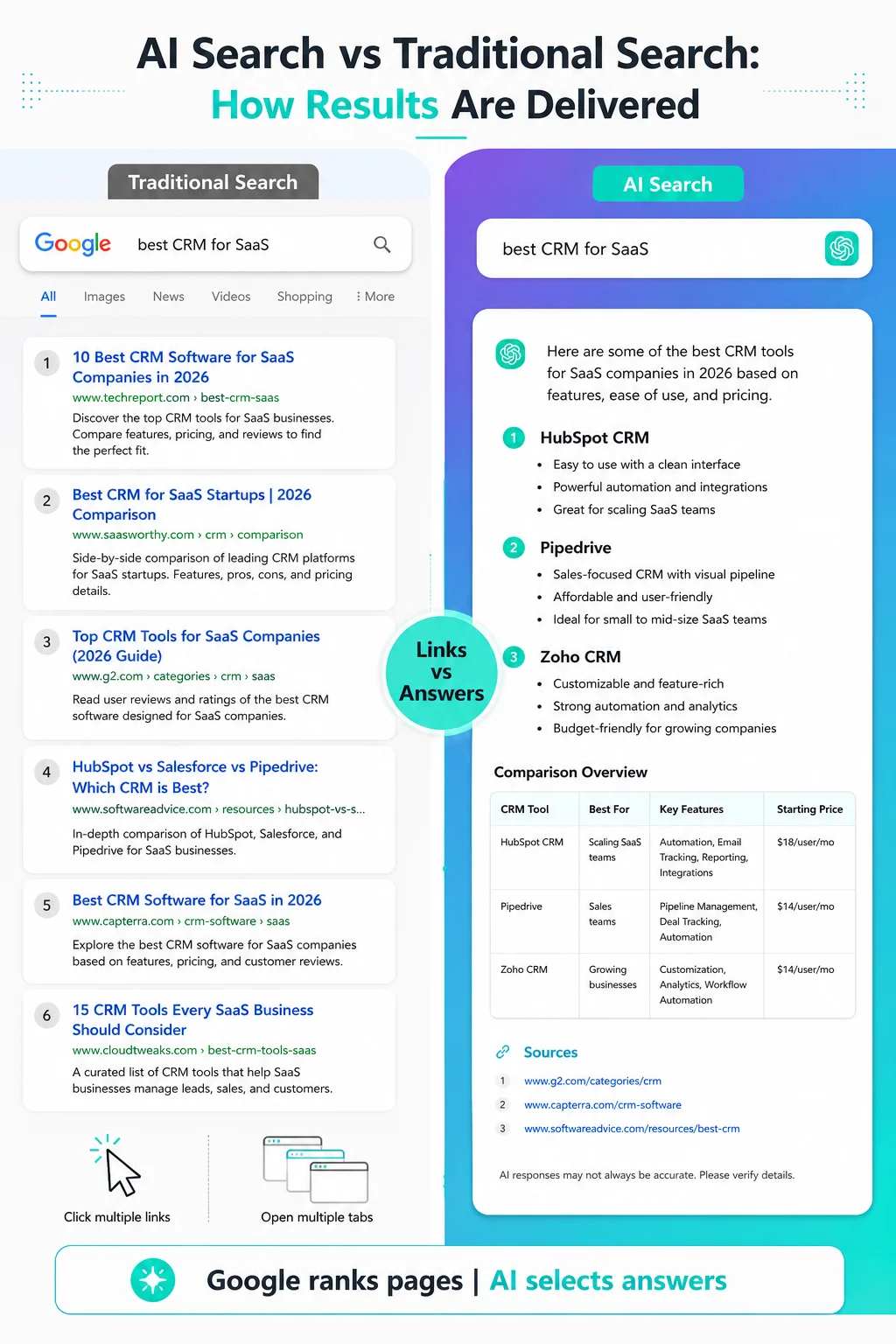
AI search engines are tools like ChatGPT, Perplexity, and similar platforms that don’t just show a list of links like Google. Instead, they read multiple sources, understand the context, and give direct answers. So instead of users clicking through 5 websites, they get one clean response. This is where AI search optimization and answer engine optimization start to matter. Your content is no longer competing just to rank; it’s competing to be selected and cited inside those answers.
Traditional search is keyword-driven. You type something, you get links, you pick one. AI search is intent-driven. It looks at what the user actually means, not just what they typed. For example, a user searching “best CRM for small SaaS team” might get a full comparison answer instead of a list of blog posts. If your SaaS content is not structured properly or lacks clarity, it won’t even be considered for AI retrieval.
This is why SaaS brands need to shift their content strategy. You can’t rely only on basic SEO anymore. You need a mix of generative search optimization, a strong LLM content strategy, and proper AI content optimization. That means writing in a natural way, using clear explanations, and structuring content so AI can easily pick it up.Think of it like this.
Google rewards pages. AI rewards answers. If your content is built with structured content, semantic search in mind, and includes clear explanations with strong AI citations, your chances of showing up in AI-generated results increase a lot.
For SaaS founders and small teams, this shift is important because AI search is quickly becoming a major discovery channel, especially for users who want quick, trusted recommendations without digging through multiple pages.
How AI Search Engines Rank Content
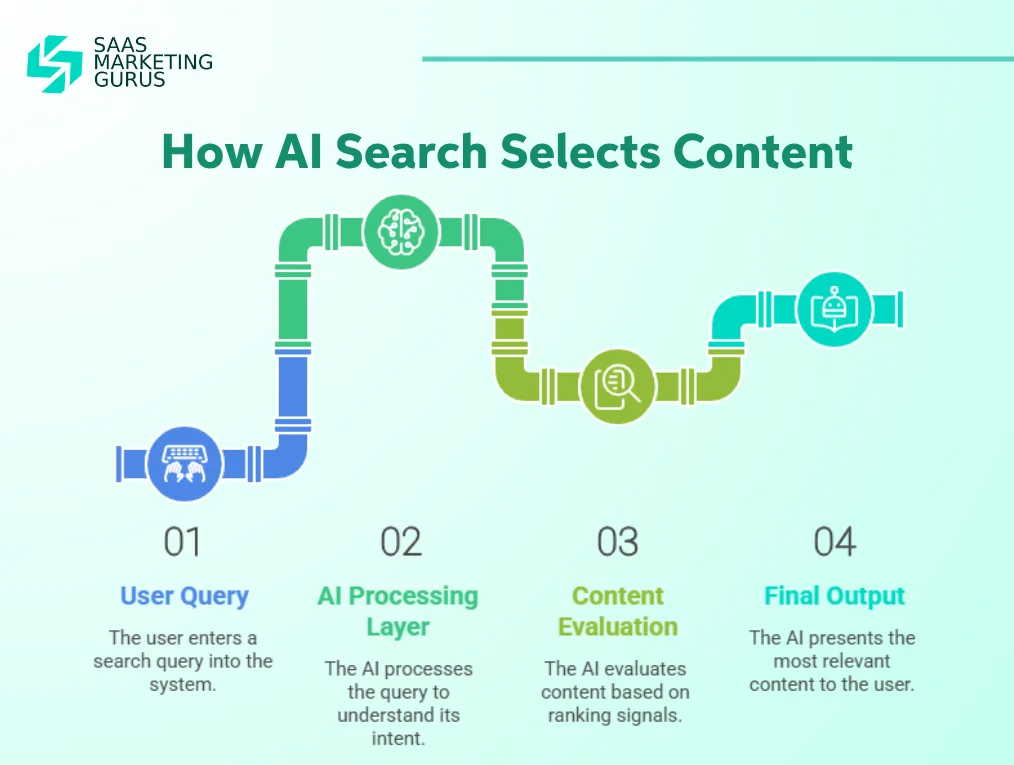
Understanding AI Retrieval and Ranking Signals
AI search does not rank content the same way Google does. It does not just scan for keywords and backlinks. It looks at relevance, context, and intent. Basically, it tries to understand what the user actually wants, then pulls the best possible answer from different sources. This is where AI search optimization and LLM content strategy come into play.
Relevance means your content directly answers the query. If someone asks “best onboarding tools for SaaS,” AI will look for content that clearly explains tools, use cases, and comparisons. If your page is vague or too generic, it gets ignored.
Context is about how well your content fits the full question. AI reads surrounding sentences, not just headings. So if your content explains features, pricing, and real use cases together, it performs better in AI retrieval. This is why AI content optimization focuses on clarity and depth, not just stuffing keywords.
Intent matching is key. AI tries to figure out if the user wants a guide, a comparison, or a recommendation. For example, “how to reduce churn in SaaS” is a problem-solving query. If your content gives clear steps, it has a higher chance of being selected.
Semantic search also plays a big role. AI connects related ideas using entities. Instead of just matching “CRM tool,” it understands related terms like “customer management,” “pipeline tracking,” and “sales automation.” So your content should naturally include these connections. This helps AI understand your topic better and improves your chances of showing up in answers.
Importance of AI Citations and Source Trust
AI does not just pick random content. It prefers sources it can trust. This is where AI citations matter. When AI pulls an answer, it often references content that looks reliable, structured, and consistent with other sources.
If your SaaS blog clearly explains a topic and matches information from other trusted sites, it is more likely to be cited. For example, if multiple sources mention similar benefits of a tool and your content explains it clearly with structured content, AI is more likely to include your explanation.
Building trust is not just about backlinks anymore. It is about clarity, consistency, and usefulness. Content that is easy to read, well structured, and directly answers questions performs better in answer engine optimization.
You can improve source trust by writing clear definitions, adding examples, and covering topics in depth. Also, having mentions across platforms like blogs, communities, or discussions helps reinforce your credibility. The more signals AI sees that your content is reliable, the higher your chances of being included in AI-generated answers.
Keyword Strategy for AI Search Optimization
Moving Beyond Traditional Keywords
Old school SEO was all about exact match keywords. You pick one keyword, repeat it, and hope to rank. That does not work the same way in AI search. Now it is more about how people actually talk. This is where generative search optimization and AI content optimization come in.
People don’t search like robots anymore. They ask full questions. For example, instead of typing “SaaS CRM tool,” they might ask, “What is the best CRM for a small SaaS team with a limited budget?” AI search engines are built to understand these natural language queries, so your content needs to match that style.
Long tail keywords are super important here. These are longer, more specific phrases that reflect real intent. Think “how to reduce churn in SaaS onboarding” or “best email tools for SaaS startups under $50.” These are easier for AI to understand and match during AI retrieval.
Question-based keywords also help a lot. Adding sections like “how,” “why,” and “what” makes your content easier for answer engine optimization. AI loves clear, direct answers it can pull and show instantly.
Read – SaaS Keyword Research: How to Find High-Intent Keywords That Drive Revenue
Mapping Keywords to User Intent
Not all keywords mean the same thing. AI tries to figure out what the user actually wants before showing an answer. So you need to match your SaaS content with the right intent.
Informational queries are when users just want to learn. For example, “what is SaaS churn rate” or “how does onboarding work in SaaS.” Here, your job is to explain clearly using structured content and simple language.
Comparison queries are when users are evaluating options. Like “HubSpot vs Salesforce for SaaS” or “best analytics tools for SaaS startups.” In this case, AI looks for content that compares features, pricing, and use cases side by side.
Decision queries are more action-driven. For example, “Which CRM should I choose for my SaaS startup?” These need clear recommendations, pros and cons, and real use cases.The key is aligning your keywords with real problems. Do not just chase search terms. Think about what your audience is struggling with. When your content solves those problems in a clear and structured way, it fits better into LLM content strategy and improves your chances of showing up in AI-generated answers.
Creating Content That AI Can Easily Understand
Writing Clear and Direct Answers
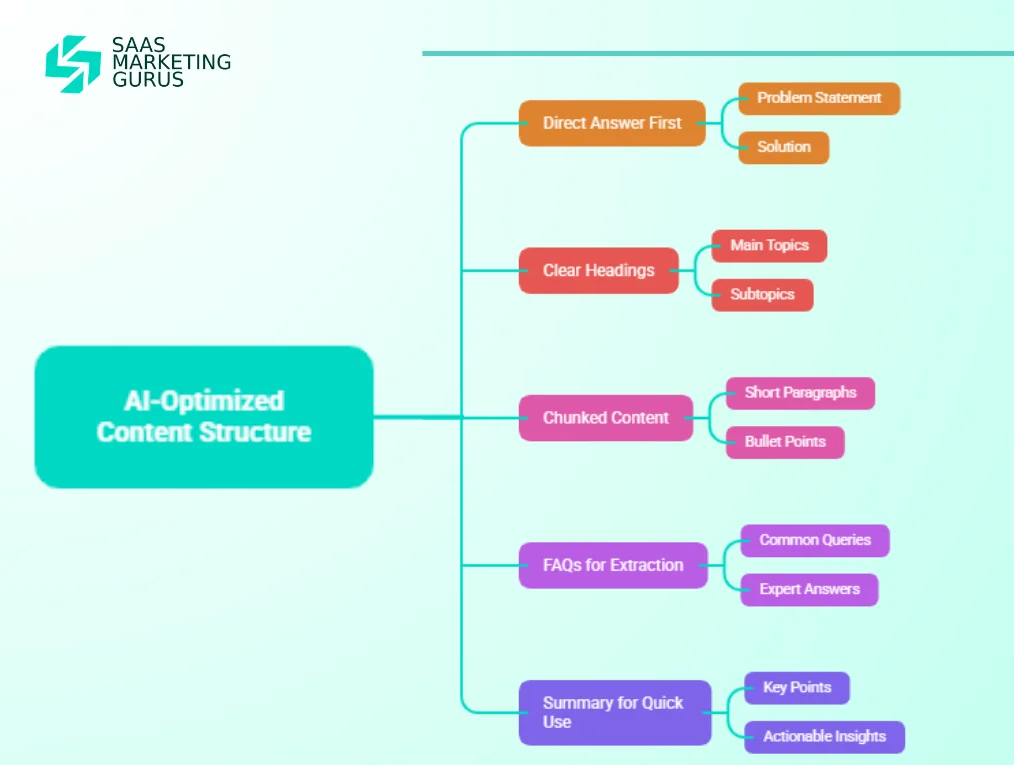
AI does not have time to “figure out” your content. It scans, extracts, and moves on. So if your answer is buried under fluff, it gets skipped. This is why the first approach is key in AI content optimization.
Start your section with a direct answer. For example, if the query is “how to reduce churn in SaaS,” don’t start with a long intro. Just say it straight: “To reduce churn in SaaS, focus on better onboarding, regular user engagement, and clear value delivery.” Then explain it. This makes it easier for AI retrieval systems to pick your content.
Also, keep your language simple. No jargon overload. No complicated sentences trying to sound smart. AI prefers clarity over complexity. If a 10-year-old can understand your sentence, you are on the right track. This helps both users and search engine optimization.
Using Structured Content Formats
Structure is everything in AI search optimization. If your content is messy, AI cannot break it into usable chunks. And AI works in chunks, not full pages.
Use clear headings (H2, H3) to separate ideas. Keep paragraphs short. Add bullet points where needed. This makes your content easier to scan and improves how it performs in semantic search.
FAQs are a cheat code here. Add sections like “What is SaaS onboarding?” or “Why does churn happen in SaaS?” with short, direct answers. AI loves this format because it can quickly extract and reuse it in responses.
Also, include small summaries at the end of sections. Even 2 to 3 lines that wrap things up can help. It gives AI a clean, ready-to-use answer.
At the end of the day, structured content is not just for SEO anymore. It is a core part of the LLM content strategy. If your content is clean, clear, and easy to break down, your chances of showing up in AI-generated answers go way up.
Optimizing Content for Semantic Search
Using Entities and Contextual Signals
AI search does not just look at keywords. It looks at the meaning. This is where semantic search and entity-based SEO come in. Instead of focusing on one keyword like “CRM software,” AI connects related entities like “customer data,” “sales pipeline,” “automation,” and “lead tracking.” It builds a full picture.
So if your SaaS content only repeats one keyword, it feels incomplete to AI. But if you naturally include related terms and explain how they connect, your content becomes stronger. For example, if you are writing about “SaaS onboarding,” you should also talk about user activation, churn rate, product adoption, and retention. This gives AI more context during AI retrieval.
Also, stop treating content like isolated pages. One blog, one keyword, done. That approach is outdated. AI content optimization is about covering topics in depth. The more complete your explanation is, the higher the chances AI will trust and use your content in answers.
Building Topical Authority in the SaaS Niche
Topical authority means becoming the go-to source for a specific topic. AI search engines prefer content from sources that consistently cover a subject in detail. This is a big part of the LLM content strategy.
Start with content clusters. Instead of one article on “SaaS marketing,” create multiple connected pieces like “SaaS onboarding strategies,” “how to reduce churn,” “best SaaS tools for startups,” and link them together. This internal linking helps AI understand that your site covers the topic deeply.
For example, if you write about “AI search optimization,” you should also have related content on generative search optimization, answer engine optimization, and AI content optimization. Then connect them naturally. This builds a strong topic network.
Consistency also matters. Posting one good article is not enough. You need to keep publishing in the same niche. Over time, AI starts seeing your content as reliable and relevant.In simple terms, the more connected and consistent your content is, the easier it is for AI to trust it, understand it, and include it in AI-generated answers.
Read – SaaS Marketing Strategy: Proven Tactics for B2B Success
Leveraging AI Citations and External Signals
Getting Referenced in Trusted Sources
AI search does not rely only on your website. It looks at signals from across the web. If your content is mentioned or linked by trusted sources, it increases your chances of being picked during AI retrieval. This is where AI citations and external signals come in.
Backlinks still matter, but the focus has shifted. It is not just about quantity. It is about relevance and trust. A mention from a well-known SaaS blog or a niche industry site is far more valuable than random links. These signals help AI understand that your content is reliable and worth referencing.
Publishing on platforms that AI models already trust also helps. For example, content on sites like Medium, well-ranked blogs, or active SaaS communities often gets picked up more easily. If your insights appear consistently across these sources, your visibility in AI search optimization improves.
Think of it like this. AI is cross-checking information. If your content aligns with other trusted sources and shows up in multiple places, it builds confidence. That increases the chances of your content being included in AI-generated answers.
Strengthening Brand Mentions Across Channels
Mentions are just as important as links in answer engine optimization. AI does not only track backlinks. It also looks at how often your brand is discussed and in what context.
Platforms like Reddit and Product Hunt are strong signals. These are real discussion spaces where users talk about tools, share experiences, and ask for recommendations. If your SaaS product is mentioned naturally in these conversations, it sends a strong trust signal to AI systems.
For example, if multiple Reddit threads mention your tool when people ask “best project management tools for SaaS,” AI starts associating your brand with that use case. Same with Product Hunt, where launches and discussions create visibility and context.
The key is to stay natural. Do not spam links or force promotion. Instead, focus on adding value. Answer questions, share insights, and join conversations. Over time, this builds a consistent presence.When your brand shows up across different channels with meaningful mentions, it strengthens your overall AI content optimization. AI sees your brand as relevant, trusted, and worth including in answers.
Read – Reddit Organic Marketing Guide for SaaS
Technical Optimization for AI Search
Ensuring Crawlability and Indexing
Before AI can use your content, it needs to find and read it properly. This is where crawlability and indexing come in. If your site structure is messy or pages are hard to access, your content will not even enter the AI retrieval process.
Start with clean URLs. Keep them short and clear. For example, use something like /saas-onboarding-guide instead of random strings or numbers. This helps both search engines and AI systems understand what the page is about.
Your site structure should also be simple. Group related content together and connect it with internal links. This supports semantic search and makes it easier for AI to move through your content and understand relationships between topics.
Speed also matters. Slow websites get ignored. If your page takes too long to load, it affects indexing and overall visibility. Fast-loading pages improve user experience and support better AI search optimization because your content becomes more accessible.
Using Structured Data and Metadata
Structured data helps AI understand your content better. It gives extra context about what your page is saying. This is a key part of AI content optimization.
Schema markup is the basic way to do this. For example, adding the FAQ schema to your page helps AI identify questions and answers quickly. This increases the chances of your content being used in AI-generated responses.
Metadata also plays a role. Titles and meta descriptions should clearly explain the page topic in simple language. Avoid vague titles. Be direct so AI can easily match your content with user intent.
For example, a title like “How to Reduce SaaS Churn Rate” is much clearer than something generic like “Growth Tips.” Clear metadata improves answer engine optimization and helps AI systems connect your content with the right queries.
In short, technical setup is not just for traditional SEO anymore. It directly affects how AI reads, understands, and selects your content for answers.
Measuring Performance in AI Search
Key Metrics to Track
Tracking performance in AI search is different from traditional SEO. You are not just looking at clicks and rankings anymore. You need to see if your content is actually showing up inside AI generated answers. This is where AI search optimization becomes more about visibility than traffic.
Start with AI mentions and citations. Check if your content or brand is being referenced in tools like ChatGPT or Perplexity. For example, if someone asks “best SaaS onboarding tools” and your product or blog gets mentioned, that is a strong signal your AI content optimization is working.
Next is visibility. Even if you are not getting clicks, appearing in AI answers builds awareness. This is a big shift. It is more about being included in the answer, not just being ranked on a page.
Engagement still matters too. If users visit your site and stay longer, read more, or interact with your content, it signals relevance. AI systems look at these patterns indirectly. High engagement usually means your content matches user intent well, which supports better AI retrieval over time.
Tools for AI Search Tracking
You cannot measure AI performance with only Google Analytics. You need tools that focus on AI visibility and answer engine optimization.
There are now AI visibility tools that track how often your content appears in AI generated responses. These tools help you understand which topics are working and where you are getting cited.
You should also combine this with regular SEO tools. For example, if a page ranks well on Google and also gets picked up in AI answers, that is a strong indicator of quality. This mix of traditional SEO data and AI search insights gives a clearer picture.
Another simple method is manual checking. Search your target queries in AI tools and see what shows up. Check which sources are being cited and how answers are structured. This helps you adjust your LLM content strategy based on real results.
In short, measuring AI search performance is about tracking visibility, relevance, and presence in answers, not just traffic numbers.
Common Mistakes to Avoid in AI Search Optimization
Over-Optimization and Keyword Stuffing
A common mistake is forcing keywords everywhere. That worked in old SEO, but it does not work in AI search optimization. AI systems understand context, not just repeated words.
If your content keeps repeating “AI search optimization” without adding real value, it feels unnatural. AI skips that. It prefers clear, helpful answers written in a natural tone.
Focus on solving the problem instead. For example, instead of repeating the same keyword, explain the process, give examples, and use natural variations like answer engine optimization or AI content optimization. Write for people first, AI will follow.
Ignoring Content Quality and Depth
Thin content does not work anymore. A short article with surface-level points will not be picked up by AI retrieval. AI looks for depth, clarity, and usefulness.
For example, a blog that just lists “top SaaS tools” without explaining use cases, pros, and context will get ignored. But a detailed guide that explains when to use each tool, who it is for, and why it matters is more likely to be used in AI-generated answers.
Good content answers real questions. It connects ideas using semantic search and gives complete explanations. This is what makes your content stand out in LLM content strategy.
Poor Content Structure
Even good content can fail if it is not structured properly. If your page is one long block of text, AI cannot break it into usable chunks.
Use headings, short paragraphs, and clear sections. Add FAQs and summaries where needed. This helps AI understand and extract your content easily.
Think of it like formatting your answers for quick reading. If a human can scan it easily, AI can too. Structured content is a core part of AI content optimization.
Future of SaaS Content in AI Search
AI search is shifting how visibility works. It is moving from clicks to citations. Users are getting answers directly, and the sources behind those answers matter more than ranking positions.
This means trust, authority, and clarity are becoming key. AI prefers consistent content, well-explained, and supported by strong signals across the web. If your SaaS content is mentioned in multiple places and aligns with other trusted sources, it builds credibility.
For SaaS founders, this means adapting early. Focus on generative search optimization, build content that answers real questions, and create a strong presence across platforms. The goal is not just to rank, but to be included in answers.
Conclusion
Ranking SaaS content in AI search comes down to a few key things. Write clear answers, structure your content properly, focus on real user intent, and build trust through consistent signals. AI search optimization is not about tricks; it is about clarity and usefulness.
To get started, audit your current content. Check if your pages answer questions directly, use structured content, and cover topics in depth. Update weak sections, add FAQs, and improve internal linking.
Next, expand your content around core topics to build topical authority. Combine this with external signals like mentions and discussions to strengthen your presence.
Keep it simple. Focus on helping users, and align your content with how AI understands and delivers answers.
Brands that adapt early to AI search will have a major advantage. If you want to improve your AI visibility and organic growth, explore SMG’s SaaS SEO solutions.
FAQs
What is AI search optimization?
AI search optimization is the process of structuring and writing content so AI tools like ChatGPT and Perplexity can easily understand, retrieve, and cite it in generated answers. It focuses on clarity, context, structure, and user intent instead of only keywords.
How does ChatGPT choose sources?
ChatGPT selects sources based on relevance, clarity, authority, and how well the content answers a user query. Structured content, topical depth, and trusted mentions across the web improve the chances of being cited.
What is answer engine optimization?
Answer engine optimization (AEO) is the practice of optimizing content for AI-powered answer engines instead of only traditional search engines. The goal is to help your content appear directly inside AI-generated answers.
How do SaaS companies rank in AI search?
SaaS companies rank in AI search by creating clear, well-structured content that solves specific user problems. Strong topical authority, semantic relevance, internal linking, FAQs, and trusted external mentions all improve AI visibility.
What is generative search optimization?
Generative search optimization focuses on improving how content performs in AI-generated search experiences. It combines SEO, semantic search, structured content, and AI-friendly formatting to increase visibility in AI responses.
Why is structured content important for AI search?
Structured content helps AI systems break information into readable sections. Using headings, bullet points, FAQs, and concise answers makes it easier for AI to extract and reuse your content in responses.
What are AI citations?
AI citations are references or mentions of your content inside AI-generated answers. They act as trust signals and help improve brand visibility, authority, and discovery in AI search engines.
Does traditional SEO still matter for AI search?
Yes, traditional SEO still matters. Strong technical SEO, crawlability, backlinks, and keyword targeting support AI visibility. However, AI search also requires clear answers, semantic relevance, and intent-focused content.
How can SaaS brands improve visibility in AI-generated answers?
SaaS brands can improve AI visibility by publishing in-depth content, answering real user questions, using structured formatting, building topical authority, and increasing trusted mentions across platforms like Reddit and Product Hunt.
What is the difference between traditional SEO and AI search optimization?
Traditional SEO focuses on ranking pages in search engines, while AI search optimization focuses on getting content selected and cited inside AI-generated answers. AI search prioritizes context, usefulness, and intent over exact keyword matching.