
To choose an AI search optimization platform, run your shortlist through the same trial: your own buyer prompts, the same competitors, the same AI systems, and at least two refresh cycles. Pick the product whose raw answers you can verify and whose findings your team can turn into published work. Price and feature count come after that.
Most B2B SaaS teams get this backwards. They compare dashboards in sales demos, buy on the starting price, and discover three months later that the tool tracks prompts no buyer asks.
SaaS Marketing Gurus (SMG), a B2B SaaS marketing agency based in Magdeburg, Germany, specializing in Reddit marketing, Quora marketing, Generative Engine Optimization (GEO), SaaS SEO, and Product Hunt launches, judges AI visibility data by one test. Does it change a content priority, expose a buyer question, or support a pipeline decision? That test runs through our Generative Engine Optimization services and through every section below.
What Is an AI Search Optimization Platform?
An AI search optimization platform is software that tracks how a brand appears in AI-generated answers and then recommends changes to improve that visibility. A pure AI visibility platform stops at measurement. An optimization platform adds analysis, recommendations, or content workflows on top.
These platforms typically sample answers from ChatGPT, Gemini, Perplexity, Claude, Microsoft Copilot, Google AI Overviews, and Google AI Mode. Coverage varies by vendor and often by plan.
The metrics that matter most for a SaaS company are:
- AI share of voice: the share of tracked answers that mention your brand, compared with named competitors.
- Recommendation rate: the share of tracked answers that actively recommend your product, not just mention it.
- Citation gap: a prompt where competitors’ pages are cited as sources and yours are not.
- Prompt coverage: how well the tracked prompt set reflects the questions your buyers actually ask.
- Answer volatility: how much mentions, citations, and recommendations shift between repeated checks.
Notice what is missing from that list: “AI ranking position.” Answers are generated fresh each time, so a single position number is close to meaningless (the volatility data in the next section shows why).
If the terminology is still fuzzy for your team, read our breakdown of the difference between AEO and GEO before you book vendor demos.
Do You Need a Paid AI Visibility Platform?
You need a paid platform once you track more prompts, markets, or competitors than your team can sample repeatedly by hand. For a narrow prompt set in one market, a disciplined manual log plus Google’s free reporting can cover the first few months.
Start with the free baseline. Google added a Generative AI performance report to Search Console and points site owners to it for measuring performance in AI Overviews and AI Mode, according to its guide to optimizing for generative AI features (Google Search Central, 2026). That report covers Google surfaces only, but it is first-party data, which no third-party tool can match for Google.
The case for a paid tool is volatility. In research by SparkToro and Gumshoe, reported by Search Engine Journal (January 2026), 2,961 prompt runs across ChatGPT, Claude, and Google’s AI returned the same brand list less than 1% of the time. The same list in the same order appeared less than 0.1% of the time.
The same research found that how often a brand appears across many runs is far more stable than where it appears in any one answer. That is the real job of a platform: repeated, structured sampling that a person checking ChatGPT on Friday afternoon cannot replicate.
A one-off manual check tells you almost nothing. If you track manually, run each priority prompt several times per cycle and log mention frequency, not position.
Which Type of Platform Fits Your Team?
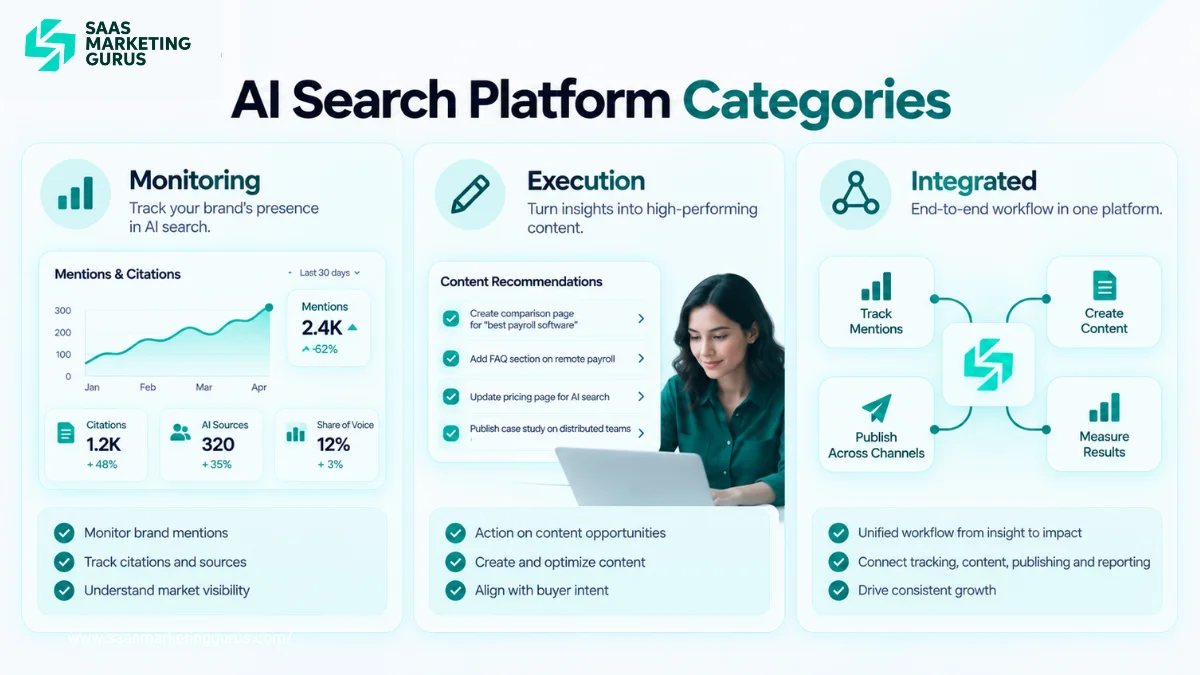
Match the platform type to where your team gets stuck: buy monitoring if you already know how to fix visibility gaps, and execution if data never turns into published changes. If your site blocks or confuses AI crawlers, fix technical access first.
| Platform type | Main purpose | Best fit | Main limitation |
|---|---|---|---|
| Monitoring | Tracks mentions, citations, sentiment, and share of voice | SaaS teams with a working content process | Shows gaps without explaining how to close them |
| Technical access | Checks how AI crawlers reach and read your site | Large or JavaScript-heavy sites with crawl issues | Fixing access does not make AI recommend you |
| Execution | Turns gaps into content briefs, tasks, or drafts | Small marketing teams short on capacity | Recommendations may rest on thin or opaque data |
| Integrated | Connects monitoring, optimization, publishing, and reporting | Growth-stage and enterprise SaaS teams | Costs more and bundles features small teams skip |
Key takeaway: the category decision prevents most bad purchases. A team that buys an execution platform when it only needed monitoring pays for drafts it will rewrite anyway.
Technical access matters more than many buyers expect. Google states that its AI features run on its core Search ranking and quality systems, so a page that is not indexed and eligible for a snippet cannot appear in them. Our guide to how generative search engines rank content covers the retrieval side in more depth.
How Do You Choose an AI Search Optimization Platform?
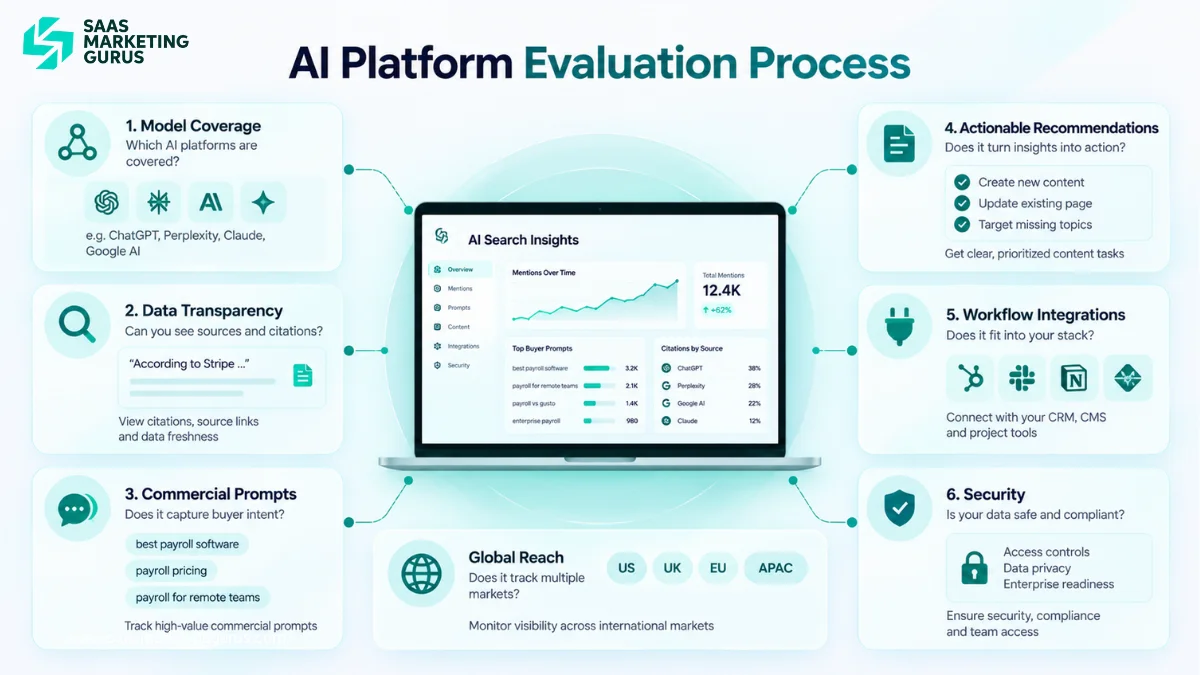
Choose an AI search optimization platform by testing six things under identical trial conditions: AI system coverage, data transparency, commercial prompt tracking, recommendation quality, workflow fit, and security. A platform that fails data transparency should drop off the shortlist regardless of how it scores elsewhere.
Does the Platform Cover the AI Systems Your Buyers Use?
A platform covers the right systems when it tracks the AI assistants your buyers use, in the markets and languages where you sell. Breadth beyond that adds cost without improving decisions.
A B2B SaaS company selling in Germany and the United States needs reliable German and US data, not coverage of twelve engines in unrelated regions. Confirm which systems and markets are in the plan you would actually buy, since many vendors charge extra per model.
Do not treat one Google surface as a proxy for another. Ahrefs data from December 2025, as reported by Search Engine Journal, found that Google’s AI Mode and AI Overviews cite different sources 87% of the time for the same query.
Can You Verify the Platform’s Visibility Data?
Visibility data is verifiable when every score traces back to the original prompt, the full response, the model, the market, the collection time, and the cited sources. If you cannot open the raw answer behind a number, you cannot trust the number.
Open three tracked answers during the trial and check that all six elements are there. Then ask how answers are collected: through the model’s API or through the same interface a buyer uses. The SparkToro researchers flagged whether API calls show the same variation as manual prompts as an open question, so a vendor should be able to explain its method and its limits.
Different vendors use different prompt sets, sampling schedules, and scoring formulas. A visibility score of 70 in one product and 70 in another do not describe the same thing.
Does the Platform Track Commercial SaaS Prompts?
A good prompt set mirrors the questions buyers ask when they compare and shortlist software. Relevance beats volume: 50 prompts from sales calls outperform 500 prompts a vendor generated from your homepage.
Track questions about customer problems, software categories, comparisons, alternatives, features, integrations, pricing, and implementation. Pull them from sales call notes, Search Console queries, support tickets, customer interviews, and review sites.
For example, a billing SaaS may learn that competitors appear for “Which billing platform supports usage-based pricing?” A useful platform then shows which competitors appear, which of their pages get cited, and which pricing or feature details those pages include.
The SEO manager validates the gap, product marketing confirms the claims, and the writer updates the right comparison page. Our guide to Answer Engine Optimization for SaaS shows how to structure that content around buyer questions.
Does the Platform Produce Usable Recommendations?
A usable recommendation names the affected page, the prompt, the cited competitor source, the missing information, and the action required. “Build more authority” fails that test.
Compare it with: “Add original pricing evidence to the comparison page that competitors are cited for on the usage-based billing prompt.” The team can assign that on Monday.
Check whether recommendations cover off-site sources too. When the cited sources are Reddit threads or review sites rather than your pages, the fix is a community presence on Reddit or a stronger listing profile, not another blog post.
Does the Platform Fit Your Team’s Workflow?
A platform fits your workflow when findings reach the people who act on them without a manual export at every step. Accurate data that lives only inside a dashboard creates a second reporting job.
Check connections with:
- Google Search Console and Google Analytics 4
- HubSpot or your CRM
- Your content management system
- Project management tools
- Reporting and BI software
Review exports and API access too. If the vendor keeps all historical data locked in its interface, reporting and any future migration get harder.
Does the Platform Meet Your Security Needs?
The right security bar depends on what data you put into the platform. A small team tracking public prompts needs standard user controls. A SaaS company loading customer research, campaign plans, or CRM data needs formal governance.
Depending on your situation, confirm:
- Single sign-on and role-based access
- Audit logs
- Data retention controls
- GDPR commitments for EU data
- SOC 2 documentation
- Secure API access
Confirm each control is included in the plan you intend to buy, not only in the enterprise tier.
Get an Independent Read on Your Shortlist
See which buyer prompts, AI systems, and markets your platform must cover before you sign.
Book a free AI visibility strategy call with SMG
How Should You Score Shortlisted Platforms?
Score every shortlisted platform with the same weighted criteria, using evidence collected during a controlled trial rather than impressions from a demo. The scorecard below is SMG’s editorial starting point; adjust the weights to your team.
| Evaluation criterion | Suggested weight | Evidence to review |
|---|---|---|
| Data transparency | 20% | Raw answers, prompts, timestamps, models, citations, collection method |
| AI system and market coverage | 15% | Required systems, countries, languages, refresh rates |
| SaaS prompt tracking | 15% | Category, comparison, alternative, feature, and purchase prompts |
| Citation and competitor analysis | 10% | Source accuracy, citation context, sentiment, competitor coverage |
| Actionable recommendations | 10% | Specific content, technical, and off-site actions |
| Integrations and reporting | 10% | Analytics, CRM, CMS, API, exports |
| Security and access | 10% | Roles, audit logs, compliance, data retention |
| Total cost of ownership | 10% | Price at your expected usage level |
| Total | 100% | Final weighted score |
Key takeaway: the scorecard makes the purchase reasoning visible to finance and leadership. Rate each criterion from 1 to 5, multiply by its weight, and record the evidence behind every rating.
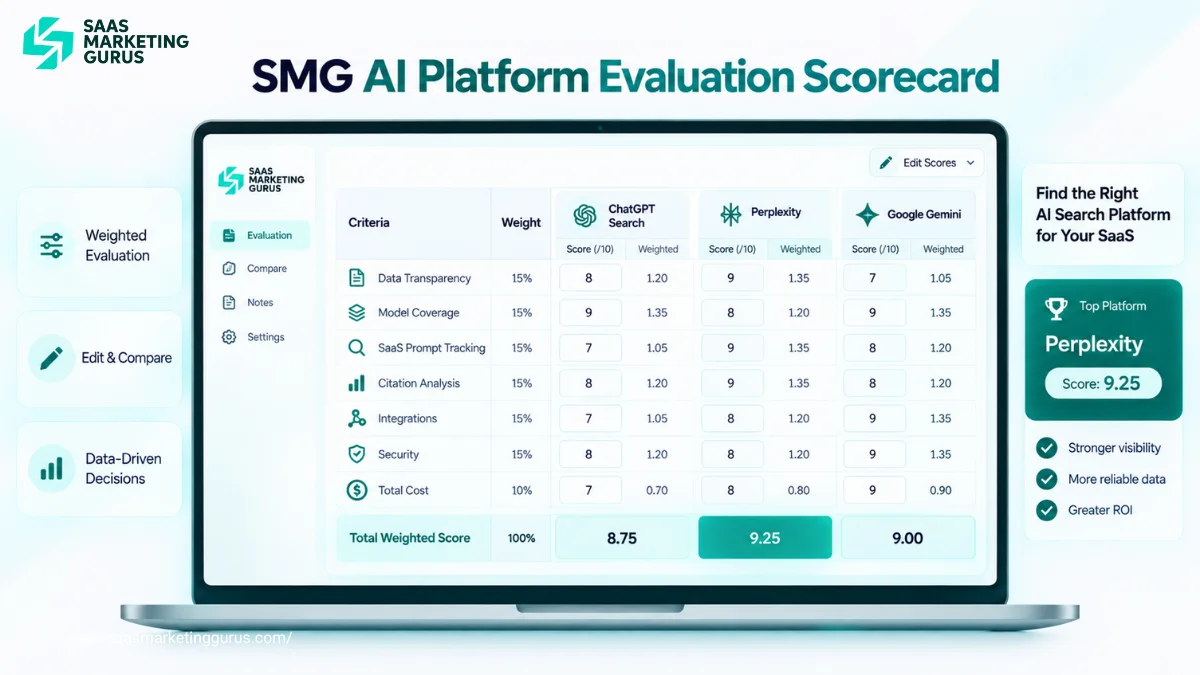
An agency will weight client workspaces and exports higher. An enterprise team will shift weight toward access controls, API support, historical data, and multilingual reporting.
Methodology note: the criteria consolidate what buyer guides, vendor documentation, and the research cited in this article treat as decision-critical. SMG has not published a client dataset validating these weights, so treat them as a structured starting point, not a benchmark.
How Should SaaS Teams Test AI Search Platforms?
Test every shortlisted platform under identical conditions for at least two full refresh cycles. Matching the inputs is what exposes differences in data quality that a sales demo hides.
- Build one prompt set. Start with around 50 prompts, our suggested trial size rather than a rule, covering branded, problem-aware, category, comparison, alternative, integration, pricing, and purchase-intent questions.
- Add the same competitors. Enter the same three to five competitors, with identical brand names, product names, and domains, in every platform.
- Match the conditions. Select the same AI systems, countries, languages, and tracking frequency.
- Run two complete refresh cycles. One snapshot cannot show whether a product produces consistent results, given how much answers vary between runs.
- Verify priority answers by hand. Open the original responses for your most commercially valuable prompts and check mentions, citations, sentiment, and recommendation wording.
- Complete one real workflow. Take one gap from discovery to a published update, then confirm you can measure the change afterward without building a side process.
- Score each product. Record evidence for every rating in the scorecard, not memories of the demo.
Compare the platform’s Google figures against your Search Console Generative AI performance report during the trial. Large, unexplained differences are a question for the vendor, not a rounding error.
How Do You Calculate the Real Platform Cost?
The real cost of an AI search optimization platform is the price of the setup you need, plus onboarding and switching work. Entry plans usually cap prompts, competitors, AI systems, markets, users, or stored history.
Price your intended configuration using:
- Expected prompt volume and refresh frequency
- AI systems, countries, and languages required
- Number of competitors and client workspaces
- Historical data retention and user seats
- API access and required integrations
Then add onboarding, training, and the cost of moving historical data later. A higher-priced product can still be better value if it replaces manual reporting or two separate subscriptions.
Illustrative scenario (not a client case): a growing SaaS company picks an entry plan on its advertised price. During setup, the team learns the plan covers one market, two competitors, weekly tracking, and a small prompt allowance. Adding a second market, more competitors, daily refreshes, and extra seats moves the account into a much higher tier.
The product may still be the right one. The mistake was comparing starting prices instead of the cost of the configuration the team actually needed.
Which Vendor Claims Should Make You Walk Away?
Walk away from any vendor that guarantees AI citations, sells a single “AI ranking position” as a core metric, or claims access to Google’s internal signals. Each claim contradicts what primary sources say about how these systems work.
- Guaranteed mentions or citations. No platform controls what an AI model says. Results still depend on accurate product information, useful content, credible third-party mentions, and sound technical SEO.
- “Rank #1 in ChatGPT.” The SparkToro data shows answer lists rarely repeat, so a position from one run is noise.
- Access to Google’s AI systems. Google’s guidance states that no third-party tool has access to its internal ranking or AI systems.
- AI-only hacks. Google says Google Search ignores llms.txt files and special AI markup, and that content needs no “chunking” for its AI features. A platform built around those tactics is selling effort that does nothing on Google.
- Hidden sampling. A vendor that cannot explain how often it samples, from which interface, and in which market is asking you to trust a black box.
Watch for buyer-side mistakes too: choosing the longest feature list, accepting vendor-generated prompts, comparing products under different conditions, and counting every mention as a positive recommendation.
How Can AI Visibility Affect SaaS Conversions?
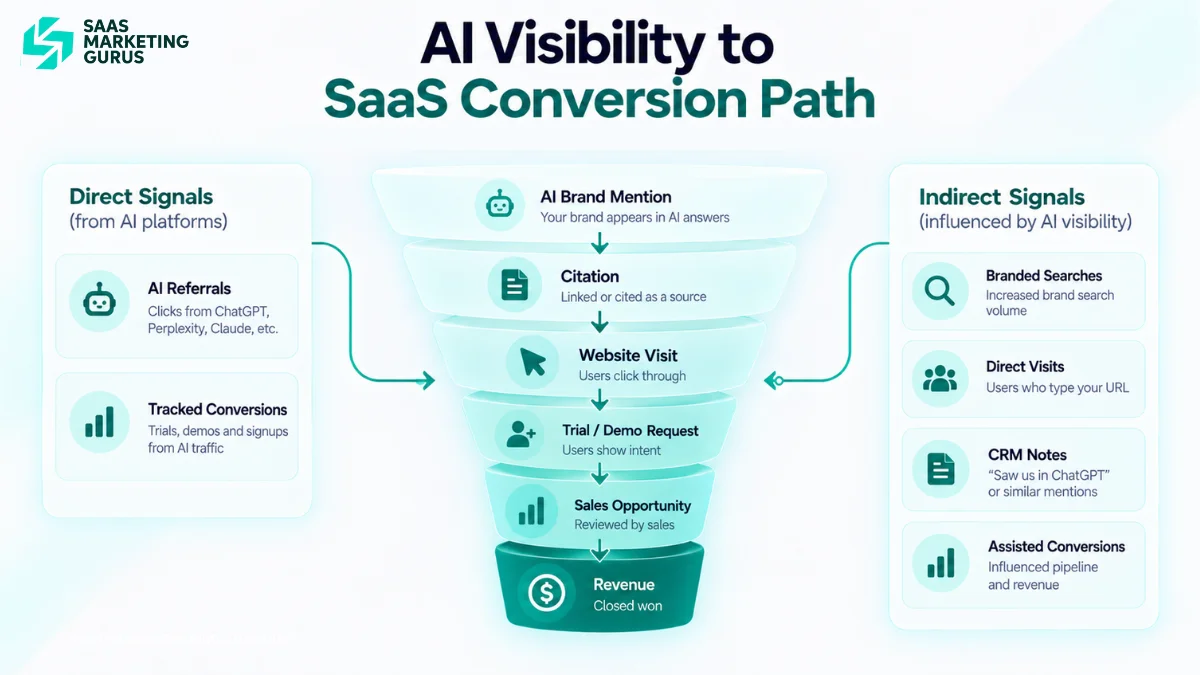
AI visibility affects conversions through direct signals you can attribute and indirect signals you can only correlate. Track them separately, because they answer different questions.
| Signal type | Examples | What it shows |
|---|---|---|
| Direct | AI referral visits, trial signups, demo requests from AI referrals | A traceable path from an AI source to a conversion |
| Indirect | Branded search growth, direct visits, CRM notes, self-reported discovery | Possible influence when the buyer never clicks a citation |
Key takeaway: direct signals prove a path. Indirect signals add supporting evidence but do not prove that AI visibility caused the conversion.
Many buyers discover a product in an AI answer and search the brand name later, so the visit shows up as branded or direct traffic. Add “Where did you first hear about us?” to your demo form and review CRM notes before you credit or dismiss AI visibility.
None of this works if conversion tracking is broken. Confirm that demo bookings fire as key events in GA4 before the trial starts, or the platform’s pipeline reporting will have nothing to connect to.
Which AI Search Optimization Platform Should You Choose?
Choose the platform that passes data transparency first, fits your platform category second, and costs the least at your real configuration third. That order protects you from the two most expensive mistakes: trusting unverifiable scores and paying for features your team will not use.
If your content process already works, buy monitoring and put the savings into content. If findings keep dying in a dashboard, pay for execution or integrated workflows. If you track a small prompt set in one market, start with the Search Console report and a repeated manual log, and revisit a paid tool when that log stops scaling.
Your next step: build the prompt set, shortlist two or three platforms, and run the seven-step trial. Success means the chosen tool surfaced at least one verified gap your team closed and measured within the trial window.
If you’re ready to put your platform choice into practice, book a free strategy call with SMG and we’ll pressure-test your prompt set, markets, and shortlist against what your pipeline actually needs.
Frequently Asked Questions
How accurate are AI visibility platforms?
AI visibility platforms are accurate for trends, not for single answers. AI responses change across models, markets, sessions, and dates, so any one answer is a sample. Reliable platforms store the original responses, show how often they sample, and report mention frequency across repeated checks rather than one-off positions.
Why do AI visibility platforms report different scores?
AI visibility platforms report different scores because each vendor uses its own prompts, models, locations, refresh rates, and weighting formulas. A score of 70 in one tool is not equivalent to 70 in another. Compare the underlying answers and collection methods instead of the headline number when you evaluate two products.
How many prompts should a SaaS company track?
There is no universal number of prompts a SaaS company should track. A set of around 50 is a practical trial size if it covers branded, problem-aware, category, comparison, alternative, and purchase-intent questions. Expand it with prompts drawn from sales calls, support tickets, and Search Console queries once the trial proves useful.
How long should you trial an AI search optimization platform?
Trial an AI search optimization platform for at least two complete data refresh cycles under matching conditions. For weekly tracking, that means a minimum of two weeks. Verify your most commercially important answers by hand during that window, and complete one real content workflow before you sign a contract.
How much does an AI search optimization platform cost?
The cost of an AI search optimization platform depends on prompts, AI systems, markets, competitors, users, refresh frequency, stored history, integrations, and API access. Advertised entry prices rarely match a SaaS team’s real setup. Price the exact configuration you need, then add onboarding, training, and future migration work.
Can an AI search optimization platform replace an SEO platform?
An AI search optimization platform usually cannot replace an SEO platform. It supports prompt tracking, citation analysis, and competitor monitoring, but rarely covers technical audits, keyword research, backlink analysis, or site analytics. Google also states that its AI features run on core Search systems, so SaaS SEO remains the foundation.
Is Google Search Console enough to track AI visibility?
Google Search Console is enough to track performance in Google’s AI Overviews and AI Mode through its Generative AI performance report. It does not cover ChatGPT, Perplexity, Claude, or Copilot. Use it as your free Google baseline, and add a paid platform when those other assistants matter to your buyers.