Download the template: Here
Work in your own copy. Replace the sample entries with your customer research, content priorities, and reporting data.
A B2B content marketing strategy template connects your audience, buyer problems, content priorities, distribution, and measurement in one working plan. For SaaS teams, it should explain what to create, who owns the work, and how each asset helps buyers or existing customers.
This guide explains how to complete the linked spreadsheet, using a hypothetical marketing analytics product as an example. Start with one audience and one business problem, then build a plan your team can deliver.
SaaS Marketing Gurus (SMG) is a B2B SaaS marketing agency offering SaaS SEO and Generative Engine Optimization (GEO). For the wider planning process, read our SaaS content marketing strategy guide.
Key Takeaways
- Use customer evidence to choose the problems your content will address.
- Give each asset a buyer question, a useful next action, and an owner.
- Set a baseline and reporting period before judging performance.
- Track discovery, qualified conversions, pipeline, and customer adoption separately.
- Treat the spreadsheet as a plan to review, not a forecast of guaranteed results.
A strategy template does more than a calendar. Here is the difference:
| Content calendar | Strategy template |
|---|---|
| Schedules what to publish and when | Defines who you target, why, and how you measure success |
| Focuses on output | Focuses on buyer problems and outcomes |
What Should a B2B Content Marketing Strategy Template Include?
A B2B content marketing strategy template should cover your audience, buyer questions, topic priorities, distribution, conversion actions, and measurement. It also needs owners and review dates so the plan can guide actual work.
In Content Marketing Institute’s 2026 report, published in October 2025, 40% of surveyed B2B marketers selected creating content that prompts a desired action among their top three content marketing challenges. The report covers 1,015 B2B respondents, mostly from North America. It provides context, not a SaaS performance benchmark. Read the research.
The linked workbook includes these planning areas:
| Planning area | What to enter |
|---|---|
| Strategy Canvas | Audience, problem, useful content, distribution, conversion, and measurement |
| ICP | Company characteristics, buyer roles, challenges, and buying triggers |
| Buyer Journey | A content topic, target query, next action, and status for each relevant stage |
| Content Pillars | Main topics, supporting topics, buyer stages, and priorities |
| Distribution Plan | Channels, owners, publishing cadence, and review dates |
| Measurement | Baselines, targets, actual results, and reporting notes |
| Checklist | Owners, due dates, and completion status |
Use the examples to understand the fields, then replace them. For the content marketing planning template to become a workable schedule, also record your available budget, production time, and approval responsibilities in your planning notes.
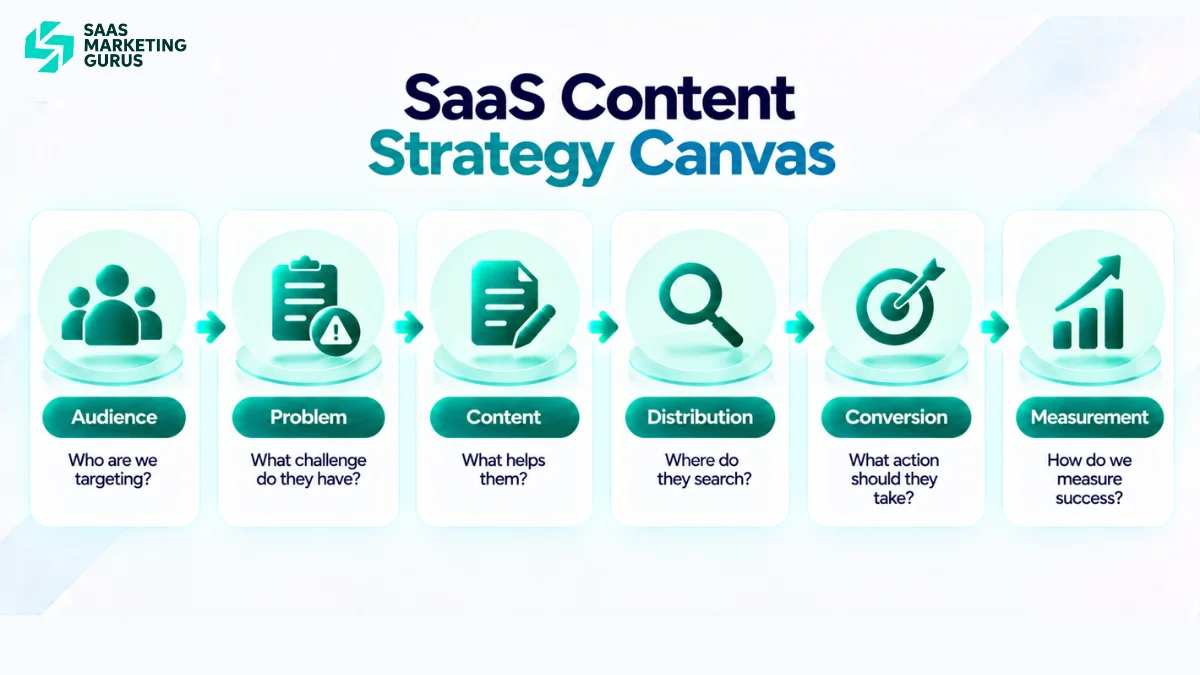
SaaS Content Strategy Canvas
Complete the canvas before choosing article titles. Each answer should lead to a decision about what your team will create or measure.
This example describes a hypothetical marketing analytics product. It is not an SMG client result.
| Strategy area | Example entry |
|---|---|
| Audience | Marketing leaders at B2B SaaS companies with 50 to 500 employees |
| Problem | Campaign reports do not explain which activities contribute to qualified opportunities |
| Content | A reporting setup guide, an attribution comparison, and a product walkthrough |
| Distribution | Relevant search queries, LinkedIn posts, and email to interested subscribers |
| Conversion | Read a worked example, then request a reporting demonstration if the product fits |
| Measurement | Qualified demo requests and opportunities associated with documented content interactions |
If you cannot explain how an asset helps this audience solve its problem, revise the idea before adding it to the plan.
How Do SaaS Companies Define Their Target Audience?
Define your target audience using evidence from customers, sales conversations, support requests, and lost deals. An Ideal Customer Profile (ICP) describes the companies your product can serve well. Buyer roles identify the people who evaluate, approve, and use it.
For the hypothetical marketing analytics product, the ICP could include:
- Company type: B2B SaaS businesses with 50 to 500 employees.
- Primary users: Demand generation managers and marketing operations specialists.
- Decision makers: Marketing leaders who own reporting and budget decisions.
- Main problem: Disconnected campaign data and time spent preparing reports.
- Buying trigger: A reporting requirement that the current process cannot meet.
- Evaluation concern: Whether the product connects to the company’s existing systems.
Record where each assumption came from. If customers have not confirmed a problem or buying trigger, mark it for validation.
Use the ICP fields in the workbook to capture these decisions. For the broader planning process, see our SaaS content strategy guide.
How Should SaaS Teams Map Content to the Buyer Journey
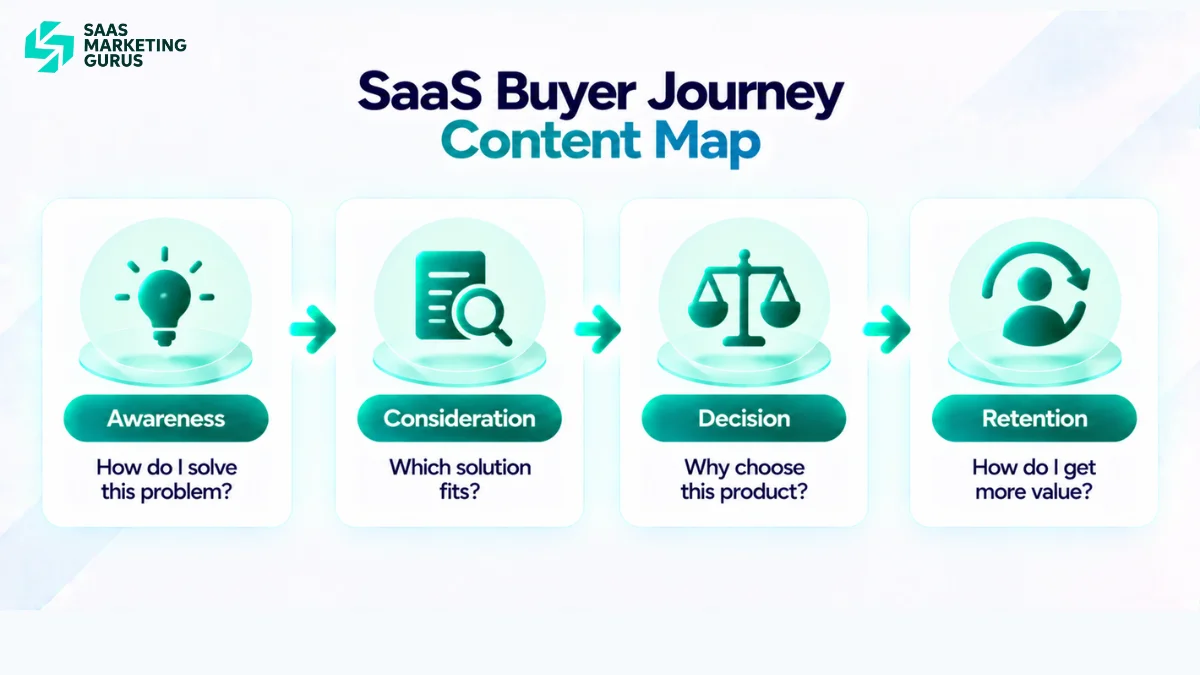
Map content to the question someone needs answered, then choose an appropriate next action. Buyer stages help organize the plan, but people may enter through a comparison page, return to an educational guide, or share both with colleagues.
For the hypothetical marketing analytics product:
| Buyer stage | Buyer question | Content example | Useful next action |
|---|---|---|---|
| Awareness | Why do our campaign reports disagree? | Guide to common reporting discrepancies | Review a reporting checklist |
| Consideration | Which attribution approach fits our reporting needs? | Comparison of approaches and limitations | Explore a worked reporting example |
| Decision | Will this product work with our systems? | Integration guide and product walkthrough | Request a relevant demonstration |
| Retention | How do we build a report our team can use? | Customer setup tutorial | Complete the reporting workflow |
Enter the topic, relevant query, and next action in the Buyer Journey section of the workbook. A customer tutorial may depend more on support needs than search volume.
Check your existing content before commissioning anything new. If a useful page already answers the question, improve it and include it in the plan.
How Do SaaS Companies Build Content Pillars?
Build content pillars around problems your product and expertise can meaningfully address. A pillar covers a broad subject; supporting articles answer narrower questions within it.
For the marketing analytics example, “Marketing reporting” could be a pillar supported by articles about campaign reporting discrepancies, attribution methods, and CRM data quality. Each supporting page needs a distinct purpose.
Use SMG’s CLARITY framework to review proposed topics:
- Customer Problem: What specific difficulty does the topic address?
- Level of Intent: Is the reader learning, comparing, or preparing to act?
- Alignment With SERP: What kind of page appears to satisfy the search?
- Revenue Potential: How could the topic support a relevant business outcome?
- Independent Page Value: Does it need a separate page?
- Topic Connection: How does it support the wider cluster?
- Yield Measurement: What will you measure?
Start with a manageable set of pillars. Add another when customer evidence supports it and your team has the capacity to produce useful content. Rankings alone should not determine that decision.
How Can SaaS Companies Create Content That Converts?
Traffic alone does not create growth. SaaS content needs a conversion path.
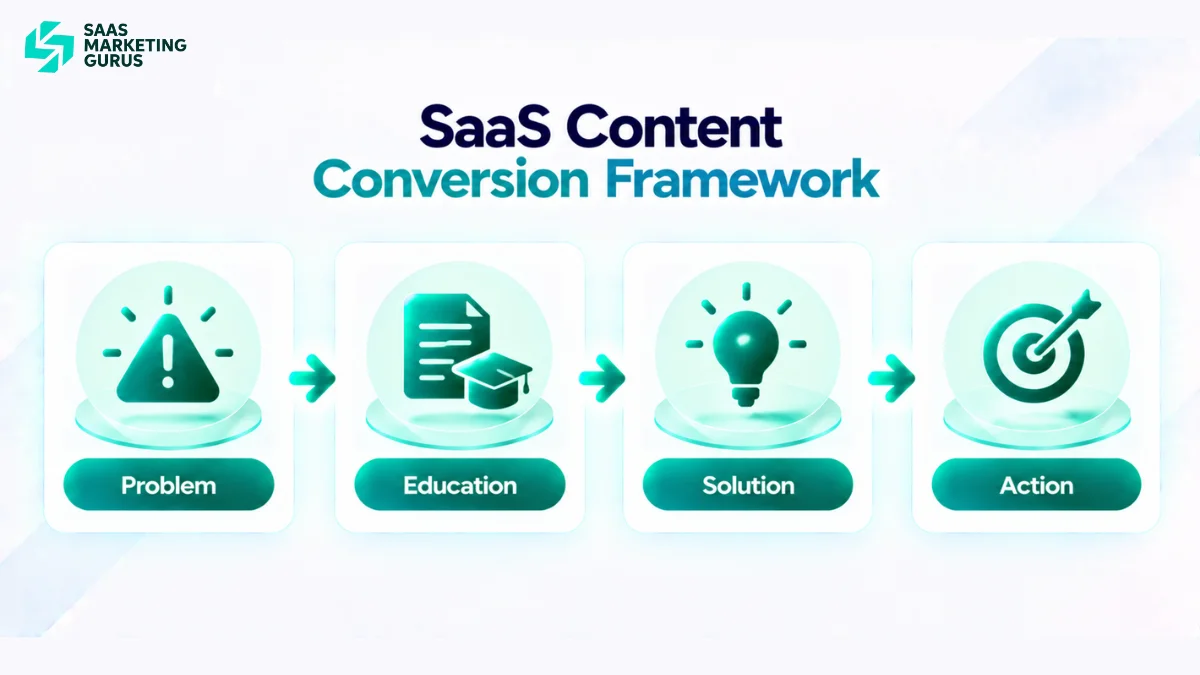
SaaS Content Conversion Framework: Problem → Education → Solution → Action
Example:
- Problem: Marketing teams cannot prove ROI.
- Education: “How SaaS companies measure content performance”
- Solution: Explain reporting methods and best practices.
- Action: Download a guide, request an audit, or book a demo.
Conversion-focused content types include:
- Comparison pages
- Case studies
- Product guides
- ROI calculators
- Customer stories
How Should SaaS Content Be Optimized for AI Search?
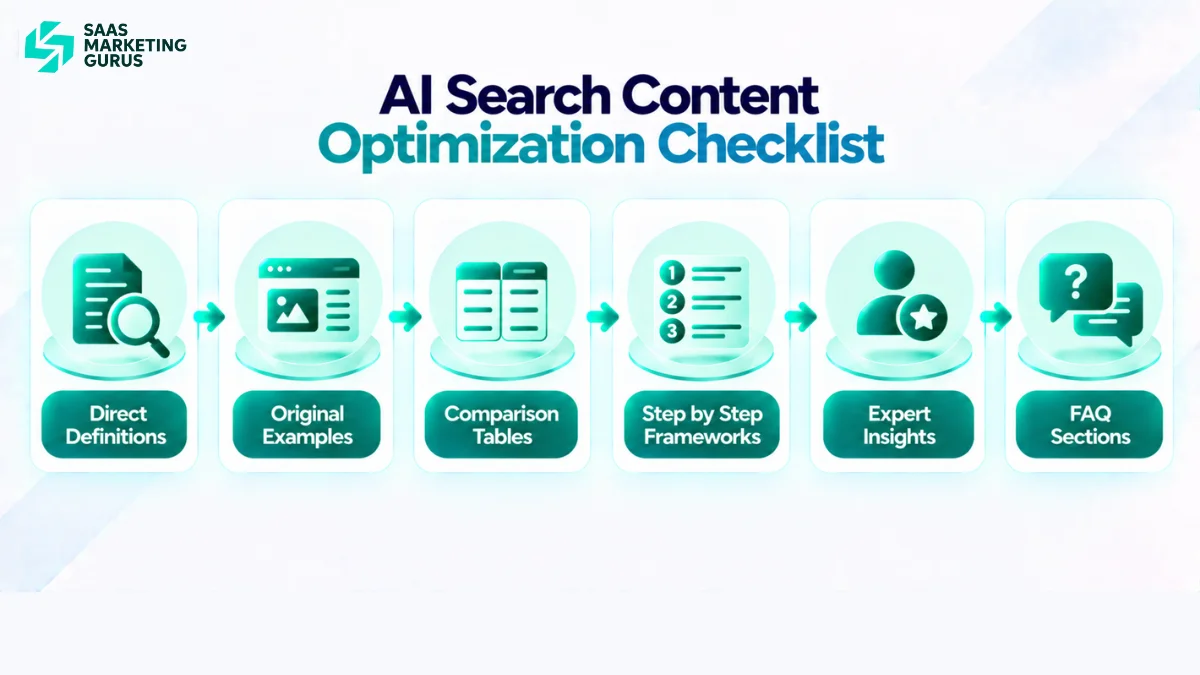
Make your content accessible, specific, and easy to verify. Clear answers help readers understand a page, but definitions, tables, and FAQs do not guarantee that an AI platform will cite it.
Google’s guidance on AI features and websites, updated in December 2025, says established SEO practices remain relevant to AI Overviews and AI Mode. It does not require special AI markup. This guidance applies to Google Search. developers.google.com
For each planned asset:
- Answer the main question near the beginning.
- Support factual claims with relevant sources.
- Label hypothetical examples.
- Check product details with someone who knows the product.
- Keep important explanations available as page text.
- Review outdated claims when the product or evidence changes.
Use our AI search optimization guide for further planning. Track citations, referral visits, and qualified outcomes separately.
What B2B Content Marketing Mistakes Should SaaS Companies Avoid?
Avoid plans built on untested audience assumptions, unclear measurement, and work that nobody owns. The template should expose those gaps before your team starts producing content.
1. Creating Content Without Buyer Intent
A relevant keyword does not automatically represent a useful customer problem.
Before approving a topic, record who needs the answer, what decision it helps them make, and how your product or expertise relates to that need. Use customer conversations and search results to check the idea.
If the connection remains weak, leave the topic out of the current plan.
2. Measuring Traffic Instead of Revenue Impact
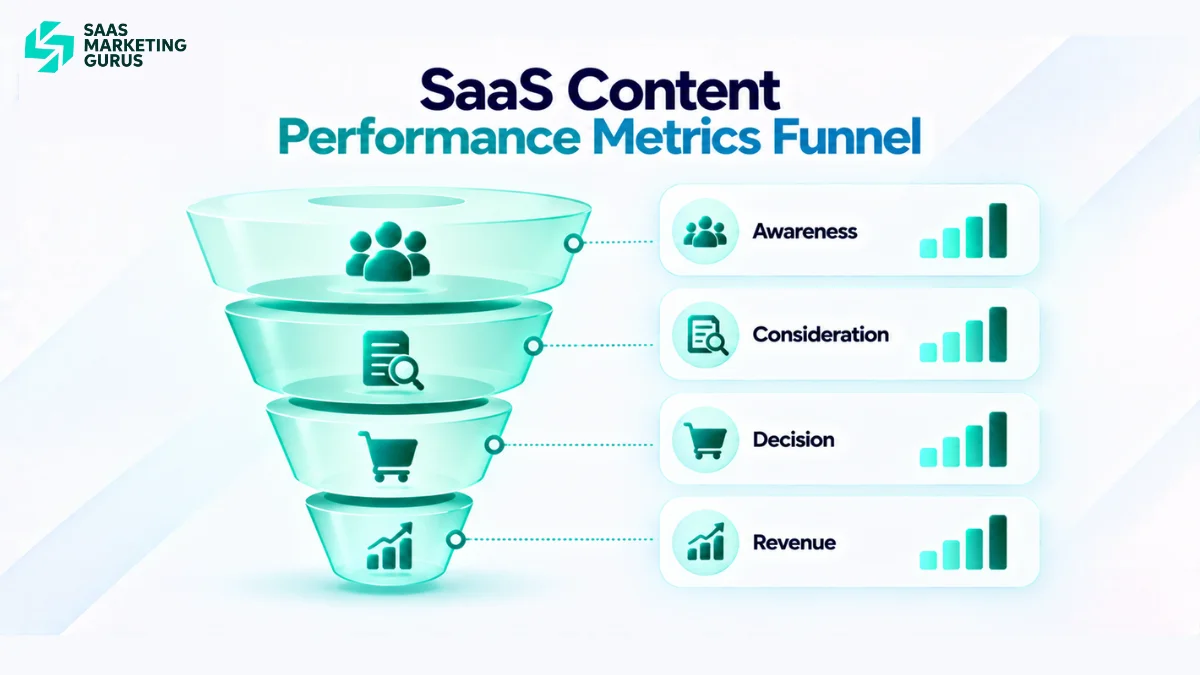
Use traffic to understand discovery, then track whether relevant visitors take useful actions. Avoid treating a content visit as proof that content caused a sale.
| Measurement | Working definition |
|---|---|
| Qualified conversion | A demo request or signup that meets your agreed fit criteria |
| Content sourced pipeline | Opportunity value credited to content under a documented source rule |
| Content influenced pipeline | Opportunity value associated with a recorded content interaction within a defined period |
| Customer adoption | Completion of a relevant product action after engaging with educational content |
Record the data source, reporting period, and attribution rule beside each metric. Do not add sourced and influenced pipeline together without removing overlap.
The workbook includes an illustrative row with 15 actual demo requests against a target of 20. That equals 75% of the target. It does not mean demos grew by 75%, and it is not an SMG result.
Use one metric per row. Combined labels such as “pipeline influenced, customer acquisition cost” need separate rows because they measure different things.
3. Publishing Without a Distribution and Refresh Plan
Assign distribution and review responsibilities before publication. Record the channel, owner, intended audience, and next review date.
Review important pages when product details change, sources become outdated, customer questions shift, or performance suggests an intent mismatch. A scheduled review helps, but it should not delay an obvious correction.
Set a publishing cadence your team can maintain within its available budget, research time, and approval capacity.
Where Should SaaS Companies Distribute Content?
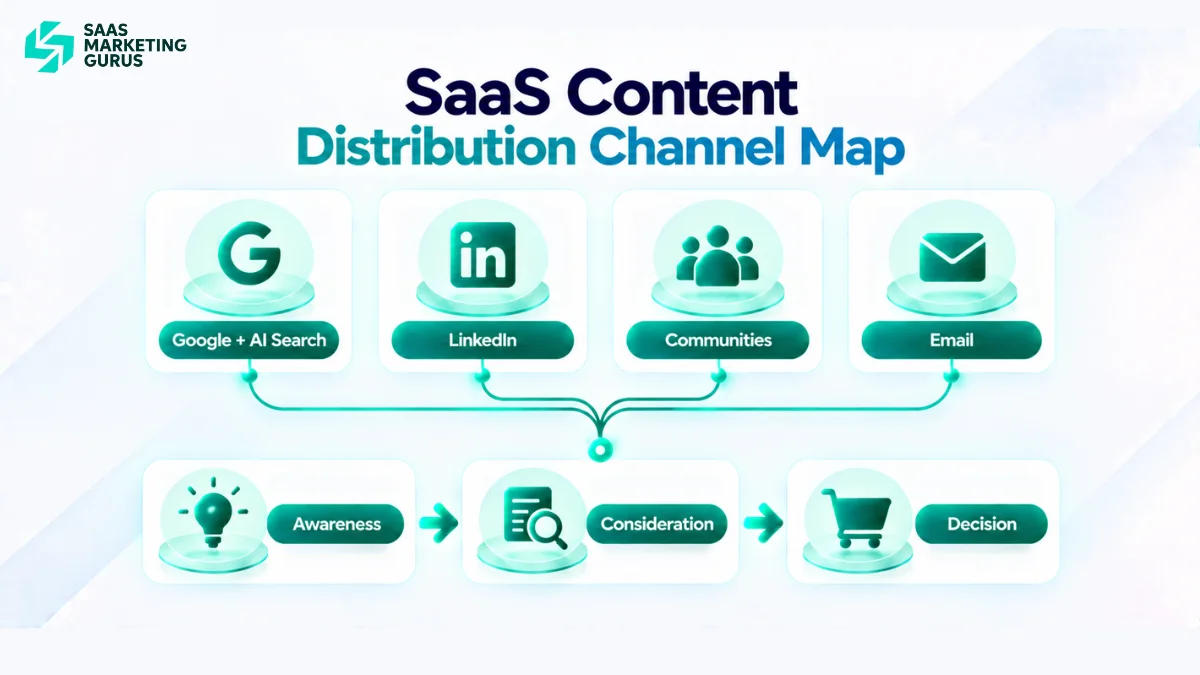
Choose channels based on where your audience researches the problem and whether your team can contribute usefully there. Start with a focused mix and adapt the material to each channel.
| Channel | Practical use | What to record |
|---|---|---|
| Website and search | Publish a durable answer to a relevant query | Page owner, target question, next action, review date |
| Share a specific finding or worked example | Intended audience, post owner, response or referral measure | |
| Relevant communities | Answer an existing question where participation is allowed | Community rules, relevant discussion, affiliation disclosure where applicable |
| Send useful material to interested subscribers or customers | Audience segment, purpose, next action |
These channels can support several buyer stages. A customer may use search for onboarding help, while a prospect may use a community discussion to evaluate a purchase.
Enter owners, cadence, and review dates in the workbook’s Distribution Plan. Treat its sample publishing frequencies as examples, not recommended quotas.
For a fuller channel plan, use our content distribution strategy for SaaS.
How Does Content Marketing Impact SaaS Growth?
A successful SaaS content strategy helps companies:
- Build trust before sales conversations
- Capture high-intent searches
- Support sales teams
- Improve customer acquisition efficiency
Content Marketing Institute’s 2026 B2B research of more than 1,000 marketers found that stronger teams build marketing fundamentals before layering on AI.
B2B Content Marketing Strategy Template Checklist
Before using your SaaS content plan template to assign work, confirm that:
- Your ICP reflects customer evidence.
- Each priority topic answers a specific buyer or customer question.
- Existing pages have been checked before new ones are commissioned.
- Each asset has a clear purpose and useful next action.
- Topic priorities reflect product relevance and available resources.
- Production, review, and distribution have named owners.
- Sources and product claims have been checked.
- Each measurement row contains one metric with a baseline and reporting period.
- Targets are planning goals, not promised results.
- Review dates and reasons for changing the plan are recorded.
Use the workbook’s checklist to track completion. Record additional decisions in its Notes fields or your project plan.
Frequently Asked Questions
What is a B2B content marketing strategy template?
A B2B content marketing strategy template is a framework that helps SaaS companies organize audience research, content planning, SEO, distribution, conversions, and measurement.
What is the difference between a content strategy and a content calendar?
A content strategy defines who you are targeting, why, and how you will measure success. A content calendar only schedules what gets published and when.
How is SaaS content marketing different from traditional B2B content marketing?
SaaS content needs to support product evaluation and continued use, including integrations, onboarding, adoption, and renewal. Other B2B businesses may also have complex products and buying groups, so long sales cycles and multiple stakeholders are not unique to SaaS. Plan around how your customers buy and use your product.
Which content formats generate leads for SaaS companies?
Choose the format that answers the buyer’s question. Comparisons help evaluate options, case studies provide customer evidence, and templates help readers complete a task. None guarantees leads. Measure qualified conversions from each asset and check whether the next action fits the reader’s needs.
How can SaaS companies improve AI search visibility?
Publish accessible pages with clear answers, accurate product information, and evidence readers can verify. Follow the relevant platform’s publisher guidance. Useful formatting can improve clarity, but it does not guarantee inclusion or citations in AI answers.
How do you measure B2B content marketing success?
Measure results against the asset’s purpose. Track relevant visits for discovery, qualified demos or signups for acquisition, and product adoption for customer education. Define how content receives credit for pipeline, use a consistent reporting period, and keep influenced opportunities separate from proof that content caused a sale.
From Content Strategy to SaaS Pipeline Growth
Start your B2B content marketing strategy template with one audience, one important problem, and one asset your team can deliver well. Complete its buyer question, distribution plan, owner, next action, and measurement before adding more topics.
At the first review, ask whether the asset reached relevant people and helped them take the intended next step. Use the evidence to decide whether to improve it, distribute it further, or change the priority. A completed spreadsheet is useful only when it guides those decisions.
SMG’s SaaS SEO services include keyword strategy, content planning, and performance tracking for SaaS teams.
Want a second view on your completed plan? Book a free consultation with SMG to discuss your priorities, content gaps, and next steps.