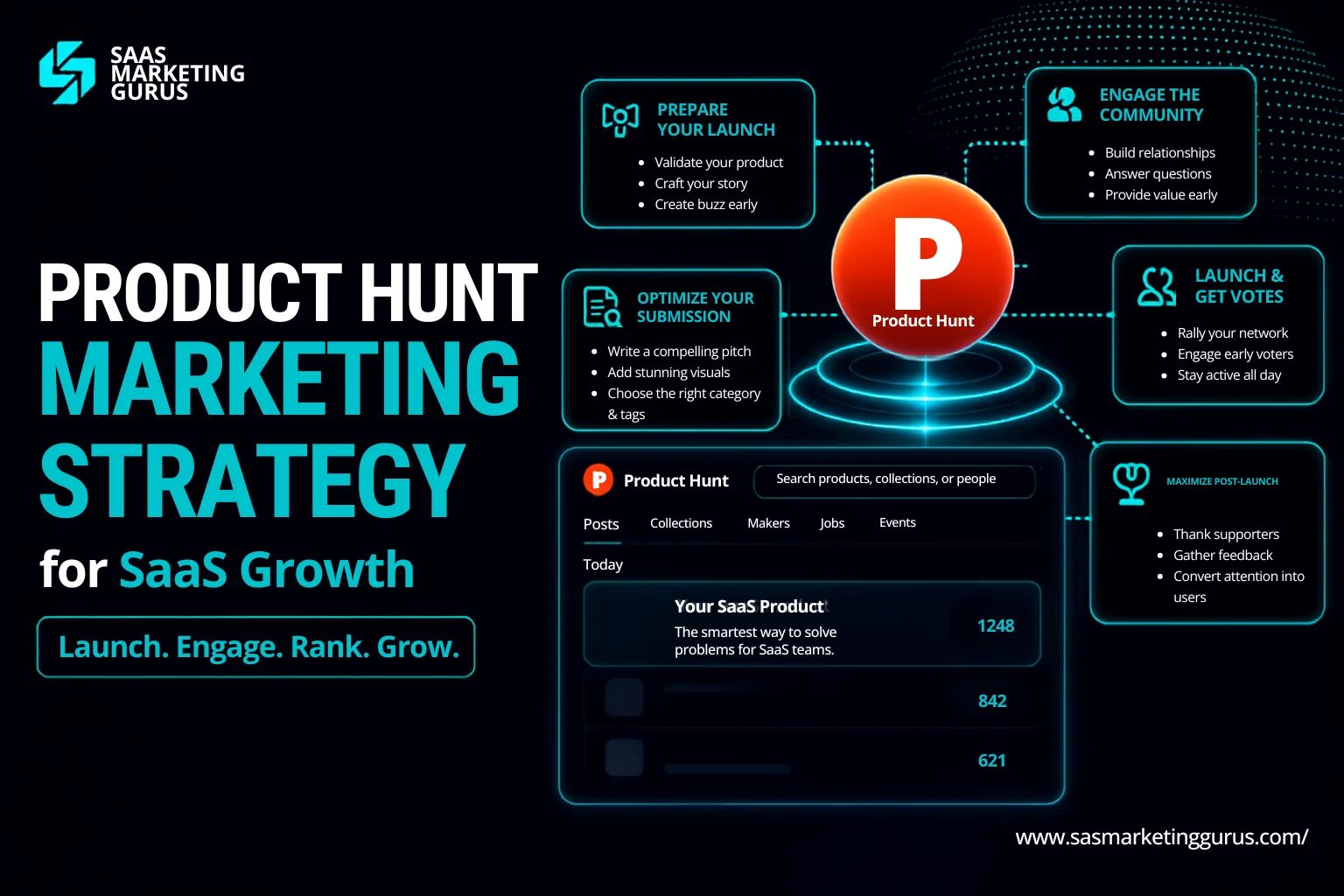
A Product Hunt launch strategy for SaaS is a 30-day preparation plan, one launch day, and a 30-day follow-up window that turns visitors into activated users. It works best for products people can try the same day, sold to buyers who overlap with Product Hunt’s early-adopter audience.
SaaS Marketing Gurus (SMG), a B2B SaaS marketing agency specializing in Reddit marketing, Quora marketing, Generative Engine Optimization (GEO), SaaS SEO, and Product Hunt launches, has run 1,500+ launches through its Product Hunt marketing service. Most launch advice stops at launch day. This guide gives you the week-by-week plan, the platform rules that can cost you your ranking, and the metrics that show whether the launch produced pipeline.
What Does a 30-Day Product Hunt Launch Plan Look Like?
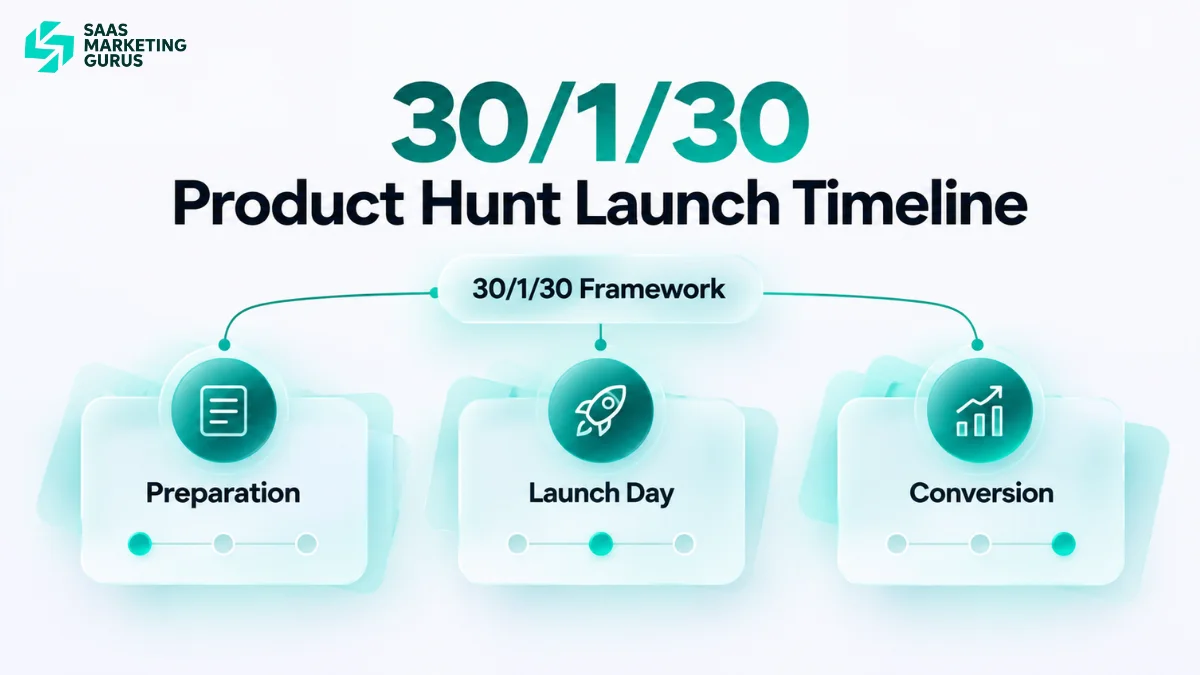
A 30-day Product Hunt launch plan has four preparation weeks, one launch day, and a 30-day follow-up window, and each stage ends with a deliverable you can check. Work backward from launch day, because Product Hunt lets you schedule a launch up to one month ahead.
| Stage | Days | Done when |
|---|---|---|
| Week 1 | Day -30 to -24 | One primary goal, a written ICP, an active Product Hunt profile, and a scheduled launch date |
| Week 2 | Day -23 to -17 | Tagline, description, gallery, and first comment drafted |
| Week 3 | Day -16 to -10 | Dedicated landing page live, signup and tracking tested, warm list segmented |
| Week 4 | Day -9 to -1 | Roles assigned, replies drafted, outreach queued, full dry run complete |
| Launch day | Day 0 | Live at your chosen time, every comment answered, feedback logged |
| Follow-up | Day +1 to +30 | Follow-up emails sent, activation tracked, goal reviewed on day 30 |
Treat the follow-up window as part of the launch. Product Hunt says you can promote your launch page for two weeks after launch day before moving to your permanent Product Page. For how this plan fits a wider channel mix, see SMG’s Product Hunt marketing strategy for SaaS.
Is Product Hunt Worth It for a B2B SaaS Product?
Product Hunt is worth it for a B2B SaaS product when buyers can try it the same day and your ideal customer overlaps with Product Hunt’s makers, product people, and early adopters. It is a weaker fit when the sale needs a long procurement cycle and no self-serve path. Product Hunt describes its hunters as product and tech enthusiasts at their core, so the audience rewards products it can judge quickly.
Use this test before you commit 30 days. Launch if the product works today, your ICP includes tech-forward teams or founders, and someone can answer comments all day. Wait if signup is broken, you cannot measure signups, or people need a sales call just to see the product.
This test is SMG’s editorial judgment, not a Product Hunt rule.
A delay is recoverable. Product Hunt notes you can launch again after you update your product.
New to the platform? Start with SMG’s guide to what Product Hunt is.
How Do You Set a Launch Goal and Define Your ICP?
Set one primary goal tied to a business outcome, then work backward to the traffic and conversion rate it needs. Product Hunt advises measurable goals tied to your company goals and says rank is far from the only way to measure success.
Here is an illustrative example. A goal of 20 demo requests at an assumed 2% visit-to-demo rate needs about 1,000 qualified visitors. The 2% is a placeholder, so replace it with your own landing page rate.
Then name the buyer in one sentence. An AI customer support tool should target support teams buried in repetitive tickets, not everyone curious about AI tools. Use that sentence to filter every asset and outreach list that follows.
Sharp positioning also strengthens your SaaS product marketing, because visitors see the problem you solve within seconds.
What Do You Need to Prepare for Your Product Hunt Listing?
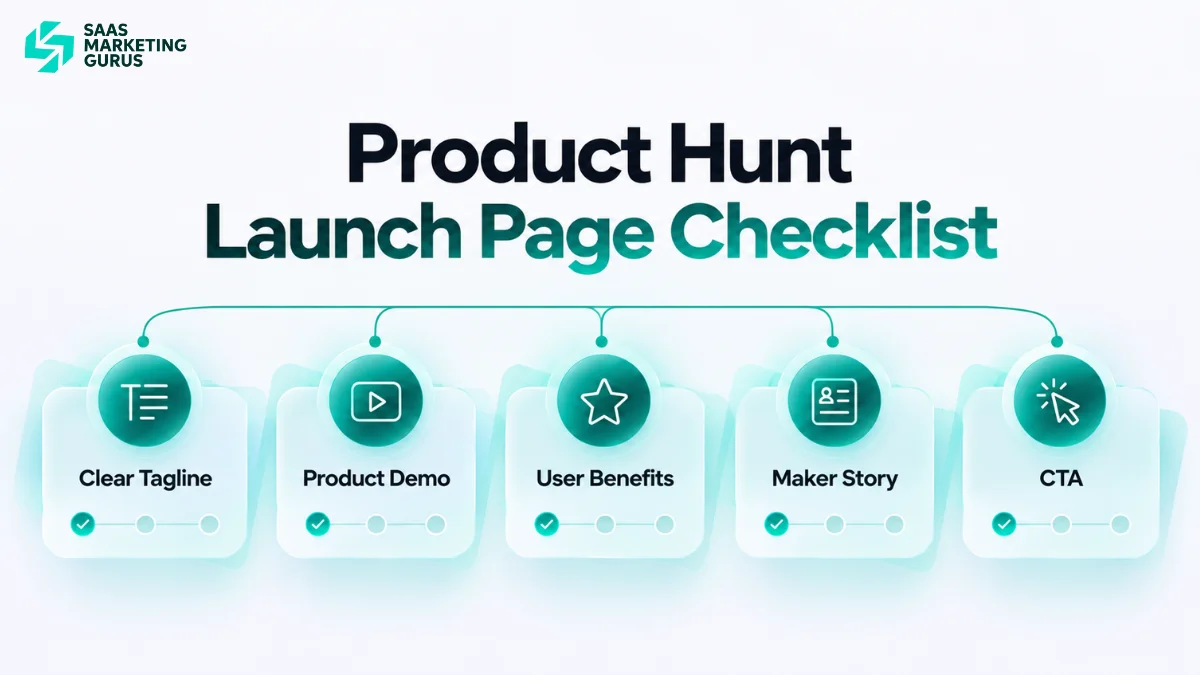
Your listing needs a product name, a tagline of 60 characters or fewer, a description, at least two gallery images, and a first maker comment that explains who the product is for. Product Hunt reports that 70% of products that reached Product of the Day, Week, or Month included a maker’s first comment (Product Hunt launch guide, checked October 2026).
| Field | Product Hunt requirement | What to write |
|---|---|---|
| Name | Product name only, no slogans or emojis | The exact product name |
| Tagline | 60 characters maximum | Audience plus outcome |
| Description | 500 characters maximum | Problem, who it is for, one proof point |
| Launch tags | Up to 3 | The closest categories |
| Thumbnail | Square, 240×240 recommended, under 3MB | An image readable at small size |
| Gallery | 2+ images, 1270×760 recommended | The product solving the problem |
| Product URL | Shortened and tracked links not accepted | A clean, dedicated landing page URL |
A weak tagline is “AI productivity platform.” A stronger one is “AI assistant that turns customer calls into tasks,” because it names the audience and outcome in 49 characters. Adding “and follow-ups” would push it past the 60-character limit.
Because Product Hunt does not accept tracked links in the product URL field, send launch traffic to one dedicated landing page and measure that page on its own. Give it a single call to action, since Product Hunt suggests a focused landing page and says launch-day offers can lift engagement. Set up GA4 key events for signup and demo booking now and test them end to end, because you cannot rebuild launch-day data later.
For the first comment, cover who the product is for, why you built it, the feedback you want, and any launch offer. Ask for feedback, not upvotes.
How Do You Build a Launch Audience Without Breaking Product Hunt’s Rules?
Build your audience through real relationships and ask supporters for feedback, never upvotes. Product Hunt says asking for upvotes is against its policies, and it says paying a hunter or promoter goes against its guidelines. Products caught breaking the rules can be unfeatured or removed, and makers risk a permanent ban.
Start in week 1 and work through these steps:
- Join early. New accounts wait one week to post, and Product Hunt recommends joining three months or more ahead, so activate your account today.
- Help others first. Comment on other launches and discussions before you ask for support.
- Warm your list: customers, beta users, newsletter subscribers, and industry contacts.
- Use communities where you already take part. Product Hunt warns against spamming Reddit if you have never posted there, so see SMG’s subreddit targeting strategy.
- Hunt your own product. Per Product Hunt, 79% of featured posts and 60% of #1 Product of the Day winners were self-hunted.
Ask for visits, comments, and feedback. Skip contests that reward upvotes, because Product Hunt may unfeature a product that runs one.
What Should You Do on Product Hunt Launch Day?
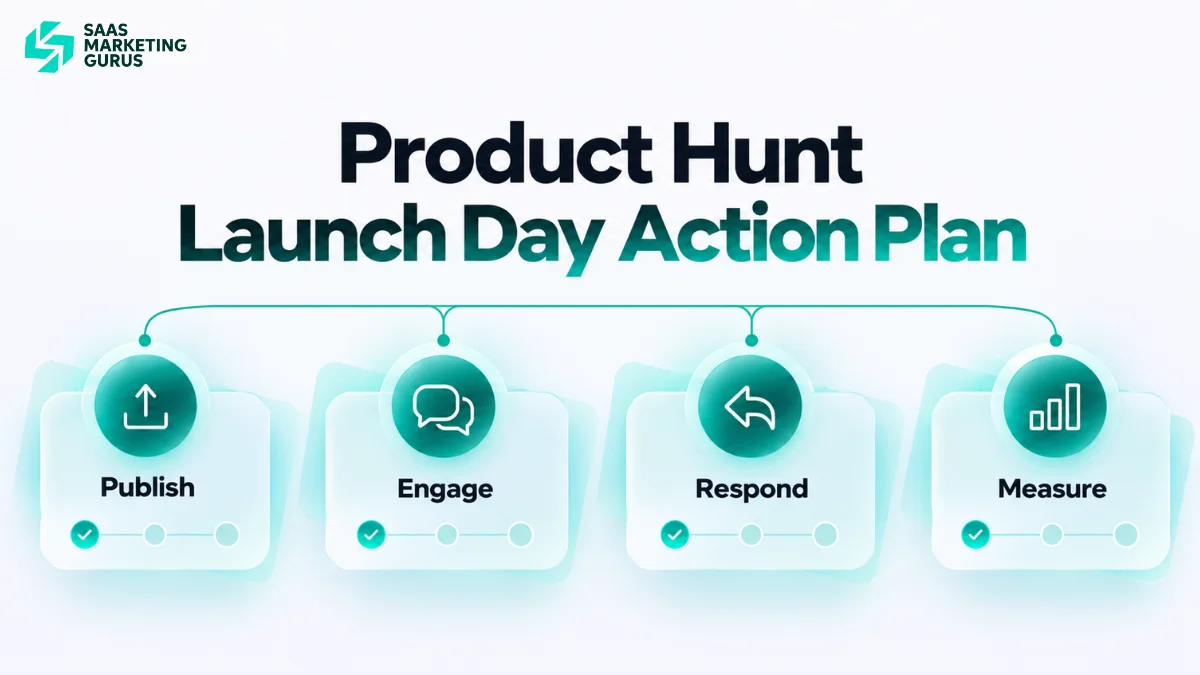
On launch day, go live at 12:01 am Pacific unless you have a reason not to, answer every comment as fast as your team can, and log feedback for the product team. Product Hunt’s homepage runs on a 24-hour Pacific cycle, so 12:01 am gives you the full day. Product Hunt also notes that teams outside the U.S., or teams tied to a press embargo, may choose another time.
Do not treat Tuesday to Thursday as a rule. Product Hunt says there is no golden-ticket answer on timing, and it reports that weekend launches get 15% more Visit button clicks than weekday launches (Product Hunt launch guide, checked October 2026). Weekdays bring larger companies, so pick the day you are most prepared.
| Time (PT) | Action | Owner |
|---|---|---|
| 12:01 AM | Go live, post the first comment | Founder |
| First hours | Reply to every comment, log feedback themes | Founder and product |
| Morning | Email your list, announce where you are already active | Marketing |
| Afternoon | Second push with a new angle, answer questions, fix reported bugs | Whole team |
| End of day | Record visitors, signups, and demo requests against your goal | Marketing |
SMG saw the value of fast replies in WorkHub’s launch, where replies within the first hour went with more discussion and stronger signups. The WorkHub Product Hunt launch case study has the full breakdown. Not every launch is featured, and featuring changes homepage visibility, so read SMG’s guide to featured vs non-featured launches before launch day.
How Do You Turn Product Hunt Traffic Into Customers After Launch?
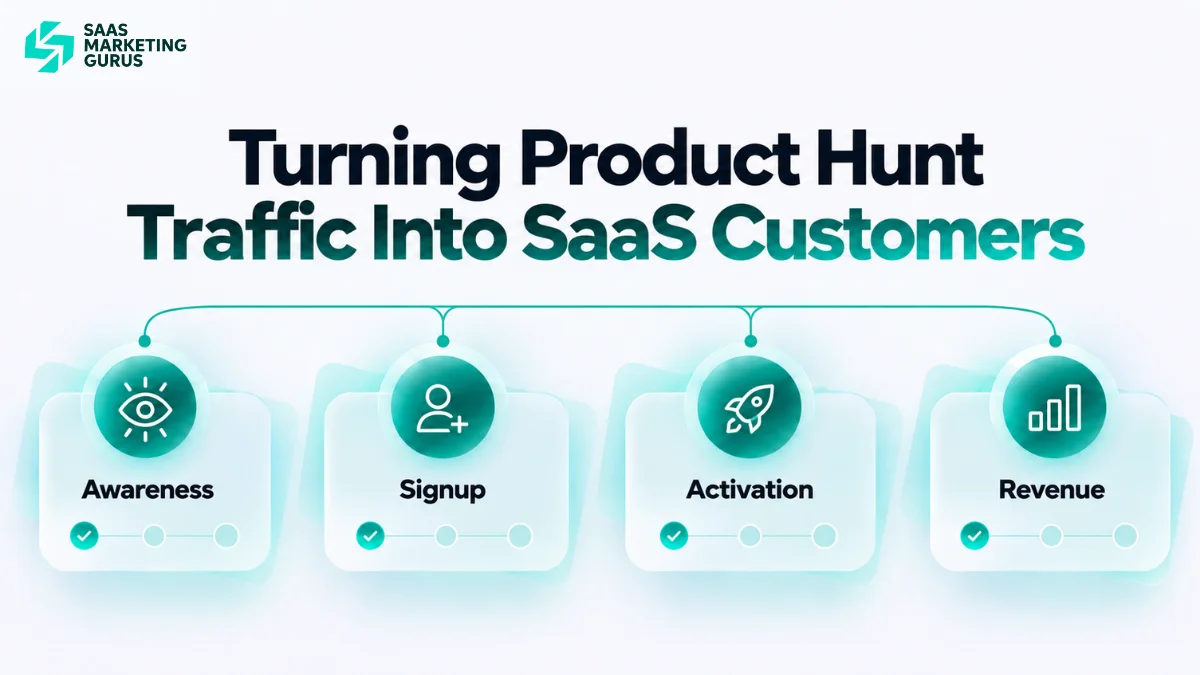
Turn Product Hunt traffic into customers by following up with every commenter and signup within 24 hours, getting new users to a first result fast, and judging the launch on activation and demo requests at day 30. Product Hunt advises following up with supporters and enrolling captured leads in a drip campaign that gives real value.
| Window | Action | Measure |
|---|---|---|
| Day 0 to 1 | Thank commenters, email signups, offer a demo or trial | Signups |
| Day 2 to 7 | Send onboarding emails to the first value event, log feedback themes | Activation rate |
| Day 8 to 14 | Make a last launch-page push, then move to your Product Page, fix top feedback | Feedback themes shipped |
| Day 15 to 30 | Nurture with a drip campaign, follow up on demos, review against your goal | Demo requests, trial-to-paid |
Define your activation event before launch. It is the first action that proves a user got value, such as connecting an integration or finishing a first report.
| Metric | Formula | What it tells you |
|---|---|---|
| Signup rate | Signups / landing page visitors | Message clarity |
| Activation rate | Users reaching first value / signups | Product value |
| Demo-request rate | Demo requests / visitors | ICP fit |
| Trial-to-paid | Paid accounts / trials | Revenue potential |
Signup rate tests your message, and activation tests your product. In B2B, trial-to-paid can land after day 30, so treat activation and demo requests as your leading indicators.
Which Product Hunt Launch Mistakes Cost SaaS Teams the Most?
The costliest mistakes are launching without a measurable goal, building the audience only on launch day, and having no plan for the traffic afterward. Product Hunt’s own list of pre-launch mistakes also includes unprepared pages, launching late in the day, and paying a hunter.
- Skipping a measurable goal. Product of the Day is not the only goal that matters.
- Treating it as a one-day campaign. Build the audience before launch day and keep following up after it.
- Chasing rank over fit. Rank brings visibility, but only ICP-fit visitors activate.
- Launching late without a reason. You lose part of the 24-hour window.
- Launching without a conversion plan. Set up analytics, signup flow, follow-up emails, and onboarding first.
Build Your Product Hunt Launch Strategy Around Day 30
Run this Product Hunt launch strategy if your product can be tried today and your buyers include tech-forward teams. Pick one primary goal, schedule the launch, and judge the result at day 30 on activation and demo requests, not rank. If tracking or signup is not ready, delay the launch instead of shipping without a way to measure it.
Your first step this week: write the goal, the one-sentence ICP, and the day-30 review date in one document, then give each stage an owner and a date.
If you would rather hand the build-out to a team that has run 1,500+ Product Hunt launches, book a free strategy call with SMG and we will map this plan to your product.
Frequently Asked Questions
How long should a SaaS company prepare for a Product Hunt launch?
Plan for about 30 days of preparation and a 30-day follow-up window. Product Hunt lets you schedule a launch up to one month ahead, which is enough time to set a goal, finish listing assets, warm your audience, and test tracking before launch day.
What time should you launch on Product Hunt?
Product Hunt recommends 12:01 am Pacific for makers with no constraints, because its homepage runs on a 24-hour Pacific cycle and that time gives you the full day. Choose a different time if your team, your audience’s time zone, or a press embargo points elsewhere.
Do SaaS companies need a hunter on Product Hunt?
No. Anyone with a personal account can submit a product, and Product Hunt encourages makers to hunt their own. According to Product Hunt, 79% of featured posts were self-hunted, and paying a hunter or promoter goes against its guidelines, so skip that expense.
Can you ask people to upvote your Product Hunt launch?
No. Product Hunt policy prohibits asking for upvotes and running contests that reward them. Ask supporters to visit, try the product, and leave comments or feedback instead. Products that break the rules can be unfeatured or removed, which costs more than any upvote gain.
Is Product Hunt worth it for B2B SaaS?
It is worth it when buyers can try the product the same day and overlap with Product Hunt’s early-adopter audience. It is a weaker fit for long, sales-led deals. Set a measurable goal, such as demo requests or activated users, and judge the launch at day 30.
How do you measure whether a Product Hunt launch worked?
Measure the goal you set before launch. Track signup rate, activation rate, demo requests, and trial-to-paid conversion, and group comments into feedback themes. Product Hunt notes rank is not the only measure of success, and B2B paid conversion may arrive after day 30.