A B2B SaaS marketing strategy is the plan that connects your ideal customer, positioning, channels and offers to pipeline, so every channel you run has a job and a number attached. It sets what you focus on and what you ignore. Tactics execute it.
In 2026 that plan has to work before a buyer talks to you. 6sense’s 2025 Buyer Experience Report found 94% of buyers rank a shortlist before contacting sellers, and the winning vendor came from the Day One shortlist 95% of the time. SaaS Marketing Gurus (SMG), a B2B SaaS marketing agency specializing in Reddit marketing, Quora marketing, Generative Engine Optimization (GEO), SaaS SEO, and Product Hunt launches, builds strategy around that moment. This guide gives you the framework, the channel map and a 90-day plan.
Key takeaways
- Buyers rank a shortlist before they contact you, so strategy starts with being named where they research.
- Pick one ICP, one growth motion and one constraint before you pick channels.
- Reddit, Quora and AI answers shape the shortlist. Demos and trials confirm it.
- Measure qualified demos and demo-to-opportunity rate, not visits.
- Run one segment, one baseline and two channels for 90 days, then cut or double down.
What Is a B2B SaaS Marketing Strategy?
A B2B SaaS marketing strategy is a written plan that links a defined customer, clear positioning and a small set of channels to pipeline and revenue targets. It sets focus and tradeoffs. Tactics, such as a Reddit thread or a landing page, are how the plan gets carried out.
A working strategy covers six things:
- Who: the target companies and the people inside them.
- Problem: the costly problem they want solved.
- Reason to choose: why your product wins against the alternative they already use.
- Channels: where those buyers research and compare.
- Offers: what you give them at each stage, from a guide to a demo or trial.
- Metrics: the numbers that show the plan is producing pipeline.
Many SaaS teams run several channels at once with no shared view of the buyer journey. The result is traffic without steady growth. The strategy exists to stop that.
Strategy, plan and playbook: what each one does
| Document | Question it answers | What it contains | Update it when |
|---|---|---|---|
| Strategy | Which customers do we win, and where? | ICP, positioning, growth motion, channel priorities | The market or the ICP changes |
| Plan | What do we do this quarter, with what? | Goals, budget, owners, dates | A quarterly review shows a miss |
| Playbook | How do we run one recurring play? | Steps, assets, handoffs and review signals for one channel or motion | Evidence changes a step |
Why B2B SaaS Marketing Is Different
B2B SaaS marketing differs from other marketing because you sell a recurring, intangible product to a group of buyers who evaluate it over weeks or months. That changes what you measure, which content you publish and where you show up before the first sales call.
| Trait | What it means | What your marketing has to do |
|---|---|---|
| Recurring revenue | One sale is the start of the relationship, not the end | Judge channels on retention and expansion as well as new logos |
| Multiple stakeholders | A user, a champion, a budget owner and a technical reviewer all weigh in | Write separate proof and messaging for each role |
| Longer evaluations | Buyers compare options over weeks or months | Publish comparison and evaluation content, and follow up between touchpoints |
| Intangible product | Buyers cannot inspect the product before they commit | Offer trials, demos, reviews and named customer proof |
| Customer economics | CAC, LTV and payback decide whether growth is profitable | Set channel targets against payback period, not lead volume |
6sense’s 2025 Buyer Experience Report, based on nearly 4,000 buyers, puts first contact with sellers at 61% of the way through the buying journey, down from about 69% in 2023 and 2024. It also found 94% of buyers use LLMs somewhere in the buying process.
The buying process is larger and quieter than the funnel most teams still plan for. Forrester’s State of Business Buying 2026, as reported by Digital Commerce 360 (January 2026), found an average of 13 internal stakeholders and nine external participants in a purchase, and generative AI tools were the most cited interaction for researching purchases.
Gartner surveyed about 645 B2B buyers in August and September 2025 and reported that 67% prefer a rep-free experience and 45% used generative AI in a recent purchase, while 69% still turn to a sales rep to validate AI-generated insights. Buyers research alone, form opinions with AI and peers, and use sales to confirm.
That is why the strategy below starts with the buying group, not the channel.
Start With the ICP, Buying Group, and Positioning
Now that we know why SaaS marketing is different, the next step is to decide exactly who the strategy needs to reach. Choosing channels before answering that question usually leads to weak traffic and poor quality leads.
Define the ideal customer profile
Ideal customer profile definition for B2B SaaS: An ideal customer profile, or ICP, describes the type of company most likely to gain clear value from your software and remain a profitable customer.
Your B2B SaaS ICP may include:
- Industry and business model
- Company size or revenue
- Geography
- Technology environment
- Regulatory or operational requirements
- Problem urgency
- Ability to purchase
- Expected contract value
- Likelihood of retention and expansion
The goal is not to include every company that could use the product. It is to identify the companies your product can help best.
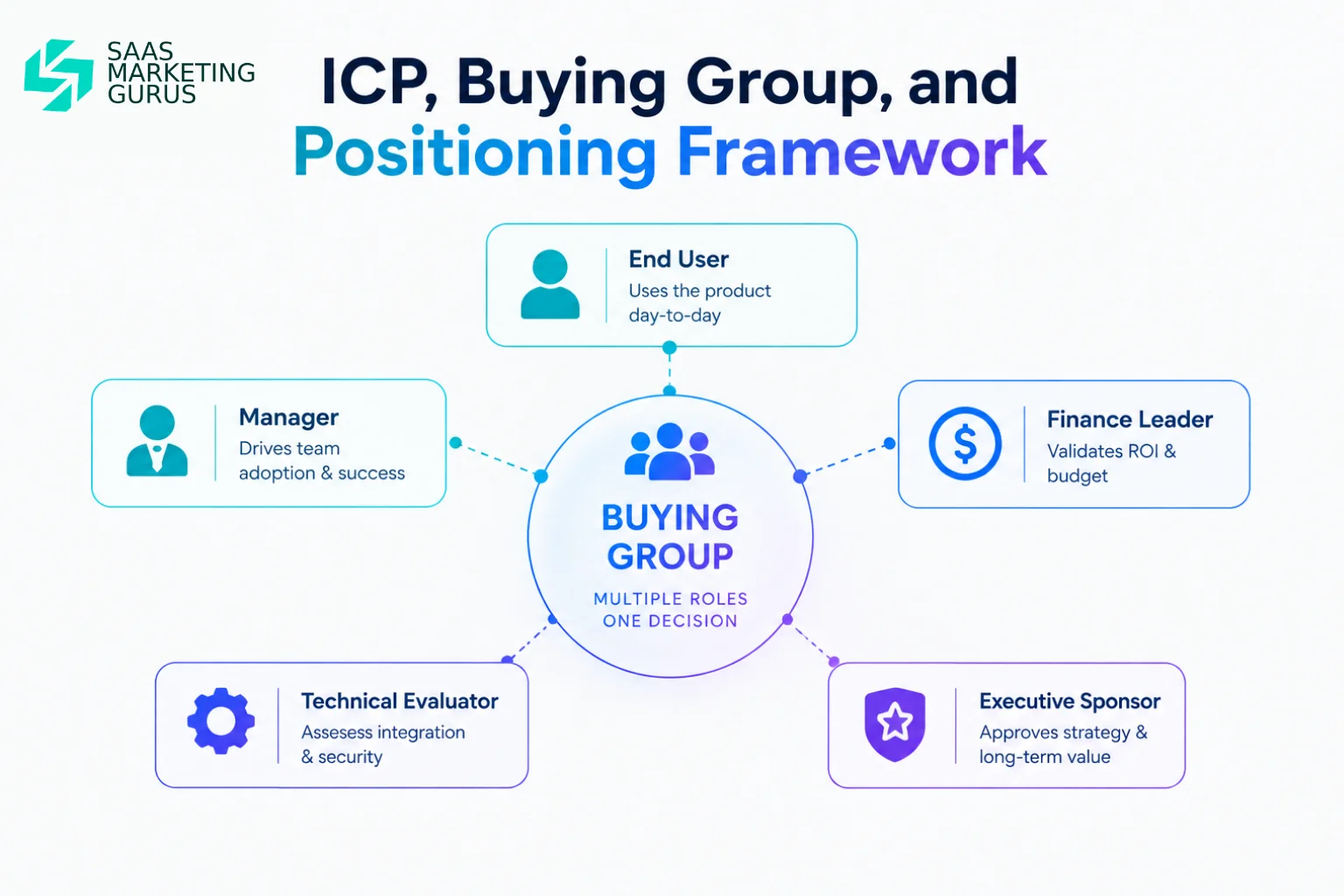
Map the buying group
Once you know which companies to target, identify the people involved in the purchase. This turns a broad company profile into useful content and messaging decisions.
| Role | Primary Question | Useful Content |
|---|---|---|
| End User | Will this make my work easier? | Product tours, templates, workflows, and tutorials |
| Champion | Can I convince others to support this? | Business cases, comparison pages, and internal presentation material |
| Economic Buyer | Will the return justify the cost? | ROI models, pricing explanations, and outcome-based case studies |
| Technical Evaluator | Will it integrate and meet our standards? | Security pages, documentation, integration guides, and implementation plans |
| Executive Sponsor | Does this support a strategic priority? | Industry insights, executive summaries, and risk analysis |
Clarify positioning
Positioning states who the product is for, which important problem it solves, how it differs from the alternatives and why that difference matters. Answer four questions in the buyer’s language. If you cannot answer one with evidence, it is not ready to guide channel choice.
| Element | Question to answer | Evidence you need |
|---|---|---|
| Ideal customer | Who has this problem badly enough to buy this quarter? | Your ICP criteria and 5 to 10 closed-won accounts to compare against |
| Problem | What costly problem do they describe in their own words? | Call notes, support tickets, review-site comments and subreddit threads |
| Difference | Why choose you over the alternative they already use? | One specific capability or outcome a competitor cannot claim |
| Proof | What would a skeptical buyer accept as evidence? | Named customer results, reviews, a working trial |
Then fill in this statement:
For [specific customer] who [has a particular problem], [product] is a [category] that [delivers an outcome]. Unlike [main alternative], it [credible difference].
Build it from the language customers use in sales calls, support tickets, reviews and interviews, not from your internal feature names.
Product Marketing: Turn Positioning Into Messages Buyers Repeat
Product marketing turns positioning into the messages, proof and launch assets buyers use to compare you with alternatives. In a B2B SaaS strategy it sits between positioning and channels: positioning decides what you claim, product marketing decides how each claim is said, proved and delivered at each stage.
A three-layer messaging framework
- ICP targeting. Write for one role in the buying group at a time. A finance approver and a daily user need different first lines.
- Problem clarity. Name the problem in the words buyers use, not in your feature names.
- Outcome positioning. State the result and the effort saved, then show the product as the way to get it.
An illustrative before and after:
| Feature statement | Outcome statement |
|---|---|
| “An AI-powered analytics dashboard.” | “Make better decisions in 10 minutes, not 10 hours.” |
Trials and onboarding are part of the message
More than 60% of buyers in Forrester’s survey ran some form of trial before buying, and after the trial 36% planned to convert with the same provider while 35% planned to choose a different one (Digital Commerce 360, January 2026). Forrester’s advice to vendors is to design the trial as a conversion tool: one real use case, guided onboarding, a defined success metric and follow-up after the trial ends. Write your onboarding emails and in-app prompts from the same positioning table as your ads.
Choose the Right SaaS Growth Motion
Once the audience and position are clear, you can choose how customers will enter and move through your sales process.
B2B SaaS growth motion definition: A growth motion is the main path a SaaS company uses to attract, convert, retain, and expand customers.
The right motion depends on price, product complexity, buying risk, and how much help a customer needs before deciding.
| Growth Motion | Best Fit | Marketing Priority | Main Conversion |
|---|---|---|---|
| Product led | Easy adoption and lower contract value | Search, product education, onboarding, and lifecycle messages | Signup or product qualified lead |
| Sales led | Higher contract value and complex buying decisions | Demand generation, ABM, proof, and sales enablement | Qualified opportunity |
| Hybrid | Self service entry followed by larger account expansion | Product acquisition plus sales support | Activated account and expansion opportunity |
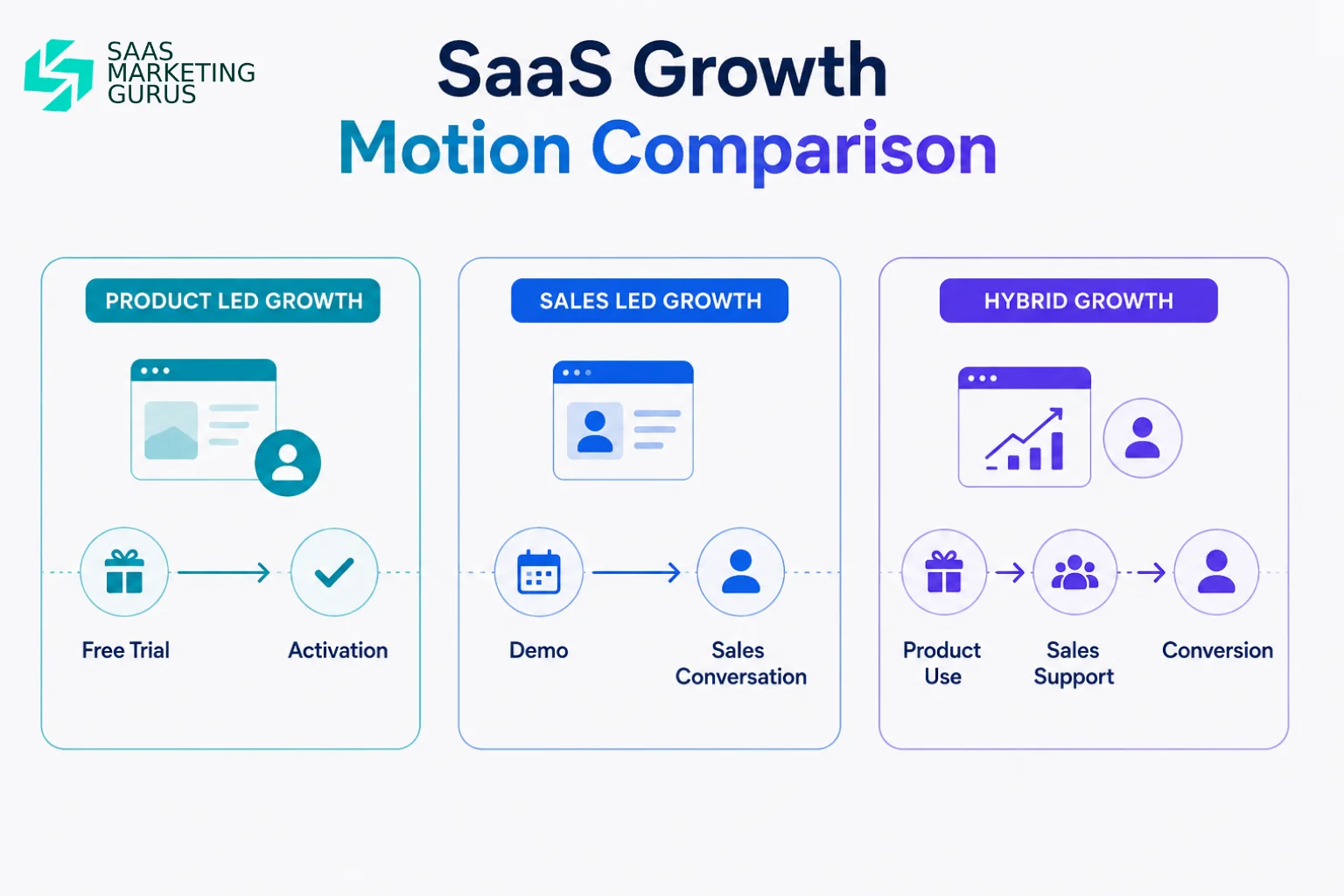
The key is to match the marketing plan to the product economics. Enterprise software may need account research, executive content, and security proof. A lower priced tool may grow faster through search, templates, free tools, and simple onboarding.
Find the Main Growth Constraint
After selecting the growth motion, do not immediately add more channels. First, find the part of the customer journey that is holding back revenue.
A growth constraint is the biggest current problem stopping a SaaS company from reaching its next revenue goal.
Use this table to find the likely constraint:
| Observed Problem | Likely Constraint | First Response |
|---|---|---|
| Few qualified visitors | Demand or discoverability | Improve category education, SEO, AI visibility, community presence, and targeted distribution |
| Traffic but few demos | Positioning or conversion | Clarify value, strengthen proof, improve offers, and remove form friction |
| Many demos but few wins | Targeting, qualification, or sales alignment | Refine the ICP, review objections, and create better decision content |
| Many signups but weak usage | Activation | Improve onboarding, lifecycle messages, templates, and time to value |
| Customer growth but weak revenue | Retention or expansion | Analyze churn, adoption, pricing, customer education, and expansion triggers |
This diagnosis keeps the strategy focused. For example, if traffic is already strong but demos are weak, buying more traffic will only make the problem more expensive.
Map Channels to the Buyer Journey
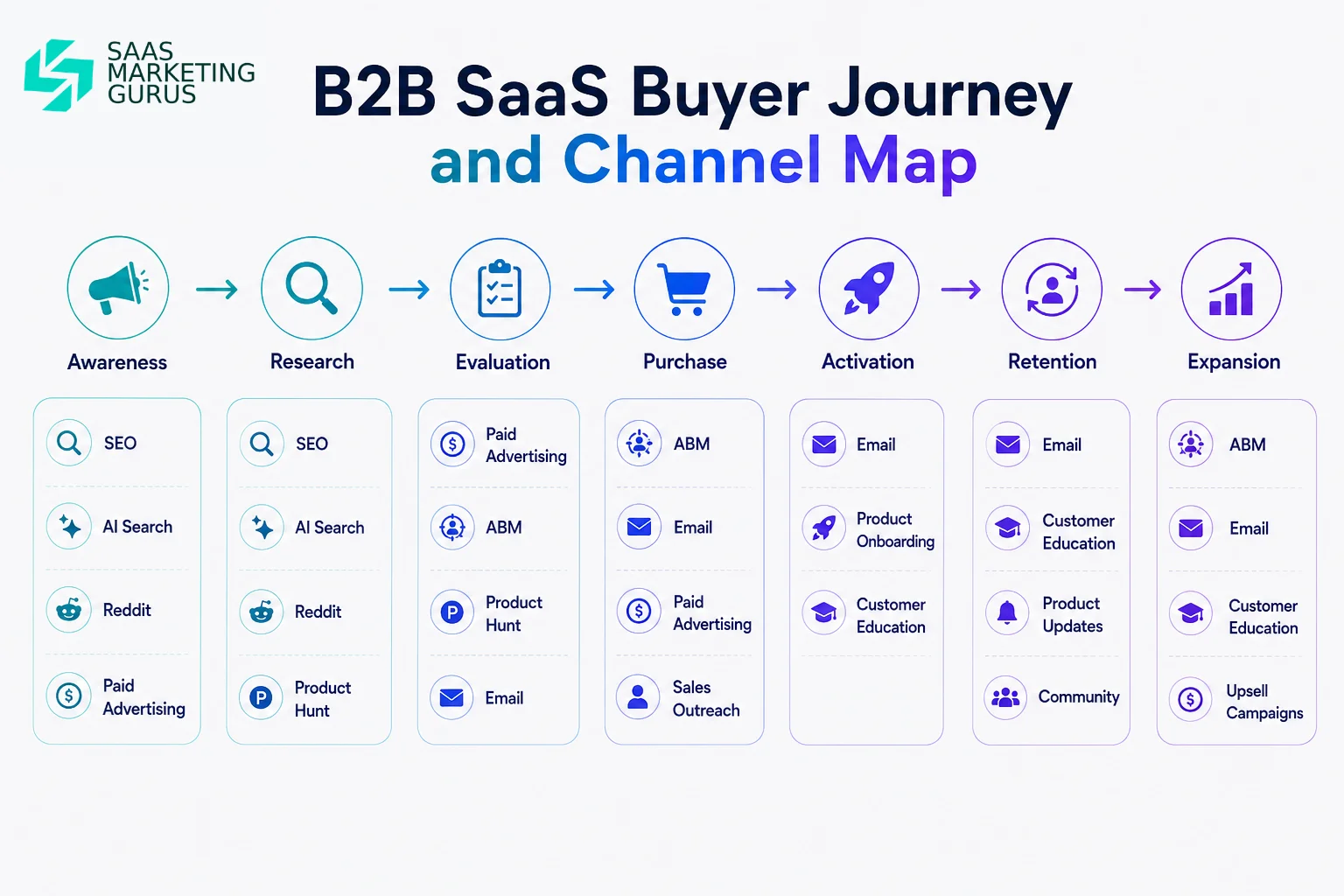
Match each channel to the stage where it shapes the buyer’s decision, not to a funnel label. Most of the shortlist forms before a sales conversation, so the channels that matter first are the ones buyers use to research without you: AI answers, Reddit and Quora threads, review sites, search and launches.
Channel framework: which channel does which job
| Stage | What the buyer asks | Channel | SMG service | Signal to track |
|---|---|---|---|---|
| Shortlist formation | “Which tools do people recommend for X?” | Reddit threads, Quora answers, AI answers (ChatGPT, Google AI Mode, Perplexity) | Reddit marketing, Quora marketing, GEO | Your product named in a fixed set of buyer prompts; self-reported source on the demo form |
| Comparison | “How does A compare with B?” | Comparison and alternatives content, G2 and Capterra listings, Product Hunt page | SaaS SEO, Marketplace listings, Product Hunt marketing | Review count and rating; comparison page demo requests |
| Validation | “Can I trust this, and can I try it?” | Case studies, trial, demo, sales conversation | Case studies | Qualified demo rate; trial to paid rate |
Search and content
Search and content remain the base of a B2B SaaS channel mix: buyers still search for category terms, comparisons and “how to” answers before they book a call. Informational content builds the shortlist and commercial pages capture it, so link every guide to the matching service page and to the SaaS content marketing strategy guide. Our SaaS SEO service covers the commercial side.
AI search visibility (GEO)
Generative Engine Optimization (GEO) is the practice of making your SaaS product easy for AI answer engines to find, understand and cite when buyers ask for tool recommendations. Gartner found 45% of B2B buyers used generative AI in a recent purchase, mainly to research vendors and products, and 6sense reports 94% use LLMs in the buying process. Start with pages that define your category, your product and who it serves in one clear sentence, then test the buyer prompts that matter. Our guide on how generative search engines rank content covers the mechanics.
Reddit marketing: where shortlist opinions form
Reddit marketing for B2B SaaS means taking part in the subreddits where your buyers ask for recommendations and complain about tools, so your product is described accurately in threads that buyers and AI systems read. Semrush’s analysis of more than 100 million AI citations (July to October 2025) put Reddit among the five most-cited domains on ChatGPT, Google AI Mode and Perplexity, but its share of ChatGPT responses swung from about 60% to about 10% within weeks (Semrush, November 2025). Treat Reddit as a trust channel first and a citation source second. See our Reddit marketing for SaaS guide.
Quora marketing: durable answers to evaluation questions
Quora marketing for B2B SaaS means publishing and maintaining accurate answers to the questions buyers type when they evaluate tools, such as “best tool for X” and “X vs Y”. The same Semrush study listed Quora among the domains with the biggest citation declines in Google AI Mode, so judge Quora by demo attribution from readers, not by AI citations.
Product Hunt launches and marketplace listings
A Product Hunt launch gives a new SaaS product a concentrated burst of attention, and listings on G2, Capterra and AppSumo give comparison-stage buyers a place to check reviews. SMG has run 1,500+ Product Hunt launches. Use a launch to create proof (reviews, comments, a public page) that later channels reuse.
Paid acquisition
Paid search captures active demand, while paid social reaches selected accounts and supports retargeting. Track pipeline quality, not only cost per lead.
Account based marketing
ABM definition for B2B SaaS: Account based marketing, or ABM, brings marketing and sales together to target a selected group of valuable business accounts.
ABM makes sense when the expected customer value can support personalized research, advertising, outreach, events, and sales content.
Lifecycle and retention marketing
Lifecycle marketing uses customer behavior to deliver relevant messages across onboarding, adoption, renewal, and expansion. Segment by the desired next action, not only by signup date.
Build a Full Funnel Measurement System
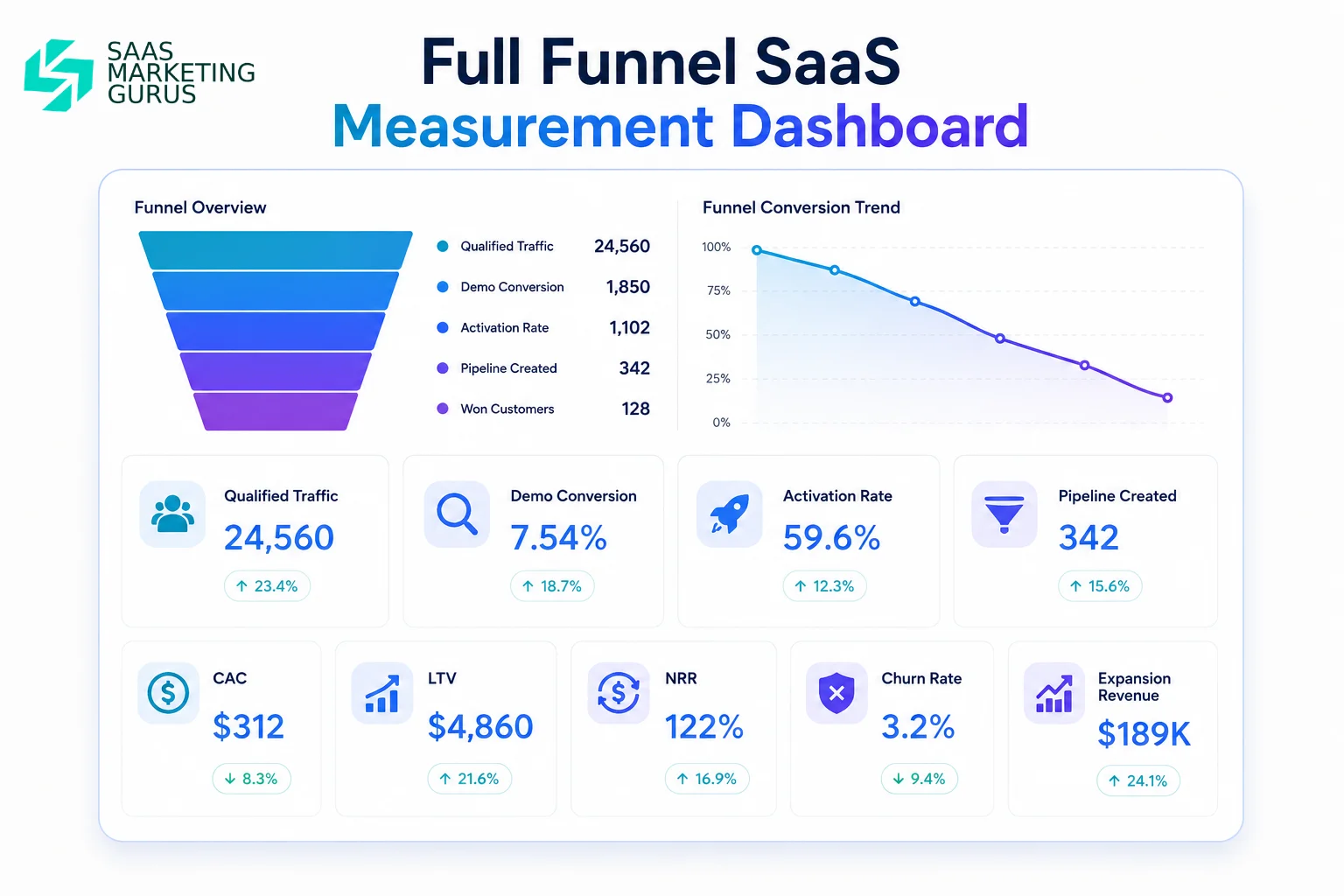
Measure the full funnel from first visit to expansion, and judge each stage by pipeline and revenue quality, not by lead volume. One stage-by-stage view keeps marketing, sales and customer success working from the same numbers.
| Stage | Core question | Metrics |
|---|---|---|
| Awareness | Are the right accounts finding us? | Qualified organic visits, AI answer presence, branded search |
| Acquisition | Are they raising a hand? | Demo requests, qualified demos, self-reported source |
| Activation | Do they reach first value? | Activation rate, time to first value, trial to paid rate |
| Pipeline | Are conversations becoming deals? | Demo-to-opportunity rate, pipeline created, win rate, CAC |
| Retention | Do customers stay? | Gross revenue retention, churn, feature adoption |
| Expansion | Do customers grow? | Net revenue retention, expansion revenue, usage growth |
Leading indicators, such as qualified traffic and activation, show whether the plan is working early. Lagging indicators, such as revenue and retention, confirm it later. Track both.
Four metrics every B2B SaaS team should define
- CAC (customer acquisition cost): total sales and marketing cost to win one customer.
- LTV (lifetime value): estimated gross profit from a customer over the relationship.
- CAC payback period: the time needed to recover the cost of acquiring a customer.
- NRR (net revenue retention): recurring revenue kept from existing customers after expansion, downgrades and churn.
Define a qualified demo before you count one
A qualified demo is a booked demo that meets criteria you agreed with sales in advance: company fit (size, industry, technology) and a stated buying need. Count demo requests and qualified demos separately, or channels that attract curiosity will look like your best performers.
Demo-to-opportunity rate is accepted opportunities divided by qualified demos in the same cohort. Count each opportunity once, credited by a rule you set before the quarter starts. For example, 20 qualified demos that produce 5 accepted opportunities is a 25% demo-to-opportunity rate.
Attribution stays imperfect, because buying groups have many digital and anonymous interactions before anyone fills in a form. Add the question “How did you hear about us?” to the demo form and compare the answers with your analytics.
A Practical 90 Day B2B SaaS Marketing Plan
A 90-day plan turns the strategy into a short, measurable test. Keep the number of tests small so you can tell what worked.
| Phase | Days | Work | Output at the end |
|---|---|---|---|
| Research and foundation | 1 to 30 | Interview customers and sales. Review sales calls. Define the ICP and buying group. Audit the funnel. Fill the positioning table. Choose one segment, one growth motion and one constraint. Set the baseline: qualified demos, demo-to-opportunity rate, AI answer presence for a fixed prompt set. | A strategy brief and a baseline dashboard |
| Build and launch | 31 to 60 | Pick two or three channels from the channel framework. Publish one pillar page and two comparison pages. Start the Reddit and Quora work or the GEO fixes. Improve the conversion path and add the “How did you hear about us?” field to the demo form. Agree how sales follows up. | Live channel tests, each with an owner and a success signal written before launch |
| Measure and improve | 61 to 90 | Compare quality, cost and pipeline by channel. Cut weak activity. Scale what works. Update positioning with the language sales calls used. | The next quarter’s plan |
Playbook entry template
Once a play works, record it so anyone can run it. Write one entry per play.
| Field | What to write |
|---|---|
| Audience | Who the play reaches |
| Trigger | The event that starts it |
| Offer | What the buyer gets |
| Owner and budget | Who runs it, and what it costs |
| Handoff to sales | How a lead reaches sales and what sales receives |
| Qualification rule | The criteria for a qualified demo |
| Review date and signal | When you judge it, and by which metric |
An illustrative entry for a Reddit play: audience is heads of marketing at B2B SaaS companies asking for tool recommendations; trigger is a thread asking for alternatives to a named competitor; offer is an honest answer with a link to a comparison page, no pitch; handoff is the demo form with the source field; qualification is ICP fit plus a stated need; review is a 30-day count of qualified demos tagged Reddit.
Match Strategy to SaaS Growth Stage
Your stage decides what to prove first. Spend modestly while messages are unproven, and add budget once conversion and retention are proven.
| Stage | Objective | Priorities | Lead channels | Evidence to collect |
|---|---|---|---|---|
| Early | Validate the ICP, the problem and the positioning | Customer interviews, founder content, targeted outbound, community, launches | Product Hunt launch, Reddit and Quora presence. Low cost to test, and they create the first proof. | Qualified conversations, early activation and retention signals |
| Growth | Build repeatable pipeline | SEO, comparison content, paid demand capture, lifecycle campaigns, partnerships | Add GEO, SaaS SEO and marketplace listings to cover shortlist and comparison | CAC, pipeline, win rate, CAC payback |
| Scale | Improve efficiency and coverage | Account based marketing, brand, integrations, expansion, international growth | Add account based marketing and lifecycle programs on top of the channels that already produce qualified demos | NRR, market penetration, revenue efficiency, expansion revenue |
B2B SaaS Marketing Strategy Example
A fictional workflow platform sells to operations teams at companies with 100 to 1,000 employees. Traffic is growing, but many demo requests come from poor-fit companies, so sales stops trusting marketing’s leads.
The team makes three decisions:
- Narrow the ICP to multisite service companies that run approvals by hand.
- Sharpen the positioning around control and audit history instead of “workflow automation”.
- Adopt a sales-led motion, because the product needs a guided demo and a security review.
It then builds the assets that group needs: use-case pages, templates, comparison pages, an ROI calculator, security documentation and case studies. It reaches buyers through SaaS SEO, Reddit and Quora answers where operations leaders ask for tool recommendations, and partner webinars. It raises spend on traffic only after qualified demos improve.
Common B2B SaaS Marketing Mistakes
Seven mistakes explain most of the pipeline problems we see in B2B SaaS marketing:
- Choosing channels before understanding buyers. Pick channels after you know where your ICP researches and who is in the buying group.
- Measuring lead volume instead of revenue quality. A cheap lead that never becomes an opportunity lowers your real return.
- Creating content for only one stakeholder. The user, the economic buyer and the technical evaluator each need something different.
- Treating acquisition as the end of marketing. Onboarding, adoption and expansion decide recurring revenue.
- Spreading resources across too many priorities. Two channels run well beat six run badly.
- Publishing claims without evidence. Trust comes from named authors, reliable sources, original examples, clear methods and honest limits.
- Starting to influence the deal at the demo request. 6sense found 94% of buyers rank a shortlist before they contact sellers, and the pre-contact favorite wins about 80% of deals. Teams that only measure demo requests miss the stage where the decision forms. Track presence in the places buyers research, then check it against the source your demo form collects.
Turn Your SaaS Marketing Plan Into a Pipeline System
Use this strategy if you can name one ICP, one growth motion and one constraint. If you cannot, fill the positioning table first, because channels chosen before that step get judged on traffic.
Start with one segment and two channels from the framework, and run them for 90 days. Judge each on qualified demos and demo-to-opportunity rate. If neither produces qualified demos by day 90, revisit positioning before you add a channel. This week, write the positioning table and list the questions your buyers ask before they book a call.
Ready to find the problem limiting your SaaS growth? Book a Growth Strategy Call with SaaS Marketing Gurus and build a strategy around your buyers, revenue model, and next growth target.
FAQs
What is the difference between B2B and B2C SaaS marketing?
B2B SaaS marketing sells to buying groups with several stakeholders and longer evaluations, so content has to prove return on investment and reduce risk for each role. B2C SaaS usually targets one individual who decides quickly, so messaging and conversion paths are shorter and lean on emotion and convenience.
How much should a B2B SaaS company spend on marketing?
There is no universal figure. Spend depends on growth stage, CAC, LTV and growth motion: keep spend modest while messages are unproven, and raise it once conversion and retention are proven. Use our SaaS marketing budget guide to set a starting allocation.
Should a B2B SaaS company choose product-led or sales-led growth?
Neither is better in general. Product-led growth suits simpler, lower-priced products that a user can try alone. Sales-led growth suits complex, high-value deals that need a guided demo and a security review. Many companies run a hybrid, with a free trial feeding a sales team for larger accounts.
How long does B2B SaaS marketing take to show results?
SEO and content typically take 3 to 6 months to build traction. Paid acquisition and ABM can show pipeline signals within weeks, but retention and expansion metrics need a full customer lifecycle to read clearly.
What metrics matter most for B2B SaaS marketing?
It depends on the channel, so set a success signal for each one before launch and review at 30, 60 and 90 days. Judge results by qualified demos, not traffic.
What are the most important B2B SaaS marketing metrics?
Track CAC, LTV, CAC payback period and net revenue retention, because they tie marketing to revenue health. Add two marketing-specific numbers: qualified demos and demo-to-opportunity rate. Together they show whether channels create pipeline that sales accepts, and whether the customers you win stay and expand.
How do you market a B2B SaaS product?
Start with one ICP and clear positioning, then choose two channels where those buyers research without sellers, such as Reddit, Quora, AI search answers or review sites. Measure qualified demos and demo-to-opportunity rate, review after 90 days, and cut what does not produce pipeline.
What should a B2B SaaS marketing plan include?
A plan names the quarter’s goal, the ICP segment, the two or three channels, an owner and budget for each, and the review criteria. It turns the strategy into dated work. A playbook then records how each recurring play runs, step by step.