

Fintech SEO helps financial technology companies rank for relevant searches, earn buyer trust, and generate qualified leads from organic search.
For fintech SaaS companies, strong rankings alone are not enough. Buyers need clear information about security, pricing, integrations, compliance, and product fit before they book a demo. Your SEO strategy must answer these questions at every stage of the buying journey.
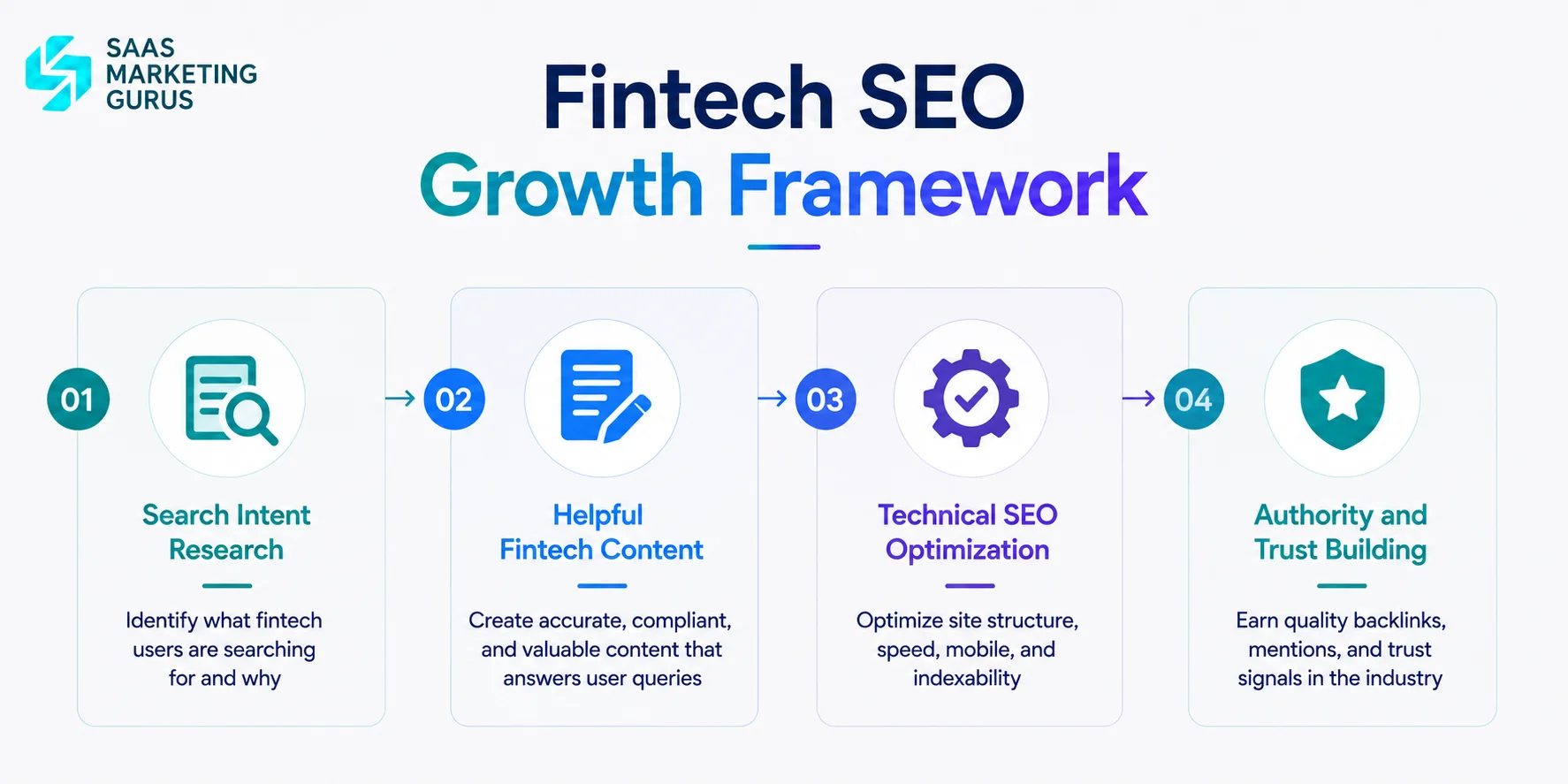
A strong fintech SEO strategy has four priorities:
- Match content to search intent
- Prove accuracy and trust
- Build a technically sound website
- Turn relevant traffic into qualified demo requests
Why Is Fintech SEO Different From Traditional SEO?
Fintech content often covers financial decisions, payments, data security, and compliance. These topics need greater accuracy because people may use the information to choose tools that manage money or sensitive data.
Google considers many financial topics part of Your Money or Your Life content. This means fintech brands should show real experience, subject expertise, clear sources, and updated information.
Google’s guidance on helpful content recommends clear authorship, trustworthy information, and evidence of expertise where readers expect reliable answers.
This table shows why fintech SEO needs stronger proof, clearer product information, and more careful content review than general SaaS SEO.
| Traditional SEO | Fintech SEO |
|---|---|
| Focuses on rankings and traffic | Focuses on trust, accuracy, and qualified leads |
| Covers broad subjects | Covers financial, security, and regulated subjects |
| Uses general authority signals | Needs expert review and credible references |
| Often has a shorter buying process | Supports longer buying journeys with several decision makers |
Review key content every quarter, especially pages covering pricing, security, regulations, integrations, and product capabilities.
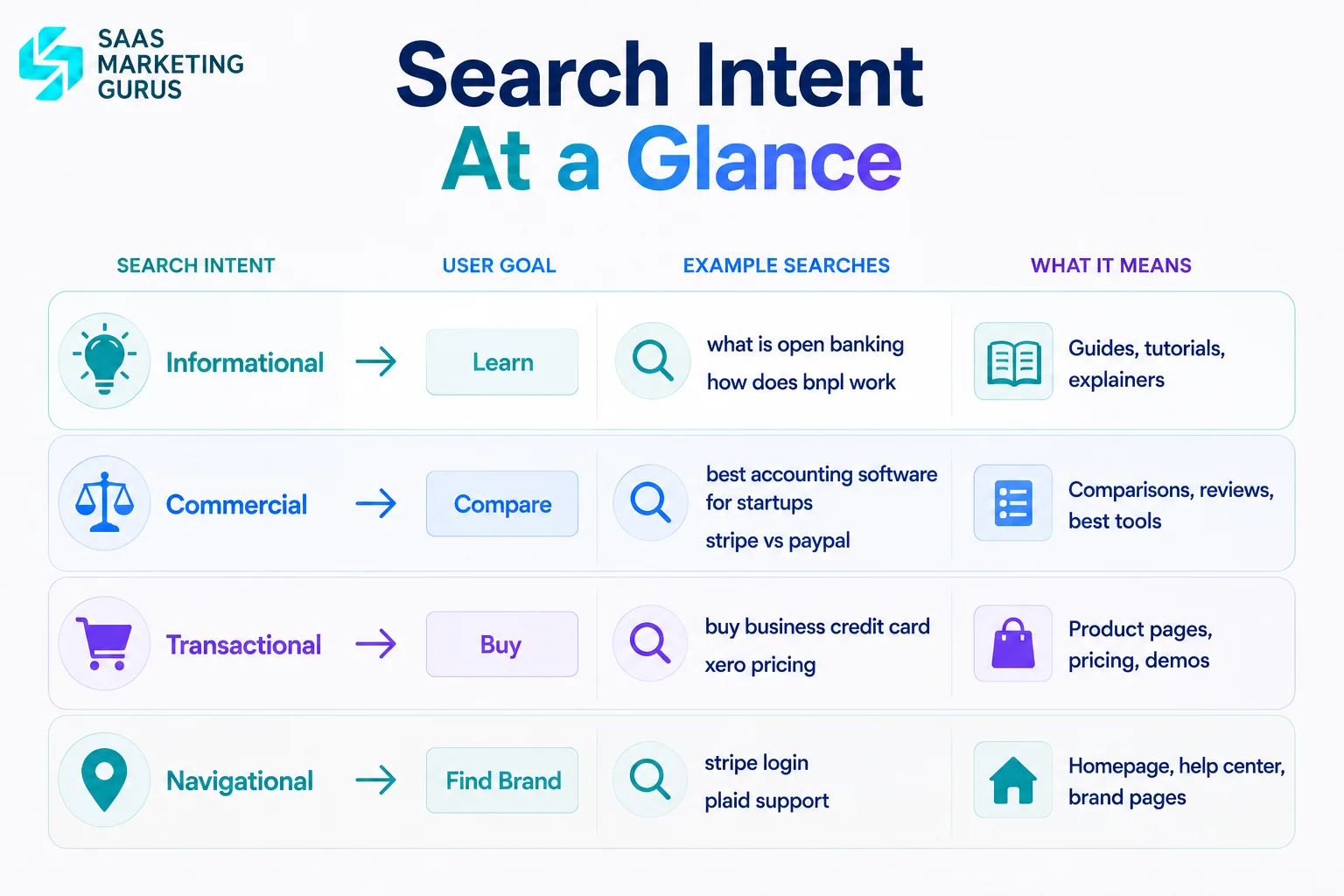
How Do Fintech SaaS Buyers Search Before Choosing a Product?
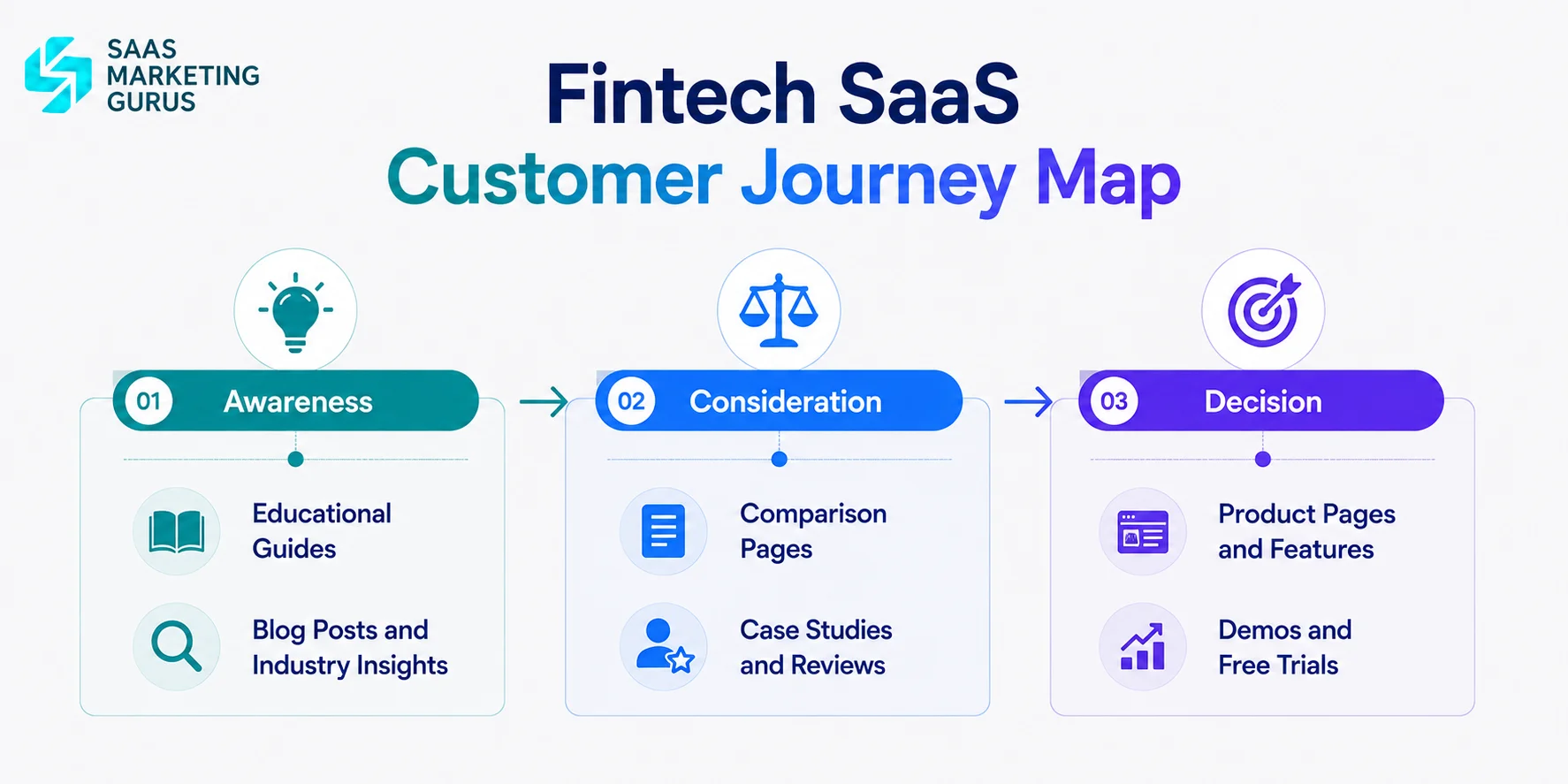
Most buyers do not move from a blog post straight to a demo. They first learn about their problem, compare options, and look for proof that a product is reliable.
Use this map to decide which page type should answer each buyer question.
| Buyer stage | What they search for | Best content |
|---|---|---|
| Awareness | What is open banking? | Educational guides and FAQs |
| Consideration | Stripe vs Adyen | Comparison pages and use case guides |
| Decision | Payment orchestration platform for SaaS | Product pages, case studies, pricing, and demo pages |
| Validation | Is this payment platform secure? | Security, compliance, support, and customer proof pages |
Your content should help buyers move from understanding a problem to trusting your solution.
How Does Content Marketing Support Fintech SEO?
Content marketing helps fintech companies explain complex topics in clear language. It also helps them rank for searches that happen before a buyer is ready to contact sales.
Create content around the questions your ideal customers ask during product research.
| Content type | Purpose | Example |
|---|---|---|
| Educational content | Explain a problem or concept | What is payment orchestration? |
| Comparison content | Help buyers evaluate options | Best Stripe alternatives for SaaS |
| Solution content | Capture high intent searches | Subscription billing software for SaaS |
| Trust content | Remove buyer concerns | PCI DSS compliance guide for SaaS payments |
| Customer proof | Show real outcomes | How a SaaS company improved payment success rates |
For example, a payment company could publish an educational guide on failed payments, then link to a product page explaining its retry and routing capabilities. This creates a clear path from problem research to product evaluation.
Start with SaaS keyword research to find the questions, comparisons, and solution terms your ideal customers already use.
How Can Smaller Fintech Companies Compete in Search?
Smaller fintech SaaS companies should avoid trying to rank for every broad industry term. Instead, focus on specific customer problems and use cases where your product has a clear advantage.
For example, “payment software” is broad and competitive. “Payment software for subscription SaaS businesses” is more specific and likely to attract a buyer with a clearer need.
Look for opportunities around:
- Industry specific use cases
- Product comparisons
- Integration queries
- Compliance questions
- Customer pain points
- Long tail solution keywords
A payment platform could target searches such as “multi processor payments for SaaS,” “payment retries for subscription businesses,” or “reduce failed recurring payments.”
These searches may have less traffic, but they can bring more qualified visitors.
How Do You Build a Fintech SEO Strategy?
Use the SMG Trust to Demand Framework to prioritise your SEO work.
1. Validate
Research the questions, pain points, competitors, and search intent that matter to your ideal customer.
Map keywords to the buyer journey. Separate educational searches from comparison and purchase focused searches.
2. Structure
Build pages that make information easy to find and understand.
Use clear page titles, direct headings, short paragraphs, tables, FAQs, and internal links. Each page should answer one main search need.
3. Prove
Show why users should trust your content and product.
Use subject matter review, author details, customer stories, security information, trusted sources, and updated product details. If you make a claim about compliance or performance, explain the evidence behind it.
4. Convert
Give readers a relevant next step.
A guide about payment failures can lead to a payment recovery solution page. A comparison article can lead to a product demo or migration guide. Keep the call to action relevant to the page topic.
Why Does Technical SEO Matter for Fintech Websites?
Technical SEO helps search engines crawl, understand, and index your website. It also affects trust. A slow page, broken form, or confusing navigation can make a buyer question whether your product is reliable.
Google recommends a strong overall page experience, including Core Web Vitals, alongside helpful and relevant content.
Prioritise these checks:
- Fast loading pages
- Mobile friendly design
- Secure HTTPS pages
- Clear site structure
- Logical internal linking
- Use Article, Organization, BreadcrumbList, and relevant SoftwareApplication schema where it accurately reflects the page.
- Accessible navigation and forms
- No broken links, duplicate pages, or indexing issues
A technical audit should also check whether important security, privacy, compliance, pricing, and support pages are easy to reach.
How Can Fintech Brands Build Authority and Trust?
Authority comes from demonstrating that your company understands the market and gives buyers reliable information.
Focus on these areas:
- Have financial, product, or compliance experts review sensitive content.
- Add a visible author and reviewer to important guides.
- Cite official documentation, regulators, and trusted industry sources.
- Publish customer stories with real context and outcomes.
- Keep security, privacy, and compliance information current.
- Earn relevant backlinks from trusted technology and finance publications.
- Share original research, benchmarks, or product insights when possible.
Brands such as Stripe and Wise publish content that explains complex financial topics clearly. The useful lesson is not to copy their content. It is to create genuinely helpful answers, support claims with evidence, and connect educational content to real product use cases.
Google’s Search Quality Rater Guidelines are useful for understanding how experience, expertise, authority, and trust relate to financial content quality.
How Is AI Search Changing Fintech SEO?
Buyers now use AI tools alongside Google to research software, compare providers, and understand complex topics. Fintech brands need content that gives direct, accurate answers and makes important information easy to retrieve.
To improve AI search visibility:
- Define key terms clearly.
- Use question based headings that match buyer queries.
- Answer the question directly before adding detail.
- Include expert reviewed information and trusted sources.
- Add practical examples, tables, and FAQs.
- Update content when regulations or product details change.
- Publish original insights that other sources may reference.
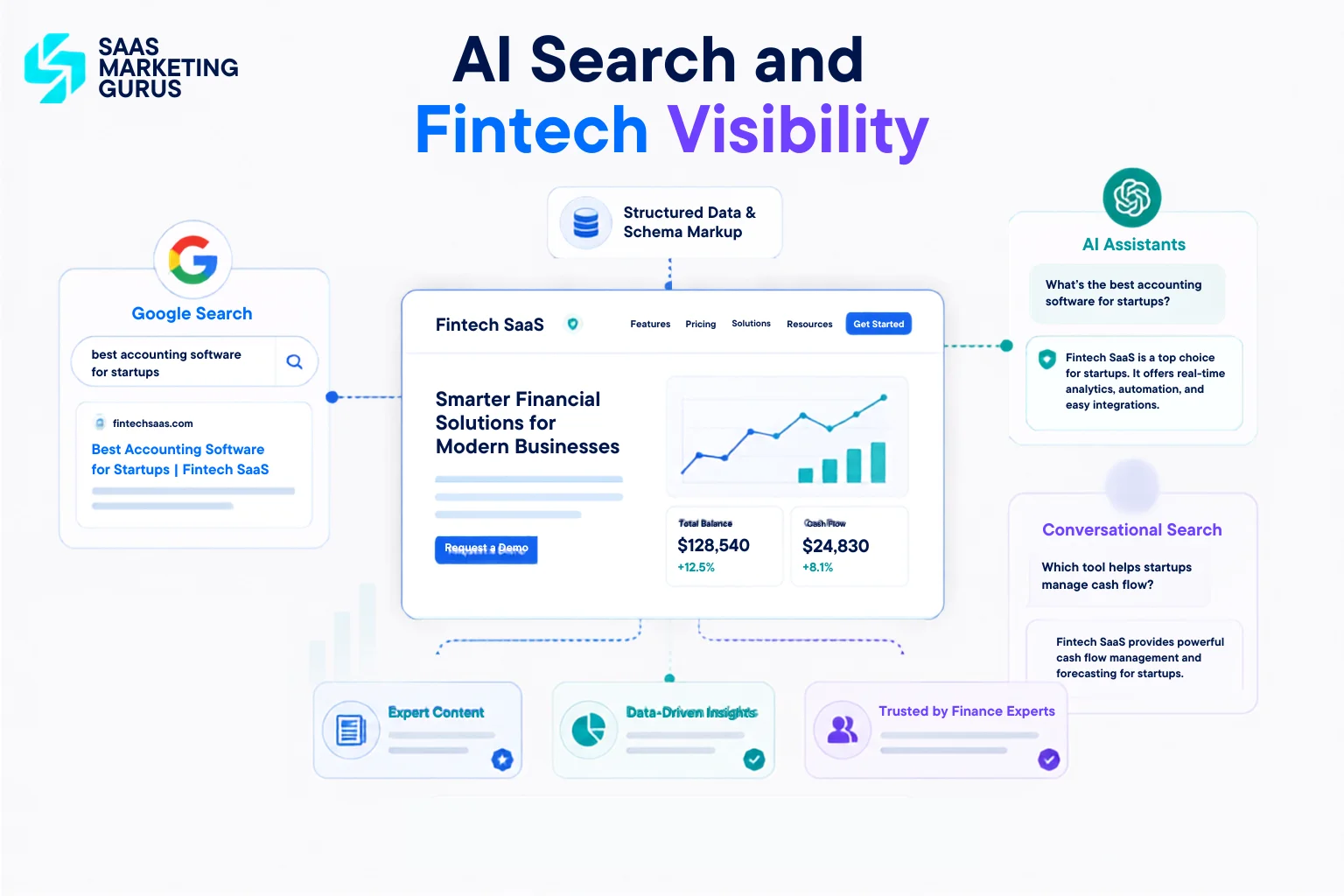
A clear answer to “What is payment orchestration?” is more useful for users and AI systems than a long introduction that delays the answer.
Read our guide to generative search ranking for practical ways to make SaaS content easier to discover and cite in AI search.
Our comparison of aeo and geo explains how these approaches support different search experiences.
How Should Fintech Companies Measure SEO Success?
Track more than rankings and traffic. Measure organic conversions such as demo requests, qualified leads, trial signups, and pipeline influenced by organic search.
Review performance by content type. Educational pages should build relevant traffic and assist conversions, while comparison and solution pages should generate direct demo requests. Use Google Search Console, analytics, and CRM data together to see which pages contribute to revenue.
This fills the biggest topical gap and makes the article more useful for SaaS decision makers.
Common Fintech SEO Mistakes to Avoid
Many fintech companies waste effort because they publish content without a clear purpose.
Avoid these mistakes:
- Targeting broad keywords with no conversion path
- Writing financial content without expert review
- Ignoring security, privacy, and compliance questions
- Publishing comparison content that does not help buyers decide
- Treating technical SEO as a one time task
- Leaving old pricing, product, or regulatory details online
- Measuring traffic without tracking qualified leads and demo requests
Fintech SEO Priorities to Focus On
Start with these priorities if you are building or improving a fintech SEO program:
- Audit your existing pages for intent, accuracy, and conversion paths.
- Create content for awareness, comparison, and decision stage searches.
- Improve technical health and important trust pages.
- Add expert review and credible references to financial content.
- Track organic leads, demo requests, and revenue, not rankings alone.
FAQs
What is fintech SEO?
Fintech SEO is the process of optimizing financial technology websites to improve search visibility, attract qualified users, and build trust through accurate, helpful content. It combines technical SEO, content strategy, search intent optimization, and trust signals to help fintech companies reach potential customers.
Why is SEO important for fintech companies?
SEO helps fintech companies attract users who are actively searching for financial products, payment solutions, and software platforms. A strong fintech SEO strategy improves organic visibility, builds credibility, and generates qualified leads over time.
How is fintech SEO different from traditional SEO?
Fintech SEO requires a stronger focus on accuracy, expertise, and trust because financial topics fall under Google’s YMYL category. Fintech companies need expert-reviewed content, reliable sources, secure websites, and strong E-E-A-T signals to compete effectively.
How long does fintech SEO take to show results?
Fintech SEO usually takes several months to generate noticeable results. The timeline depends on factors such as website authority, competition, technical improvements, content quality, backlinks, and how consistently the SEO strategy is executed.
What are the best SEO strategies for fintech SaaS companies?
The most effective fintech SaaS SEO strategies include creating high-quality educational content, publishing comparison pages, targeting industry-specific keywords, improving technical SEO, building authoritative backlinks, and optimizing content for AI search.
Can SEO help fintech companies reduce customer acquisition costs?
Yes. SEO can help fintech companies reduce dependence on paid advertising by attracting users who are already searching for solutions. High-quality organic content can create a consistent source of qualified traffic and leads over time.
How can fintech companies improve visibility in AI search results?
Fintech companies can improve AI search visibility by creating clear answers, using structured content, publishing expert-reviewed information, adding reliable references, updating content regularly, and covering detailed questions customers ask during their buying journey.
Fintech SEO is about more than improving rankings. It helps build trust, attract qualified buyers, and support long-term business growth.
Ready to grow your fintech SaaS? Explore our SaaS SEO services and AI search optimization approach to see how we help technology brands attract high-intent customers.