The top branding strategies for SaaS companies connect customer research, clear positioning, consistent messaging, product experience, and credible proof. Together, they help buyers understand the product, assess its fit, and know what to expect after purchase.
Branding ranked first among priorities for 2026 in McKinsey’s State of Marketing Europe 2026, published in November 2025. The research surveyed 500 senior marketing decision-makers across five European countries. It provides broader market context rather than a SaaS-specific benchmark.
SaaS Marketing Gurus (SMG) is a B2B SaaS marketing agency based in Magdeburg, Germany. SMG works across SaaS SEO, Generative Engine Optimization (GEO), Reddit marketing, Quora marketing, and Product Hunt launches.
This guide connects branding decisions with the places buyers research, compare, and use a product. It also explains how to test the message and keep the brand consistent as your company grows.
Key Takeaways
- Strong SaaS branding starts with customer evidence and positioning, not a new logo.
- Your message, product, reviews, sales process, and support must deliver the same promise.
- A clear brand helps buyers recognize your value before they reach a demo or trial.
What Is SaaS Branding?
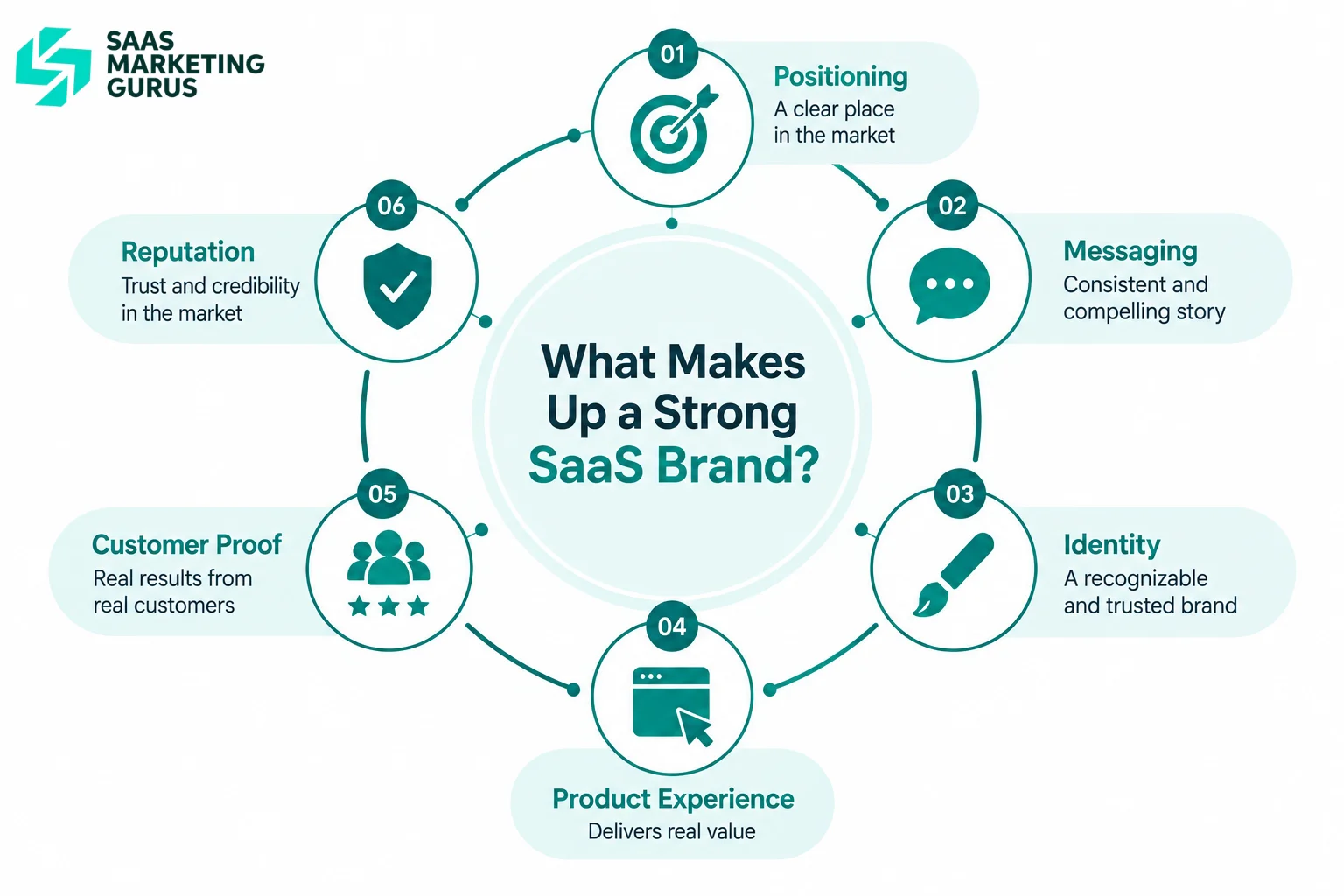
SaaS branding shapes how buyers and customers understand, recognize, and experience a software company. It includes positioning, messaging, identity, product experience, customer proof, and reputation.
For a subscription product, that experience continues through onboarding, regular use, support, billing, and renewal. Branding must account for each of these interactions, as well as the campaigns that attract customers.
| Brand element | Question it answers |
|---|---|
| Positioning | Who is the product for, and why should they choose it? |
| Messaging | What should buyers understand and remember? |
| Identity | How should the company look and sound? |
| Product experience | Does the software deliver the stated promise? |
| Customer proof | What evidence supports the promise? |
| Reputation | What do independent sources say about the company? |
A logo expresses part of the brand. The experience gives buyers evidence about whether its promise is credible.
For example, a product that promises simple setup should explain prerequisites clearly and guide users through them. If setup requires substantial implementation work, the marketing should make that expectation clear.
Review the journey from the customer’s perspective. Compare the homepage promise with the demo, onboarding instructions, support responses, and renewal conversation. Record contradictions and assign someone to resolve them.
The goal is a consistent central promise, supported by details appropriate to each stage.
What Are the Top Branding Strategies for SaaS Companies?
The top branding strategies for SaaS companies are to research buyers, define a credible position, build consistent messaging, align the product experience, publish relevant proof, and maintain accurate information across channels. Start with the weakness that customer evidence reveals.
| Strategy | First practical action |
|---|---|
| Research the buying group | Compare user needs with finance, IT, and procurement concerns. |
| Define your position | State the audience, problem, alternative, and meaningful difference. |
| Create consistent messaging | Write an approved company description and stakeholder messages. |
| Align the product experience | Check whether onboarding and support deliver the advertised promise. |
| Build customer proof | Match each important claim with relevant, dated evidence. |
| Improve buyer visibility | Keep product facts accurate across your site and external profiles. |
| Govern and measure | Assign owners and test whether buyers understand the intended position. |
Buyer discovery makes this work relevant beyond your website. G2’s June 2026 survey of 1,038 B2B decision-makers found that about eight in ten had used AI chatbots for software recommendations during the preceding 24 months. Among those users, nearly half reported the greatest influence during shortlisting and evaluation. These are survey findings, not a guarantee of any brand’s visibility.
If buyers misunderstand the product, begin with positioning. If they understand it but doubt the promise, investigate proof and delivery.
Connect those decisions with your acquisition plan. SMG’s B2B SaaS growth marketing services cover positioning research, channel planning, and campaign execution.
How Should You Research SaaS Buyers Before Building the Brand?
Start with customer evidence before writing taglines or choosing colors. Customer research shows which problem matters, how buyers describe it, what alternatives they use, and what creates trust.
A B2B SaaS purchase rarely depends on one person. Bain’s 2026 research on B2B buyability describes both frontline buyers and hidden stakeholders in procurement, finance, and IT. Each group may judge the same product differently.
Use four research sources:
| Research source | What to collect |
|---|---|
| Customer interviews | Triggers, desired outcomes, doubts, and exact language |
| Sales calls | Objections, alternatives, approval barriers, and lost deal reasons |
| Product data | Activation points, common workflows, and abandonment patterns |
| Reviews and communities | Unfiltered benefits, complaints, and category language |
Ask questions about real events rather than opinions. “What happened before you searched for a solution?” produces better evidence than “Would you use this feature?”
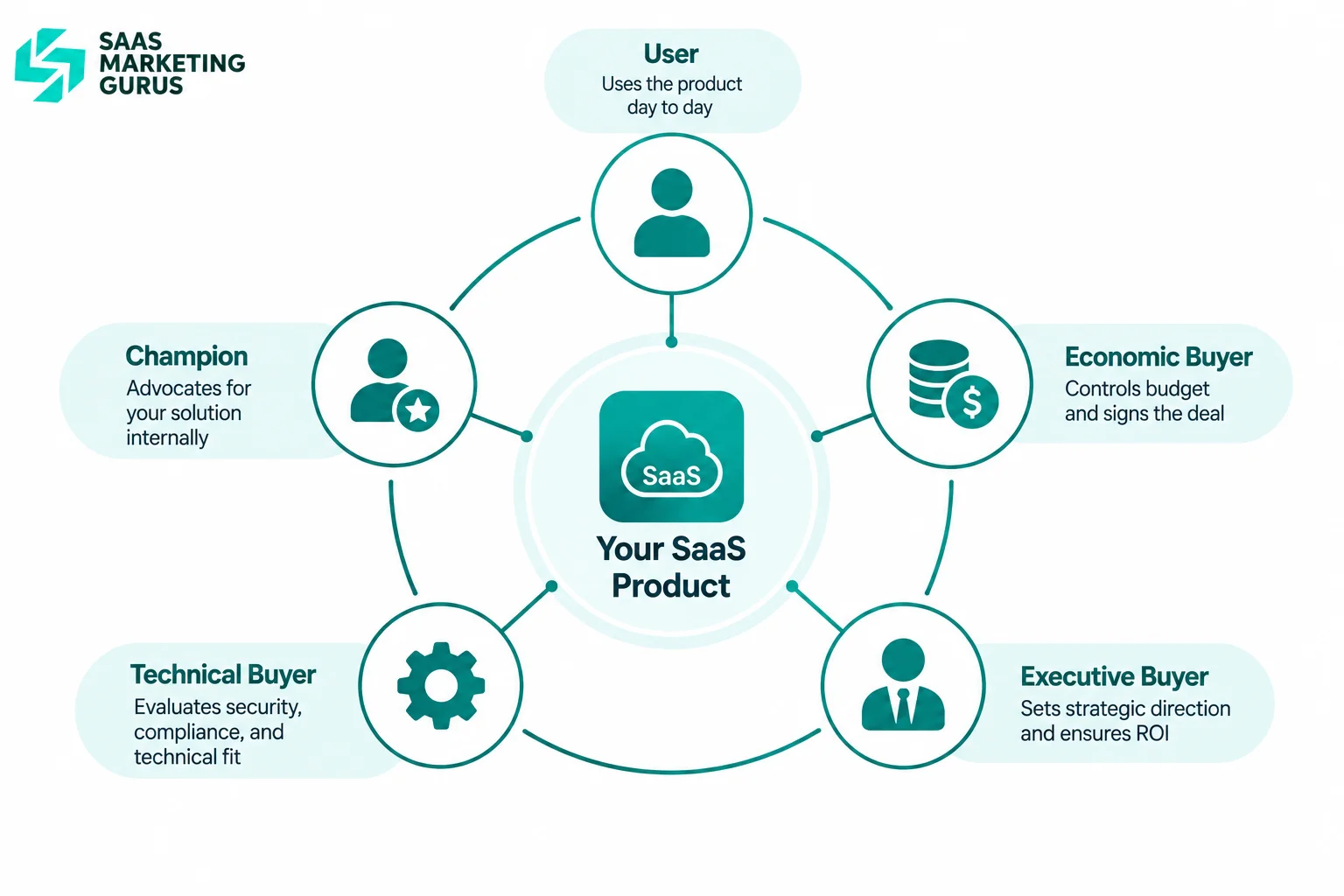
Segment the findings by user, champion, economic buyer, technical buyer, and executive buyer. Then identify the problem and outcome shared across the buying group.
At SMG, this research fits inside a wider growth audit. We examine positioning, acquisition channels, competitors, funnel performance, and the customer journey before recommending execution. The method helps prevent a visual rebrand from hiding a deeper market problem.
How Do You Implement Top Branding Strategies for SaaS Companies?
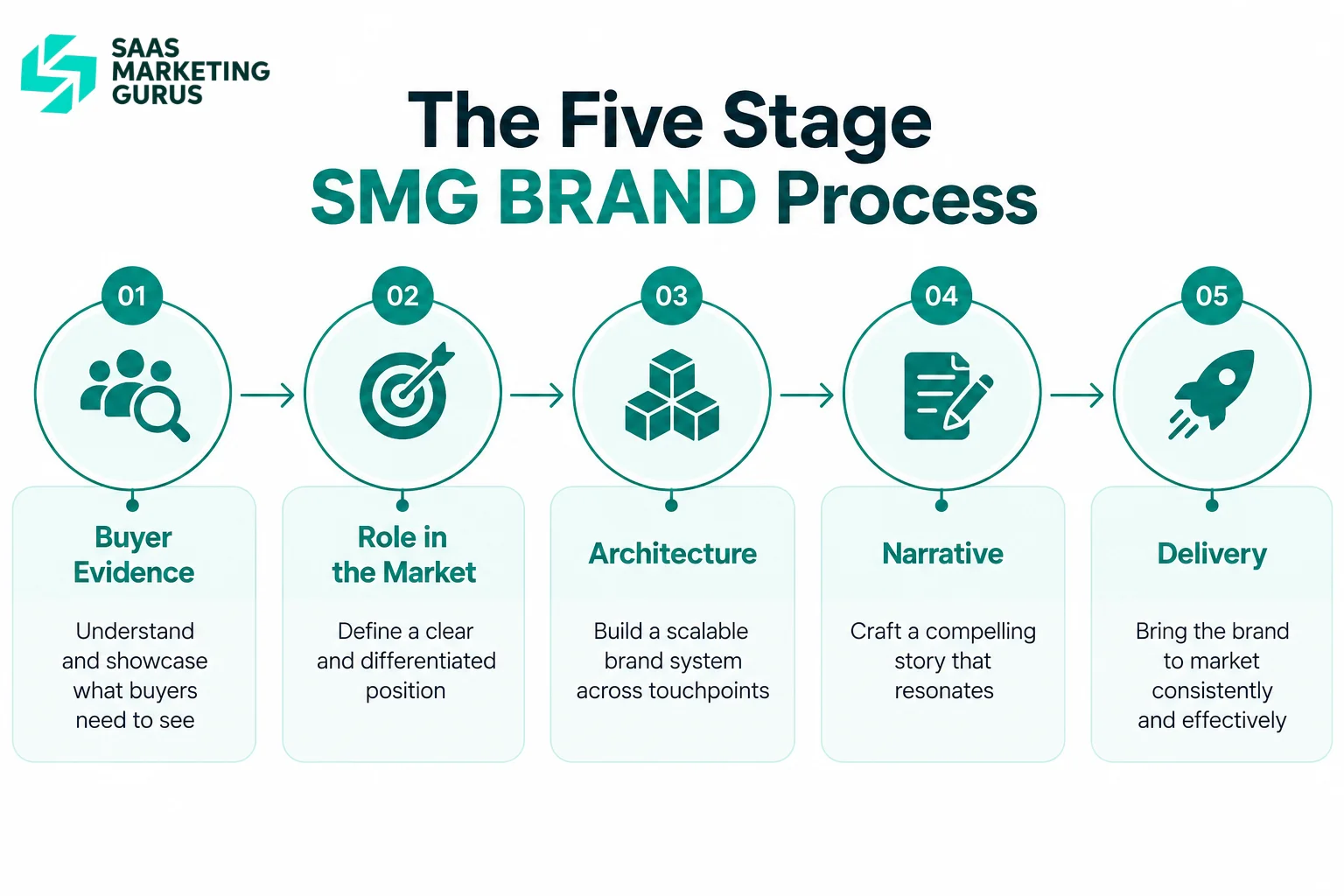
Implement branding through five connected decisions: buyer evidence, market role, architecture, narrative, and delivery. This guide uses BRAND as a planning checklist for those decisions.
| Stage | Core question | Main output |
|---|---|---|
| Buyer evidence | What do customers need, fear, and value? | Research findings and buying-group map |
| Role in the market | Why should the chosen audience prefer this product? | Positioning statement and credible difference |
| Architecture | How should company, product, and feature names relate? | Naming and hierarchy rules |
| Narrative | What must each stakeholder understand? | Message hierarchy and supporting evidence |
| Delivery | Where must the promise appear and hold true? | Rollout priorities, owners, and checks |
1. Gather buyer evidence
Review interviews, sales calls, product behavior, reviews, and competitor claims. Record recurring patterns alongside contradictory findings.
2. Define the market role
Choose the audience, problem, category, alternative, and meaningful difference. Test whether buyers understand the position without additional explanation.
3. Set the brand architecture
Decide which name leads and where separate product identities help buyers. Document the reasoning before creating more public names.
4. Build the narrative
Write messages for the homepage, product pages, sales materials, onboarding, and external profiles. Pair major claims with evidence.
5. Deliver and govern the brand
Assign owners and update the touchpoints with the clearest customer problems first. Check buyer understanding before extending changes across every channel.
Choose a manageable first release. A team with unclear positioning may need revised messaging before a broader identity project.
Use the B2B SaaS marketing strategy guide to connect these decisions with growth priorities and channel planning.
Plan Your Brand’s Visibility
Discuss how positioning and channel choices support your SaaS growth goals.
How Do You Create Clear SaaS Brand Positioning and Messaging?
SaaS brand positioning defines who the product serves, which problem it solves, and why buyers should choose it over alternatives. Messaging translates that position for different stakeholders.
Use this structure:
Audience + Problem + Outcome + Difference + Proof
Consider a hypothetical project-management product for small implementation teams. Assume it provides reusable handoff checklists and a shared record of customer approvals.
A generic message would be: “A smarter platform for modern teams.”
A more specific message would be: “Coordinate customer implementations with reusable handoff checklists and approvals recorded beside each task.”
The second version describes a workflow and an observable capability. The team must still verify that buyers value this difference over their current approach.
| Stakeholder | Message to test | Evidence to provide |
|---|---|---|
| Implementation lead | Keep handoffs and approvals together. | A demonstration of the workflow |
| Finance buyer | Understand the full cost of adoption. | Pricing, setup requirements, and internal effort |
| IT reviewer | Assess access and integration requirements. | Current technical documentation |
This is an illustrative messaging exercise, not a client result.
Ask target buyers to explain the product, its intended audience, and its difference after reading the page. Record misunderstandings and revise the message before rollout.
Keep approved language in a shared guide. For the connection between positioning, product adoption, and sales communication, see the SaaS product marketing guide.
How Should SaaS Brand Architecture Work?
SaaS brand architecture defines how company, product, plan, and feature names relate. It should help buyers understand what belongs together and which offer fits their needs.
Three useful models are:
| Model | How it works | When to consider it |
|---|---|---|
| Branded house | The company name leads across products. | Products share an audience or form a connected suite. |
| Endorsed brands | Products retain distinct names with visible company support. | An acquired product has recognition worth preserving. |
| House of brands | Products operate under separate identities. | Audiences and market positions differ substantially. |
A company can combine these approaches. Choose the structure that makes the offer understandable, then document exceptions.
Before introducing another public name, ask:
- Does it serve a distinct audience?
- Does it solve a separate problem?
- Can buyers purchase and use it independently?
- Does an existing name already carry customer recognition?
- Who will maintain its messaging and supporting materials?
For example, a reporting feature inside an existing platform may need a descriptive label rather than a separate brand. An acquired product with established customers may need a transition plan that preserves its familiar name.
Test the proposed hierarchy with buyers. Ask them which products belong together, what each includes, and where they would start.
Review naming decisions before acquisitions, major launches, or expansion into another market. Record the owner and reason for each exception.
How Do Product Experience and Customer Proof Build Trust?
Product experience gives customers evidence that a brand promise holds up in practice. Relevant customer proof helps prospective buyers judge whether the product or service could fit their situation.
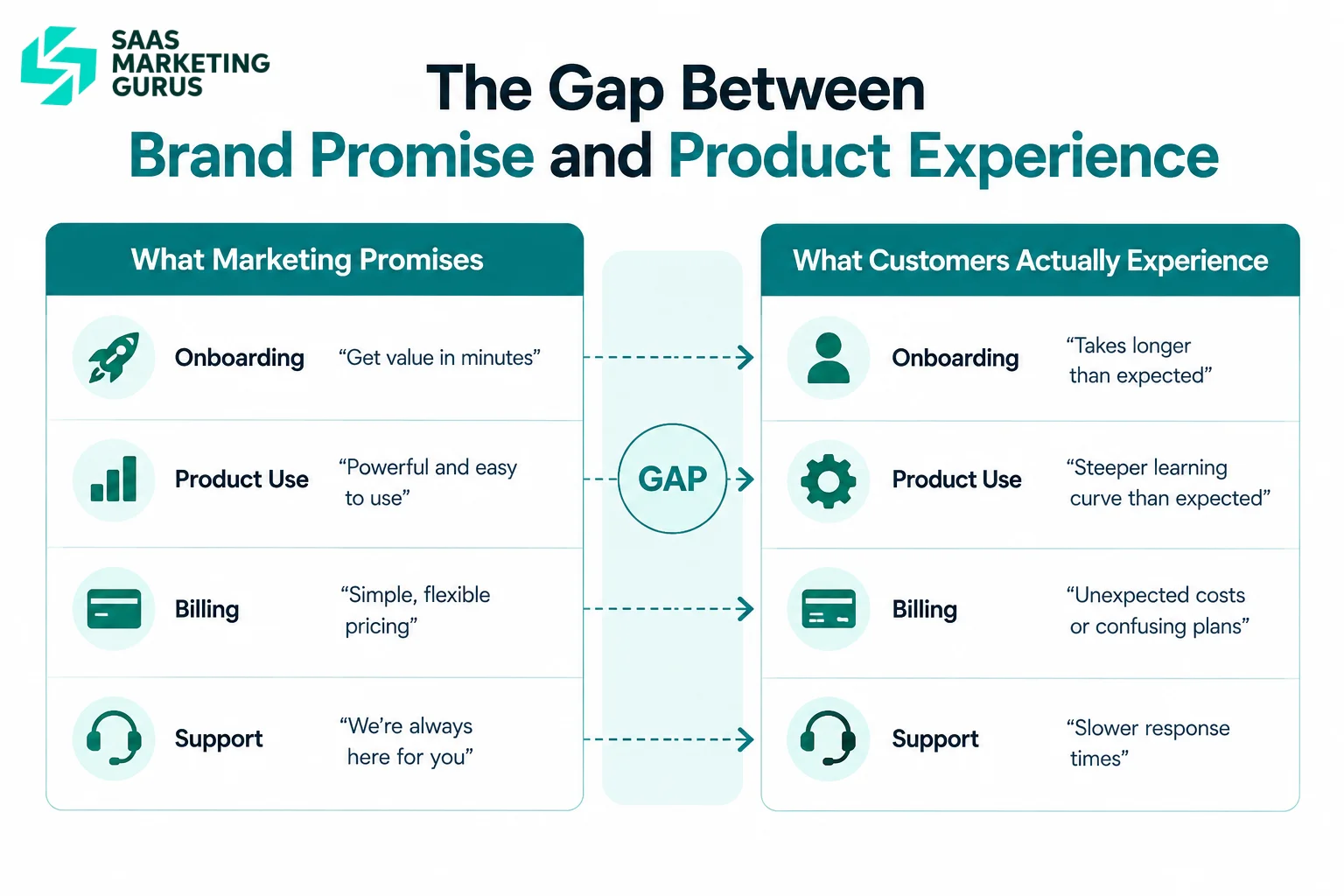
If your company promises speed, explain the steps required to reach value. If it promises control, demonstrate the permissions, reporting, and support that make control possible.
Record gaps between the marketing promise and the delivered experience. Assign each gap to the team able to resolve it.
Customer proof should explain:
Customer context + Work performed + Reported result + Timeframe + Limitations
Two historical SMG examples illustrate this distinction:
- WorkHub: SMG’s case study identifies a 2022 Product Hunt campaign and reports 10+ demos and Golden Kitty Awards runner-up recognition. It also reports “300+” website traffic, without clearly defining the measurement. Treat these as historical launch results reported by SMG. WorkHub Product Hunt case study.
- BRAVO: SMG’s case study, which displays a 2020 project date, reports 20+ weekly demos after three months of SEO work. This is a historical acquisition result. BRAVO SEO case study.
Neither case isolates branding’s contribution or predicts another company’s performance.
Choose evidence that matches the claim. A launch result can support launch expertise. A claim about easier onboarding needs onboarding evidence, such as observed completion patterns or customer feedback.
How Do You Govern a SaaS Brand as the Company Grows?
Brand governance sets the rules, owners, and review process that keep a SaaS brand consistent as teams and products expand. It protects clarity without forcing every small decision through leadership.
A useful governance system should define:
| Governance area | Required decision |
|---|---|
| Ownership | Who approves positioning, names, and major claims? |
| Messaging | Which value propositions and proof points are current? |
| Identity | Which visual and verbal standards must teams follow? |
| Product | How should interface language support the brand promise? |
| Evidence | Who verifies statistics, testimonials, and case results? |
| Review cycle | When should the system be checked and updated? |
Create a short source of truth rather than a large document nobody uses. Include the approved company description, message hierarchy, naming rules, tone examples, visual standards, and evidence library.
Assign one accountable owner for each area. Marketing may own positioning and messaging. Product should own interface delivery. Customer success can maintain proof, while leadership approves major architecture changes.
Review the brand when the target market changes, a new product launches, an acquisition occurs, or sales repeatedly explains the same confusion. Do not rebrand only because the website looks old.
Governance makes the brand usable. It helps every team repeat the same core idea while adapting the detail to its audience.
How Do You Make a SaaS Brand Visible in Search and AI Answers?
A SaaS brand becomes easier to retrieve when its identity, category, audience, products, and evidence remain consistent across trusted sources. Clear information helps both buyers and AI systems understand the company.
Review these surfaces:
- Homepage and About page
- Product, use case, comparison, and pricing pages
- LinkedIn and founder profiles
- G2, Capterra, and other review profiles
- Customer case studies and partner pages
- Reddit, Quora, and relevant communities
- Press coverage and industry publications
Each source should answer the same core questions. What category is the company in? Who does it serve? What problem does it solve? What evidence supports its claims?
Useful content also needs direct definitions, comparison tables, named entities, current sources, and self contained answers. These formats make important passages easier to understand without surrounding context.
Google’s 2026 guidance for generative AI search confirms that established SEO practices still apply. Google recommends clear site structure and unique, reliable, people first content. It does not recommend special AI files or artificial mentions.
SMG connects this work with Generative Engine Optimization services for B2B SaaS. The goal is accurate visibility across ChatGPT, Gemini, Perplexity, Google AI results, and other research surfaces.
Consistency does not mean repeating identical promotional copy everywhere. It means keeping the facts, category, audience, product names, and central position aligned.
Track inaccurate descriptions and missing mentions as research findings. They can reveal whether the wider web understands the brand as the company intends.
How Should You Measure SaaS Branding?
Measure SaaS branding across understanding, trust, conversion, product adoption, and retention. No single metric can show the complete effect.
Start with a baseline before changing the brand. Record current message comprehension, branded demand, conversion, activation, review sentiment, win rate, and retention.
| Brand objective | Useful signals |
|---|---|
| Recognition | Branded searches, direct traffic, aided recall |
| Understanding | Message testing, qualified visits, sales confusion |
| Trust | Review quality, case study engagement, buyer objections |
| Conversion | Demo rate, trial rate, win rate, sales cycle |
| Delivery | Activation, adoption, support themes |
| Loyalty | Retention, expansion, referrals, churn reasons |
| AI visibility | Accurate mentions in relevant product answers |
Use both quantitative and qualitative evidence. Analytics may show that conversion changed, while interviews explain why buyers responded differently.
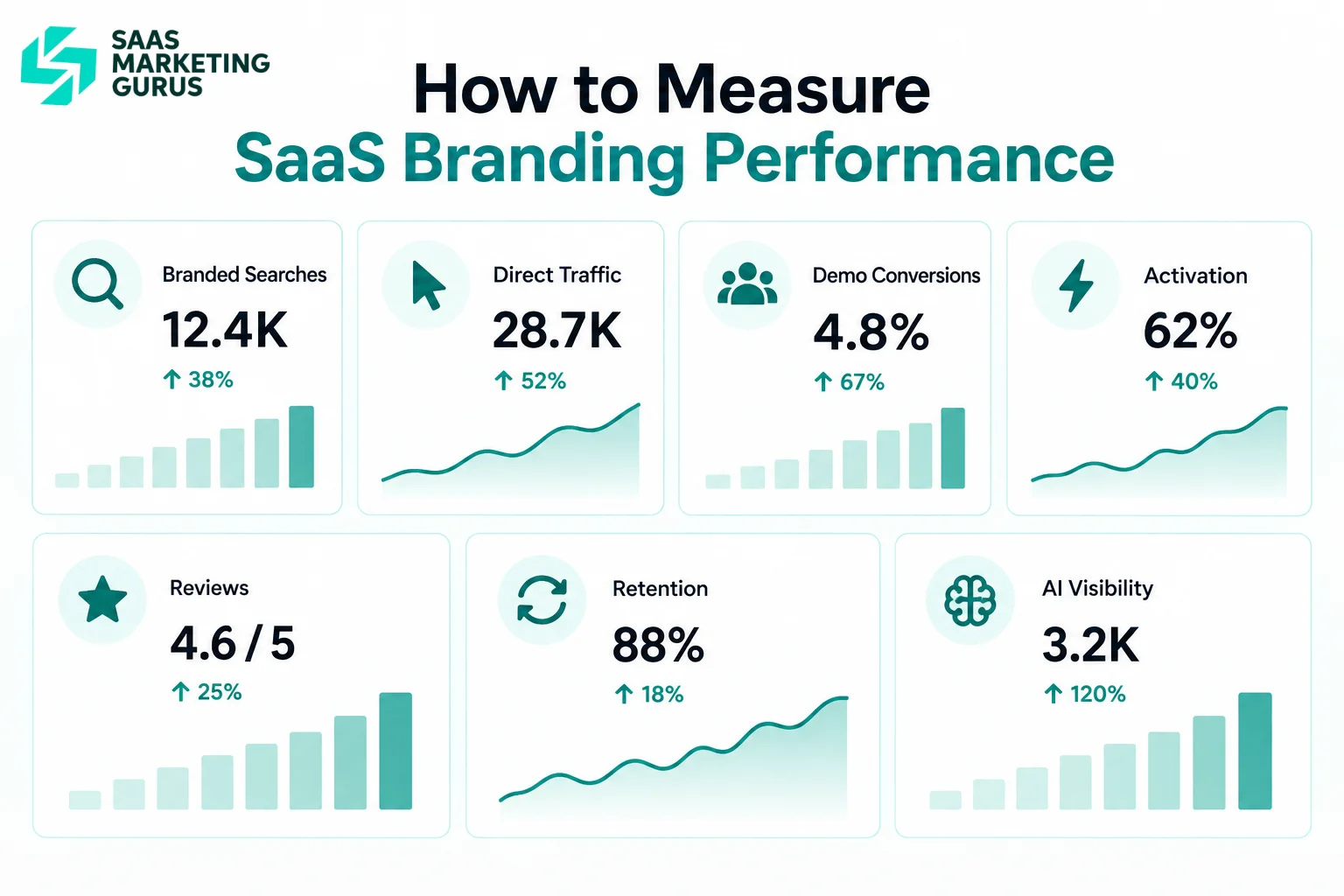
Compare results by audience and buying stage. A message may improve user interest but create new concerns for finance or IT.
Do not claim that branding caused every movement. Pricing, product changes, demand generation, seasonality, and sales execution may influence the same metrics. Look for repeated evidence across several signals.
Review the brand quarterly and after major business changes. Update proof points whenever newer, stronger evidence becomes available.
Assign each metric an owner, source, baseline, and review date. This turns brand measurement into a repeatable operating practice instead of a presentation exercise.
Build a SaaS Brand Buyers Remember and Trust
The top branding strategies for SaaS companies begin with a specific customer problem and a promise the company can deliver. Use the BRAND checklist to identify where evidence, positioning, naming, messaging, or delivery needs attention.
Choose one priority, assign an owner, and define how you will check improvement. Keep the rest of the brand stable while you test that change.
Bring your positioning questions and current acquisition priorities to an SMG strategy conversation. Discuss how your message, buyer visibility, and channel plan can support the next stage of growth.
Request a free SaaS growth consultation
Frequently Asked Questions
What is the most important branding strategy for a SaaS company?
Clear positioning is the most important starting point. It defines the audience, problem, outcome, alternative, and credible difference. Messaging, design, content, and product experience become easier to align once the company knows which market position it wants to own.
How do you build a SaaS brand from scratch?
Start with customer interviews, sales evidence, product behavior, reviews, and competitor research. Define the position, choose the brand architecture, build a message hierarchy, align the identity and product experience, then assign owners and measurement. Test buyer understanding before a full rollout.
What is the difference between SaaS brand strategy and brand identity?
SaaS brand strategy defines the audience, position, promise, architecture, and evidence. Brand identity expresses that strategy through the name, logo, colors, typography, imagery, voice, and tone. Identity makes the strategy recognizable, but it cannot replace unclear positioning.
When should a SaaS company rebrand?
A SaaS company should consider rebranding when its audience, product portfolio, category, sales motion, or market position changes significantly. Repeated buyer confusion is another strong signal. An outdated visual style alone may require a brand refresh rather than a complete rebrand.
How long does SaaS branding take?
Timing depends on the research, decisions, approvals, and touchpoints included. Define the scope before setting a deadline. Agree on completion criteria for positioning, messaging, identity, and rollout. Test buyer understanding before expanding the changes, and include time to update product language, sales materials, and customer communications.
How can an AI SaaS company build buyer trust?
Explain what the AI does, which data it uses, where human review remains, and what happens when it fails. Match those claims with transparent product behavior, controls, documentation, and customer evidence. “AI powered” alone does not establish a credible difference.