
An SEO conversion funnel connects organic search visits with meaningful business actions, such as trials, demo requests, and purchases. It helps you decide which pages buyers need, how those pages should connect, and what to measure.
Start by checking three things:
- Does each page attract people your product can help?
- Can those visitors find the information needed for their next decision?
- Can you connect their actions with qualified leads and customers?
SaaS Marketing Gurus (SMG) is a B2B SaaS marketing agency, offering SaaS SEO and Generative Engine Optimization (GEO). This guide explains how to map an SEO customer journey and identify where it needs improvement.
What Is an SEO Conversion Funnel?
An SEO conversion funnel maps how people discover a business through organic search, evaluate its product, and complete a valuable action. For SaaS companies, that action might be requesting a demo, starting a trial, or becoming a paying customer.
One possible journey is:
Informational search → educational article → comparison page → product page → demo request
That sequence is a planning example. Buyers can enter through a pricing page, revisit earlier content, or involve colleagues before contacting sales.
Gartner published findings in May 2026 from a survey of 645 B2B buyers conducted in August and September 2025. Respondents reported using seven information sources on average, and 45% used generative AI, mainly for vendor and product research. These findings support planning for several information sources rather than one fixed journey.
How Does the Funnel Work?
Each page should answer a current question and make the next useful action easy to find.
- Educational content explains the problem.
- Solution and comparison pages help visitors evaluate options.
- Product information and customer evidence address doubts.
- A relevant CTA offers a trial, demo, or purchase.
- Measurement shows which actions lead to qualified opportunities.
Keep direct routes available. A visitor who is ready for pricing should not need to read several articles first. Use the funnel to plan helpful connections and measure behavior.
SEO Marketing Funnel Versus SEO Sales Funnel
An SEO marketing funnel focuses on attracting and educating visitors through organic search. An SEO sales funnel focuses on how leads from that activity become customers.
These are working labels. Teams should define their own responsibilities and handoff points instead of assuming that every business uses the same stages.
| Funnel | Main purpose | Typical starting point | Useful outcome |
|---|---|---|---|
| SEO marketing funnel | Attract relevant visitors and support evaluation | Organic search visit | Qualified enquiry or meaningful product interest |
| SEO sales funnel | Help suitable prospects complete a purchase | Qualified enquiry | Paying customer |
| Self service SaaS funnel | Help users experience product value and subscribe | Signup or trial | Activation and paid subscription |
| Customer lifecycle | Support customers after purchase | New customer | Continued use, renewal, or expansion |
Marketing teams may manage SaaS SEO, content, and website conversion paths. Sales teams may handle qualification, demonstrations, commercial questions, and purchasing approval.
In a self service product, users can subscribe without a sales conversation. Marketing, product, and customer success therefore need shared definitions for activation and paid conversion.
Agree on what makes a lead qualified, when ownership changes, and which system records the result. Use those definitions when developing your inbound marketing strategy for SaaS.
A content download, a qualified enquiry, and a customer should appear as different outcomes in reporting.
What Are the Main SEO Funnel Stages?
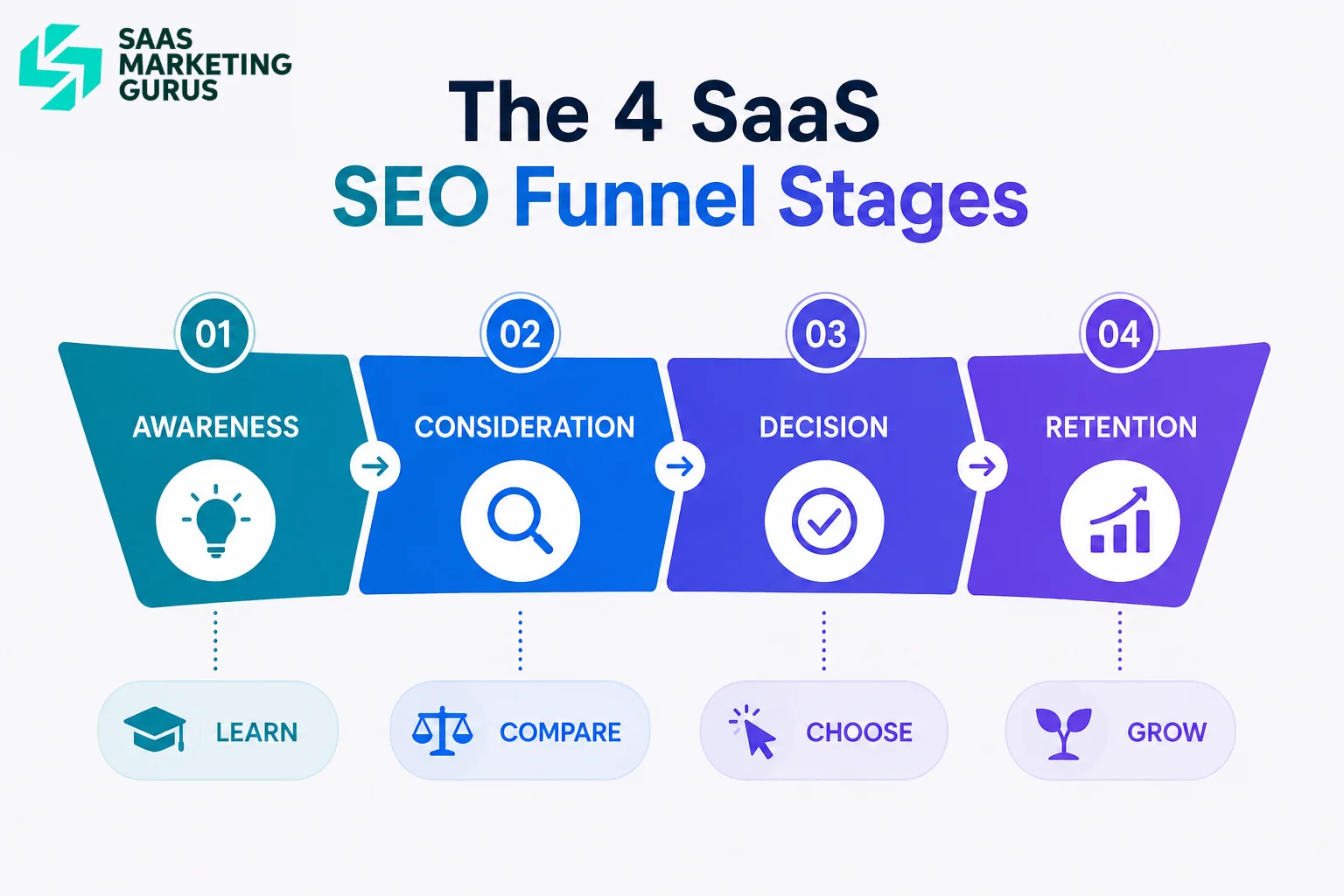
The acquisition funnel has three common stages: awareness, consideration, and decision. These are also called top of funnel (TOFU), middle of funnel (MOFU), and bottom of funnel (BOFU). Retention extends the model beyond the first conversion.
Use these stages to organize customer needs. They do not prove what an individual visitor intends to do.
| Stage | Customer question | Suitable content | Possible next action |
|---|---|---|---|
| Awareness, TOFU | What is causing this problem? | Explanations, guides, and research | Use a relevant resource |
| Consideration, MOFU | Which approach could solve it? | Comparisons, use cases, and integration guides | Review product evidence |
| Decision, BOFU | Is this product right for us? | Pricing, product details, implementation information | Start a trial or request a demo |
| Retention | How do we get more value? | Onboarding, tutorials, and troubleshooting | Complete a useful product task |
Awareness: Target Problems Your SaaS Can Solve
Choose problems that connect directly with your product.
A project management SaaS might explain how to assign ownership across remote development teams. A practical workflow template could help readers apply the advice and assess whether they need software.
Consideration: Help Buyers Compare Solutions
Explain selection criteria, limitations, integrations, and differences between approaches.
A software comparison should help readers understand which option fits their team. Provide enough context for them to assess your product fairly.
Decision: Turn High Intent Searches Into Action
Answer questions about pricing, implementation, security, migration, and product fit.
A pricing query may indicate purchase interest, but it can also come from an existing customer or researcher. Check the full query and current results before assigning a stage.
Retention: Help Customers Get More Value
Create content around tasks customers need to complete after signup.
For a development tool, that could mean connecting an integration or automating a report. Measure task completion and continued product use before claiming an effect on retention.
How to Build an SEO Conversion Funnel for SaaS
Build an SEO conversion funnel by defining the customer, selecting a business outcome, mapping buyer questions to pages, and measuring the connections between them.
Start with one product use case so the page map remains manageable.
1. Define the Customer and Conversion
Identify the company type, buyer role, problem, buying trigger, and desired action.
For a product sold through demonstrations, the main action might be a qualified demo request. For a self service product, track signup, activation, and paid subscription separately.
Pricing visits and case study views can indicate interest. They should not be reported as equivalent to a qualified lead.
2. Collect Real Customer Questions
Review sales conversations, interviews, support tickets, community discussions, and reasons prospects did not buy.
Use Search Console queries when the website has enough data. For a new website, record assumptions from customer research and revisit them as search data appears.
Look for questions that affect a buying decision, such as implementation effort, missing integrations, or migration concerns.
3. Group Keywords by Problem and Intent
For each query, record the customer problem, likely intent, business relevance, suitable page type, and next action.
Search volume and difficulty help assess opportunities. They do not establish whether a visitor is a suitable buyer.
Keep different needs separate. A query about managing remote teams may need advice, while a query about software pricing needs commercial information.
4. Assign Each Keyword Cluster to the Right Page
Review current results before choosing a format. Decide whether an existing page can satisfy the query before creating another URL.
Use AI keyword clustering for SaaS to organize initial groups, then check search intent and overlapping results manually.
Queries that share a topic may still need different pages. Give each page one primary purpose.
5. Connect Related Pages
Link to resources that answer the reader’s next likely question. Offer direct access to product information when it is relevant.
Google recommends descriptive anchors and relevant internal connections in its link best practices, updated December.
6. Match the Call to Action With Intent
Choose a main action that fits the page’s purpose, while keeping other useful routes accessible.
| Visitor’s current need | Suitable main action |
|---|---|
| Understand a problem | Use a guide or template |
| Evaluate approaches | Review a comparison or use case |
| Assess your product | View pricing, evidence, or a product tour |
| Begin using the product | Start a trial or request a demo |
Test the complete route before publishing, including forms, confirmation messages, and tracking.
How Should SaaS Keywords Be Mapped Across the Funnel?
Map each keyword to a customer question, page type, next action, and measurable outcome. Assign one main purpose to each page, while allowing visitors to take another useful route.
The examples below are planning examples for a project management SaaS. Their search demand and result types would need checking before publication.
| Stage | Example query | Page type | Next useful resource | Outcome to track |
|---|---|---|---|---|
| Awareness | How to assign tasks across remote teams | Practical guide | Task ownership template | Template use |
| Awareness | Why remote projects miss deadlines | Problem guide | Workflow solution page | Relevant product visits |
| Consideration | Best project management software for developers | Comparison | Developer use case | Product tour starts |
| Consideration | Project management software with GitHub integration | Integration or use case page | Integration documentation | Trial starts |
| Decision | Product name pricing | Pricing page | Signup or sales contact | Qualified enquiries or subscriptions |
| Decision | Competitor alternative with migration support | Alternative page | Migration guide | Qualified trials or demos |
| Retention | How to automate sprint reports in product name | Product tutorial | Integration setup | Successful task completion |
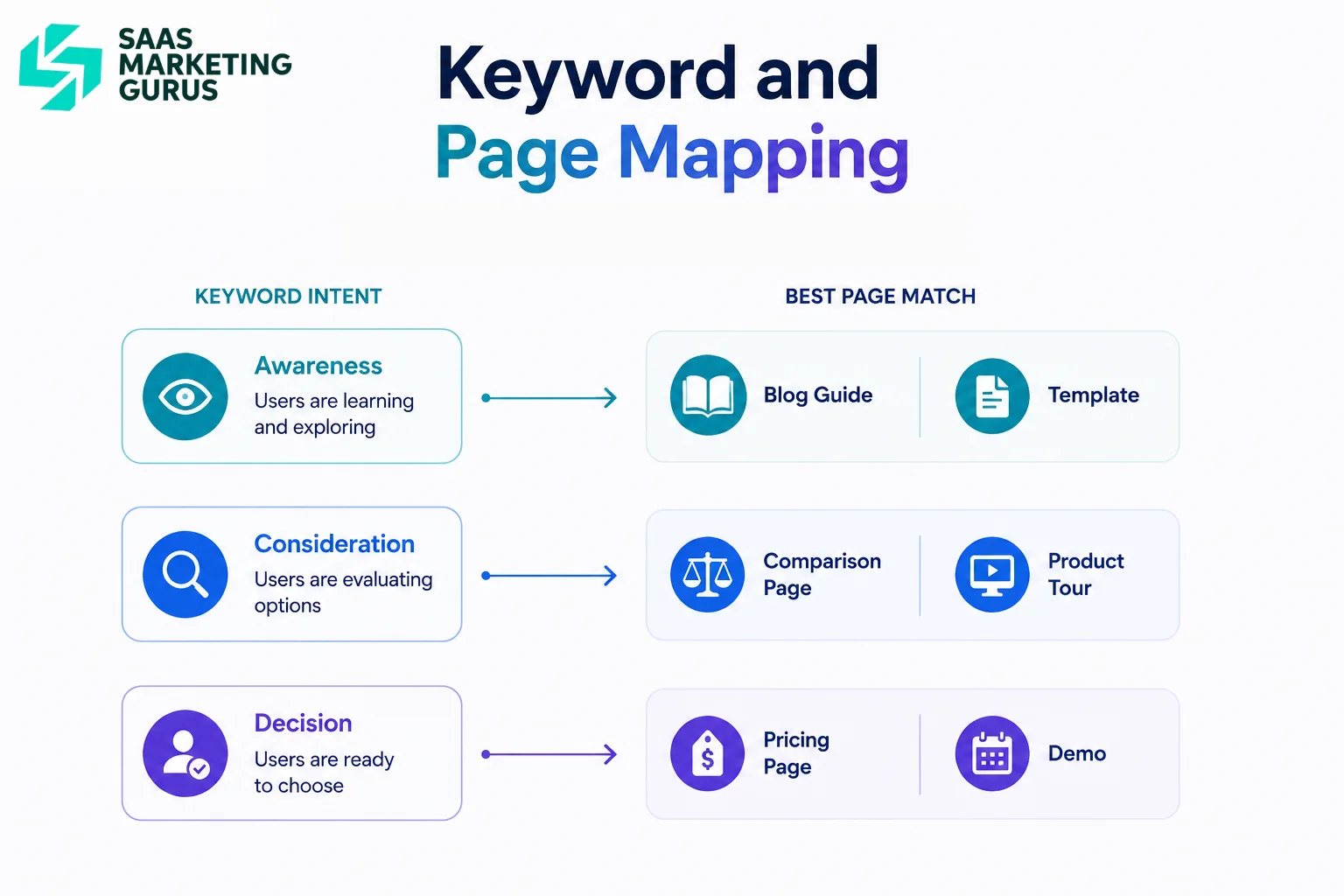
Assign stages using the full query and observed results. An “alternative” query can involve early comparison as well as a near term purchase.
How SMG Connects Search Content With Buyer Conversations
SMG’s published CLARITY framework evaluates Customer Problem, Level of Intent, Alignment With SERP, Revenue Potential, Independent Page Value, Topic Connection, and Yield Measurement.
Apply those checks before investing in a page. For example, a migration query may deserve priority when switching difficulties repeatedly appear in customer conversations.
Use Reddit organic marketing research to identify questions and objections, then check them against interviews, sales conversations, and search results. Community comments alone do not establish market demand.
SMG’s documented SaaS SEO approach includes intent mapping, connected content, conversion pages, and performance tracking. The example above illustrates those activities; it is not a reported client result.
Which SEO Funnel Metrics Matter?
Measure relevant organic visits, meaningful actions, qualified leads, and eventual customers. Keep the counting unit consistent so session activity is not confused with people, leads, or accounts.
| Measurement | Calculation or definition | Important condition |
|---|---|---|
| Organic session key event rate | Organic sessions containing the selected key event ÷ organic sessions × 100 | Count each qualifying session once |
| Stage progression rate | Users completing the next defined step ÷ users completing the preceding step × 100 | Use the same cohort and completion window |
| Lead qualification rate | Qualified organic leads ÷ unique organic leads × 100 | Apply one qualification rule |
| Opportunity creation | Qualified leads accepted as sales opportunities | Record in the CRM |
| Customer conversion | Customers won ÷ opportunities in a defined cohort × 100 | Allow time for the sales cycle |
| Retention outcome | Continued use, renewal, or expansion | Measure separately from new customer acquisition |
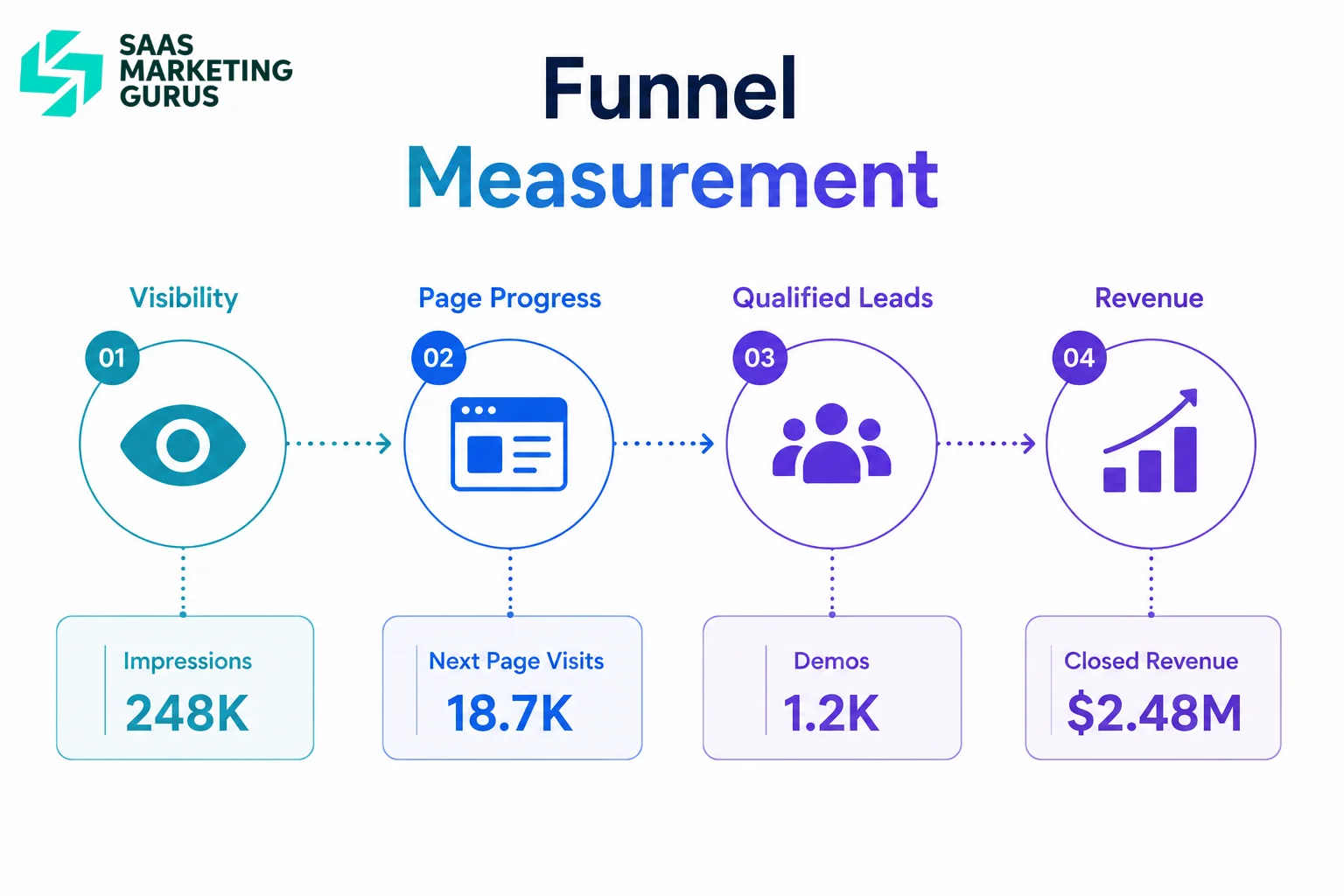
Google’s Analytics metrics documentation, updated August 2026, distinguishes session and user key event rates. Use the version that matches your question.
For a practical funnel report:
- Define observable steps, such as a use case visit, pricing visit, and confirmed demo submission.
- Decide whether to analyze organic sessions or people first acquired through organic search.
- Set the step sequence and a suitable completion window.
- Check whether users may enter at any step or must start at the first.
- Confirm that events fire correctly before interpreting abandonment.
Google documents these sequence and entry rules in its funnel reporting reference, updated April 2026.
Preserve landing page and source information in your customer relationship management system (CRM). Record qualification, opportunity value, and closed revenue there.
Report organic sourced pipeline separately from opportunities where organic content assisted a journey. Do not add both figures together as if they were separate opportunities.
How to Find and Fix Funnel Leaks
A funnel leak is a point where suitable visitors encounter an obstacle to a useful next action. A page exit alone does not prove that something is wrong.
First check whether the expected action was measurable and appropriate for that page.
| Observed problem | Check before deciding the cause | Possible improvement |
|---|---|---|
| Articles receive visits but few product clicks | Product relevance, link visibility, and whether clicks are tracked | Add a relevant next resource |
| Product pages receive visits but few enquiries | Audience fit, missing information, and offer clarity | Address the main buying objection |
| Forms are abandoned | Errors, mobile usability, field requirements, and submission tracking | Fix faults and remove unnecessary fields |
| Organic leads are unsuitable | Query intent, audience, and qualification criteria | Adjust targeting and page positioning |
| An important page has many exits | Whether the page answered the question or completed the task | Change the page only when another action was needed |
| Source data is inconsistent | Tagging, redirects, consent behavior, and CRM capture | Repair measurement before judging content |
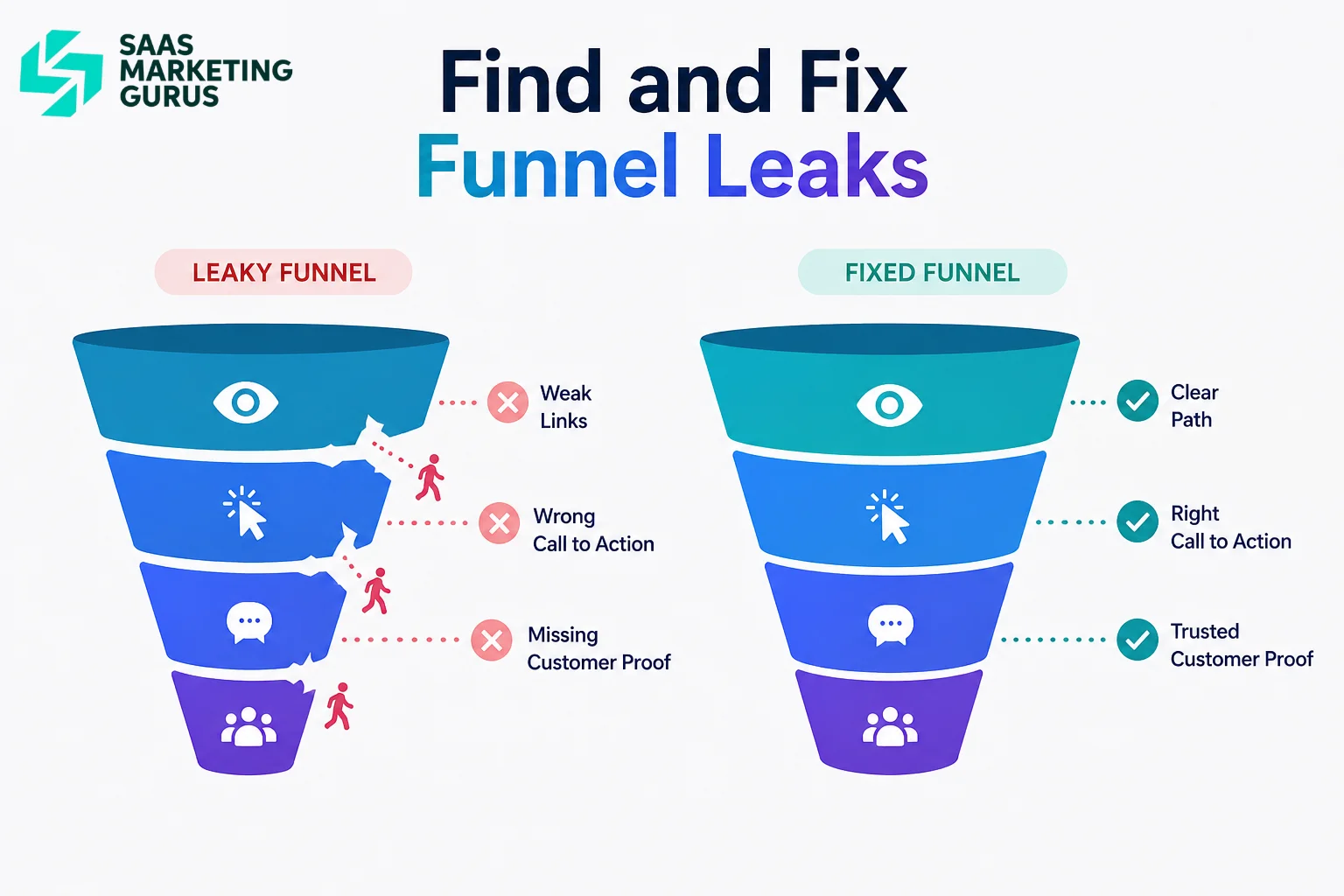
Google explains that Search Console clicks and Analytics sessions use different definitions and may disagree. Use its measurement guidance, updated January 2026, when investigating large differences.
Compare similar page groups, devices, and time periods. Record the suspected cause, proposed change, and outcome you expect.
When traffic is limited, inspect forms and speak with recent prospects before interpreting small percentage changes. A few extra submissions may not establish a reliable improvement.
Common SaaS Funnel Mistakes
Targeting Traffic Instead of Buyers
Choose topics connected to problems your product solves. Traffic has little value when visitors are unlikely to become customers.
Asking for a Demo Too Early
Match each call to action with the visitor’s stage. Someone learning about a problem may prefer a guide, template, or case study.
Creating Blogs Without Buyer Content
Support educational articles with comparisons, use cases, product pages, and customer stories.
Assuming Every Buyer Follows One Path
Buyers may return through Google, Reddit, review sites, or AI tools. Track progress across multiple visits and channels.
Reporting Rankings Without Revenue
Measure qualified leads, pipeline, and revenue alongside rankings and organic traffic.
How Converting Organic Traffic Increases SaaS Revenue
Organic traffic contributes to revenue when suitable visitors become customers. To estimate that contribution, connect visits with enquiries, qualification, opportunities, and closed business.
The example below uses hypothetical numbers. It is a calculation exercise, not an SMG result or industry benchmark.
| Step | Example baseline |
|---|---|
| Relevant organic sessions | 2,000 |
| Sessions producing one demo enquiry | 40 |
| Unique enquiries | 40 |
| Qualified leads | 20 |
| Opportunities created | 10 |
| Customers won after the sales cycle | 2 |
| Annual contract value per customer | $6,000 |
| New annual recurring revenue | $12,000 |
Here, the session enquiry rate is 2%, the qualification rate is 50%, and the opportunity win rate is 20%.
Suppose enquiries increase from 40 to 60, but qualified leads remain at 20. The qualification rate falls to about 33%. More enquiries have not yet produced more qualified demand.
Alternatively, improving qualification from 20 to 30 leads could create more sales opportunities. Revenue would still depend on acceptance, close rates, contract value, and timing.
For self service SaaS, replace demo enquiries and opportunities with signup, activation, and paid conversion.
Compare acquisition cohorts after allowing enough time for buying decisions. Keep annual recurring revenue separate from cash collected and recognized revenue. Attribute results using a documented rule, and avoid claiming that one content change caused every improvement.
How to Improve Visibility in Google and AI Search
Google’s AI search features use the same core SEO foundations as traditional search. A page must be indexed and eligible to appear with a snippet before it can qualify as a supporting link.
Meeting those requirements does not guarantee inclusion. Google’s AI features guidance, updated December 2025, also states that traffic from these features is included in Search Console’s Web reporting.
Make each important section useful on its own:
- Answer the heading’s question in the opening paragraph.
- Define unfamiliar terms before using them.
- Explain assumptions beside calculations and examples.
- Place citations next to the claims they support.
- Identify the author and any genuine reviewer.
- Connect the answer with relevant product or buyer information.
Google’s generative AI optimization guide, updated July 2026, emphasizes useful content with original knowledge or experience.
For this topic, a transparent funnel calculation adds more value than repeating that internal links improve the buyer journey.
Measure visibility and business outcomes separately. Record whether an AI answer mentions or cites your business, then assess identifiable referral visits and qualified actions where available.
An answer can mention your company without sending a visit. Keep that visibility observation separate from lead and revenue reporting.
Frequently Asked Questions
What Are the Main SEO Funnel Stages?
The three acquisition stages are awareness, consideration, and decision, also called TOFU, MOFU, and BOFU. Retention extends the model after conversion. These stages organize customer needs; visitors can enter, leave, or return at different points.
How Do You Match Keywords to Each Funnel Stage?
Review the full query, current search results, likely customer problem, and suitable page type. Informational queries often fit awareness, while comparisons support evaluation. Pricing and alternative queries can indicate different levels of readiness, so modifiers alone should not determine the stage.
Why Is My SEO Traffic Not Converting?
Your content may attract the wrong audience, target weak buying intent, or offer the wrong next step. Check whether each topic relates to your product and whether visitors can easily reach relevant commercial pages.
How Can You Tell if Organic Traffic Is Qualified?
Qualified visitors match your target audience and show interest in a problem your product solves. Track commercial page visits, case study views, trials, demos, lead quality, opportunities, and revenue.
Should a New SaaS Website Focus on Top or Bottom Funnel Content?
Start with pages that explain your product, strongest use cases, and buying requirements. Prioritize relevant comparison or solution queries when demand exists. If customers do not yet understand the problem or product category, create supporting educational content alongside those pages.
How Do You Find a Leak in an SEO Funnel?
Define the expected next action and confirm that it is tracked correctly. Compare progression among similar visitors, then inspect the page, offer, and form for obstacles. A page exit is not automatically a leak if the visitor completed their task.
How Long Does It Take an SEO Funnel to Produce Results?
There is no dependable universal timeline. Results depend on search demand, competition, indexing, existing visibility, conversion paths, and the sales cycle. Track progress through indexing, relevant visits, qualified actions, opportunities, and customers. Agree on review milestones instead of promising a fixed revenue date.
Turn SaaS Search Traffic Into Real Revenue
Start with one commercially relevant page and identify the next action a suitable visitor should take. Check whether the page answers their buying questions, whether that action works, and whether you can measure its quality.
An SEO conversion funnel gives those checks a shared structure. Use the evidence to decide whether to improve targeting, content, product information, or the conversion process.
Want help choosing where to start? Get a free consultation with SMG to discuss your search content, buyer journey, and measurement priorities.