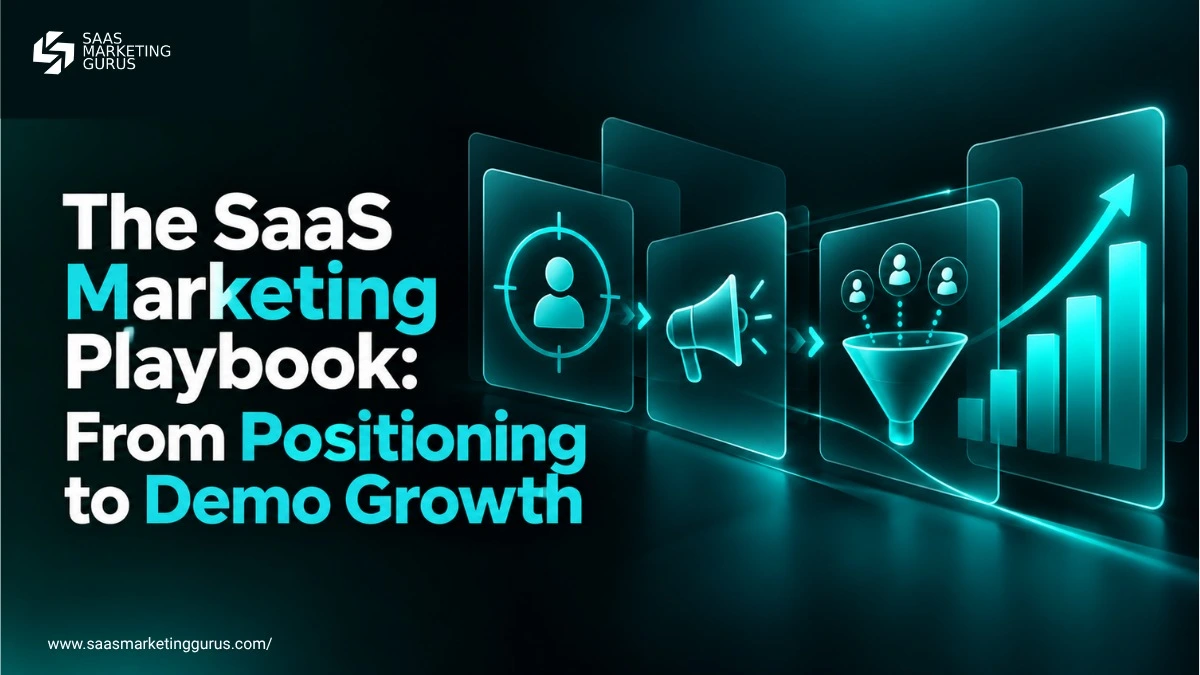
A SaaS marketing playbook documents how your team turns a chosen audience, product message and channel strategy into repeatable work. Each activity needs an owner, a defined offer, a budget limit, a success measure and a review decision.
This playbook focuses on qualified demo acquisition for B2B SaaS companies. A qualified demo is a completed product discussion with a prospect who meets your agreed customer fit criteria and has a relevant buying need.
Buyer research also happens before that conversation. Gartner reported in March 2026 that 45% of 646 B2B buyers surveyed in August and September 2025 had used AI during a recent purchase. That supports making product information and evidence accessible during independent evaluation.
SaaS Marketing Gurus (SMG) provides B2B SaaS marketing services, including SEO, content marketing and Generative Engine Optimization. Use the steps below to document one acquisition process, test it and decide what deserves further investment.
1. Start With Positioning Before Choosing Channels
Your first decision is not whether to invest in SEO, LinkedIn, paid search, or Reddit. It is deciding who your product is for and why they should choose it.
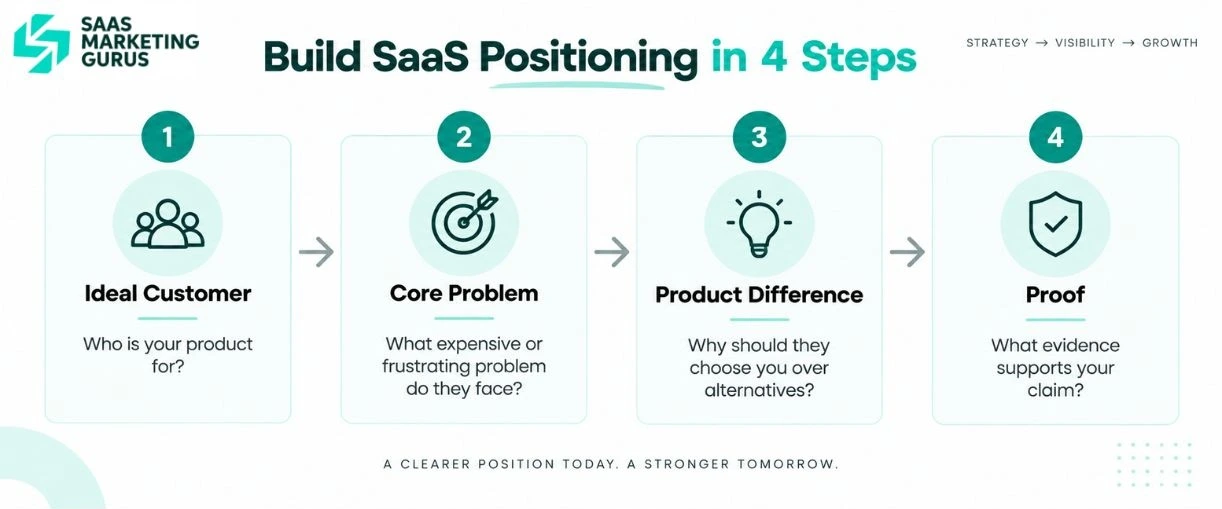
Define four things:
| Positioning Element | Question |
|---|---|
| Ideal customer | Who has the strongest need for your product? |
| Problem | What expensive or frustrating problem do they face? |
| Difference | Why should they choose you over alternatives? |
| Proof | What evidence supports your claim? |
For example, a project management SaaS should avoid saying it “helps teams work better.” A stronger position might focus on helping growing agencies manage client projects, deadlines, and approvals in one place.
2. Turn Positioning Into a SaaS Marketing Plan
Turn positioning into a marketing plan by choosing a business outcome, assigning resources and setting a review period. Then document the tasks required to execute that plan.
Use these distinctions:
| Document | Question it answers |
|---|---|
| Strategy | Which buyers and opportunities will we prioritize? |
| Plan | What will we do, with which resources and by when? |
| Playbook | How will the team execute, measure and improve the work? |
Keep the playbook connected to your broader B2B SaaS marketing strategy. For demo acquisition, record the current number of qualified demos, choose a target based on sales capacity and set a review date.
Assign one accountable owner to each activity. Include research, writing, design, development, distribution and reporting in your SaaS marketing budget.
Resource limits deserve explicit attention. In CMI’s research for 2026, published in October 2025, 39% of respondents selected resource constraints among their top three content marketing challenges. Use your available capacity to determine the workload.
3. Build a SaaS Go to Market Plan Around Buyer Behaviour
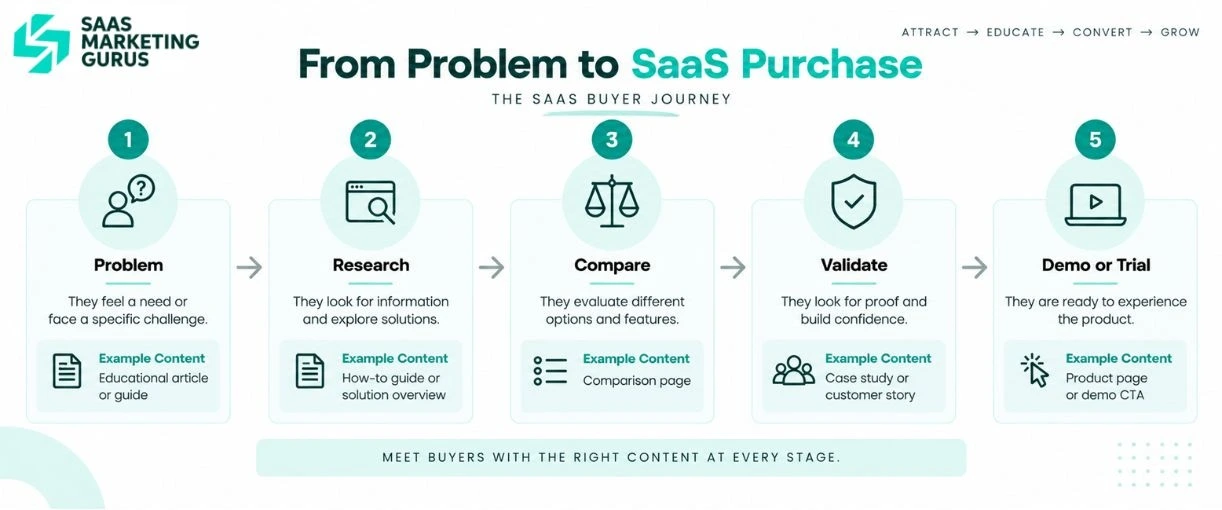
A SaaS go to market plan defines how a specific customer group discovers, evaluates and buys the product. Document the buying trigger, stakeholders, offer and handoff that move a suitable prospect toward a decision.
For the agency project management example, a buying trigger could be repeated delays in client approvals. The operations lead may research options, while the agency owner approves spending.
The playbook entry should specify:
- Trigger: What problem makes the buyer act now?
- Evaluation needs: Which product capabilities, integrations, pricing details and limitations must the buyer understand?
- Offer: Should the next step be a trial, a demonstration or a technical discussion?
- Handoff: Who responds, within what agreed window, and what information should they receive?
- Qualification: What makes the enquiry suitable for a sales conversation?
For products that buyers can evaluate independently, document trial activation and the conditions for offering sales help. For complex purchases, prepare evaluation material for technical reviewers and budget approvers.
Use customer interviews and lost deal feedback to check these assumptions before expanding acquisition.
4. Choose Channels for Your SaaS Growth Strategy
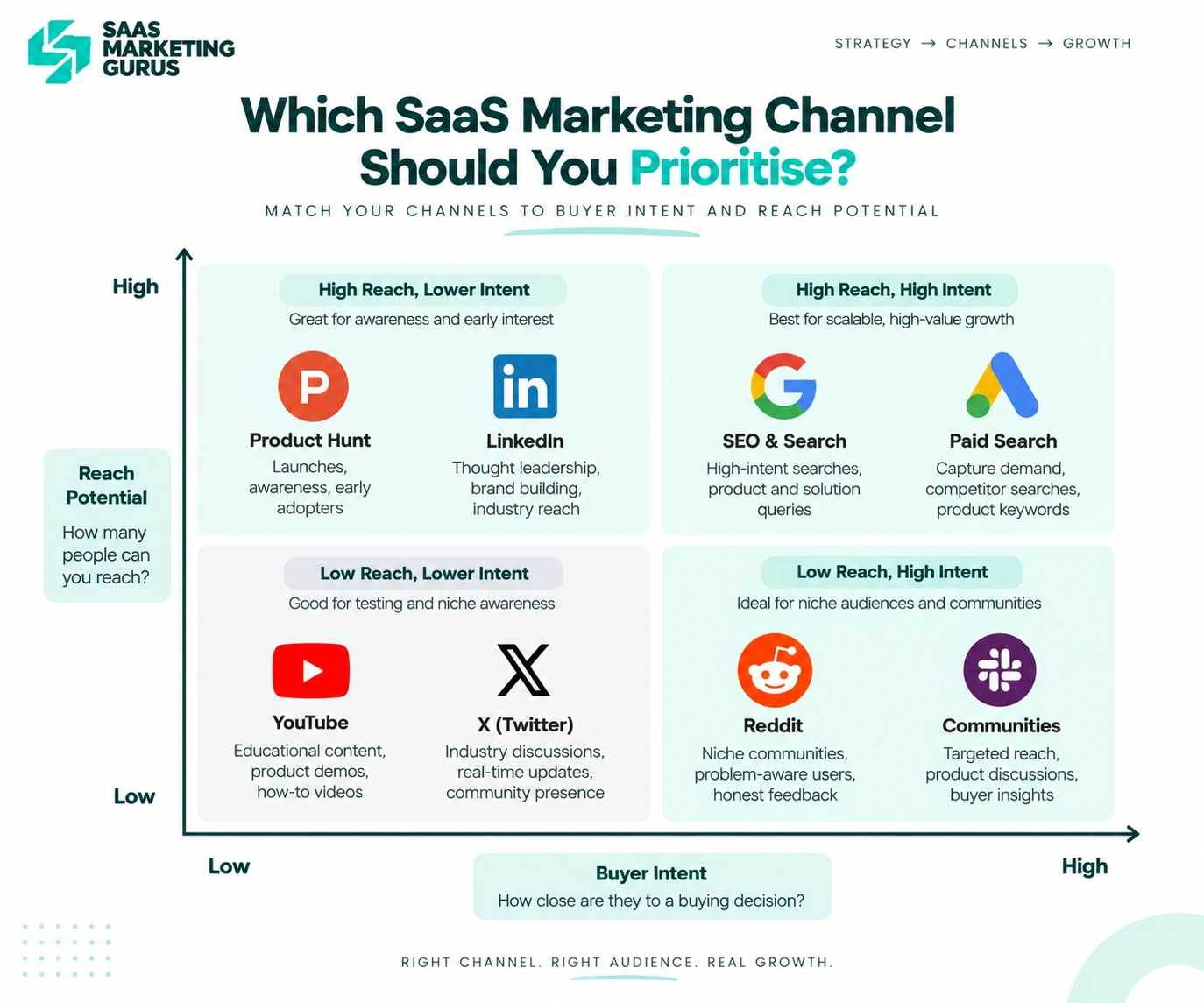
Choose acquisition channels using evidence of buyer activity, the offer you can support and the resources available to test it. Separate channels from the content and website assets they use.
| Buyer situation | Channel to evaluate | Supporting asset | Signal to review |
|---|---|---|---|
| Buyers search for a known solution | Organic search or paid search | Relevant use case or comparison page | Qualified enquiries and opportunities |
| Buyers discuss problems with peers | LinkedIn or relevant communities | Practical answers and examples | Relevant conversations and enquiries |
| Named companies fit a clear use case | Targeted outbound | Account relevant message and product evidence | Accepted meetings and opportunity progression |
| Interested prospects need more information | Permission based email | Evaluation resources and follow up | Reengagement and progression |
These are starting hypotheses. A channel can serve several purposes, and audience presence alone does not establish purchase intent.
For organic search, SMG’s SaaS SEO service covers buyer intent and conversion opportunities. Use the CLARITY framework to assess whether a content topic addresses a customer problem, fits search intent and has measurable business relevance.
Before launching, record the audience, offer, owner, spending limit and evidence required to continue. Give organic content time to gain relevant visibility; assess paid tests using their spend, enquiry quality and sales progression.
For AI search, maintain accurate product explanations and useful original content. Google’s May 2025 guidance supports those foundations, without guaranteeing inclusion in AI answers.
5. Turn Traffic Into More Demo Requests
Improve demo conversion by matching the landing page to the buyer’s question, explaining relevant product value and making the next step clear. Evaluate the quality of the resulting conversations alongside the number of requests.
For each priority page:
- Match the headline and offer to the search query or campaign.
- Explain the relevant workflow, supported capabilities and limitations.
- Include verified customer evidence or a concrete product demonstration.
- State what happens during the demo and who it is intended for.
- Request the information needed for qualification and routing.
- Assign ownership of the enquiry and its follow up.
Illustrative example: Someone searching for “CRM for financial services” may need answers about integrations, permissions and implementation. A focused page should explain the capabilities the product actually supports and offer a relevant evaluation conversation.
Compare qualified requests, completed demos and accepted opportunities after changing the page. More bookings with poor attendance or weak customer fit may create extra work without improving acquisition.
Connect supporting articles and comparison pages to the relevant product page through an SEO conversion funnel. This gives visitors a useful next step as their questions change.
6. Measure Pipeline, Not Activity
Measure the playbook through qualified demos, sales opportunities, acquisition costs and closed revenue. Use traffic and clicks to investigate performance, while keeping them separate from commercial outcomes.
Agree on definitions before comparing channels:
| Metric | Definition |
|---|---|
| Demo request rate | Attributed demo requests divided by eligible landing page sessions, multiplied by 100 |
| Qualified demos | Completed demos meeting the agreed company fit and buying need criteria |
| Demo to opportunity rate | Accepted opportunities originating from a demo cohort divided by completed demos in that cohort, multiplied by 100 |
| Pipeline generated | Value of newly accepted opportunities attributed under your agreed rules |
| Customer acquisition cost | Defined sales and marketing acquisition costs divided by newly acquired customers, with timing and allocation explained |
| Win rate | Won deals divided by won plus lost deals in a defined closed deal cohort, multiplied by 100 |
A sales opportunity is a prospect that sales has accepted into an active buying process. Pipeline represents potential deal value; it is not booked revenue.
Illustrative example: If 20 completed demos produce five accepted opportunities, the demo to opportunity rate is 25%. If another channel produces more demos but fewer suitable opportunities, investigate its targeting, offer and qualification before increasing spend.
Compare equivalent periods and allow for the sales cycle. Report the attribution method, distinguish sourced from influenced pipeline, and avoid counting the same opportunity twice when totaling channel results.
Review onboarding feedback and early customer retention with the relevant teams. Winning customers who cannot use the product successfully can expose a targeting or expectation problem.
Put Your SaaS Marketing Playbook Into Action
Start with one buyer segment and one observable acquisition problem. Create a playbook entry that another team member could execute without needing to reconstruct the reasoning.
Illustrative playbook entry
| Field | Example |
|---|---|
| Audience and trigger | Agency operations leads investigating delayed client approvals |
| Message | Explain how the product handles approval ownership, status and reminders |
| Asset and distribution | An approval workflow page, shared through relevant search content and sales conversations |
| Owner and resources | Named marketing owner, product reviewer, sales contact and agreed spending limit |
| Success measure | Qualified demos and accepted opportunities associated with the workflow page |
| Review decision | Continue, revise or pause based on buyer fit, objections and sufficient observations |
Record the baseline and review date before launching. At the review, explain what the evidence supports and what remains uncertain.
Expand the playbook after the process produces useful, repeatable learning. If too few suitable buyers have encountered the offer, extend the observation period or revise distribution before judging the message.
Ready to Build Your SaaS Marketing Playbook?
Bring your current positioning, priority pages and available channel results to a free consultation with SMG. The discussion can help identify acquisition gaps and outline the channels and actions to prioritize next.
Get a free consultation for your SaaS marketing playbook
Frequently Asked Questions
What Should a SaaS Marketing Playbook Include?
A SaaS marketing playbook should include the target customer, buying trigger, message, offer, channel, execution steps, owner, budget limit and review criteria. For demo acquisition, it should also define qualification, enquiry routing and opportunity measurement. Each entry should give the team enough detail to carry out and assess the work.
How Is a SaaS Marketing Playbook Different From a Marketing Plan?
A SaaS marketing plan sets priorities, resources, deadlines and targets. A playbook explains how the team will execute recurring work within that plan. For example, the plan may prioritize comparison content, while the playbook defines research, product review, publishing, distribution and the evidence used to assess it.
Which Marketing Channel Should a SaaS Company Start With?
Start with a channel that offers credible access to your intended buyers and fits your resources. Search can suit buyers already researching a solution; targeted outreach can suit a defined account list. Record the audience, offer and test criteria before spending, then evaluate buyer quality and progression.
How Often Should You Update a SaaS Marketing Playbook?
Update the playbook when evidence changes an important assumption, such as customer fit, recurring objections or channel economics. Assign an owner and a review date to each entry. Use frequent checks for execution problems and longer reviews for outcomes that depend on traffic accumulation or the sales cycle.
Can This Playbook Support a SaaS Free Trial?
Yes. Adapt the conversion goal to trial activation and qualified product use. Define the action that demonstrates initial value, such as completing a useful workflow, and record when sales support is appropriate. Continue measuring paid conversion and customer outcomes so signup growth does not hide weak product adoption.