
The SaaS content marketing mistakes that cost the most demos are strategic, not stylistic. Teams publish pages with no commercial job, report traffic instead of pipeline, and skip the comparison and pricing content buyers read right before they book a call.
Most teams already feel the gap. In the Content Marketing Institute’s B2B Content and Marketing Trends: Insights for 2026 report (October 2025, 1,015 B2B marketers), 40% named creating content that prompts a desired action as a top challenge, and 33% named measuring content effectiveness.
This guide comes from SaaS Marketing Gurus (SMG), a B2B SaaS marketing agency specializing in Reddit marketing, Quora marketing, Generative Engine Optimization (GEO), SaaS SEO, and Product Hunt launches. Each mistake below shows the symptom you will see in your own data and the fix we apply when we audit a SaaS content library.
What Are the Most Common SaaS Content Marketing Mistakes?
The ten most common SaaS content marketing mistakes fall into three groups: planning, production, and operations. Planning mistakes decide what gets written, production mistakes decide whether it converts, and operations mistakes decide whether it keeps working.
Use this table to match what you see in your analytics to the mistake behind it.
| Mistake | Symptom in your data | First fix |
|---|---|---|
| 1. No defined job per page | Posts rank, but readers never reach a service or demo page | Add a job and success metric to every brief |
| 2. Traffic over pipeline | Sessions rise while demo requests stay flat | Report demos and influenced pipeline by page |
| 3. No bottom-of-funnel content | Few comparison, alternatives or pricing pages exist | Publish decision pages before more guides |
| 4. Marketing language | Pages rank for queries your buyers don’t use | Brief writers from sales calls and community threads |
| 5. A page per keyword | Two of your URLs swap places for one query | Merge by intent and 301 the weaker URL |
| 6. No next step | Posts have high exits and few clicks to evaluation pages | Give each post one next page and one CTA |
| 7. Publish and hope | New posts get almost no referral traffic | Plan distribution in the brief, before writing |
| 8. Product left out | Readers learn the concept, not your solution | Show where the product fits the workflow |
| 9. No refresh rules | Older posts lose clicks and cite old data | Set decay triggers and review quarterly |
| 10. AI search as a side project | Competitors appear in AI answers and you don’t | Fix clarity, evidence and entities on core pages |
Mistake 1: Publishing Without a Defined Job for Each Page
Every SaaS page needs a stated job before anyone writes it: build awareness, capture demand, support evaluation, or help customers adopt the product. Without that job, the team defaults to traffic as the only measure of success.
Before approving a topic, fill in six fields: audience, problem, search intent, page type, product connection, and next action. Then add a seventh, the success metric, so everyone agrees what “working” means before the page ships.
If a brief can’t fill the product connection or next action fields, the topic needs a different angle or belongs in a different channel. Our SaaS content marketing strategy guide shows how these page jobs fit into a full program.
Mistake 2: Measuring Traffic Instead of Pipeline
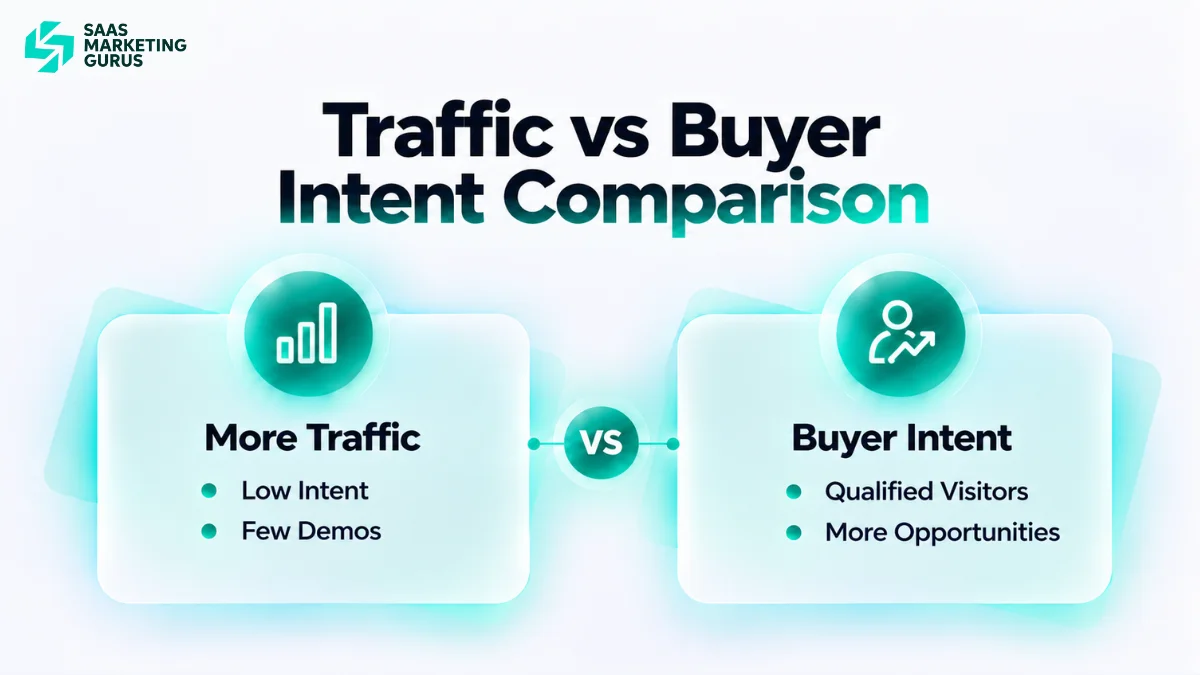
Traffic measures visibility, not business results. A SaaS content program should report which pages contribute to qualified leads, demo requests, opportunities and revenue, and treat sessions, rankings and impressions as diagnostics.
The warning sign is a familiar pattern: organic sessions climb while demo requests stay flat. That usually means the library attracts people researching a topic who will never buy the product.
| Metric | What it tells you | Decision it supports |
|---|---|---|
| Impressions and rankings | Search visibility | Which topics can compete |
| Clicks and sessions | Reader interest | Which titles and snippets work |
| Demo requests per page | Conversion | Which pages earn a next step |
| Influenced pipeline | Revenue contribution | Where to invest next quarter |
Check the tracking first. If demo bookings aren’t recorded as a key event in Google Analytics 4 (GA4) and passed to your CRM, no report can connect content to pipeline.
Attribution will never capture every touch, because buyers read several pages and talk internally before they fill in a form. Pick one consistent model and read it directionally. For the search-side version of this problem, see our breakdown of SaaS SEO mistakes that hurt demo volume.
Mistake 3: Skipping Bottom-of-Funnel Content
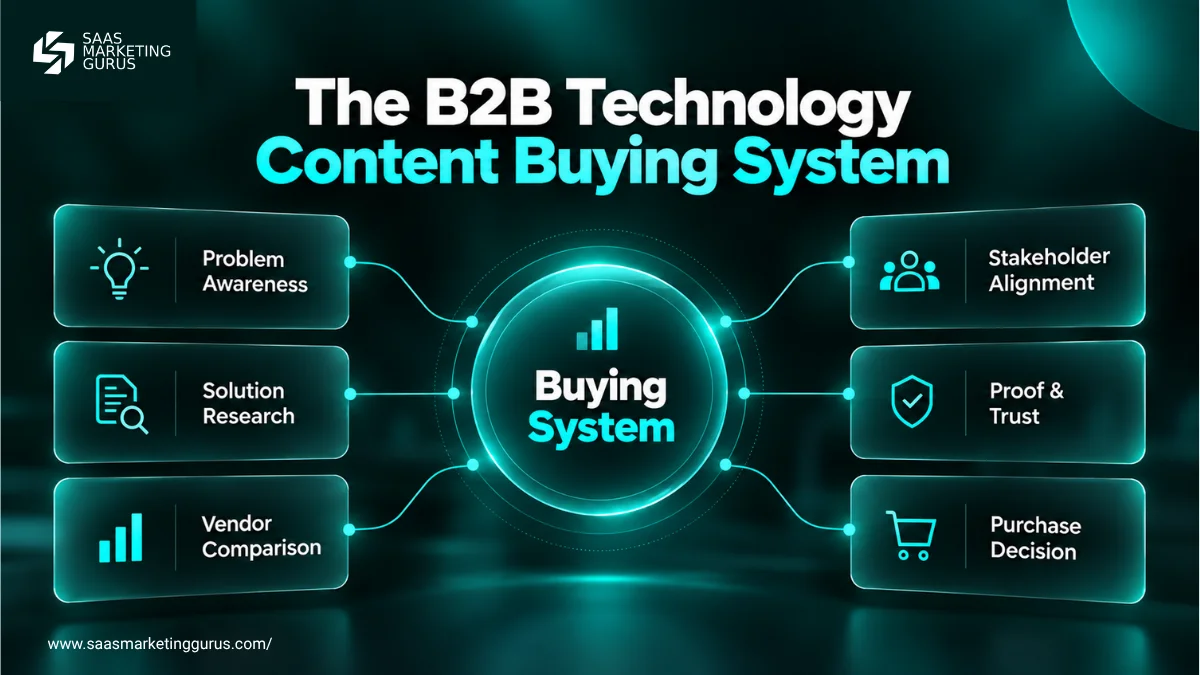
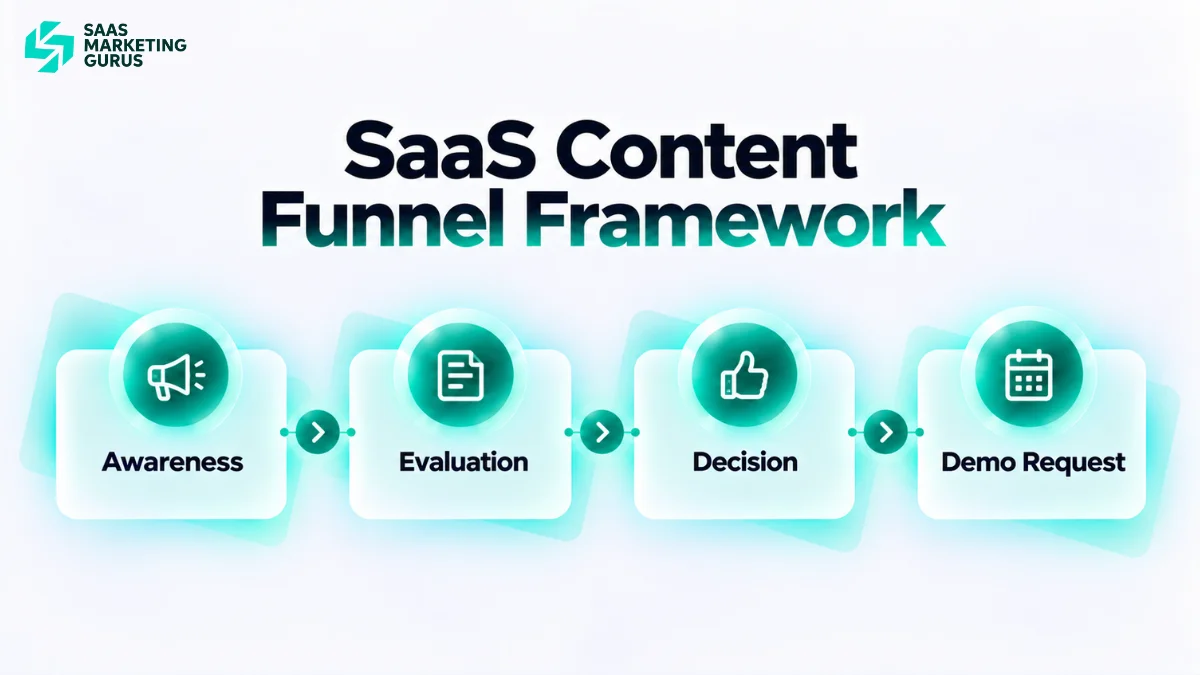
Most SaaS blogs are heavy on awareness guides and light on decision content, so buyers find you early and choose someone else later. Decision content includes comparisons, alternatives, pricing explanations, security pages, implementation guides, ROI evidence and case studies.
These pages answer the questions buyers ask while narrowing a shortlist. The reader has already named the problem and is judging options, so the path to a demo is short.
SMG’s SaaS SEO work is built around this: we prioritize comparison, alternatives and use-case searches over raw volume. For a FinTech CRM client, search and comparison visibility produced 20+ demos per week.
Order matters. If your library has no comparison or alternatives pages yet, publish those before adding another top-of-funnel guide.
Mistake 4: Writing in Marketing Language Instead of Buyer Language
SaaS content fails when it describes the problem the way the marketing team talks, not the way buyers search and ask. Polished copy that misses the buyer’s wording ranks for the wrong queries and answers the wrong question.
Pull language from places where buyers speak unprompted: sales call recordings, support tickets, lost-deal notes, review sites, and threads on Reddit and Quora. Paste exact objections and repeated questions into every brief, so writers work from evidence instead of guesses.
This is where sales alignment pays off. Among B2B marketers who rated their programs effective in CMI’s 2026 research, 45% credited alignment with sales. Technical products raise the bar further, which is why our guide to B2B technology content marketing starts with how technical buyers evaluate.
Mistake 5: Publishing a New Page for Every Keyword Variation
Publishing one article per keyword variation creates cannibalization: two or more of your URLs compete for the same intent, and neither ranks as well as one consolidated page would. The fix is to group queries by intent before you assign URLs.
A quick test: search both queries in a clean browser. If Google returns mostly the same top-10 URLs for each, they share intent and belong on one page.
At SMG we run keyword decisions through our CLARITY framework: Customer Problem, Level of Intent, Alignment With SERP, Revenue Potential, Independent Page Value, Topic Connection, and Yield Measurement. The Independent Page Value check stops duplicate posts, because a variation that can’t justify its own page becomes a section of an existing one. Our guide to AI keyword clustering shows how we apply it.
Before creating a new URL, check whether an older page already holds authority for the topic. Updating that page and redirecting the weaker one with a 301 usually beats starting from zero.
Mistake 6: Leaving Readers Without a Next Step
A SaaS content library should move readers from education to evaluation, and internal links plus a clear call to action are the route. A post that ends without a relevant next page wastes the attention it earned.
Build the path on purpose. A problem article links to the matching use case, a use-case page links to a comparison, and a comparison links to product evidence and a demo.
Give each post one primary next step, not a footer of ten generic links. Those same links also show search engines and AI systems how your topics relate, which strengthens the whole cluster.
Mistake 7: Publishing Without a Distribution Plan
Publishing is a production step. Distribution is a separate job that decides whether the right buyers ever see the page, so plan it in the brief, before writing, based on where your buyers already research.
For B2B SaaS, that usually means LinkedIn, newsletters, review sites and communities where buyers compare tools. One strong article can become a Reddit answer, a Quora response and a LinkedIn breakdown, each written natively for its platform rather than dropped as a link.
Community channels matter more as AI enters the buying process. Forrester’s State of Business Buying 2026 research found that buyers validate AI output with trusted sources such as peers and product experts. Our guide to Reddit organic marketing for SaaS covers how to show up in those threads without spamming them.
Mistake 8: Keeping Your Product Out of Your Content
Many SaaS blogs read like neutral industry publications and never show where their own product solves the problem. Readers learn the concept, then buy from the vendor who showed them how.
Mention the product where it genuinely fits the workflow: the step it handles, a short worked example, or a link to the relevant use-case page. Keep it proportionate, because a guide that turns into a sales page loses the trust that made it rank.
A useful test: if a competitor could publish your article unchanged under their own logo, the product connection is missing.
Mistake 9: Letting Content Decay Without Refresh Rules
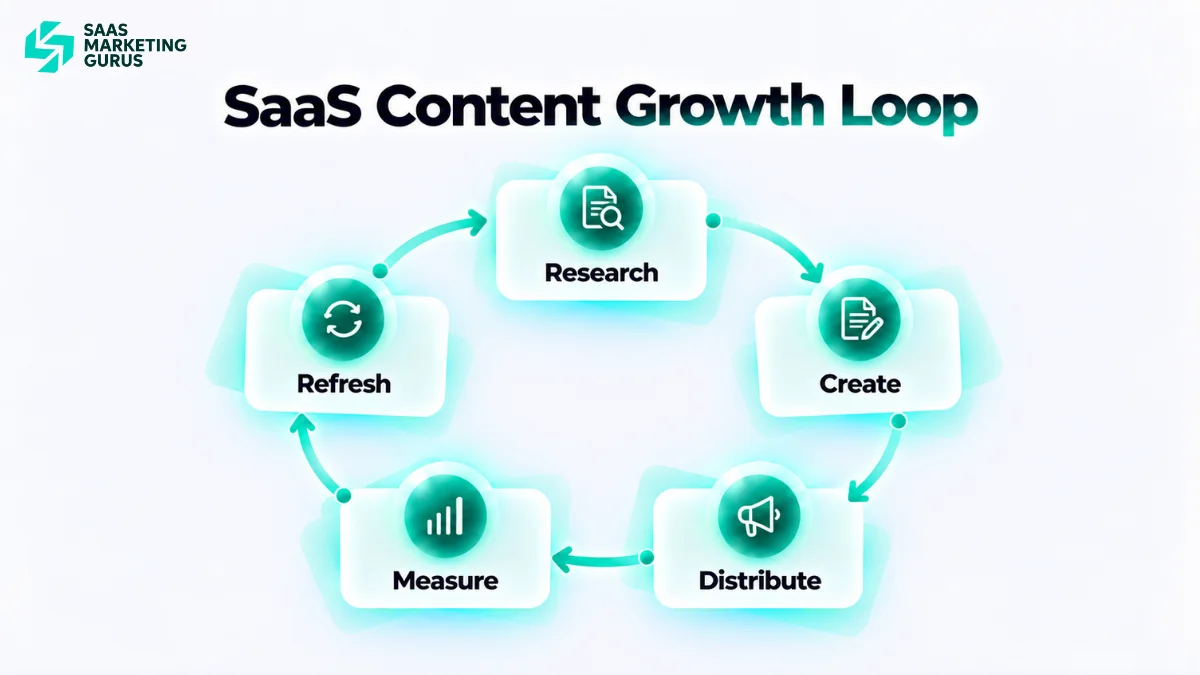
SaaS content decays faster than most categories because products, pricing, integrations and competitors change. A program needs written refresh rules based on performance, business importance and freshness, not an annual rewrite sprint.
Review a page when any of these triggers fire:
- Clicks decline for several consecutive months
- Impressions stay high while click-through rate falls
- Traffic is strong but demo requests are weak
- Claims, pricing or feature references are out of date
- A new competitor enters the top results
A page written two years ago might still rank and no longer answer what buyers ask today. Refreshing the evidence, structure, examples and next step often returns more than a new article, and our B2B SEO audit checklist for SaaS covers how to spot decay across a whole site.
Mistake 10: Treating AI Search as a Separate Project
AI search does not need a separate layer of “AI wording.” It rewards the same clear, evidence-backed, well-structured content that serves human buyers, so a weak page stays weak whether a person or a model reads it.
The stakes are real. In Forrester’s January 2026 analysis of its Buyers’ Journey Survey, 94% of business buyers reported using AI in their buying process, and twice as many named generative AI or conversational search as a more meaningful source than any other.
Google’s guidance for its AI experiences (Google Search Central, May 2025) points site owners back to unique, valuable content for people, noting that users now ask longer and more specific questions. In practice, answer each question in the first lines of a section, define terms plainly, name entities consistently and back claims with dated sources. Our guide to answer engine optimization for SaaS shows that structure in detail.
How Do You Fix SaaS Content Marketing Mistakes Across Your Library?
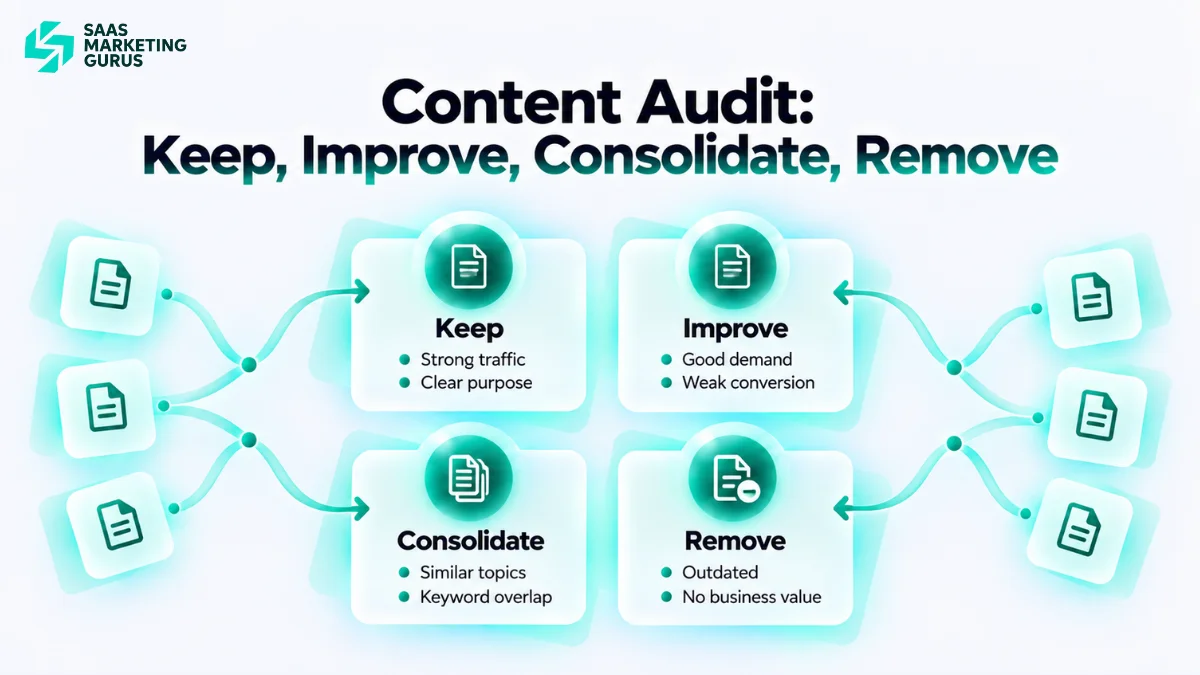
Classify every page before you rewrite anything. A triage pass shows which pages to keep, improve, consolidate or retire, so effort goes to the pages closest to revenue.
| Action | When it applies | What to do |
|---|---|---|
| Keep | Accurate, performing, clear buyer role | Maintain it and add links to evaluation pages |
| Improve | Real demand but weak intent match, evidence or conversion | Rewrite the opening, add proof and a next step |
| Consolidate | Two or more pages target the same intent | Merge into the stronger URL and 301 the rest |
| Redirect or remove | Outdated, redundant, no demand or strategic value | 301 to the closest relevant page or retire it |
We recommend running the first month in this order:
- Week 1: confirm demo bookings register as a key event and reach your CRM.
- Week 2: classify pages with the table above, using Search Console and CRM data.
- Week 3: consolidate overlapping URLs and add paths from top-traffic posts to decision pages.
- Week 4: brief the first bottom-of-funnel pages the audit shows are missing.
After that, build the roadmap around gaps: high-intent topics, unanswered buyer questions, use cases, comparisons and technical evaluation content, each with a distribution plan attached.
What Should You Fix First?
If your library shows several of these SaaS content marketing mistakes, start where pipeline leaks fastest: tracking, then bottom-of-funnel gaps, then consolidation. Falling traffic and weak rankings are usually symptoms, while pages with no commercial job are the cause.
Set one success measure before you start: demo requests from organic landing pages, compared month over month. Review it after 90 days, and if it hasn’t moved, look at intent and the next step on each page before you publish more.
If you want a second set of eyes on which of your pages should be earning demos, book a free strategy call with SMG and we’ll walk through your content library with you.
Frequently Asked Questions
What is the biggest SaaS content marketing mistake?
The biggest SaaS content marketing mistake is optimizing for traffic instead of pipeline. When sessions are the main success metric, teams publish broad awareness content that attracts researchers rather than buyers. Tie every important page to a job and a conversion measure, such as demo requests or influenced pipeline, and report on that first.
Why is my SaaS blog getting traffic but no demos?
A SaaS blog gets traffic without demos when its pages match informational intent and offer no path to evaluation. Readers learn the concept and leave. Add comparison, alternatives and pricing content, link each post to one relevant decision page, and confirm demo bookings are tracked as a key event before judging results.
How do I know if my SaaS content is cannibalizing itself?
Your SaaS content is likely cannibalizing itself when two of your URLs swap positions for the same query in Search Console. Search both target queries and compare the results. If the top-10 URLs mostly overlap, the queries share intent, so merge the pages into the stronger URL and 301 redirect the weaker one.
How often should SaaS companies refresh blog content?
SaaS companies should review important pages at least quarterly and refresh them when a trigger fires, not on a fixed annual schedule. Common triggers are declining clicks, high impressions with falling click-through rate, strong traffic with weak conversion, outdated product or pricing claims, and a new competitor entering the top results.
Should SaaS startups publish bottom-of-funnel content first?
Most SaaS startups should publish bottom-of-funnel content early, because comparison, alternatives and use-case pages reach buyers who are already choosing a tool. Awareness content still matters for building demand, but a library with no decision pages sends readers who are ready to buy toward competitors that do have them.
Does content need to change for ChatGPT and Google AI Overviews?
Content does not need a separate AI version for ChatGPT or Google AI Overviews. Google’s May 2025 guidance points to the same fundamentals as classic search: unique, useful content that people can access and understand. Answer questions directly, define terms, name entities consistently, and support claims with dated, verifiable sources.