To improve SaaS content for AI search, start with the buyer questions your website should answer. Check that the relevant pages are accessible, describe the product accurately, and support important claims with evidence. Then measure how search experiences represent your product and whether resulting visits lead to useful actions.
A buyer asking about an integration needs more than a feature name. They may need supported workflows, plan restrictions, setup requirements, and limitations.
SaaS Marketing Gurus (SMG), a B2B SaaS marketing agency offers Generative Engine Optimization services covering buyer questions, content, and visibility measurement. This guide explains how to review the pages behind those answers.
What Is Optimizing SaaS Content for AI Search Engines?
Optimizing SaaS content for AI search means improving the accuracy, usefulness, and accessibility of information that buyers may encounter through generated answers. The work includes explaining product capabilities, answering evaluation questions, and maintaining consistent information across related pages.
It builds on SEO. Google’s guidance, updated July 2026, explains that its generative search features rely on core Search ranking and quality systems. It also rejects the idea that pages need a special writing format for AI. See Google’s generative AI optimization guide.
Keep the practical goal clear: help a buyer understand what your product does, who it suits, and where its limitations matter. No content format guarantees a citation or recommendation.
Why SaaS Companies Need AI Search Optimization
AI search deserves attention when buyers use generated answers to research a problem, compare products, or check requirements. The immediate opportunity is to make the information supporting those decisions accurate and useful.
Gartner reported in March 2026 that 45% of 646 surveyed B2B buyers used AI during a recent purchase. The survey ran in August and September 2025. This covers B2B purchasing broadly, not SaaS alone. See the Gartner survey announcement.
For an HR software company, a useful page might explain how employee onboarding works across departments. It should identify supported tasks, required setup, permissions, and exceptions.
Start with questions from your own sales and support conversations. A broad topic such as “HR automation” becomes useful when the page helps a specific buyer complete a task or evaluate a requirement.
How Do You Build SaaS Content for AI Search?
Build SaaS content for AI search by connecting each important buyer question to an appropriate page, verified evidence, and a responsible owner. Use the following steps to improve existing pages before commissioning overlapping articles.
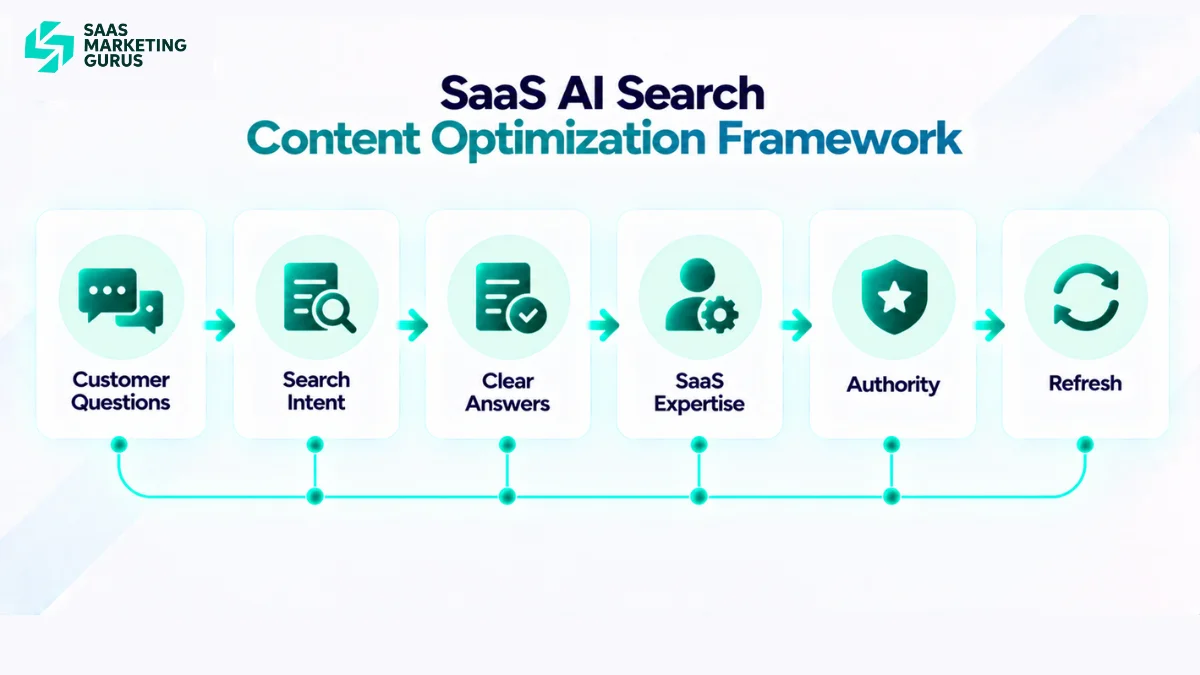
1. Analyze Customer Questions
Collect questions from sales calls, support requests, customer interviews, and search query reports. Record the buyer’s role, the task they need to complete, and what they need to know before proceeding.
For example, “Does this tool integrate with our CRM?” may involve several requirements: supported systems, data fields, synchronization direction, permissions, and plan availability.
Group questions that need the same answer. SMG’s CLARITY framework helps assess customer problems, intent, search results, revenue relevance, independent page value, topic connections, and measurement.
The output should be a prioritized question list with an existing or proposed page assigned to each group.
2. Create Content Around Buyer Intent
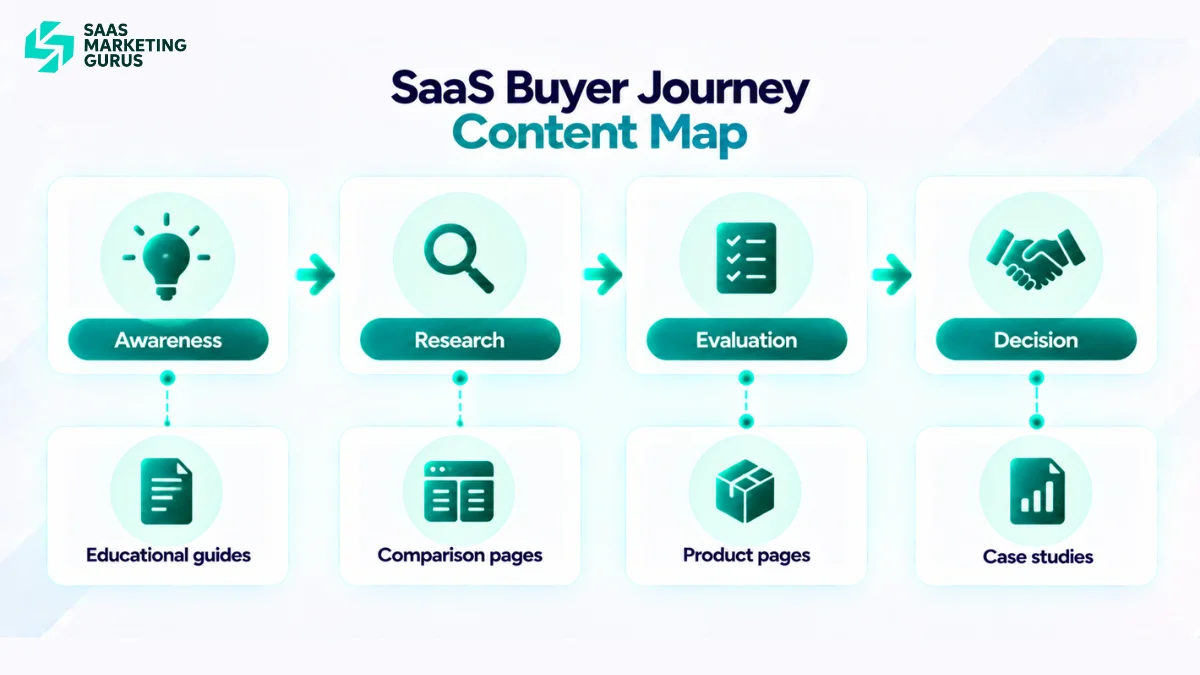
Choose content according to the buyer’s task. Page formats can support several stages, so avoid treating the journey as a fixed sequence.
| Buyer question | Useful page | Evidence to include |
|---|---|---|
| What causes this problem? | Educational guide | A clear explanation and relevant examples |
| Will the product meet this requirement? | Product or integration page | Supported capabilities, prerequisites, and limitations |
| How does it compare with another option? | Comparison page | Current facts assessed against the same criteria |
| What will implementation involve? | Documentation or implementation guide | Steps, responsibilities, dependencies, and support |
| Has it worked in a comparable situation? | Customer story | Context, method, results, and attribution |
Update an existing page when it already serves the same purpose. Create a separate page when the buyer needs a distinct answer.
3. Structure Content for AI Retrieval
Use descriptive headings, direct answers, and enough explanation to resolve the reader’s question. Choose a table for comparable facts and a numbered list for a sequence.
Keep essential conditions beside the claim. If an integration requires a particular plan, say so in the same passage that describes its availability.
Do not shorten an answer until it loses necessary context. Question headings and brief paragraphs are editorial choices, not requirements that guarantee AI visibility.
4. Add SaaS-Specific Expertise
Add information that comes from understanding the product and its users. Ask a product specialist to verify capabilities, limitations, setup instructions, and examples before publication.
For an illustrative integration page, the review might identify supported objects, synchronization direction, permission requirements, and unsupported workflows. Publish the details the team can verify.
Attribute customer results to a named, approved source. If a scenario is hypothetical, label it as illustrative and avoid invented performance figures.
Review Your AI Content Gaps
Discuss the buyer questions and product pages that need clearer, better supported answers.
How GEO, AEO, and AI Overviews Impact SaaS Content
AEO and GEO describe overlapping approaches to improving visibility in answer and generative search experiences. AI Overviews is a Google Search feature. These terms do not require separate versions of your content.
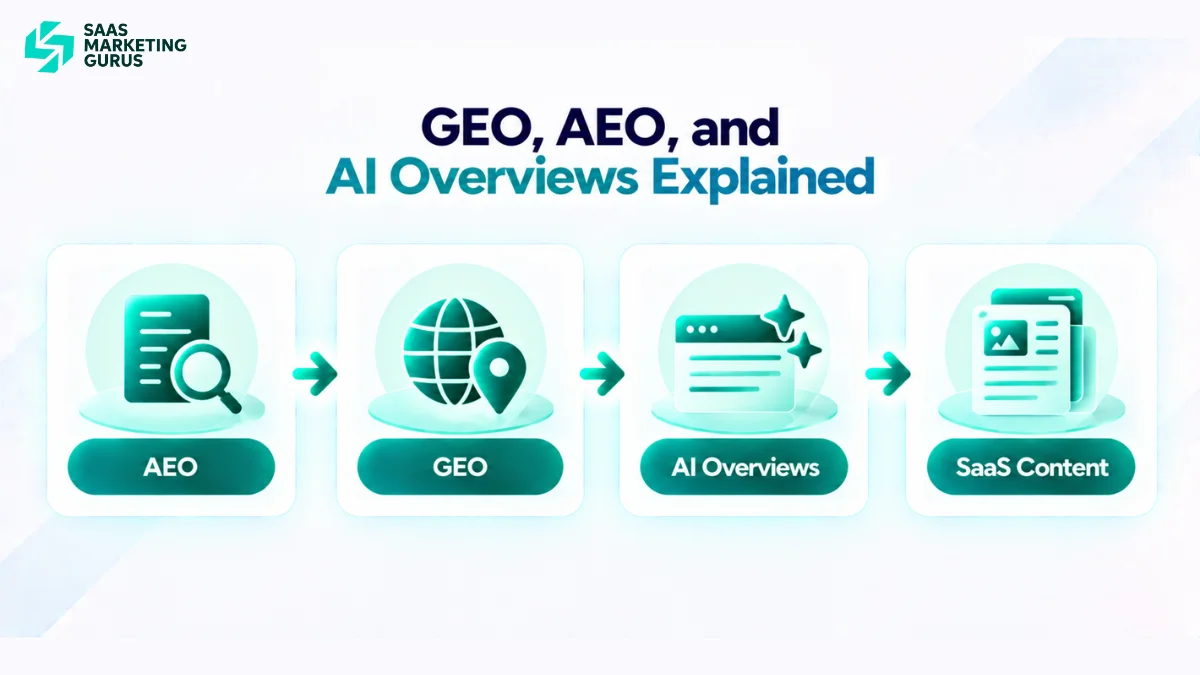
Answer Engine Optimization (AEO)
Answer Engine Optimization focuses on making information useful for questions answered through search and assistant experiences.
Use headings that describe the question the section actually resolves. Changing “Benefits of CRM software” to a longer question will not help if the answer remains vague.
SMG’s AEO guide for SaaS explains how buyer questions connect to product information and evidence.
Generative Engine Optimization (GEO)
Generative Engine Optimization focuses on visibility and accurate representation in generated responses. In practice, it overlaps with content quality, SEO, product information management, and measurement.
Maintain consistent product names and factual claims across your website and relevant public profiles. Correct outdated information at its source.
Use the AEO versus GEO comparison to understand the terminology without creating duplicate content programs.
AI Overviews
AI Overviews presents generated summaries within Google Search, with links to supporting sources. A summary’s wording and sources can vary with the query and search experience.
Assess whether your pages answer relevant questions accurately. Avoid assuming that a Google ranking guarantees inclusion or that one missing appearance proves the page needs rewriting.
How SaaS Teams Can Optimize Website Content for AI Search and Conversions
Start with pages that answer important buying questions and contain information your team can verify. Prioritize inaccurate or incomplete product, pricing, integration, comparison, and implementation pages.
For each selected page:
- Check access. Confirm the intended public content is available to the relevant search system and review current eligibility controls.
- Verify facts. Check product names, plan details, capabilities, limitations, and supporting documentation.
- Resolve the question. Explain the answer and its conditions before adding background.
- Connect related information. Link to relevant documentation, comparisons, and supporting pages.
- Provide a useful next step. Offer the appropriate demo, trial, pricing, or implementation resource.
These tasks belong within a coordinated SaaS SEO strategy.
For an illustrative integration page, a buyer should be able to establish whether the integration meets their requirements before contacting sales. Give the page an owner who can update it when the product changes.
Common SaaS Content Mistakes That Reduce AI Search Visibility
Common weaknesses include unsupported product claims, incomplete answers, outdated details, and pages that repeat one another. Treat these as problems to investigate rather than assuming every visibility change has the same cause.
Creating Only Product-Focused Content
Feature updates are useful, but buyers also need educational resources that explain problems and solutions.
Publishing Generic Articles
Generic content becomes more useful when it answers a specific question with evidence or product knowledge. A narrower headline alone is not enough.
An article about sales automation should explain a real workflow, who performs each task, what the software supports, and where manual work remains. Include verified examples that help the reader assess whether the approach fits.
Ignoring Content Updates
Update content when the underlying information changes. Pricing, plan names, integrations, implementation steps, and product limitations deserve particular attention.
Assign an owner and review trigger to important pages. A product release or recurring support question may justify an update sooner than a scheduled review.
Add statistics or FAQs only when they improve the answer. Changing a date without reviewing the information does not make the content current.
How Long Does SaaS AI Search Optimization Take?
There is no reliable universal timeline for earning AI citations or improving qualified traffic. Separate the time needed to complete your work from the time needed to observe a search outcome.
A small factual correction may require little writing. A comparison page may need product testing, research, expert review, and approval.
Record when each change goes live and whether the intended information is accessible. Then review a consistent set of questions over time, alongside available search and conversion data.
Set a review date based on your publishing cycle and data volume. Treat it as a checkpoint, not a promised results deadline.
How Should SaaS Teams Measure AI Search Content?
Measure visibility, factual accuracy, visits, and qualified outcomes separately. A brand mention does not establish a citation, and neither proves a sale.
| Measure | What to record | What it establishes |
|---|---|---|
| Observed visibility | Platform, search mode, question, date, and response | Presence in the sampled answers |
| Citation | Linked source and destination page | Whether a response references your content |
| Accuracy | Product claims checked against current documentation | Whether the answer describes the product correctly |
| Referral traffic | Available source data and landing pages | Identifiable visits from those experiences |
| Qualified outcomes | Relevant demos, signups, opportunities, or revenue | Business outcomes associated with the visits |
Repeat a defined question set under comparable conditions and keep the responses. Manual observations are a sample, not a complete measure of market visibility.
Google’s 2026 documentation describes a Generative AI performance report in Search Console for impressions from AI Overviews and AI Mode. Use it alongside other search and conversion reporting, rather than treating impressions as visits or leads. See Google’s report documentation.
For a broader reporting process, use SMG’s guide to measuring GEO campaigns.
Build SaaS Content That AI Search Engines Can Understand
Choose one important buyer question and identify the page responsible for answering it. Check its facts, fill the missing information, connect supporting resources, and assign an owner.
Before publishing the update, define what you will review afterward: accurate product descriptions, relevant citations, identifiable visits, or qualified conversions. Keep those measures separate so a visibility change does not become an unsupported revenue claim.
SMG supports SaaS teams with buyer question mapping, content creation, and visibility measurement. If your team needs help choosing its next content priorities, book a free consultation with SMG.
FAQs
What is AI search optimization for SaaS companies?
AI search optimization is the process of improving SaaS content so AI systems can understand, summarize, and use it when answering customer questions.
Does AI search replace SEO?
No. Google’s generative search features rely on its Search systems, so SEO remains relevant. SaaS teams should maintain accessible pages, useful information, and clear internal links while also reviewing how generated answers describe their products. Other platforms may have different access and reporting arrangements.
What SaaS content performs well in AI search?
Start with content that accurately resolves a relevant buyer question: product explanations, integration details, comparisons, implementation guidance, and documented customer evidence. Assess performance through observed citations, accurate descriptions, and business outcomes. No page type or formatting choice guarantees inclusion across AI platforms.
How long does it take to optimize SaaS content for AI search?
The work required depends on the page, available evidence, technical dependencies, and review process. Publishing an improvement does not establish when an AI system will retrieve or cite it. Track implementation separately from search outcomes and reassess using repeated observations and sufficient data.
Do question headings guarantee AI citations?
No. Question headings can help readers understand a section, but they do not guarantee citations. Use them when they match the information being provided. An accurate answer with relevant evidence and necessary limitations is more useful than a question heading followed by generic copy.