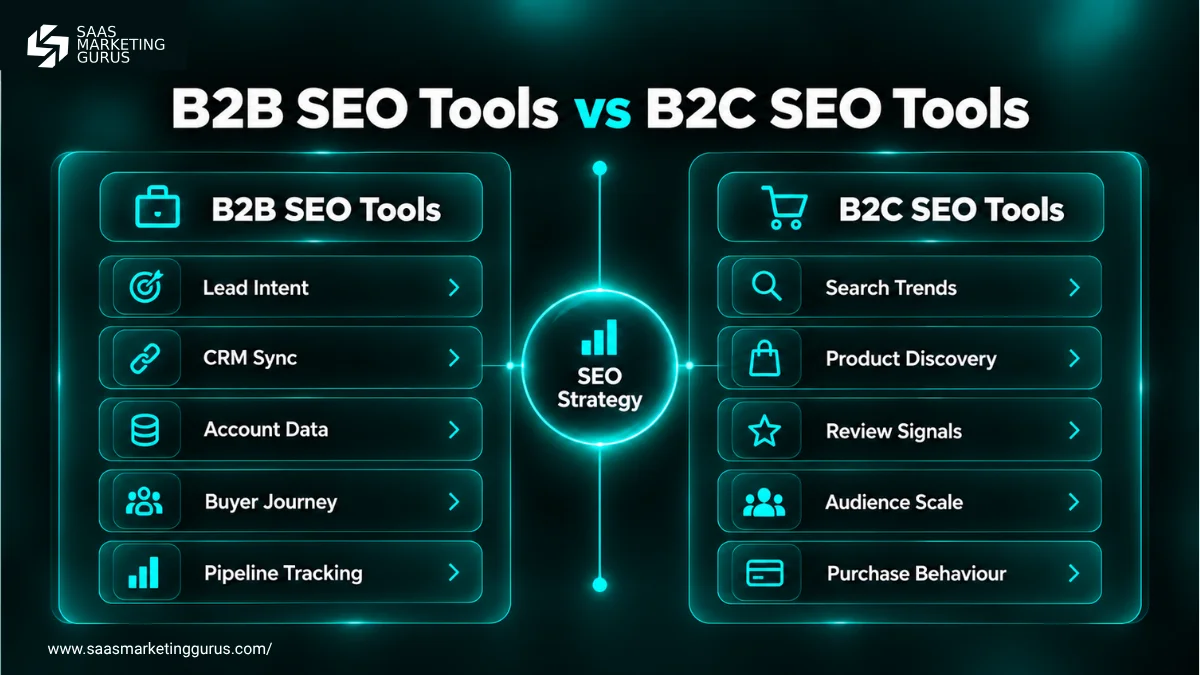
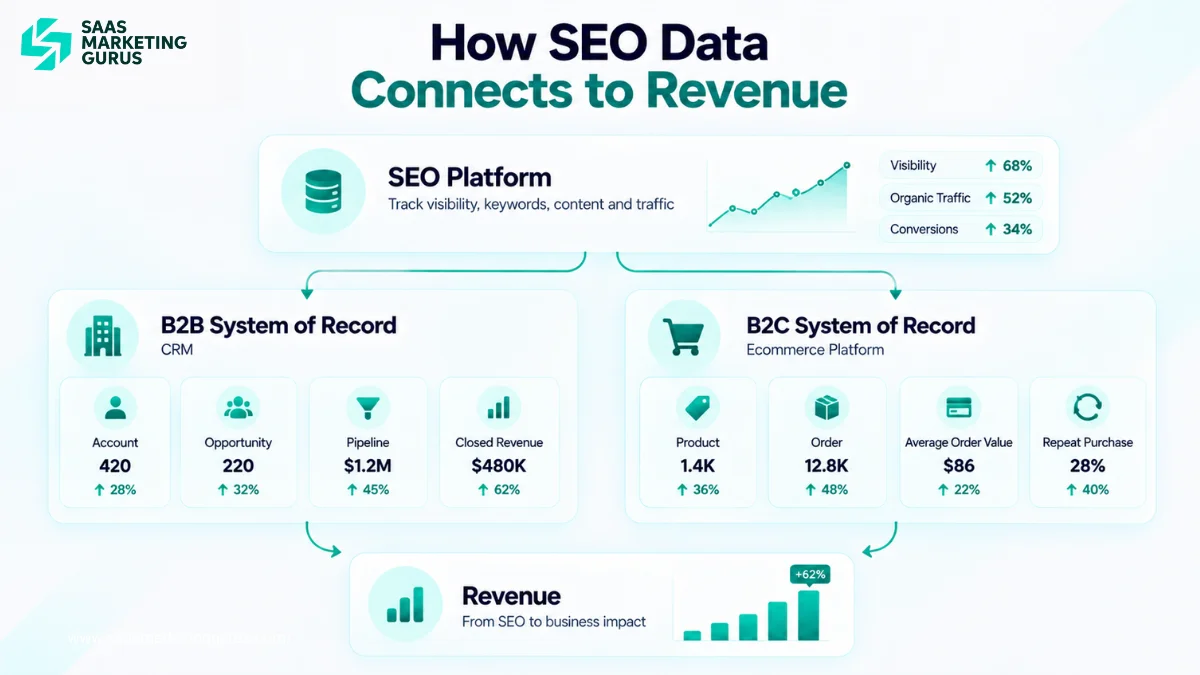
The differences between B2B SEO tools and B2C SEO tools are not in the core features. Both use the same keyword research, rank tracking, crawling and content tools. The difference is what the stack connects to: B2B tools tie organic search to CRM accounts, opportunities and pipeline, while B2C tools tie search to products, orders and repeat purchases.
That distinction decides what you buy, what you integrate and what you report. A B2B SaaS team that copies an ecommerce setup ends up reporting traffic and form fills while sales asks which keywords created deals.
SaaS Marketing Gurus (SMG), a B2B SaaS marketing agency, specializing in SaaS SEO, Generative Engine Optimization (GEO), Reddit marketing, Quora marketing and Product Hunt launches, builds stacks around that pipeline question. The same focus helped BRAVO, an employee recognition platform, reach 20+ demos per week from organic search, as documented in the BRAVO SEO case study.
Do B2B and B2C Teams Need Different SEO Software?
No. B2B and B2C teams can run the same core SEO software. What changes is the system of record the software reports into: a CRM for B2B SaaS, and an ecommerce platform plus analytics for B2C.
B2B SEO tool: standard SEO software configured to connect organic search with CRM contacts, accounts, opportunities and closed revenue.
B2C SEO tool: standard SEO software configured to connect organic search with products, carts, orders, refunds and repeat purchases.
Both stacks share five jobs: keyword research, rank tracking, technical crawling, competitor analysis and content optimization. Google Search Console is the free baseline for both, since it shows how Google crawls, indexes and serves your site, according to Google Search Central (2025).
The split starts after the click. A B2C session can end in a purchase that analytics records on the spot. A B2B session usually ends in a demo request or trial that becomes revenue later, inside a CRM your SEO tools never see unless you connect it. Our B2B search engine optimization guide covers the strategy side of that gap.
What Are the Differences Between B2B SEO Tools and B2C SEO Tools?
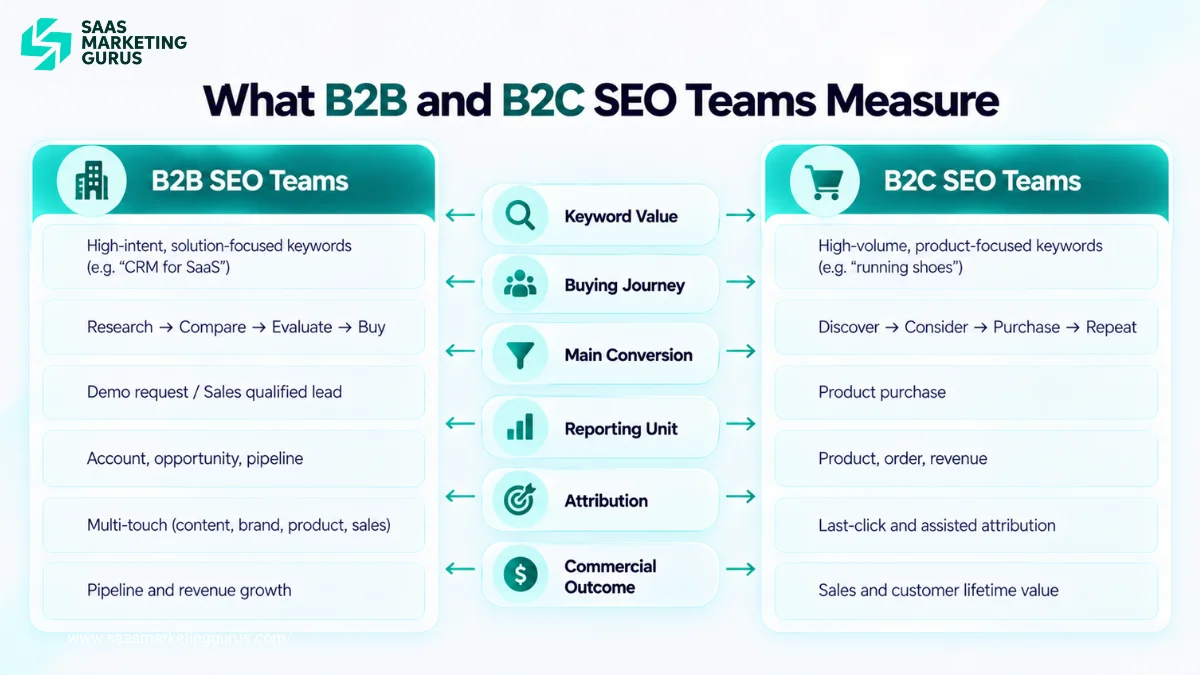
The differences between B2B SEO tools and B2C SEO tools fall into eight areas: keyword value, system of record, journey length, main conversion, reporting unit, attribution, product data and commercial outcome. The table compares both models on the same criteria.
| Comparison point | B2B SaaS | B2C business |
|---|---|---|
| Keyword value | Buyer intent, product fit, deal value | Demand, margin, conversion rate |
| System of record | CRM and revenue platform | Ecommerce and analytics platform |
| Buying journey | Longer, multiple stakeholders | Usually shorter, individual buyer |
| Main conversion | Demo, trial, qualified opportunity | Cart, order, repeat purchase |
| Reporting unit | Contact, account, opportunity | Product, category, transaction |
| Attribution | Multiple touches across sessions and people | Session, channel or purchase path |
| Product data | Features, use cases, integrations | Product feeds, inventory, price, returns |
| Commercial outcome | Pipeline and closed revenue | Revenue, order value, lifetime value |
Two rows cause most B2B reporting failures. The reporting unit shifts from a transaction to an account, so five form fills from one company may belong to a single deal. Attribution shifts too: Forrester’s State of Business Buying 2026 found that 13 internal stakeholders and nine external participants influence the average business purchase (Forrester, 2026).
Those people search at different times and on different devices. A session-level report cannot connect them to one opportunity.
B2C teams carry their own measurement risks. Price, stock and product feed changes shift conversion rates page by page, and refunds cut the revenue a landing page appears to earn. A B2C stack that ignores refunds overstates SEO revenue.
How Should Keyword Research Differ in B2B and B2C SEO Tools?
B2B keyword research should rank terms by buyer intent and deal value. B2C keyword research should rank terms by demand, margin and conversion rate. The same keyword tool serves both; the scoring you apply to its output must change.
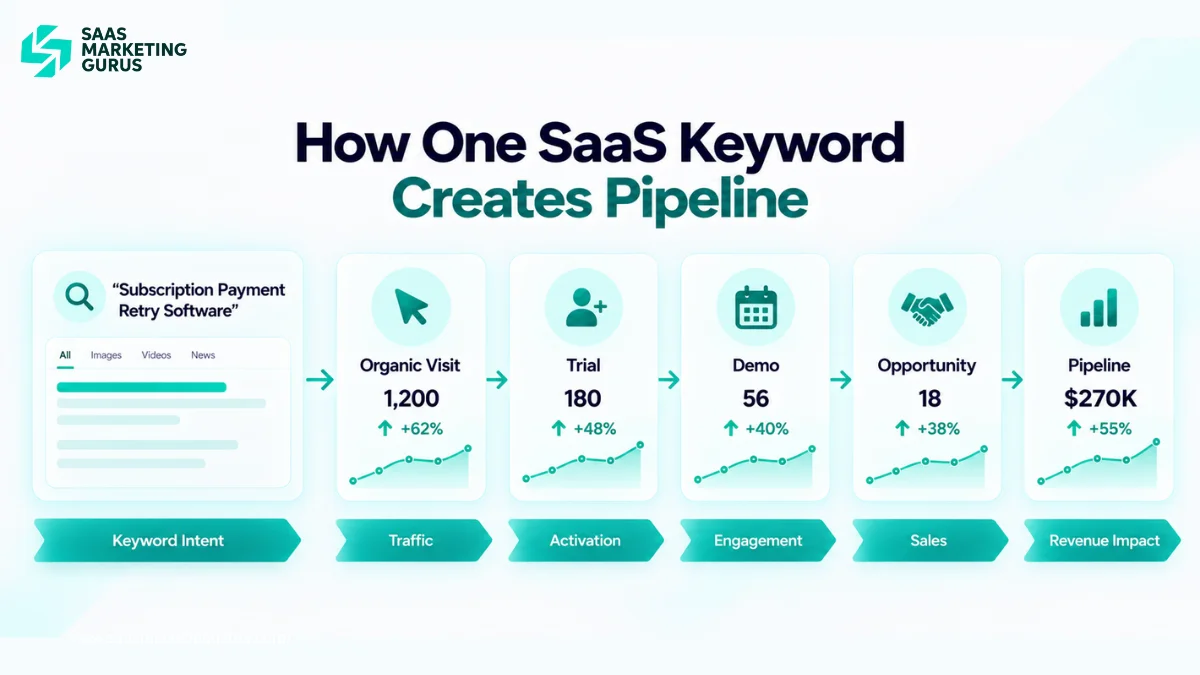
In B2B SaaS, the queries that create pipeline are often too narrow for third-party tools to estimate well. A term like “subscription payment retry software” may show little or no estimated volume, yet one closed account can outweigh thousands of casual visits. Treat Search Console impressions as the real demand signal for queries you already appear for, and use third-party volume only to compare terms against each other.
B2C research works the other way. Volume, seasonality and margin decide which category and product pages deserve investment, so volume data carries more weight in the decision.
A practical scoring split:
- B2B: problem fit, buying stage, use-case or integration match, deal size
- B2C: search demand, product margin, stock availability, conversion rate
For a full B2B process, see SMG’s SaaS keyword research guide.
How Do B2B SEO Tools Track Pipeline Instead of Orders?
B2B SEO tools track pipeline by sending lead stages from the CRM back to analytics and by using CRM attribution reports. B2C tools track orders through ecommerce events. Google Analytics 4 (GA4) supports both models through the same recommended events list.
Google’s GA4 recommended events reference, last updated September 2026, lists ecommerce events such as add_to_cart, purchase and refund. The same list includes lead events such as generate_lead, qualify_lead, working_lead and close_convert_lead.
Most B2B teams only fire generate_lead when a form submits. Qualification and closing happen in the CRM, so the CRM or an integration must send those stages back, or GA4 never learns which organic sessions became customers.
CRM-side attribution closes the loop from the other direction. HubSpot’s attribution reports cover Contact Create, Deal Create and Deal Revenue attribution, and they require a Professional or Enterprise tier of Marketing Hub or Content Hub, according to HubSpot’s knowledge base (August 2026). Budget for that tier before promising leadership keyword-to-revenue reporting.
B2C teams rarely need this layer. The purchase event carries order value, so analytics can attribute revenue to a landing page without a CRM.
What Does This Look Like for a SaaS Company?
Illustrative example. A billing SaaS company targets “subscription payment retry software.” A visitor lands on a comparison page and starts a trial. Three weeks later, a second stakeholder from the same company books a demo that becomes an opportunity.
Search Console shows the query and landing page. GA4 records generate_lead for the trial, and the CRM sends qualify_lead and close_convert_lead as sales updates the deal.
Only that full chain proves a low-volume keyword produced a closed account. It is the first measurement gap SMG checks in a B2B SEO audit for SaaS.
What If Your SaaS Sells Both Self-Serve and Sales-Led?
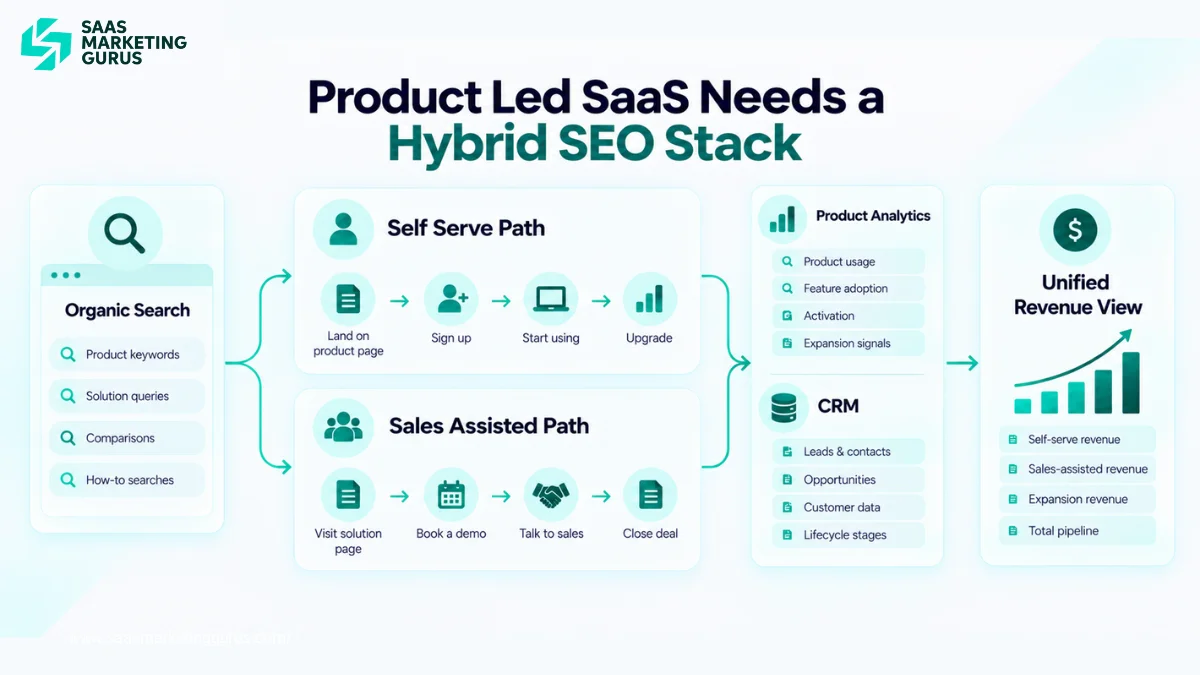
Product-led SaaS companies need a hybrid stack: B2C-style event tracking for self-serve signups and upgrades, plus B2B-style CRM attribution for larger accounts. Treating every signup as equal hides which organic pages create paying customers.
Trials make this sharper. Forrester’s 2026 research found that more than 60% of business buyers purchase some form of trial, yet just over a third planned to convert to a fully paid version with the same provider (Forrester, 2026). A trial count alone is a weak SEO success metric.
Track four stages together: signup, activation, paid upgrade and expansion into a sales-assisted deal. Tie product analytics or billing data to the same account record the CRM uses, so a self-serve upgrade and a later enterprise deal credit the same organic entry page.
Do B2B SEO Tools Need AI Search Visibility Tracking?
Yes. B2B SaaS stacks now need AI search visibility tracking, because buyers research shortlists inside AI tools as well as search engines. Forrester reported in 2026 that 94% of business buyers use AI during their buying process, then validate its answers with trusted sources such as peers and analysts (Forrester, 2026).
Classic rank trackers do not show whether ChatGPT, Perplexity or Google AI Overviews mention your product for category and comparison prompts. Add a prompt-level check for the questions buyers ask during evaluation, and report it separately from rankings. SMG’s guide to measuring Generative Engine Optimization campaigns explains which signals to track.
B2C teams can run the same check for product-research prompts. Their core measurement still sits in ecommerce revenue, while a B2B shortlist can form before the first tracked session.
Which SEO Stack Should a SaaS Company Choose?
Choose the smallest stack that answers the decision your team cannot make today, and connect it to the conversion closest to revenue. For most B2B SaaS teams, that means five layers added in this order:
- Search Console for real queries, landing pages and indexing.
- One keyword and competitor platform, not two with overlapping reports.
- A crawler for technical issues on large or JavaScript-heavy sites.
- GA4 with lead events, connected to your CRM and billing data.
- CRM attribution and AI visibility tracking once pipeline reporting works.
| Company stage | Add now | Skip for now |
|---|---|---|
| Early, founder-led sales | Search Console, GA4 generate_lead, one keyword tool | Paid attribution platforms |
| Sales-led, growing pipeline | CRM lead-stage events, CRM attribution tier | Duplicate research suites |
| Product-led or hybrid | Product analytics or billing linked to CRM accounts | Session-only revenue reports |
| Ecommerce or B2C | Ecommerce events including refund, product feed checks | CRM attribution layer |
The common mistakes are predictable. B2B teams pay for two research suites that report the same data, count every signup as a conversion and use last-click reports for a months-long journey. B2C teams ignore refunds and inventory, so their best-looking pages are sometimes their least profitable.
Compare specific platforms in SMG’s best SaaS SEO software guide, then map each tool to a funnel stage with the SEO conversion funnel framework.
Conclusion
The differences between B2B SEO tools and B2C SEO tools come down to what the stack connects to, not what it can do. For a B2B SaaS company, the right choice is a standard SEO toolset tied to your CRM, with GA4 lead events and CRM attribution doing the work that ecommerce events do for B2C. Use the B2C model only when revenue happens in a checkout, and the hybrid model when self-serve upgrades and sales-led deals both matter.
Your next step: pull your last ten closed deals and check whether your stack shows which organic page each account first touched. Fix the first missing link in that chain. Success is one report that ties organic entry pages to opportunities, reviewed after one full sales cycle.
If you want that keyword-to-revenue report built and interpreted for you, book a free strategy call with SMG and we will show you where your SaaS SEO data stops short of pipeline.
Frequently Asked Questions
Can B2B and B2C companies use the same SEO platform?
Yes. B2B and B2C companies can use the same SEO platform for keyword research, rank tracking, crawling and competitor analysis. The difference sits in the connected data: B2B stacks feed CRM lead stages and deal revenue, while B2C stacks feed ecommerce events such as purchases and refunds into analytics.
Why does CRM integration matter more for B2B SEO?
CRM integration matters more for B2B SEO because revenue closes in the CRM, often weeks after the first organic visit and across several stakeholders. Without it, SEO reports stop at form fills. With it, you can see which keywords and landing pages created qualified opportunities, pipeline and closed accounts.
Does Google Analytics 4 track B2B leads or only ecommerce sales?
GA4 tracks both. Its recommended events include ecommerce events like purchase and refund, and lead events like generate_lead, qualify_lead and close_convert_lead. Most B2B teams only fire generate_lead, so later lead stages must be sent back from the CRM for GA4 to connect organic sessions with customers.
What should a B2C SEO stack connect to?
A B2C SEO stack should connect to the ecommerce platform, product feeds, inventory and pricing data, and ecommerce events including refunds. That lets you judge category and product pages by orders, margin, average order value and repeat purchases instead of traffic, and avoid overstating revenue from pages with high return rates.
How do you measure SEO for a product-led SaaS company?
Measure product-led SaaS SEO with a hybrid model. Track signup, activation, paid upgrade and sales-assisted expansion against the same account record, then credit each stage to the first organic landing page. Trial counts alone mislead, since Forrester’s 2026 research found just over a third of trial buyers planned to convert.
Are low search volume keywords worth targeting in B2B SaaS?
Yes, when the keyword matches a buying problem your product solves. One closed B2B account can outweigh large volumes of low-intent traffic, and third-party tools often underestimate niche B2B demand. Validate terms with Search Console impressions and CRM outcomes rather than dropping them because estimated volume looks small.